


Fermetures de cabinets médicaux et reports d’opérations attendus à partir de lundi
Les médecins de ville et cliniques débutent lundi un mouvement de grève qu’ils prédisent très suivi, afin de dénoncer le budget “insuffisant” de la sécurité sociale 2026 et exprimer leur crainte de la remise en question de leur liberté d’exercice.La grève, qui doit durer dix jours, lancée par les organisations professionnelles représentatives, des syndicats étudiants et de la jeune génération de médecins, devrait conduire à la fermeture des cabinets et à l’annulation d’opérations, prédisent ces derniers. Une manifestation est aussi prévue à Paris, le 10 janvier.”Le mouvement sera excessivement suivi”, a affirmé le syndicat CSMF.Du côté des médecins de ville, Jeunes médecins Ile-de-France a lancé une plateforme pour permettre aux grévistes de se déclarer. Plus de 14.500 sont déjà enregistrés. Les grévistes déplorent un budget de la Sécu insuffisant face à des besoins croissants, un contrôle accru des prescriptions d’arrêts de travail ou des mesures permettant aux autorités de baisser “de façon autoritaire” les tarifs de certains actes, en “contournant” le dialogue social. Ils craignent également la restriction de leur liberté d’installation, objet de textes en cours d’examen au Parlement.Les patients déjà hospitalisés continueront d’être soignés mais les personnes arrivant aux urgences ou à la maternité seront, sauf urgences vitales, “transférées vers l’hôpital public”, selon les syndicats.La grève pourrait ainsi mettre sous tension l’hôpital public, déjà éprouvé par un pic d’épidémies hivernales.”Quel que soit le nombre de grévistes, l’important est de pouvoir dire à ces médecins que je suis évidemment à leur écoute”, a souligné la ministre de la Santé Stéphanie Rist, lundi matin sur France 2. “Nous devons continuer le dialogue, nous devons le renforcer. J’espère que ce mouvement durera le moins longtemps possible”.Dans un entretien à la République du Centre publié dimanche, elle a indiqué avoir “pris des mesures pour organiser la permanence des soins” avec les Agences régionales de santé (ARS), les établissements et les professionnels afin que les patients “ne soient pas en danger pendant cette mobilisation”. Elle a également souligné qu’elle pourrait “avoir recours aux réquisitions, en cas de besoin”.Pour le syndicat des gynécologues-obstétriciens (Syngof), ce mouvement est “la conséquence de politiques qui agressent les médecins”, notamment le secteur 2 (praticiens conventionnés, avec dépassements d’honoraires), alors que les tarifs remboursés par l’Assurance maladie n’ont pour certains “pas évolué depuis les années 1990”.La ministre a pour sa part rappelé qu’il y avait “une augmentation exponentielle de ces dépassements d’honoraires ces dernières années”.”Même si les abus ne concernent qu’une minorité de médecins, nous ne pouvons pas laisser la situation en l’état car nous avons des concitoyens qui renoncent aux soins pour des raisons financières”, a-t-elle expliqué.
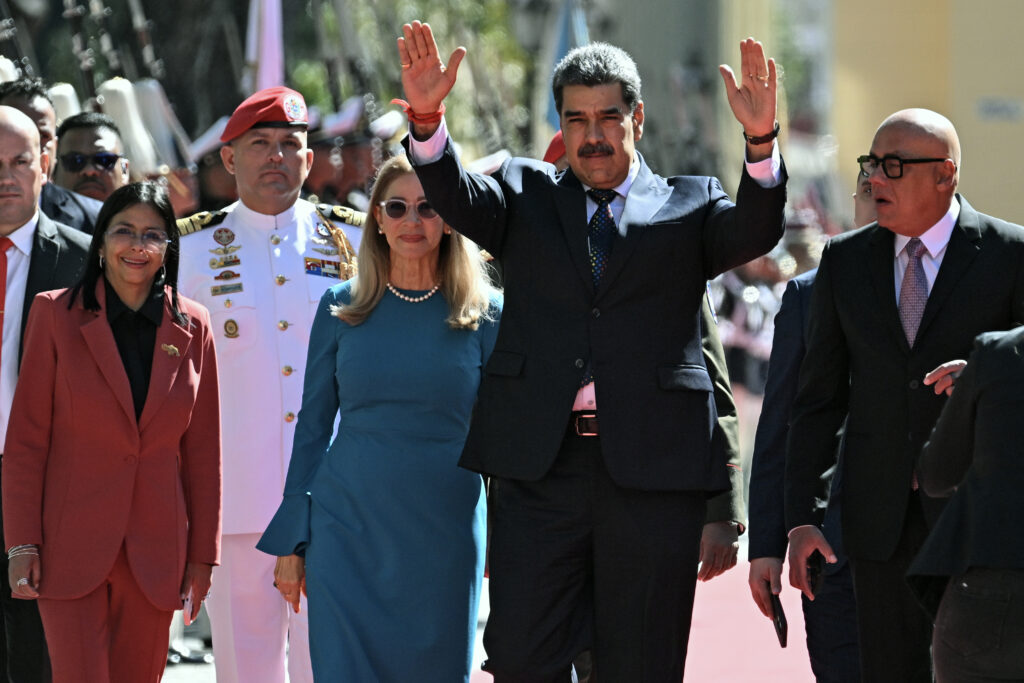
Maduro’s fall tests Venezuela’s ruling ‘club’
The ousting of Nicolas Maduro as Venezuela’s president puts to the test his “Chavista” factions that have governed the oil-rich nation for 27 years.What happens to the so-called “club of five” powerful leftist figures, now that two of its most important members — Maduro and his wife Cilia Flores — have been captured and sent to the United States to face trial?- ‘Club of five’ -Anointed by his mentor Hugo Chavez before the latter’s death in 2013, Maduro kept a tight grip on power until his capture by US forces on Saturday.Maduro ruled alongside Flores and three other powerful figures: former vice president Delcy Rodriguez — now Venezuela’s interim leader — her brother Jorge, and their rival: hardline Interior Minister Diosdado Cabello.”It’s like a club of five,” a diplomatic source in Caracas told AFP under the condition of anonymity.”They can speak, they have a voice in the government, but Maduro was the one who kept the balance. Now that he’s gone, who knows?”– Maduro and ‘Super Cilita’ –The image of Maduro handcuffed and blindfolded as US forces transported him to New York to face trial made headlines around the world.During months in the crosshairs of US President Donald Trump, who accused him of being a drug trafficker, the 63-year-old former bus driver deflected pressure by dancing to techno music at near-daily rallies, always broadcast live, as he chanted the mantra “No war, yes peace!” — in English.Frequently underestimated, Maduro managed to eliminate internal resistance and keep the opposition at bay.Murals, songs and films celebrated him, as did the animated cartoon “Super Moustache,” in which he appeared as a superhero, fighting imperialism alongside “Super Cilita,” who is based on Flores. Toy figurines of both characters were also produced.The military swore absolute loyalty to him, led by Defense Minister Vladimir Padrino Lopez.Though defiant at first and calling for Maduro’s return, Venezuela’s interim leader Rodriguez called for a “balanced and respectful relationship” between the South American country and the United States on Sunday.”The top level of government has survival as its absolute priority,” Antulio Rosales, political scientist and professor at York University in Canada, told AFP.– The Rodriguez siblings –Rodriguez controlled the economy and the oil industry as vice president while her brother Jorge is the speaker of parliament.They are known for their incendiary rhetoric, often mixing belligerence, irony and insults against the “enemies of the fatherland.”But behind the scenes, they are skilled political operators.Jorge Rodriguez was the chief negotiator with the opposition and the United States, and his sister represented Maduro in various international forums.Experts also attribute purges within government to them, such as one that sent Tareck El Aissami, a powerful oil minister until 2023, to prison.Rodriguez took over his post shortly afterwards.– The feared policeman –Diosdado Cabello meanwhile is widely feared in Venezuela. Under his ministry, some 2,400 people were detained during protests that followed Maduro’s disputed re-election in 2024, in a move that cowed the opposition.Cabello is seen as representing the most radical wing of “Chavismo,” and some see him at odds with the pragmatism of the Rodriguez pair, though both sides have denied this.Cabello acted as president for a few hours when Chavez was overthrown for two days in 2002.He accompanied Chavez in a failed coup attempt in 1992. Today he is number two in the Socialist Party behind Maduro.The US courts have now named Cabello among those wanted for trial alongside Maduro.They have offered $25 million for his capture.Having kept a low profile in the hours after Maduro’s capture, he appeared by Rodriguez’s side at her first cabinet meeting as acting president on Sunday.

Trump declares US ‘in charge’ of Venezuela and Maduro goes to court
President Donald Trump’s claim that the United States is “in charge” of Venezuela will be underscored Monday when the oil-rich nation’s deposed leader is hauled before a New York court, while his successor offers to cooperate.Leftist strongman Nicolas Maduro, 63, faces narcotrafficking charges along with his wife, who was also seized and taken out of Caracas in the shock US assault Saturday, which involved commandos, bombing by jet planes, and a massive naval force off Venezuela’s coast.The UN Security Council will hold an emergency session on Monday at Venezuela’s request. This will provide a platform for international concern over US intentions in the country of around 30 million people.Trump is unlikely fazed, as his plan to dominate Venezuela and its vast oil reserves unfolds.”We’re in charge,” Trump announced late Sunday.In a potential win for Washington, Maduro’s successor and interim leader Delcy Rodriguez dropped her initial fiery rhetoric, issuing a statement late Sunday offering to work with Trump.”We extend an invitation to the US government to work together on an agenda for cooperation,” the former vice president said.This was hours after Trump threatened that she’d pay a “very big price, probably bigger than Maduro,” if she didn’t bend to US wishes.When asked what he needs from Rodriguez, Trump said: “We need total access. We need access to the oil and other things in their country that allow us to rebuild their country.”While there are no known US forces left inside Venezuela, a huge naval presence, including an aircraft carrier, remains off the coast.The Trump administration says it retains powerful economic leverage by blockading oil tankers from Venezuela. Trump has also threatened additional military attacks if needed.- No regime change -But what happens next in Venezuela, after a combined quarter century of hard-left rule by Maduro and his late socialist predecessor Hugo Chavez, remains unclear.The Democratic Party leader in the Senate, Chuck Schumer, told ABC News that Americans were left “scratching their heads in wonderment and in fear.”The White House indicated Sunday that it does not want regime change — just Maduro gone and a pliant new government, even if it is filled with his former associates.Secretary of State Marco Rubio stressed on Sunday that Washington is not looking for radical overhaul or even a return to democracy any time soon.Rather than seek to topple the entire Maduro government, “we’re going to make an assessment on the basis of what they do,” he told CBS News.The US position leaves the Venezuelan opposition — which the Trump administration says was robbed of victory by Maduro in recent elections — out in the cold.Leading opposition figure Edmundo Gonzalez Urrutia said the US intervention was “important” but “not enough” without the release of political prisoners and acknowledgement that he won the 2024 election.- Breaching international law? -Countries such as China, Russia and Iran, which have longstanding ties with Maduro’s government, were quick to condemn the operation. Some US allies, including the EU, expressed alarm.China called for Maduro to be “immediately released” in a condemnation of the US operation, which its foreign ministry said was a “clear violation of international law.”Colombian President Gustavo Petro, whose country neighbors Venezuela, called the US action an “assault on the sovereignty” of Latin America, which would lead to a humanitarian crisis.Italy and Israel, whose leaders strongly back Trump, were more supportive.burs-sms/sla/ane
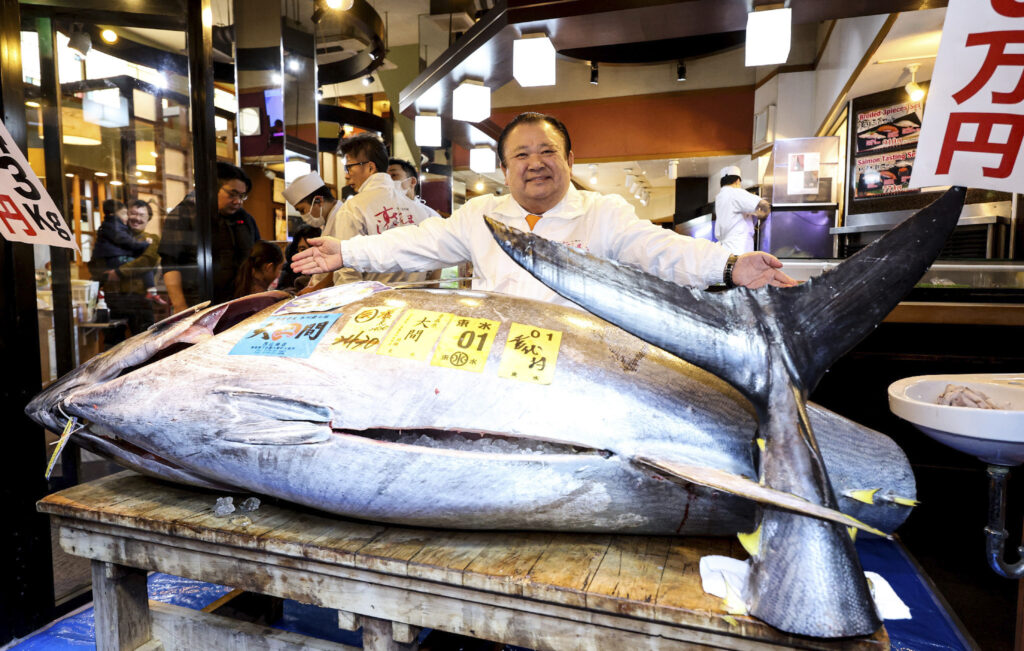
‘Tuna King’ pays record $3.2 mn for bluefin at Tokyo auction
A Japanese sushi entrepreneur paid a record $3.2 million for a giant bluefin tuna Monday at an annual prestigious new year auction in Tokyo’s main fish market, smashing the previous all-time high.Dave Gershman at the Pew Charitable Trusts’ international fisheries team used news of the auction to highlight that stocks of Pacific bluefin tuna were improving after being “near collapse”.Self-styled “Tuna King” Kiyoshi Kimura’s sushi restaurant chain paid the top price for the 243-kilogramme (536-pound) fish that was caught off Japan’s northern coast.”I’d thought we would be able to buy a little cheaper, but the price soared before you knew it,” Kimura said after the pre-dawn auction at Tokyo’s main fish market.”I was surprised at the price…I hope that by eating auspicious tuna, as many people as possible will feel energised,” he told reporters.The 510.3 million yen price at the new year’s auction was the highest since comparable data started being collected in 1999.The previous high was 333.6 million yen for a 278 kilogramme bluefin in 2019, after the fish market moved from its traditional Tsukiji area in central Tokyo to a more modern facility.The top bidder last year paid 207 million yen for a 276-kilogramme bluefin.Shortly after this year’s auction, the tuna was butchered and turned into sushi, selling for around 500 yen ($3) per roll.”I feel like I’ve begun the year in a good way after eating something so auspicious as the year starts,” 19-year-old Minami Sugiyama told AFP from a table in one of Kimura’s restaurants in Tsukiji.Fellow customer Kiyoshi Nishimura agreed.”Even without dipping it in soy sauce, there’s sweetness. And the richness, the texture… it just makes you feel happy,” the 40-year-old Shinto priest said.During the Covid-19 pandemic the new year tunas commanded only a fraction of their usual top prices as restaurants scaled back operations.Gershman said in an emailed statement that a 2017 recovery plan “is working, and if decision makers take further action in 2026, the future for Pacific bluefin will be bright”.”This year, fisheries managers from Japan, the United States, Korea, and other countries from across the Pacific who target bluefin should agree on a long-term, sustainable management plan that would lock in a healthy population and ensure that the species never again faces the overfishing of the past,” he added.

Neige/verglas: la vigilance orange étendue à 23 départements lundi
La vigilance orange neige/verglas a été étendue à 23 départements lundi dans les régions s’étendant de la Bretagne à la Normandie et au bassin parisien ainsi que les Pays de Loire et le Poitou-Charentes, a annoncé Météo-France.L’épisode de froid se poursuit sur une bonne partie du pays avec “des chutes de neige parfois significatives” a indiqué l’agence météorologique dans son dernier bulletin, qui prévoit de maintenir ce niveau d’alerte jusqu’à mardi matin.Aux sept départements déjà placés en vigilance orange neige/verglas (Finistère, Côtes-d’Armor, Ille-et-Vilaine, Manche, Calvados, Eure et Seine-Maritime), s’ajoutent la Loire-Atlantique, le Maine-et-Loire, le Morbihan, l’Oise, l’Orne, Paris, la Seine-Maritime, la Seine-et-Marne, les Yvelines, les Deux-Sèvres, la Vendée, l’Essonne, les Hauts-de-Seine, la Seine-Saint-Denis, le Val-de-Marne et le Val-d’Oise.”Quelques centimètres de neige sont tombés sur certains départements côtiers de la Manche dans la nuit, en particulier la Seine-Maritime. Il gèle assez fortement sur la majeure partie du pays (-4 à -5° par exemple en région parisienne)”, indique Météo-France.Au cours de cet épisode “jusqu’à 3 à 7 centimètres sur la Normandie avec des maxima autour de 10 centimètres possibles sur les hauteurs. Jusqu’à 5 à 10 centimètres sur la Bretagne, les Pays de Loire et jusqu’en Charente-Maritime avec des maxima autour de 15 centimètres pour la Vendée et la Charente-Maritime qui sont donc les départements les plus exposés à de fortes chutes de neige”, précise le service de météorologie.”Dans la nuit de lundi à mardi, après les chutes de neige, les gelées seront encore marquées ce qui rendra les conditions de circulation très délicates jusqu’à mardi matin”, avertit Météo-France.Les transports scolaires sont suspendus lundi en Bretagne et en Normandie en raison des chutes de neige annoncées, ont indiqué dimanche soir les deux régions.”La circulation des transports interurbains est pour l’heure maintenue mais des difficultés de circulation sont à prévoir”, a précisé la région, qui “appelle chacun à la plus grande vigilance”.La région Normandie “va rapidement informer les familles, les établissements scolaires et les autorités organisatrices de proximité (communautés de communes, syndicats scolaires…) de ces situations”.L’institut météorologique prévient qu’une nouvelle extension de la vigilance orange pourrait se produire dans la journée.
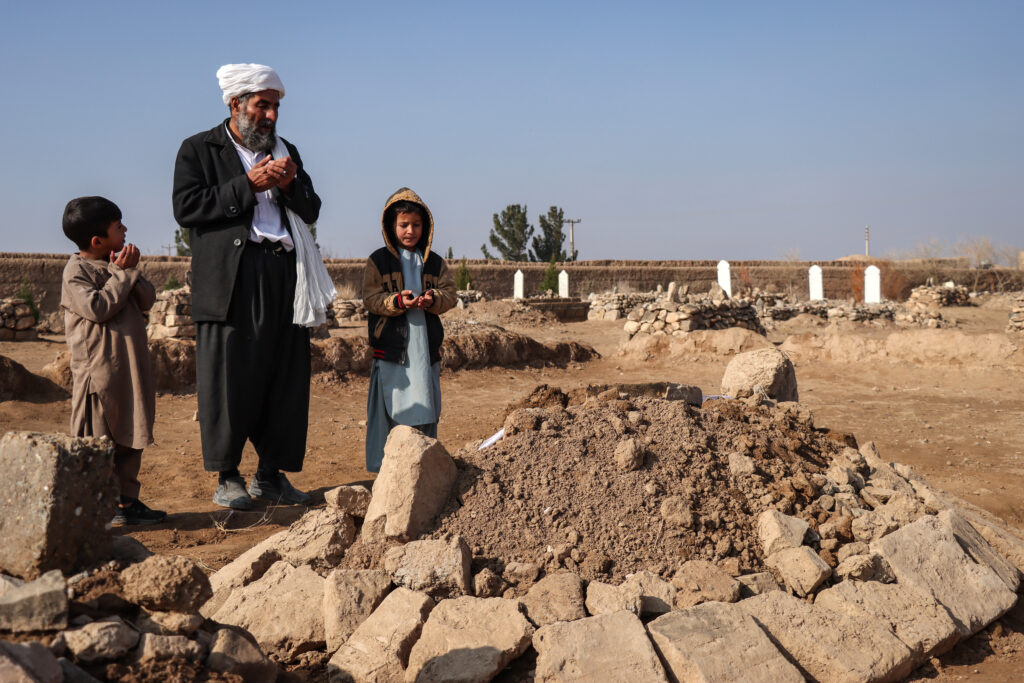
‘I can’t walk anymore’: Afghans freeze to death on route to Iran
Habibullah set off from his home in western Afghanistan determined to find work in Iran, only for the 15-year-old to freeze to death while walking across the mountainous frontier.”He was forced to go, to bring food for the family,” his mother, Mah Jan, told AFP at her mud home in Ghunjan village.”We have no food to eat, we have no clothes to wear. The house in which I live has no electricity, no water. I have no proper window, nothing to burn for heating,” she added, clutching a photo of her son.Habibullah was one of at least 18 migrants who died last month while trying to cross illegally into Iran from Afghanistan’s Herat province, according to officials, when temperatures were around -3C.With earthquakes and drought compounding a daily struggle to survive in Afghanistan, around half the population will need humanitarian assistance this year, according to the United Nations.”There was no other way left for me. I thought, let him go to make our life better,” said Mah Jan, 50, who requested the family’s surname not be published for privacy reasons.Habibullah’s stepbrother, Gul Ahmad, said the teenager had tried shoe polishing but only earned up to 15 afghanis (23 cents) per day.”He was ready to be a shepherd for 2,000 afghanis ($30 a month), to work in a shop, but he found nothing. So he was forced to leave. He told his mother, ‘Let’s trust in God, I’m going to Iran’,” said Gul Ahmad, 56.- ‘Very dangerous’ – Habibullah was among 15 bodies returned from Iran, an Afghan border source told AFP on condition of anonymity.A further three migrants who died were recovered on the Afghan side of the frontier, an army official said.Over just a matter of days last month, around 1,600 Afghan migrants “who were at risk of perishing due to the weather” were rescued in the mountains, according to Iranian border guard commander Majid Shoja, quoted by the ILNA news agency.They are drawn to Iran due to greater job opportunities and a common language, but legal routes are limited.Afghanistan’s deputy minister for labour and social affairs, Abdul Manan Omari, said Sunday it was “necessary to do more” to facilitate work permits for migrants.Iran and Pakistan have combined sent back five million Afghans since September 2023, increasing the country’s population by 10 percent, according to the International Organization for Migration.The agency’s deputy head in Afghanistan, Mutya Izora Maskun, said that many in the country report “the economy, job insecurity, food insecurity, constrained access to services” force them to leave.They do so even if that means going through “illegal crossing points that are very dangerous due to the cold and the risks of human trafficking”, she told AFP.The Taliban government has taken “serious steps to fight the smugglers”, interior ministry spokesman Abdul Mateen Qani told AFP.But attempts to reach Iran have not stopped.- ‘Destitute’ -In the last week of December, “347 people who were trying to illegally cross the border into Iran were identified and arrested”, a military unit in western Afghanistan said in a statement on Saturday.Abdul Majeed Haidari, whose one-year-old son suffers from a heart problem, tried his luck in mid-December.Working at a brick oven, the 25-year-old could no longer afford to pay for his son’s medication and family expenses.”We left because we were so destitute,” his stepbrother Yunus, who accompanied him, told AFP.”We set out in the rain. In such weather, the radars and cameras of the border guards do not work properly. But the smuggler got lost,” he said.They failed to light a fire for warmth and, as snow fell, Yunus recounted his stepbrother’s words: “I can’t walk anymore.””Some told us to leave him so as not to endanger the other 19 people in the group,” said Yunus, who requested his full name not be used.After carrying him for two more hours, “his eyes stopped closing, his body grew heavier,” Yunus recalled, before an Iranian family drove past and took them to hospital.”They gave him electric shocks, but they said he was already dead,” said Yunus, who has since returned to his village.