


Trump pushes Republicans to back ‘big, beautiful’ US tax bill
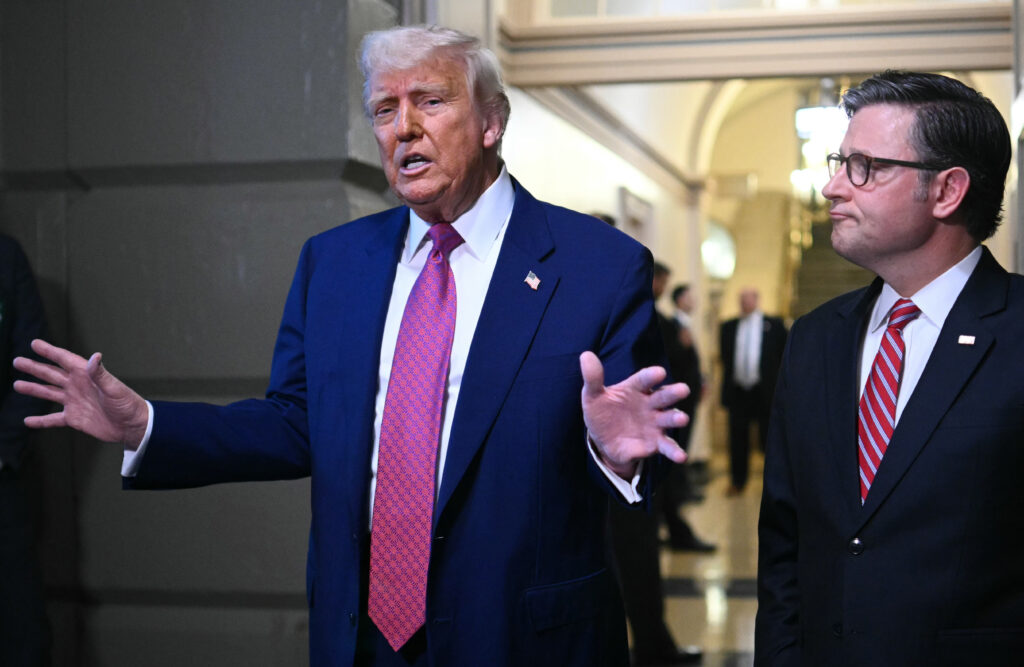
US President Donald Trump told rebel Republicans Tuesday to back his so-called “big, beautiful bill,” despite criticisms that its tax cuts will increase America’s yawning budget deficit.Trump described the talks with lawmakers on Capitol Hill as a “meeting of love” ahead of an expected close vote later this week on legislation that he has placed at the heart of his second-term agenda.The bill pairs an extension of the tax cuts from the billionaire’s first presidential term with steep savings in government spending to pay for them.But the closed-door talks apparently failed to quell concerns among Republican fiscal hawks that it will increase the national debt — and among moderates that it will cut health care for millions of the poorest Americans.Wall Street stocks fell on Tuesday as US markets, already sparked by a ratings downgrade last week, focused on the fate of Trump’s proposal.”There was no shouting, I think it was a meeting of love,” Trump told reporters afterwards alongside Republican House Speaker Mike Johnson. “We’re going to have a great victory.”Trump says Americans will face huge tax increases if the bill, which also contains provisions for migration and other issues, does not pass.Johnson is reportedly eying a vote later this week — but with the Republicans holding only a razor-thin majority in the lower house they will need every member to be on side.Democrats are united against the bill.”Nothing in Congress is ever easy, especially when you have small margins. But we are going to land this plane and deliver this,” Johnson said.There were signs that stark divisions still remained.Conservatives are angling for much deeper spending cuts to tackle the ballooning deficit.- Health care divisions -Moderates say the savings would mean millions of the poorest Americans lose health coverage under the Medicaid program — while hawks are angry that work requirements for Medicaid entitlement would not kick in until the end of Trump’s term.Several US media said Trump told the meeting: “Don’t fuck around with Medicaid.”Moderate Republicans fear overly large cuts in the popular program could upset the party’s prospects in the November 2026 midterm elections.The so-called SALT Republicans — a faction demanding bigger deductions in state and local taxes — are also at loggerheads with the leadership.Several of them reportedly texted Johnson to say they would still vote against the bill, reacting angrily after Trump called out some of them by name.Trump argued that the cuts would only benefit governors in Democratic states.Trump has been eager to present the bill as a significant legislative accomplishment early in his second term, after a frenzied first few months where he has governed largely through presidential orders.But independent congressional analysts calculate that the mega-bill’s tax provisions would add more than $2.3 trillion to the US national debt over the coming decade.The bill — which is now formally named the “One Big Beautiful Bill” after Trump initially used it as a nickname — cleared a key hurdle on Sunday when it finally progressed out of the House Budget Committee.But it now faces a tough ride.Even if the bill passes in the House, it will face challenges in the Senate, where Republicans are demanding major changes.The fate of Trump’s budget bill has renewed market jitters over the spiralling US debt, particularly amid wider global uncertainty over Trump’s sweeping tariffs on trading partners around the world.Patrick J O’Hare, analyst at Briefing.com, said investors were “waiting to see if the Treasury market can keep its cool” as the bill is debated, given it “is expected to add trillions to the budget deficit”.

Family mourns Mexican naval cadet killed in New York bridge crash
The father of one of two Mexican cadets killed when a naval sailing ship crashed into New York’s Brooklyn Bridge paid tribute to his daughter as a “wonderful” person Tuesday.Dozens of friends and relatives attended a funeral for 20-year-old America Yamileth Sanchez, who died along with Adal Jair Maldonado, 23.Around 20 other crew members were injured when the training ship, which visits foreign ports on goodwill voyages, crashed into the iconic New York bridge on Saturday, snapping the masts.Sanchez’s coffin was received with flowers, candles and tears at her home in Xalapa in the eastern state of Veracruz after a procession through the city.Mourners shouted the name of the young cadet, who was pictured in her navy uniform.”She is an example for future generations to come — an excellent person, a wonderful human being,” her father Herminio Cosme Sanchez said.Mexican President Claudia Sheinbaum offered her “love and solidarity” to the family.Numerous sailors were positioned among the Cuauhtemoc ship’s rigging at the time of the crash.It had begun a seven-month voyage in April from its base in the Pacific coastal city of Acapulco.The vessel had been departing New York at the time of the accident with flags fluttering from its rigging and an enormous Mexican flag waving off its stern.The US National Transportation Safety Board said Monday that a preliminary report into the collision was expected within 30 days.
US to limit Covid boosters to over-65s or those at high risk
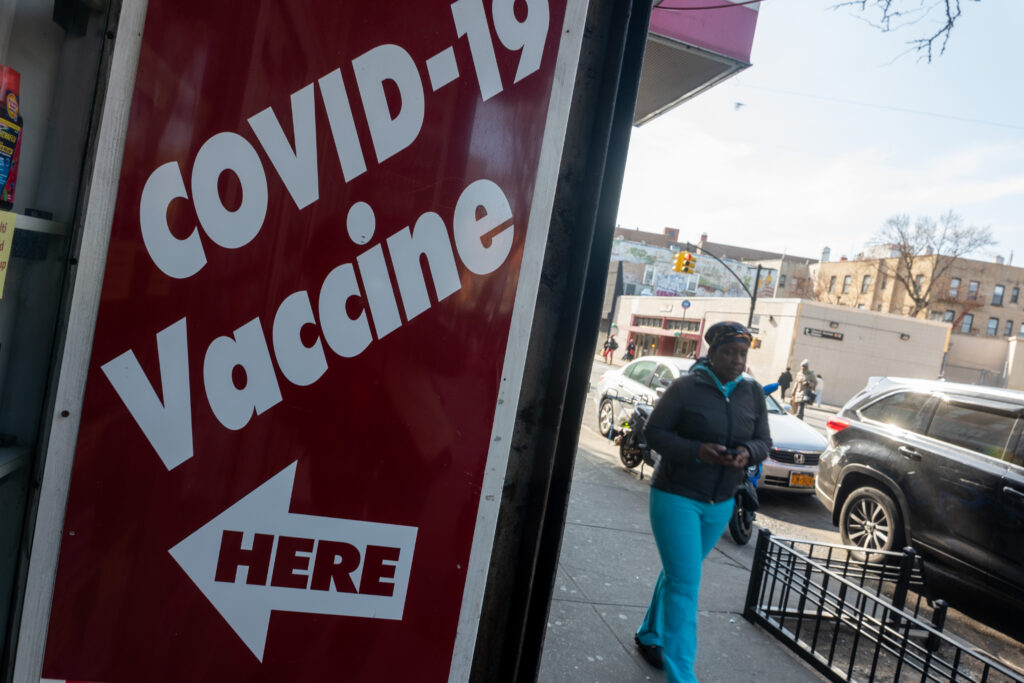
The United States will restrict routine Covid-19 boosters to people over 65 or those at higher risk of serious illness, while requiring new placebo-controlled trials to justify vaccination in healthy individuals under that age, senior officials said Tuesday.The move comes as Health Secretary Robert F. Kennedy Jr. — a longtime vaccine skeptic who has spread doubt about immunization programs — pushes to remake federal public health policy.Writing in the New England Journal of Medicine, the Food and Drug Administration’s Vinayak Prasad and Commissioner Martin Makary framed the policy shift as evidence-based and said it would bring US guidance more in line with that of European nations.They described the initial Covid-19 vaccine rollout as “a major scientific, medical, and regulatory accomplishment” — but argued the benefits of repeated boosters in low-risk individuals remain uncertain.Contrasting the US approach with that of the United Kingdom, France, and Germany, the authors criticized what they called America’s “one-size-fits-all” strategy. They said it was based on the mistaken assumption that Americans cannot understand age- and risk-based recommendations.Rather than building trust, the approach had backfired, contributing to broader vaccine hesitancy — including toward childhood immunizations such as the measles, mumps, and rubella (MMR) vaccine, the officials argued.Going forward, the FDA expects to find a favorable benefit-risk profile for people over 65, and for anyone over six months old with one or more underlying health conditions, based on antibody levels generated by vaccination.However, “for all healthy persons — those with no risk factors for severe Covid-19 — between the ages of 6 months and 64 years, the FDA anticipates the need for randomized, controlled trial data,” the officials wrote.”We simply don’t know whether a healthy 52-year-old woman with a normal BMI (body mass index) who has had Covid-19 three times and has received six previous doses of a Covid-19 vaccine will benefit from the seventh dose,” they added.Vaccine makers such as Pfizer and Moderna will be encouraged to conduct trials involving adults aged 50 to 64. These studies should assess whether boosters reduce symptomatic illness, severe disease, hospitalization, and death.Last week, pharmaceutical company Novavax received approval for its COVID-19 vaccine — but only for adults over 65, and for individuals aged 12 and older with at least one underlying health condition.- New placebo trials -Rather than comparing updated boosters against earlier versions, Makary and Prasad said “the control group could receive a saline placebo, to permit documentation of the full adverse-event profile.”That approach — using a placebo when a “standard-of-care” vaccine already exists — is contentious within the biomedical community. Covid vaccines were originally granted approval based on large-scale placebo-controlled trials involving tens of thousands of participants.The idea of retesting established vaccines against placebo was first floated earlier this month by Kennedy, according to reports.Supporters of continued Covid-19 boosters often draw parallels to annual flu shots. But Makary and Prasad pushed back on that comparison, arguing the two diseases behave differently in terms of how they mutate over time. They said Covid vaccine-induced immunity may not require yearly updates to protect against the most clinically relevant outcomes.The authors also sought to reassure Americans concerned they might lose access to boosters under the new framework.The Center for Disease Control and Prevention’s (CDC) definition of risk factors is “vast, including obesity and even mental health conditions such as depression,” they wrote, noting that between 100 million and 200 million Americans would likely still qualify.Prasad, a hematologist-oncologist who now leads the FDA’s Center for Biologics Evaluation and Research (CBER), rose to prominence during the pandemic for publicly questioning widespread booster use.