Australians vote in election overcast by prices, Trump tariffs

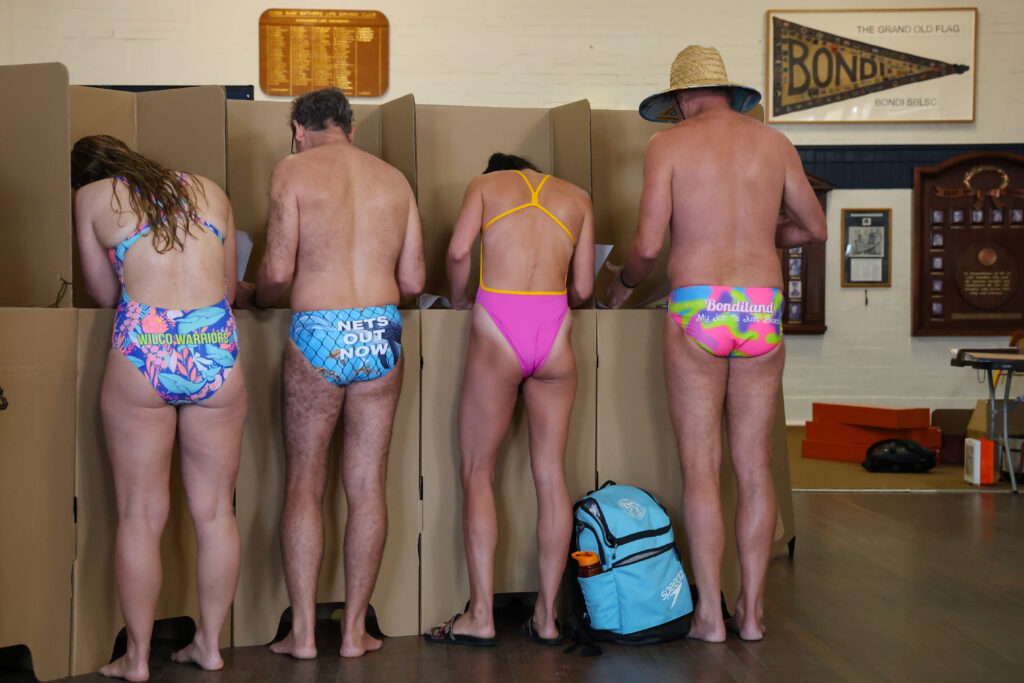
Australians voted Saturday in a general election shaped by inflation woes and Trump tariffs, with a string of polls pointing to victory for left-leaning incumbent Prime Minister Anthony Albanese. Hungry voters munched on barbecued “democracy sausages” after casting their ballot — a polling day rite of passage — while others in bright swimwear crammed into booths after taking an early morning plunge.Millions of Australians will choose between Labor leader Albanese, 62, or his conservative challenger Peter Dutton. US President Donald Trump has loomed over the vote since its earliest days, and there is keen global interest in whether his tariff-induced economic chaos will influence the result.  “The holy grail is back-to-back wins that we’re aiming for today,” Albanese told Channel Seven. “I’ll leave nothing on the field over the next three years if I’m re-elected as Australia’s prime minister.”Though trailing by a few percentage points in the polls, Dutton said “quiet Australians” could yet deliver a surprise.”I think they’re going to go into the polling booth and say: ‘You know what? I am not going to reward Anthony Albanese for the last three years’,” he told Channel Nine.- ‘Mad as a cut snake’ -Before the first vote was even counted, speculation was already mounting over whether Dutton could survive an election loss.”I am 54. I am still very young, and I’ve just got a burning passion for this country,” Dutton replied, when asked if he would stay on as opposition leader. The first polls opened at 8:00 am (2200 GMT) on Australia’s east coast, followed later by the country’s western cities and far-flung island territories.A total of 18.1 million voters have enrolled for the election. About half of them cast an early ballot, the election authority said.Voting is compulsory, enforced with fines of Aus$20 (US$13), leading to turnouts that top 90 percent.A result could come as soon as Saturday night, unless the vote is very tight.Albanese has promised to embrace renewable energy, tackle a worsening housing crisis, and pour money into a creaking healthcare system. Liberal Party leader and former police officer Dutton wants to slash immigration, crack down on crime and ditch a longstanding ban on nuclear power. Some polls showed Dutton leaking support because of Trump, who he praised this year as a “big thinker” with “gravitas” on the global stage. “I mean, Donald Trump is as mad as a cut snake, and we all know that,” said voter Alan Whitman, 59, before casting his ballot on Saturday. “And we’ve got to tiptoe around that.”- High prices -As Australians soured on Trump, both Dutton and Albanese have taken on a more pugnacious tone. “If I needed to have a fight with Donald Trump or any other world leader, to advance our nation’s interest, I’d do it in a heartbeat,” Dutton said in April. Albanese condemned Trump’s tariffs as an act of “economic self-harm” and “not the act of a friend”.Economic concerns have dominated the contest for the many Australian households struggling to pay inflated prices for milk, bread, power and petrol. “The cost of living — it’s extremely high at the moment. So, taxes as well, is also another really big thing. Petrol prices, all the basic stuff,” human resources manager Robyn Knox told AFP in Brisbane.Small business owner Jared Bell had similar concerns.”Our grocery shops are definitely way more expensive than they were a couple years ago,” he said.- Campaign stumbles -Coal-mining superpower Australia will choose between two leaders with sharply contrasting ideas on climate change and emissions reduction. Albanese’s government has embraced the global push towards decarbonisation, warning of a future in which iron ore and polluting coal exports no longer prop up the economy.Dutton’s signature policy is a US$200 billion scheme to construct seven industrial-scale nuclear reactors, doing away with the need to ramp up renewables.The 36-day campaign was a largely staid affair but there were a few moments of unscripted levity.Albanese tumbled backwards off the stage at a heaving campaign rally, while Dutton drew blood when he hit an unsuspecting cameraman in the head with a stray football.

Guinea’s Robert Sarah leads conservatives who challenged Pope FrancisSat, 03 May 2025 07:21:01 GMT

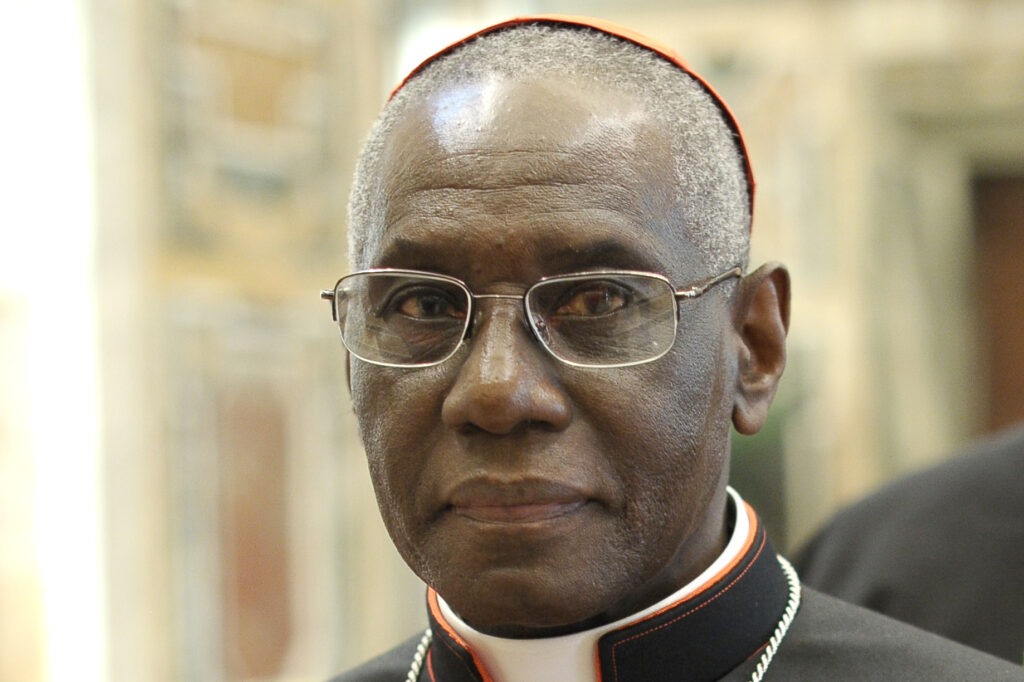
Outspoken on same-sex blessings and immigration, Robert Sarah of Guinea is a leading figure among conservative Catholic cardinals seeking a break with the late Pope Francis.At 79, Sarah is one of the oldest cardinals taking part in next week’s conclave — and almost missed out taking part as he turns 80 on June 15, an …

Guinea’s Robert Sarah leads conservatives who challenged Pope FrancisSat, 03 May 2025 07:21:01 GMT Read More »

Anxiety, pride as Harvard digs in for Trump ‘blitzkrieg’

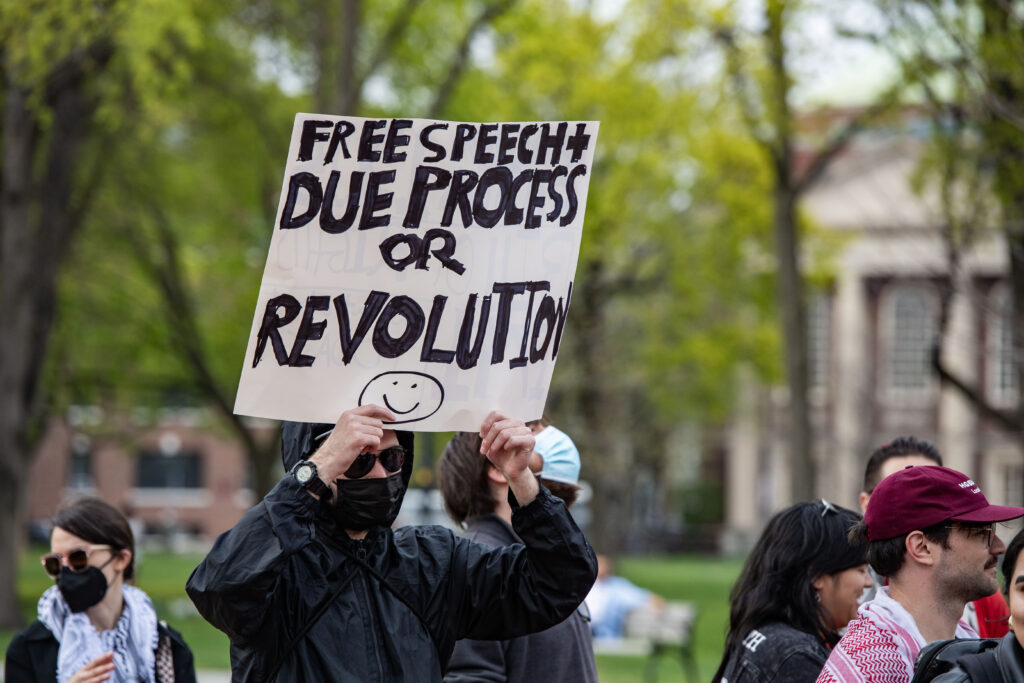
Harvard students weave through tree-lined streets and redbrick campus buildings, but beneath the veneer of daily life fear has taken root: the most prestigious university in the United States is bracing for an “assault” by President Donald Trump.Since returning to the White House, Trump has targeted prestigious universities, alleging anti-Semitism and liberal bias — with Harvard a primary quarry. He has launched what one academic called a “blitzkrieg” of measures — arresting overseas students and researchers, slashing federal funding, and seeking to end Harvard’s tax-exempt status. “It’s what they deserve!” Trump wrote on his Truth Social platform Friday. Unlike other universities that have bowed in recent days, Harvard defied Trump — suing his administration and mounting a fightback praised by students, faculty and commentators. “This is not about scalping (Harvard). This is about blitzkrieg and bringing out the biggest guns that you have,” said Sheila Jasanoff, a Harvard Kennedy School professor, her bookcases overflowing with books and articles. “There’s been essentially no check to the appetite of this administration.” First-year student Feodora Douplitzky-Lunati said “there’s a lot more wariness” among foreign students who fear they could be caught in immigration raids like those at Tufts and Columbia. Signs have advised international students not to discuss visa status, said Douplitzky-Lunati, who plans to study Slavic studies and economics.Harvard researcher Kseniia Petrova has been detained since February, after her visa was revoked returning from France. Students involved in pro-Palestinian protests following the October 7, 2023 attacks on Israel and the Gaza conflict have been arrested and slated for deportation at other campuses. Trump’s team imposed an April 30 deadline for universities to hand over international student data or risk losing a key certification to sponsor international students — affecting 27 percent of Harvard’s student body. In an email seen by AFP, Harvard said it complied, but encouraged students to focus on their studies.”I’m very concerned for my peers, and I hope most of my friends are as well,” said fourth-year US student Alice Goyer, sitting in a park near campus as students sipped coffee serenaded by a guitarist. “(We’re) at the forefront of a political battle… And I think the international students especially have been caught in the crossfire — they’re kind of being used as bargaining tools,” she said, accusing Trump of using an “authoritarian” playbook. Students described growing anxiety. Many foreign students face the dilemma of leaving for summer break and risking being denied re-entry to the United States. – ‘People are scared’ -Alongside visa measures, Trump has targeted Harvard’s finances. He put $9 billion in federal funding under review, ultimately freezing $2.2 billion in grants and $60 million in contracts in an opening salvo. Harvard imposed a hiring freeze, some researchers received stop-work orders, and its Chan School of Public Health was particularly exposed to the cuts.”The administration have been much more aggressive than anyone anticipated. There’s going to be chaos. The staff will get smaller,” said one casualty of the cuts who suggested US HIV and tuberculosis cases would increase as a result.In remarks to alumni shared with AFP, Harvard President Alan Garber said Wednesday the university’s endowment cannot legally offset shortfalls caused by Trump. “It is an assault on higher education. We must join not only with the rest of the academic community, but with civil society,” he said according to an alum on the call.Another said Garber described the situation as a long, existential battle, and appealed for alumni donations. While Goyer said she was “very proud right now to be a Harvard student” because of its defiance, she acknowledged Harvard had yielded on some points. Harvard has said it would rename its diversity, equity and inclusion department — which had drawn Trump’s ire — and defund graduation events held by affinity groups for Black, Latino, LGBTQ and other minority students. “I think it’s related to the Trump demands,” Goyer said. “It’s still kind of bowing down to Trump.” Leo Gerden, an economics and government student from Sweden, has defied the risks and become a visible international protester against Trump’s policies. “People are scared, and I understand them,” the 22-year-old said, citing the arrest by immigration officers of Rumeysa Ozturk at nearby Tufts, who wrote a pro-Palestinian op-ed. “Trump’s strategy right now is to (make) an example out of a few people — like Rumeysa — to scare everyone else into silence.”My hope is that by the end of this we’re gonna see protests just as big as during the Vietnam War.”

Lives on hold in India’s border villages with Pakistan

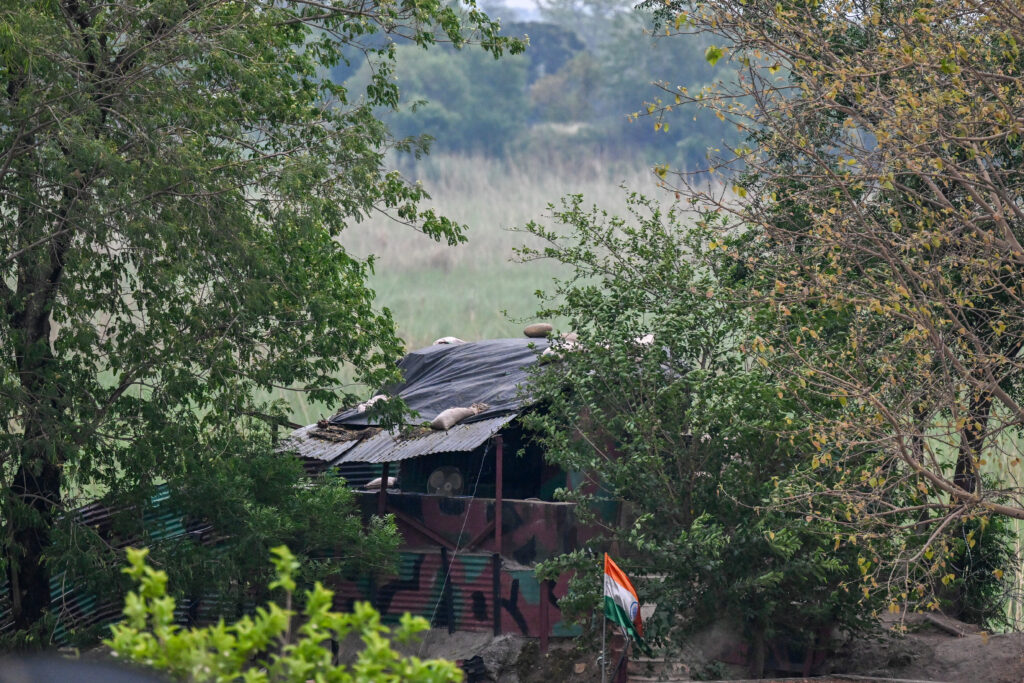
On India’s heavily fortified border with arch-rival Pakistan, residents of farming villages have sent families back from the frontier, recalling the terror of the last major conflict between the rival armies.Those who remain in the farming settlement of Sainth, home to some 1,500 people along the banks of the broad Chenab river, stare across the natural division between the nuclear-armed rivals fearing the future.”Our people can’t plan too far ahead”, said Sukhdev Kumar, 60, the village’s elected headman. “Most villagers here don’t invest beyond a very basic house,” he added.”For who knows when a misdirected shell may fall from the other side and ruin everything?”Relations between the nuclear-armed neighbours have plummeted after India accused Pakistan of backing the worst attack on civilians in Indian-administered Kashmir in years.Indian police have issued wanted posters for three men accused of carrying out the April 22 attack at Pahalgam — two Pakistanis and an Indian — who they say are members of the Pakistan-based Lashkar-e-Taiba group, a UN-designated terrorist organisation.Islamabad has rejected the charge of aiding gunmen who killed 26 people, with both countries since exchanging diplomatic barbs including expelling each other’s citizens.India’s army said Saturday its troops had exchanged gunfire with Pakistani soldiers overnight along the de facto border with contested Kashmir — which it says has taken place every night since April 24.- ‘Living in fear’ -Muslim-majority Kashmir has been divided between India and Pakistan since their independence from British rule in 1947, with both governing part of the disputed territory separately and claiming it in its entirety.Sainth, with its open and lush green fields, is in the Hindu-majority part of Indian-run Jammu and Kashmir.Security is omnipresent.Large military camps dot the main road, with watchtowers among thick bushes. Kumar said most families had saved up for a home “elsewhere as a backup”, saying that only around a third of those with fields remained in the village.”Most others have moved”, he said.The region was hit hard during the last major conflict with Pakistan, when the two sides clashed in 1999 in the high-altitude Himalayan mountains further north at Kargil.Vikram Singh, 40, who runs a local school, was a teenager at the time.He remembers the “intense mortar shelling” that flew over their heads in the village — with some exploding close by.”It was tense then, and it is tense now,” Singh told AFP. “There is a lot to worry since the attack at Pahalgam… The children are scared, the elderly are scared — everyone is living in fear”.International pressure has been piled on both New Delhi and Islamabad to settle their differences through talks.The United States has called for leaders to “de-escalate tensions” , neighbouring China urged “restraint”, with the European Union warning Friday that the situation was “alarming.On the ground, Singh seemed resigned that there would be some fighting.”At times, we feel that war must break out now because, for us, it is already an everyday reality”, he said. “We anyways live under the constant threat of shelling, so, maybe if it happens, we’d get to live peacefully for a decade or two afterwards”.- ‘Checking our bunkers’ -There has been a flurry of activity in Trewa, another small frontier village in Jammu.”So far, the situation is calm — the last cross-border firing episode was in 2023″, said Balbir Kaur, 36, the former village head.But the villagers are preparing, clearing out concrete shelters ready for use, just in case.”There were several casualties due to mortar shelling from Pakistan in the past”, she said.”We’ve spent the last few days checking our bunkers, conducting drills, and going over our emergency protocols, in case the situation worsens,” she added.Kaur said she backed New Delhi’s stand, with Prime Minister Narendra Modi vowing “to punish every terrorist and their backer” and to “pursue them to the ends of the Earth”.Dwarka Das, 65, a farmer and the head of a seven-member family, has lived through multiple India-Pakistan conflicts. “We’re used to such a situation,” Das said. “During the earlier conflicts, we fled to school shelters and nearby cities. It won’t be any different for us now”.