‘It’s terrific’: Chicago hails hometown hero Pope Leo XIV

Paula Hambrick never imagined that in her lifetime the Catholic Church would be led by a pope from the United States, never mind her hometown of Chicago.But at a mass on Friday in her Midwestern city in honor of the newly elected Pope Leo XIV, a native son of the so-called Windy City, the 77-year-old was counting her blessings.”There’s probably three things that I would have hoped for in my life: to see the Cubs win the World Series, a woman become president and an American pope,” she told AFP, naming one of the local professional baseball teams.”I got two out of three! It’s pretty good odds, right?” said Hambrick, who like the new pope hails from the city’s southern suburbs.”It’s terrific. I’m thrilled,” she added, speaking under the wood vault of Chicago’s Holy Name Cathedral.By 8 am the pews were fuller compared to one hour earlier for the first mass to celebrate the new pope, but still relatively sparse.Alejandro Mendoza, who was among the several hundred people to turn out for the service, said he had become more proud of Chicago.”I’m telling everybody that the pope is from where I’m from,” the 24-year-old said.”It feels like you know him. It’s very special, this sense of pride.”- ‘A prophetic figure’ -Maryjane Okolie, a nun who has been working in the southern suburbs of Chicago for more than a decade, said people there were “excited” and “surprised” that Robert Francis Prevost had become the 267th pope.”Everybody is talking about it,” she told AFP. She said she hoped Leo would follow in the footsteps of his predecessor, pope Francis, who gained a reputation for attending to the disadvantaged.Nate Bacon, a 61-year-old deacon who has been working in Guatemala for more than 10 years and was in town to visit his son, said he was “shocked” by the news.”At a time when the United States is in a really dominating kind of posture, to have a pope from the United States felt it had a cringe factor to it,” he said.Those concerns were assuaged when Bacon learned that Prevost had performed years of missionary service in Peru and that the new pope “was someone who built bridges and would continue the work of pope Francis.””I became enthusiastic,” Bacon told AFP.He said he hopes Leo can undo some of the “destruction” wrought by the administration of US President Donald Trump, who has adopted an aggressive anti-immigration stance since taking office this year.”I’m hoping a pope who was born in the United States could be a prophetic figure and a sign of a return to true values of justice, peace, and welcoming strangers and immigrants, and standing with those whom society has thrown away,” he added.Bishop Lawrence Sullivan, who helped lead Friday’s mass, said a return to Chicago by Leo would bring “tremendous excitement and joy.”

Pakistan warns won’t de-escalate as conflict with India spirals

Pakistan has warned it will “not de-escalate” a spiralling conflict with India, and blamed New Delhi for bringing the two nuclear-armed neighbours closer to a full-blown war, with the death toll from days of violence crossing 50.The South Asian countries have exchanged fire since India launched air strikes on Pakistani territory on Wednesday, saying they were targeting “terrorists” after a deadly attack on tourists in Indian-administered Kashmir last month.On Friday, the third day of tit-for-tat exchanges, the Indian army said it had “repulsed” waves of Pakistani attacks using drones and other munitions overnight, and gave a “befitting reply”.Pakistan’s military spokesman denied that Islamabad was carrying out such attacks, and vowed revenge for the initial Indian strikes.”We will not de-escalate — with the damages they did on our side, they should take a hit,” said Lieutenant General Ahmed Sharif Chaudhry.”So far, we have been protecting ourselves but they will get an answer in our own timing.”The clashes are the worst between the two countries — which have fought three full-scale wars since gaining independence from the British in 1947 — for decades.Civilians have come under fire on both sides, with Islamabad and New Delhi accusing each other of carrying out unprovoked artillery shelling, and missile and drone strikes.”Our life is worth nothing. At any time entire families could be wiped out,” said Naseer Ahmed Khan, 50, whose village lies near the Line of Control (LoC) that divides the disputed Kashmir region between Pakistan and India.”Our children are not able to sleep and we cannot have a meal in peace.”- ‘Reckless conduct’ -Most of the more than 50 deaths were in Pakistan during Wednesday’s air strikes by India, and included children. On Friday, Pakistani security and government officials said five civilians — including a two-year-old girl — were killed by Indian shelling overnight in areas along the heavily militarised LoC.On the other side, a police official said one woman was killed and two men wounded by heavy shelling.Pakistani military sources said that its forces had shot down 77 Indian drones in the last two days, with debris of many incursions seen by AFP in cities across the country.An Indian army spokeswoman on Friday spoke of “300 to 400” Pakistani drones being fired, but it was impossible to verify that claim independently.Pakistan has accused India of fabricating the drone strikes, and early Saturday its military claimed Delhi’s forces had bombed their own territory in Amritsar, without providing evidence.Pakistan’s foreign ministry alleged New Delhi’s “reckless conduct has brought the two nuclear-armed states closer to a major conflict”.Indian Prime Minister Narendra Modi met top security officials on Friday, including his national security advisor, defence minister and the chiefs of the armed forces, his office said.The two countries have fought several wars over Muslim-majority Kashmir, which both claim in full but administer separately.- Disruptions -Armed groups have stepped up operations in Kashmir since 2019, when Modi’s Hindu nationalist government revoked its limited autonomy and took the state under direct rule by New Delhi.Pakistan has rejected claims by India that it was behind last month’s attack in Pahalgam, in Indian-administered Kashmir, when gunmen killed 26 people, mainly male Hindu tourists.India blamed the Pakistan-based Lashkar-e-Taiba — a UN-designated terrorist organisation — for the attack.The conflict has caused major disruptions to international aviation, with airlines having to cancel flights or use longer routes that do not overfly the India-Pakistan frontier. India has closed 24 airports, with local media reporting the suspension would remain in place until next week. The mega Indian Premier League (IPL) cricket tournament was on Friday suspended for a week, while Pakistan suspended its own T20 franchise competition indefinitely, barely a day after relocating it to the United Arab Emirates over the violence.- Mediation offers -World powers have called for both sides to exercise “restraint”, with several offering to mediate the dispute.On Friday, Pakistani Prime Minister Shehbaz Sharif met with Saudi Foreign Minister Adel Al-Jubeir in Islamabad, according to a statement.That meeting came after Iranian Foreign Minister Abbas Araghchi met his Indian counterpart in Delhi on Thursday, days after visiting Pakistan.The International Crisis Group, however, said “foreign powers appear to have been somewhat indifferent” to the prospect of war, despite warnings of possible escalation.On Friday, Pakistan’s military spokesman warned India that further drone or other strikes could lead to “unpredictable” results.”They should know that the escalation ladder is always unpredictable,” he said.burs-aha/sst

Stocks mixed as global markets eye US-China tariff talks

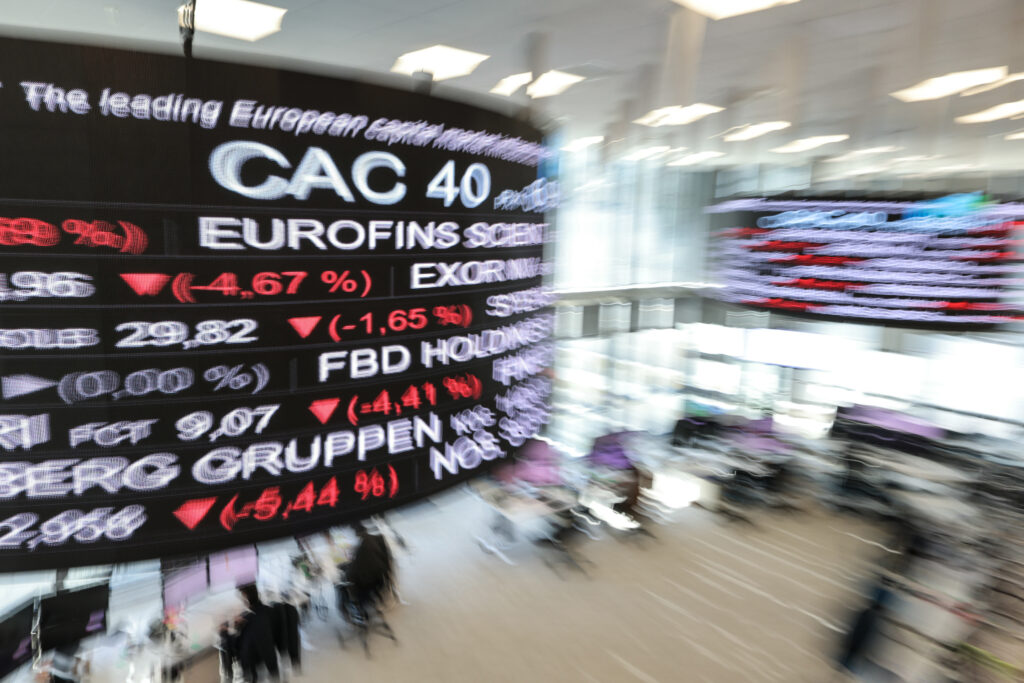
Global stocks were mixed Friday as markets awaited weekend US-China talks amid hopes for a deescalation in the trade war between the world’s two largest economies.”If ever there was a wait and see Friday, this is it,” said Art Hogan of B. Riley Wealth Management. “It’s all about our perceptions of how the trade war is going.”Representatives from the two countries are scheduled to meet in Switzerland this weekend. Analysts do not expect a breakthrough but are hoping for deescalation in the trade war.US President Donald Trump said an 80 percent tariff on China “seems right” in a post on social media. That would be a shift from the three-digit levies the two countries have imposed on each other in recent weeks.After opening higher following Trump’s remarks, US stocks moved in a choppy fashion, with the S&P 500 finishing narrowly lower.Trump’s comments came a day after the United States and Britain announced the first agreement since the US President launched his tariffs blitz last month.”Coming hot on the heels of yesterday’s UK-US trade deal, there is an air of optimism that we could see additional deals come to fruition around the globe,” said Joshua Mahony, chief market analyst at Scope Markets.Frankfurt’s DAX rose 0.6 percent, hitting a fresh high of 23,543.27 points, recouping losses spurred by Trump’s April tariffs announcements.Paris and London also climbed following a mixed showing in Asia.Tokyo and Hong Kong closed higher but Shanghai dropped as data showed China’s exports to the United States plunged by around one fifth on-year in April as Trump’s tariffs kicked in.Oil prices jumped on hopes that easing tensions between the United States and China would alleviate fears of a slump in crude demand.The dollar dropped after rallying on news of the US-UK trade deal.Among individual companies, Lyft shot up more than 28 percent as it announced a new $750 million share repurchase program after reporting mixed earnings.- Key figures at around 2030 GMT -New York – Dow: DOWN 0.3 percent at 41,249.38 (close)New York – S&P 500: DOWN 0.1 percent at 5,659.91 (close)New York – Nasdaq Composite: FLAT at 17,928.92 (close)Frankfurt – DAX: UP 0.6 percent at 23,499.32 (close)London – FTSE 100: UP 0.3 percent at 8,554.80 (close) Paris – CAC 40: UP 0.6 percent at 7,743.75 (close)Tokyo – Nikkei 225: UP 1.6 percent at 37,503.33 (close)Hong Kong – Hang Seng Index: UP 0.4 percent at 22,867.74 (close)Shanghai – Composite: DOWN 0.3 percent at 3,342.00 (close)Euro/dollar: UP at $1.1257 from $1.1228 on ThursdayPound/dollar: UP at $1.3308 from $1.3246Dollar/yen: DOWN at 145.31 yen from 145.91 yenEuro/pound: DOWN at 84.57 from 84.75 penceBrent North Sea Crude: UP 1.7 percent at $63.91 per barrelWest Texas Intermediate: UP 1.9 percent at $61.02 per barrel burs-jmb/jbr

US judge orders release of Turkish student detained in immigration case

A US judge on Friday ordered the release of a Turkish student detained by federal agents as part of President Donald Trump’s crackdown on pro-Palestinian campus activism.Judge William Sessions said Rumeysa Ozturk, a Ph.D student at Tufts University in Massachusetts, should be released “immediately” from custody while her removal proceedings continue.Ozturk’s student visa was revoked by the State Department after she co-authored an article in the university newspaper, The Tufts Daily, criticizing the college’s handling of student anger around Israel’s war against Hamas in Gaza.Video of the 30-year-old Ozturk’s March 25 arrest by masked agents on a sidewalk sparked outrage online, and added to concerns about freedom of speech and respect for due process under Trump.Sessions echoed the concerns during Friday’s live-streamed custody hearing, at which Ozturk appeared remotely from a detention center in Louisiana.”Continued detention potentially chills the speech of the millions and millions of individuals in this country who are not citizens,” the judge said.”Any one of them may now avoid exercising their First Amendment rights for fear of being whisked away to a detention center from their home,” he said.”Her continued detention cannot stand,” Sessions said. “The court orders the government to release Miss Ozturk from custody immediately.”The judge said he was not putting any travel restrictions on Ozturk and she was free to return to her home in Massachusetts.Ozturk is one of a number of foreign students facing deportation over their pro-Palestinian campus activities, and she still faces removal proceedings.The decision to release her from custody was welcomed by Turkey but condemned by the White House.Turkish Justice Minister Yilmaz Tunc, in a post on X, called it a “positive development” and said it was “unacceptable for someone to be prosecuted because of their faith or their support for Palestine.”Stephen Miller, a senior White House official, lashed out at the decision, saying “there’s a judicial coup in this country.””Foreigners in this country do not have a right to stay in this country if they support designated terrorist organizations like Hamas,” Miller told reporters.”The secretary of state has the absolute authority… to revoke an immigration benefit or a visa and then to pursue a deportation.”- ‘Won’t stop fighting’ -Tufts University has publicly backed Ozturk, demanding her release so she can return to the school and complete her doctoral studies in child development.Jessie Rossman, legal director at the American Civil Liberties Union of Massachusetts, which is among the groups representing Ozturk, welcomed her release.”For 45 days, Rumeysa has been detained in Louisiana,” Rossman said. “During that time, she has suffered regular and escalating asthma attacks.”And at the same time, the government has failed to produce any justification for her detention,” Rossman said, adding that the ACLU “won’t stop fighting until she is free for good.”Trump has targeted prestigious universities that became the epicenter of the US student protest movement sparked by Israel’s war in Gaza, stripping federal funds and directing immigration officers to deport foreign student demonstrators.Critics argue that the campaign amounts to retribution and will have a chilling effect on free speech, while its supporters insist it is necessary to restore order to campuses and protect Jewish students.

Macron et Tusk se jurent “assistance mutuelle” face à la Russie

Le président français Emmanuel Macron et le Premier ministre polonais Donald Tusk ont signé vendredi à Nancy, dans l’est de la France, un traité renforçant entre autres la coopération de défense entre les deux pays face à une Russie jugée de plus en plus menaçante après déjà trois ans de guerre en Ukraine.Le dirigeant polonais a estimé qu’il s’agissait “d’un événement historique”. “Je suis profondément convaincu (…) que la France et la Pologne pourront compter l’une sur l’autre dans toutes les circonstances, les bonnes et les difficiles”, a-t-il déclaré lors d’une conférence de presse alors que le texte comprend une clause d’assistance mutuelle en cas d’attaque armée.Ce traité marque “une nouvelle page”, a souligné de son côté Emmanuel Macron, évoquant “une solidarité irréversible”. Il a notamment assuré que s’il devait décider de recourir à l’arme nucléaire, il intègrerait dans sa réflexion les “intérêts” des “principaux partenaires” de la France.”Depuis les années 60, avec les propos du général de Gaulle, la dimension européenne de cette dissuasion a été affirmée et elle a été constamment réaffirmée par tous mes prédécesseurs”, a rappelé le président français.La France est le seul pays d’Europe occidentale, avec le Royaume-Uni, doté de l’arme nucléaire. Les autres pays européens membres de l’Otan sont jusqu’ici sous le parapluie nucléaire américain.La signature de ce traité intervient alors que la Pologne est devenue un acteur-clé sur le flanc est de l’Otan et se sent menacée par Moscou.Les retrouvailles à Nancy se sont déroulées au moment où, à Moscou, Vladimir Poutine a défié les Occidentaux avec un imposant défilé militaire pour les 80 ans de la victoire sur l’Allemagne nazie.”Le président Poutine est du côté de la guerre, pas du côté de la paix (…) et ceux qui ont pu croire qu’il avait une velléité de paix en sont pour leur compte”, a lancé Emmanuel Macron alors que la guerre en Ukraine ne faiblit pas malgré la promesse de Donald Trump d’y mettre fin.Le président ukrainien Volodymyr Zelensky a annoncé vendredi un sommet de dirigeants européens soutenant Kiev face à l’invasion russe prévu, selon lui, samedi en Ukraine. – clause de défense mutuelle -Avant de s’envoler pour la France, Donald Tusk avait annoncé que le traité inclurait une clause de défense mutuelle, qui “ouvre la possibilité d’une coopération” en matière de dissuasion nucléaire.”La dissuasion nucléaire française a une composante européenne, et dans ce traité, c’est une solidarité encore plus forte que nous scellons, qui permet de rendre opérationnel ce qu’il y a déjà dans l’article 5 de l’OTAN”, avait déclaré Emmanuel Macron sur la place Stanislas de Nancy.”Cette clause de soutien mutuel en cas d’agression contre l’un de nos pays est l’essence même de ce traité”, s’était félicité le dirigeant polonais. “En cas de menace, d’attaque contre la Pologne, et la France, les deux pays s’engagent à fournir une assistance mutuelle, y compris militaire”, avait-il précisé.Interrogé sur une aide concrète en cas d’agression de la Pologne par la Russie, Emmanuel Macron a assuré qu’un “déploiement serait possible face à une agression et si le pire devait advenir”. “J’en veux pour preuve que lorsque la Russie a décidé de cette guerre d’agression contre l’Ukraine en février 2022, nous avons pu en cinq jours déployer des troupes en Roumanie”, a-t-il rappelé.Dans le cadre des mesures de réassurance sur le flan oriental de l’Otan, Emmanuel Macron n’a par ailleurs pas exclu des survols de chasseurs Rafale français en Pologne, comme c’est le cas dans les États baltes. “Il y a une disponibilité du gouvernement de la France pour cheminer sur cette voie”, a-t-il dit dans une interview à la chaîne polonaise Telewizja Polska.Paris et Varsovie avaient déjà conclu un traité en 1991, alors que la Pologne sortait du glacis soviétique, après la chute du Rideau de fer, mais moins ambitieux.- Garanties mutuelles -Outre la défense, la coopération franco-polonaise sera renforcée dans les secteurs clés des infrastructures et l’énergie nucléaire, alors que Varsovie prévoit la construction de plusieurs centrales.Donald Tusk a mis en avant “les garanties de sécurité mutuelles”, son pays de quelque 38 millions d’habitants s’étant lancé dans un programme de modernisation accélérée de son armée et est devenue un acteur politique et militaire majeur en Europe.Jusqu’ici très dépendante des États-Unis pour sa défense, elle est profondément ébranlée par le climat d’incertitude généré par les ambivalences de Donald Trump envers l’Europe.”Nous allons organiser des exercices communs entre nos armées dans les mois qui viennent”, a annoncé Emmanuel Macron.Paris espère renforcer la coordination militaire et diplomatique dans la région, et ne plus laisser les États-Unis dominer le dialogue avec les Polonais.Le chef de l’État français a appelé de ses vœux une “voie médiane”, “celle de l’autonomie stratégique qui fait que sur tout ce qui est essentiel, nous voulons que ce soit européen” tout en coopérant avec les “alliés américains”.