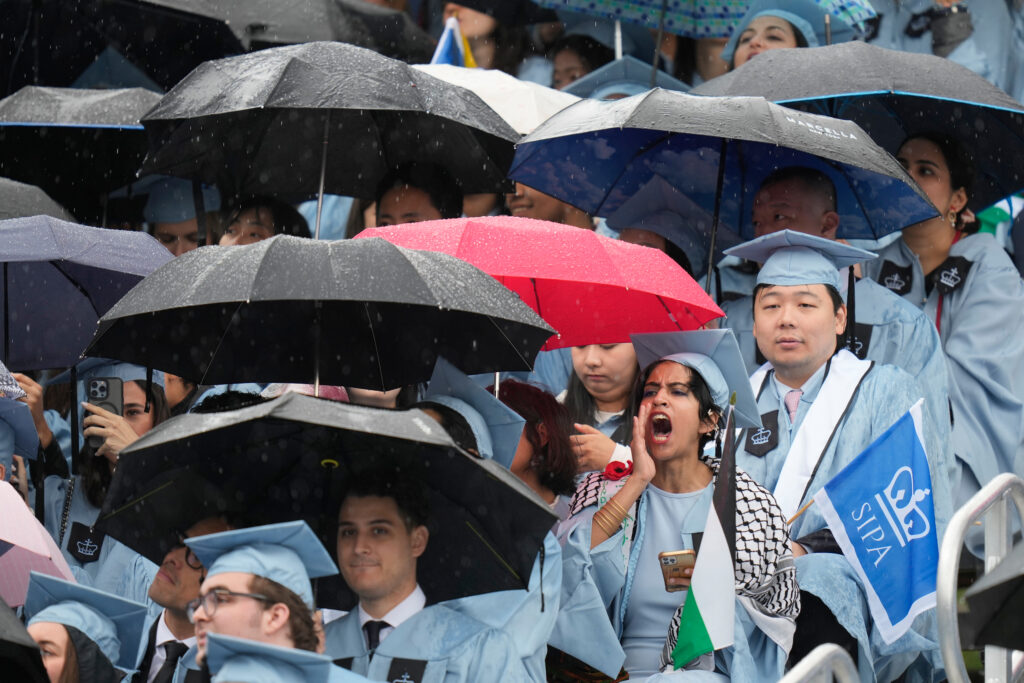
Students chant ‘Free Mahmoud’ at Columbia University graduation

There was one notable — and loudly noted — absence on  Wednesday at Columbia University’s graduation ceremony: detained pro-Palestinian student protest leader Mahmoud Khalil.”Boo… Shame on you!” students chanted when Clare Shipman, interim president of the prestigious New York City school, took the podium.Columbia has been the site of demonstrations calling for an end to violence in Gaza for the past 18 months, and more recently, has seen student protesters arrested by the Trump administration. Khalil, one of the most visible leaders of nationwide campus protests against Israel’s war in Gaza, has been detained by US authorities for more than two months following his campus activism.Even though he is a permanent US resident, he has been marked for deportation.Before Wednesday’s graduation ceremony, attendees were warned over loudspeakers that any interruption was prohibited and those who didn’t follow the rules could be asked to leave. That didn’t prevent chants of “Free Mahmoud.”Some students wore keffiyehs as scarves or in lieu of graduation caps, donning a symbol of the Palestinian cause.As light rain fell and a damp chill set in, Shipman congratulated 16,000 new graduates as they depart a school that remains in the crosshairs of the Trump administration. “We firmly believe that our international students have the same rights to freedom of speech as everyone else, and they should not be targeted by the government for exercising that right,” Shipman said. “And let me also say that I know many in our community today are mourning the absence of our graduate, Mahmoud Khalil,” she added before launching into a plea to defend democracy, which she described as “the essential work of your generation.”- ‘Embarrassed’ graduates – Without directly naming US President Donald Trump, Shipman defended academic institutions as “pillars of a healthy, functioning, democratic nation.” The White House has cut $400 million in federal aid to Columbia alone, taking aim at schools that don’t fall into line with its demands while arresting students involved in pro-Palestinian causes. Earlier in May, 80 pro-Palestinian students were arrested on Columbia’s campus after attempting to occupy the main library. US Secretary of State Marco Rubio said officials would review the visa status of the “vandals” involved for possible deportations.Recent Columbia graduate Khalil is being held in a detention center in Louisiana and faces possible deportation after his March arrest amid accusations of supporting Palestinian militant group Hamas. His lawyers said Wednesday that Immigration and Customs Enforcement officials barred Khalil from holding his newborn son, after his wife Noor Abdalla flew with the baby to Louisiana.”It is deliberate violence, the calculated cruelty of a government that tears families apart without remorse,” Abdalla said in a statement.Columbia students have reported a chill to campus free speech and a sense of shame that their university did not do more to support freedom of expression.”With the behavior of the university over the last few years — oh, it’s been horrific. I feel embarrassed every single day that my degree is attached to this university,” said Olivia Blythe, a 30-year-old masters graduate in social work who wore a keffiyeh over her pale blue gown. Blythe said tension was palpable during a ceremony Tuesday for students in her department, with audience members yelling “arrest them, get them out, kick them out” at pro-Palestinian students like herself.Sociology graduate Alfred Young said he appreciated his social justice-focused education at Columbia, but felt that was disconnected from the school’s administration.”I was honestly surprised that President Shipman referenced Mahmoud, and honestly, I do believe it was a bit tone deaf, given how the administration handled everything,” Young said.At the end of the ceremony, students tossed their caps as speakers blared Jay-Z’s “Empire State of Mind,” a hip-hop ode to New York City.With that, Columbia’s tense year ended with hugs and selfies. Outside campus, as hundreds of police kept watch, a few dozen pro-Palestinian demonstrators stood their ground. One held a sign that read: “There is no graduation in Gaza today.” 
Trump ambushes S. African president over ‘genocide’ accusation

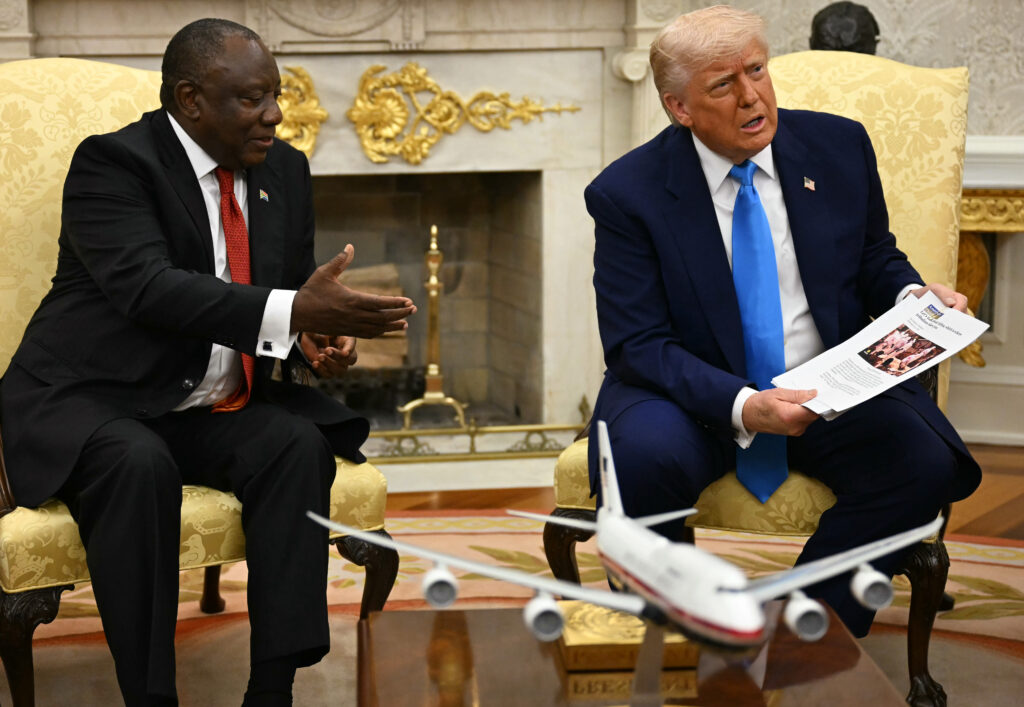
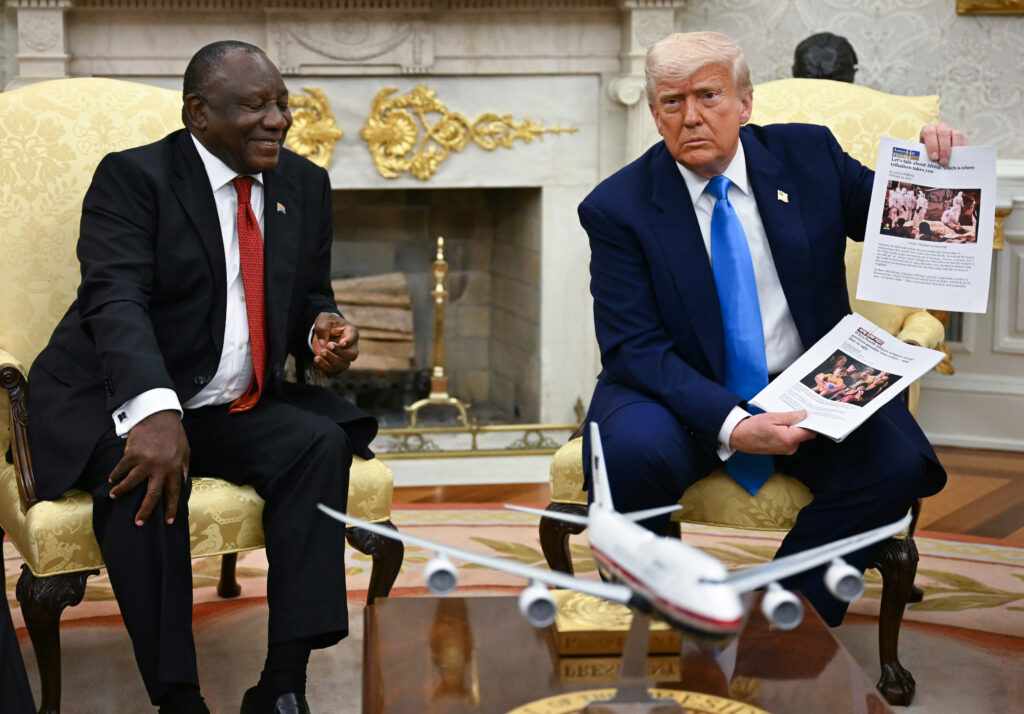
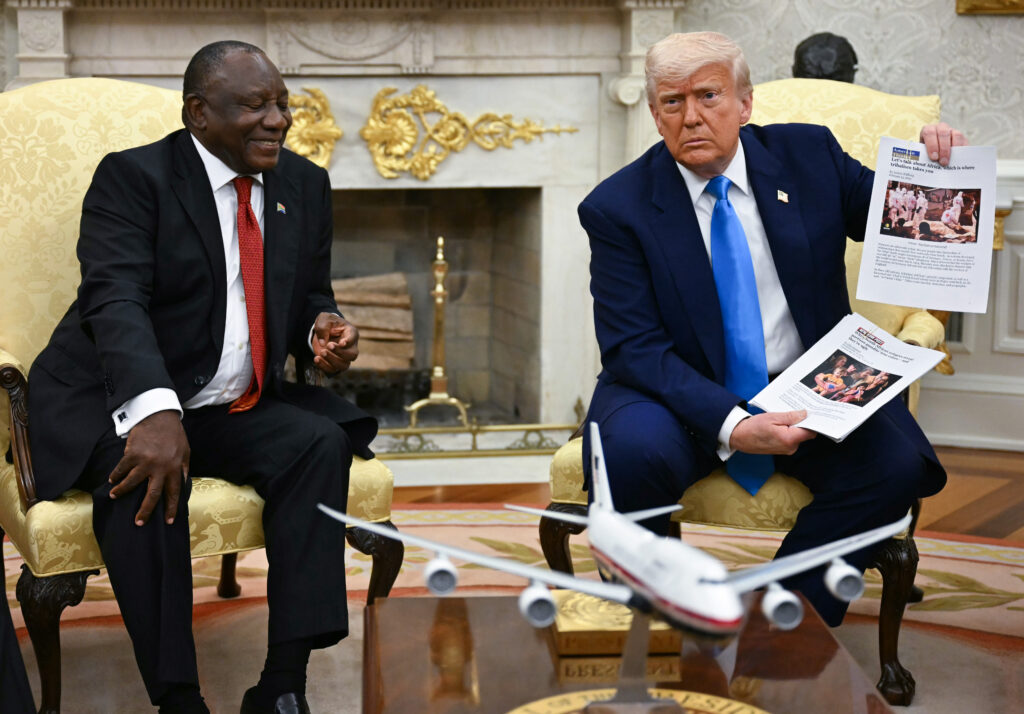
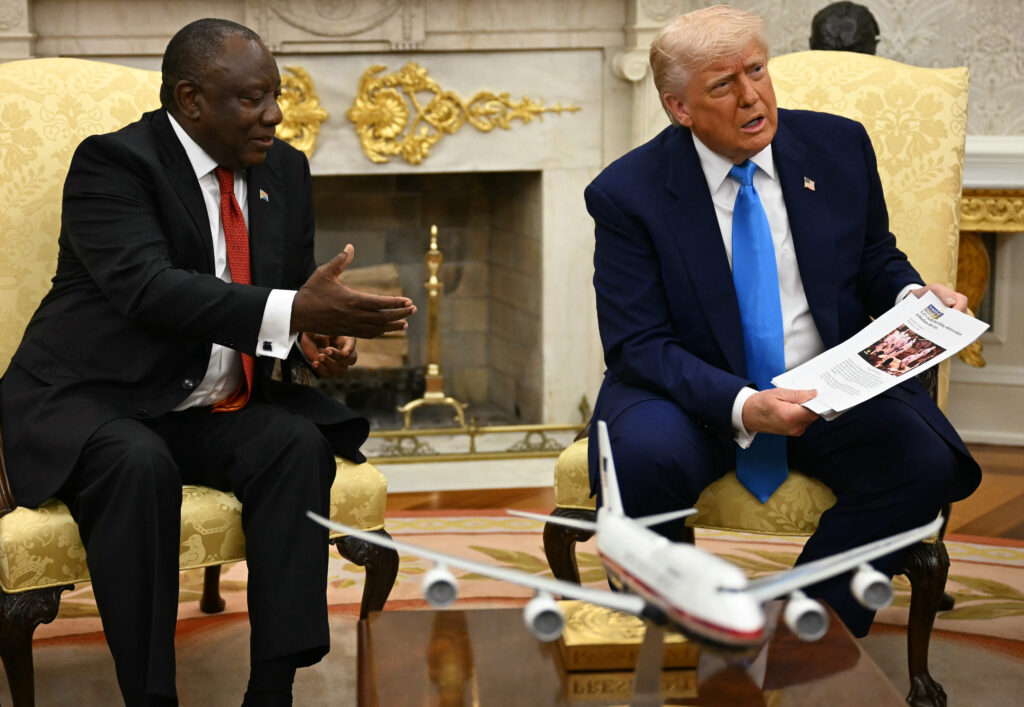
President Donald Trump ambushed South African counterpart Cyril Ramaphosa on Wednesday by playing him a video that he claimed proved genocide is being committed against white people, driving farmers to flee to the United States.The extraordinary stunt turned the usually staid diplomatic setting of the Oval Office into a stage for Trump’s contention that white South African farmers are being forced off their land and killed.With reporters present, Trump had staff put the four-minute video on a large screen, saying it showed black South African politicians calling for the persecution of white people.”You do allow them to take land, and then when they take the land, they kill the white farmer, and when they kill the white farmer, nothing happens to them,” Trump said.Trump also showed news clippings that he said backed up his claims — although one actually featured a photo from the Democratic Republic of Congo.”Death, death, death. Horrible death,” said Trump.Trump’s administration earlier this month granted refugee status to more than 50 white Afrikaners, despite the fact that it has effectively stopped taking asylum seekers from the rest of the world.But the South African president disputed Trump’s claims. And after initially appearing stunned by the move he stayed calm, avoiding the kind of row Trump had with Ukraine’s President Volodymyr Zelensky in February.- Awkward exchanges -Ramaphosa denied that his country confiscates land from white farmers under a land expropriation law signed in January that aims to redress the historical inequalities of apartheid rule.”No, no, no, no,” Ramaphosa responded. “Nobody can take land.”He also insisted that most victims of South Africa’s notoriously high crime rate are black and said the politicians in the video were from the opposition.The visit by the South African leader had been billed as a chance to repair relations following unfounded genocide claims by Trump and his billionaire, South African-born ally Elon Musk.Musk, who was also in the Oval Office, has been a key driver of the “white genocide” claims.Ramaphosa had arrived at the White House with two of South Africa’s top golfers, Ernie Els and Retief Goosen in a bid to woo the golf-loving US president.”We are essentially here to reset the relationship between the United States and South Africa,” Ramaphosa said.But Ramaphosa was left repeatedly trying to speak as the video played, even as Trump drowned him out. “Where is this?” added the South African president as he shuffled awkwardly in his seat.In the video, firebrand far-left opposition lawmaker Julius Malema was shown singing “Kill the Boer, kill the farmer” — an infamous chant dating back to the apartheid-era fight against white-minority rule.The video finished with images of a protest in South Africa where white crosses were placed along a rural roadside to represent murdered farmers — but which Trump falsely said showed their graves.- Golf diplomacy -At one point, Ramaphosa pleaded that they “talk about it very calmly.””We were taught by Nelson Mandela that whenever there are problems, people need to sit down around the table and talk about them,” he said.The two champion golfers also sought to calm the waters when Trump asked them to speak. “We want to see things get better in our home country. That’s the bottom line,” said four-time major winner Els.The South African leader later tried to put a brave face on the meeting, saying it was a “great success” and that he still expected Trump to attend a G20 summit in Johannesburg in November.He also said he did not think Trump fully believes there’s a genocide against whites despite the video.”In the end, I mean, I do believe that there is this doubt and disbelief in his head about all this,” Ramaphosa told reporters. Trump’s administration has torn into South Africa since the US president began his second term in office.It has slammed South Africa’s case accusing Israel of genocide in Gaza at the International Court of Justice, cut foreign aid, announced 31 percent tariffs, and expelled Pretoria’s ambassador after he criticized Trump’s Make America Great Again (MAGA) movement.

Trump ambushes S. African president over ‘genocide’ accusationWed, 21 May 2025 22:53:04 GMT

President Donald Trump ambushed South African counterpart Cyril Ramaphosa on Wednesday by playing him a video that he claimed proved genocide is being committed against white people, driving farmers to flee to the United States.The extraordinary stunt turned the usually staid diplomatic setting of the Oval Office into a stage for Trump’s contention that white …

Trump ambushes S. African president over ‘genocide’ accusationWed, 21 May 2025 22:53:04 GMT Read More »

Trump’s ‘Golden Dome’ US missile defense plan faces major challenges

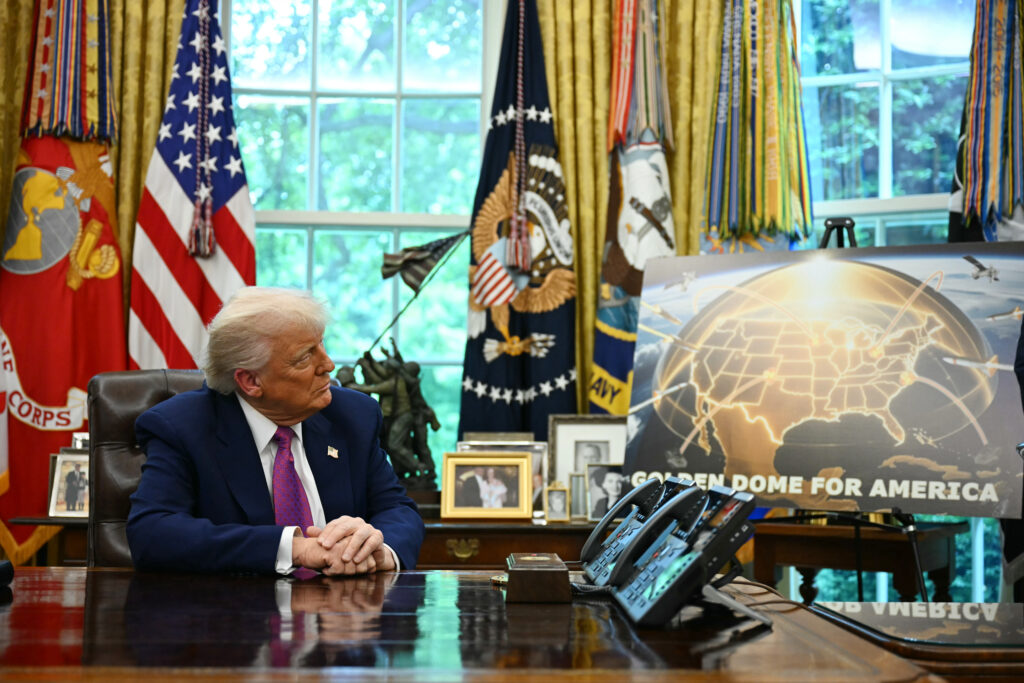
US President Donald Trump’s plan for a nationwide missile defense system — dubbed “Golden Dome” — faces significant technical and political challenges, and it could cost far more than he has estimated to achieve its goals.Trump wants a system that can defend against a wide array of enemy weapons — from intercontinental ballistic missiles to hypersonic and cruise missiles to drones — and he wants it ready in about three years, or as he nears the end of his second term in office. Four months after Trump initially ordered the Pentagon to develop options for the system, however, little in the way of further details has emerged.”The main challenges will be cost, the defense industrial base, and political will. They can all be overcome, but it will take focus and prioritization,” said Melanie Marlowe, a nonresident senior associate in the Missile Defense Project at Washington’s Center for Strategic and International Studies.”The White House and Congress are going to have to agree on how much to spend and where the money will come from,” Marlowe said, noting that “our defense industrial base has atrophied,” though “we have begun to revive it.”She also cited the need for more progress on sensors, interceptors and other components of the project.Trump on Tuesday announced an initial $25 billion in funding for Golden Dome, saying its eventual cost would be about $175 billion.That figure is likely far lower than the actual price of such a system.Thomas Roberts, assistant professor of international affairs and aerospace engineering at the Georgia Institute of Technology, said the price estimate was “not realistic.””The challenge with the statements from yesterday is that they lack the details needed to develop a model of what this constellation would really look like,” he said.- ‘Not holding my breath’ -Earlier this month, the non-partisan Congressional Budget Office (CBO) estimated the cost of space-based interceptors to defeat a limited number of intercontinental ballistic missiles at between $161 billion and $542 billion over 20 years.A system such as that envisaged by Trump “could require a more expansive SBI (space-based interceptor) capability than the systems examined in the previous studies. Quantifying those recent changes will require further analysis,” the CBO said.The Golden Dome concept — and name — stem from Israel’s Iron Dome air defense system. But the United States’ missile threats differ significantly from the short-range weapons that Iron Dome is designed to counter.Beijing is closing the gap with Washington when it comes to ballistic and hypersonic missile technology, while Moscow is modernizing its intercontinental-range missile systems and developing advanced precision strike missiles, according to the Pentagon’s 2022 Missile Defense Review.The document also said the threat of drones — which have played a key role in the Ukraine war — is likely to grow, and warned of the danger of ballistic missiles from North Korea and Iran, as well as rocket and missile threats from non-state actors.Chad Ohlandt, a senior engineer at the RAND Corporation, said “the threat is clearly getting worse,” but the “key question is how to most cost effectively counter” it.”Any questions of realism or feasibility” for Golden Dome “depend on where we set the bar. Defend against how many threats? Threats of what capability? What is to be defended? As you raise the bar, it becomes more expensive,” Ohlandt said.Thomas Withington, associate fellow at the Royal United Services Institute, said “there are a number of bureaucratic, political, science and technological milestones that will need to be achieved if Golden Dome is ever going to enter service in any meaningful capacity.””It is an incredibly expensive undertaking, even for the US defense budget. This is serious, serious money,” Withington said.”I’m not holding my breath as to whether we will actually ever see this capability.”

The Ambush Office: Trump’s Oval becomes test of nerve for world leadersWed, 21 May 2025 22:40:31 GMT

For world leaders an invitation to the Oval Office used to be a coveted prize. Under Donald Trump it’s become a ticket to a brutal political ambush.South African President Cyril Ramaphosa became the latest victim in a long line that started with Trump’s notorious row with Ukraine’s Volodymyr Zelensky in February.Trump has turned what were …

The Ambush Office: Trump’s Oval becomes test of nerve for world leadersWed, 21 May 2025 22:40:31 GMT Read More »

The Ambush Office: Trump’s Oval becomes test of nerve for world leaders

For world leaders an invitation to the Oval Office used to be a coveted prize. Under Donald Trump it’s become a ticket to a brutal political ambush.South African President Cyril Ramaphosa became the latest victim in a long line that started with Trump’s notorious row with Ukraine’s Volodymyr Zelensky in February.Trump has turned what were staid diplomatic “photo sprays” under his predecessor Joe Biden into punishing, hour-long tests of nerve in the heart of the US presidency, played out on live television.The sight has become all too familiar — a world leader perched nervously on the edge of their gold-upholstered chair in front of the famed fireplace, waiting to see what happens.Will the 78-year-old Republican lay on the charm? Will he show off the new gold-plated decor he has been proudly installing in the Oval? Will he challenge his guest on tariffs or trade or US military assistance?Or will he simply tear into them? Nobody knows before they get there. All they know is that when the cameras are allowed into the most exclusive room in the White House, they will be treading the most perilous of political tightropes.And the hot, confined space of the Oval Office adds to the pressure-cooker environment as the unpredictable billionaire seeks to wrongfoot his guests and gain the upper hand.- ‘Turn the lights down’ -Trump set the benchmark when he hosted Zelensky on February 28.Tensions over Trump’s sudden pivot towards Russia spilled into the open as a red-faced US president berated the Ukrainian leader and accused him of being ungrateful for US military aid against Russia.Many wondered if it was a deliberate ambush — especially as Vice President JD Vance appeared to step in to trigger the row.Whether or not it was on purpose, the goal in foreign capitals ever since has been to “avoid a Zelensky.”But Ramaphosa’s visit to the Oval on Wednesday was the closest yet to a repeat — and this time it was clearly planned.Ramaphosa arrived with top South African golfers Ernie Els and Retief Goosen in tow, hoping to take the edge off the golf-mad Trump’s unfounded claims of a “genocide” against white South African farmers.But his face was a picture of bemusement when after a question on the issue, Trump suddenly said to aides and said: “Turn the lights down, and just put this on.” A video of South African politicians chanting “kill the farmer” began to play on a screen set up at the side of the room. A stunned Ramaphosa looked at the screen, then at Trump, and then back at the screen.Yet unlike Zelensky, who argued back with an increasingly enraged Trump, the South African president largely stayed calm as he argued his case. Nor was he asked to leave the White House as Zelensky was, causing the Ukrainian to miss lunch.- ‘Ratings GOLD!’ -Other leaders have also done their homework. Some have emerged mostly unscathed, or even with some credit.Canadian Prime Minister Mark Carney, despite some nervous body language, stood his ground against Trump’s calls for his country to become the 51st US state and insisted that his country was “never for sale.”British Prime Minister Keir Starmer won over Trump with a letter from King Charles III, while French President Emmanuel Macron kept up his touch-feely bromance with the US president.Trump’s ideological allies have often fared even better. El Salvador’s Nayib Bukele had a major Oval Office love-fest after agreeing to take migrants at a mega-prison in the Central American country.But even some close allies have been wrongfooted. Israeli Prime Minister Benjamin Netanyahu received a warm welcome as the first foreign guest of Trump’s second term, but it was a different story when he returned in April. Cameras in the Oval Office caught his stunned face when Trump announced that Washington was starting direct talks with Iran.For Trump, though, it’s all part of a presidency that he increasingly treats like a reality show.Trump himself quipped after the Zelensky meeting that it was “going to be great television”, and one of his advisers was just as explicit after the Ramaphosa meeting.”This is literally being watched globally right now,” Jason Miller said on X, along with a picture of the encounter on multiple screens. “Ratings GOLD!”

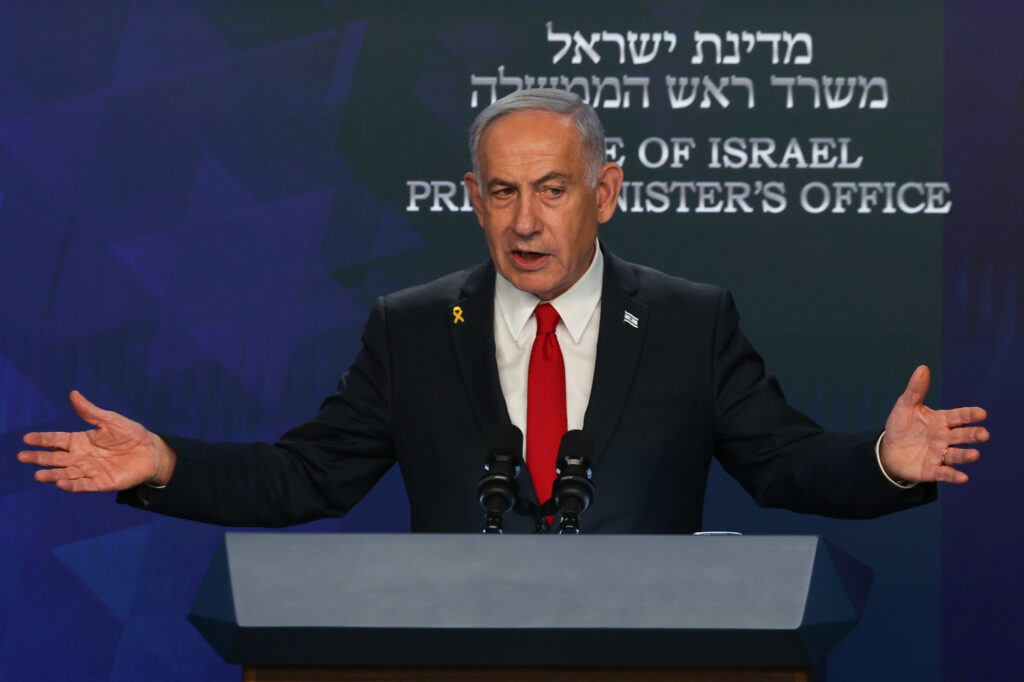
Offensive à Gaza : Netanyahu prêt à un “cessez-le-feu temporaire” pour libérer des otages

Israël est prêt à accepter un “cessez-le-feu temporaire” permettant de libérer des otages, a déclaré mercredi soir le Premier ministre Benjamin Netanyahu, tout en affirmant que l’armée contrôlerait “toute la bande de Gaza” à l’issue de l’offensive en cours dans le territoire palestinien.Cette annonce, dans un contexte de pressions internationales accrues sur Israël pour sa conduite de la guerre à Gaza, est intervenue dans la foulée d’un tollé suscité mercredi par des tirs de “coups de semonce” de l’armée israélienne lors d’une visite de diplomates étrangers organisée par l’Autorité palestinienne à Jénine, en Cisjordanie occupée.Au cours d’une conférence de presse mercredi soir à Jérusalem, M. Netanhayu n’a pas commenté l’incident déploré par l’UE, l’ONU, la Turquie, l’Uruguay et plusieurs pays européens. L’armée israélienne avait auparavant expliqué que la délégation internationale s’était “écartée de l’itinéraire approuvé” et que des soldats avaient “tiré des coups de semonce pour les éloigner”.Le Premier ministre a en revanche laissé entrevoir une possible pause dans l’offensive d’envergure lancée samedi dans le but affiché de libérer les otages et d’anéantir le Hamas. “S’il y a une option de cessez-le-feu temporaire, pour libérer des otages, nous serons prêts”, a-t-il déclaré, affirmant que 20 des 58 otages (dont un soldat tué en 2014) toujours à Gaza sont “en vie de façon certaine”. Réitérant son plan de prendre le contrôle de toute la bande de Gaza, il a concédé qu’Israël devait “éviter une crise humanitaire” pour garder sa liberté d’action. – 100 nouveaux camions d’aide à Gaza -En début de soirée, Israël a annoncé l’entrée mercredi à Gaza de 100 camions d’aide humanitaire de l’ONU, après 93 la veille et une dizaine lundi après plus de deux mois et demi de blocus total du territoire palestinien dévasté par la guerre.”Cent camions appartenant à l’ONU et à la communauté internationale, transportant de l’aide humanitaire – notamment de la farine, de la nourriture pour bébés et du matériel médical – ont été transférés aujourd’hui (mercredi) vers la bande de Gaza par le point de passage de Kerem Shalom”, a affirmé dans un communiqué le Cogat, un organisme du ministère de la Défense israélien.Mais vers 16H00 GMT, “aucune des provisions” n’avait pu “quitter la zone de chargement de Kerem Shalom”, où les marchandises doivent être transbordées, a déclaré Stéphane Dujarric, porte-parole du secrétaire général de l’ONU.Mardi, le Royaume-Uni avait annoncé la suspension de ses négociations avec Israël sur un accord de libre-échange, et l’Union européenne a décidé un réexamen de son accord d’association avec Israël, soutenu par 17 Etats membres.”Les pressions extérieures ne détourneront pas Israël de sa voie pour défendre son existence et sa sécurité”, avaient réagi les Affaires étrangères israéliennes. Et le ministère israélien avait jugé que le réexamen de l’accord d’association reflétait “une incompréhension totale de la réalité complexe à laquelle Israël” fait face et encourageait “le Hamas à rester sur ses positions”.L’attaque sans précédent du mouvement islamiste palestinien du 7 octobre 2023 a entraîné la mort de 1.218 personnes côté israélien, en majorité des civils, selon un décompte de l’AFP à partir de données officielles.  251 personnes avaient été enlevées.La campagne de représailles israéliennes a fait au moins 53.655 morts à Gaza, majoritairement des civils, selon des données du ministère de la Santé du Hamas, jugées fiables par l’ONU.L’armée israélienne a intercepté mercredi une roquette tirée de la bande de Gaza, selon un communiqué militaire, après que des sirènes d’alerte aient retenti dans des zones du sud d’Israël.Le ministère libanais de la Santé a pour sa part fait état de trois morts dans des frappes israéliennes sur le sud du pays, où Israël continue de cibler régulièrement le Hezbollah malgré un cessez-le-feu en vigueur depuis novembre.