‘Unscientific’ Japan megaquake rumours spook Hong Kong tourists

Unfounded online rumours warning that a huge earthquake will soon strike Japan are taking a toll on travel firms and airlines who report less demand from worried Hong Kongers.People from Hong Kong made nearly 2.7 million trips to Japan in 2024.Although it is impossible to know exactly when earthquakes will hit, fear-inducing predictions have spread widely among the city’s residents.Some of the false posts cite a Japanese manga comic, republished in 2021, which predicts a major natural disaster in July 2025 — based on the author’s dream.Other posts give different dates, while a Facebook group that claims to predict disasters in Japan has over a quarter of a million members, mainly in Hong Kong and Taiwan.”The earthquake prophecy has absolutely caused a big change to our customers’ preferences,” said Frankie Chow, head of Hong Kong travel agency CLS Holiday.Chow told AFP that in March and April his company received 70-80 percent fewer inquiries about travelling to Japan than last year.”I’ve never experienced this before,” said Chow, who also runs the booking website Flyagain.la.While some people changed their destination, others “did not dare to travel”, he said.Mild to moderate earthquakes are common in Japan, where strict building codes minimise damage, even from larger shakes.But the nation is no stranger to major disasters, including in 2011 when a magnitude-9.0 quake triggered a tsunami that left 18,500 people dead or missing and caused a devastating meltdown at the Fukushima nuclear plant.Earthquakes are very rarely felt in Hong Kong, but some people are easily spooked by disinformation, Chow said.- ‘Megaquake’ warning -Last month, Tokyo’s Cabinet Office said on social media platform X: “Predicting earthquakes by date, time and place is not possible based on current scientific knowledge.”A Cabinet Office official told AFP that the X post was part of its usual information-sharing about earthquakes.But Japan’s Asahi Shimbun daily reported that it was responding to prophecies that sprung up online after a Japanese government panel in January released a new estimate for the probability of a “megaquake”.The panel said the chance of a massive earthquake along the undersea Nankai Trough south of Japan in the next three decades had marginally increased to 75-82 percent.This was followed by a new damage estimate in March from the Cabinet Office, which said a Nankai Trough megaquake and tsunami could cause 298,000 deaths in Japan.Despite being a routine update of a previous 2014 figure, the estimate appears to have fanned tourists’ fears.A YouTube video featuring a feng shui master urging viewers not to visit Japan, published by local media outlet HK01, has been viewed more than 100,000 times.Don Hon, one of Hong Kong’s 7.5 million residents, does not entirely believe the online claims, but has still been influenced by them.”I will just take it as a precaution, and won’t make any particular plans to travel to Japan,” the 32-year-old social worker said.And if a friend were to ask him to visit Japan in July, Hon “might suggest going somewhere else”.- ‘No reason to worry’ -Hong Kong-based Greater Bay Airlines has reduced flights to Japan’s southern Tokushima region, a local tourism official told AFP.”The company told us demand has rapidly decreased amid rumours there will be a big quake and tsunami in Japan this summer,” she said.”Three scheduled weekly round-trip flights will be reduced to two round-trips per week from May 12 to October 25.”The airline is also reducing its flights to Sendai in the northern region of Miyagi.”There’s no reason to worry,” Miyagi’s governor Yoshihiro Murai reassured travellers, adding that Japanese people are not fleeing.But “if unscientific rumours on social media are impacting tourism, that would be a major problem”, he said last month.According to the Japan National Tourism Organization, the number of Hong Kong visitors in March stood at 208,400 — down nearly 10 percent year-on-year.However, this decline was partly due to the Easter holidays starting in mid-April this year, instead of March, they said.Hong Kong-based EGL Tours has not seen a massive decline in customers travelling to Japan, its executive director Steve Huen Kwok-chuen said.But recent bookings at its two hotels in Japan show fewer from Hong Kong guests, while the number from other global destinations remains stable.In any case, in the likely event that the predictions do not come to pass, “people will realise it’s not true”, he said.burs-nf/kaf/tc/sco

End of nuclear in Taiwan fans energy security fears

Taiwan will turn off its last nuclear reactor on Saturday, fuelling concerns over the self-ruled island’s reliance on imported energy and vulnerability to a Chinese blockade.The island, which targets net-zero emissions by 2050, depends almost entirely on imported fossil fuel to power its homes, factories and critical semiconductor chip industry.President Lai Ching-te’s Democratic Progressive Party has long vowed to phase out nuclear power, while the main opposition Kuomintang (KMT) party says continued supply is needed for energy security.Ma’anshan Nuclear Power Plant in southern Pingtung county is being closed as China intensifies military activity around Taiwan, which Beijing claims as part of its territory and has vowed to bring under its control one day. During large-scale military drills around Taiwan in April, China simulated strikes on key ports and energy sites as well as blockading the island.Ma’anshan has operated for 40 years in a region popular with tourists and which is now dotted with wind turbines and solar panels.More renewable energy is planned at the site, where state-owned Taipower plans to build a solar power station capable of supplying an estimated 15,000 households annually.But while nuclear only accounted for 4.2 percent of Taiwan’s power supply last year, some fear Ma’anshan’s closure risks an energy crunch.”Taiwan is such a small place and currently there’s no other better and more efficient natural energy source that can replace nuclear power,” said Ricky Hsiao, 41, who runs a nearby guesthouse.”The reality is that TSMC and other big companies need a lot of electricity. They would leave Taiwan if it’s not stable,” he told AFP, referring to chipmaking giant Taiwan Semiconductor Manufacturing Company.But mother-of-two Carey Chen fears an accident like the 2011 Fukushima nuclear meltdown in Japan, which like Taiwan is prone to earthquakes.”If we can find other stable power sources, I support a nuclear-free homeland for everyone’s safety,” Chen, 40, told AFP.- Stable supply – At its peak in the 1980s, nuclear power made up more than 50 percent of Taiwan’s energy generation, with three plants operating six reactors across the island. Concerns after the Fukushima disaster sawa new plant mothballed in 2014 before it was even finished.And two plants stopped operating between 2018 and 2023 after their operating permits expired.Most of Taiwan’s power is fossil fuel-based, with liquefied natural gas (LNG) accounting for 42.4 percent and coal 39.3 percent last year.Renewable energy made up 11.6 percent, well short of the government’s target of 20 percent by 2025.Solar has faced opposition from communities worried about panels occupying valuable land, while rules requiring locally made parts in wind turbines have slowed their deployment.Lai insists Taiwan’s energy supply will be stable even as AI technology boosts demand, with new units in existing LNG and coal-fired plants replacing Ma’anshan’s output.The KMT and Taiwan People’s Party, which control the parliament, amended a law on Tuesday enabling nuclear plants to extend their operating life by up to 20 years.”Nuclear power is not the most perfect way to generate electricity,” KMT lawmaker Ko Ju-chun told AFP.”But it is an option that should not be eliminated when we are developing technology, defence, and strengthening national security.”- Chinese threat -Taiwan’s reliance on imported fossil fuels is of particular concern given the risk of a Chinese blockade.The island has enough LNG and coal reserves to last just 11 and 30 days, respectively, government data show.Taiwan’s centralised electricity grid also leaves swaths of the island at risk of major power outages in case of a single fault. Without nuclear, “our energy security cannot be guaranteed, and national security will be affected”, said Yeh Tsung-kuang, an energy expert at Taiwan’s National Tsing Hua University.Environmental activists argue renewables are the best way to bolster Taiwan’s energy resilience.”If every community has solar panels on its roofs, the community can be (more) self-sufficient”, said Tsui Shu-hsin, secretary-general of Green Citizens’ Action Alliance.But others note Taiwan’s break-up with nuclear is at odds with global and regional trends.Even Japan aims for nuclear to account for 20-22 percent of its electricity by 2030, up from well under 10 percent now.And nuclear power became South Korea’s largest source of electricity in 2024, accounting for 31.7 percent of the country’s total power generation, and reaching its highest level in 18 years, according to government data.Yu Shih-ching, chief of Hengchun town where Ma’anshan is located, said the plant had brought jobs and boosted the local economy.”Our view is that nuclear power is necessary,” he told AFP, calling it “an important driving force for the national economy” and a “great help to local areas”.And Lai acknowledged recently he would not rule out a return to nuclear one day.”Whether or not we will use nuclear power in the future depends on three foundations which include nuclear safety, a solution to nuclear waste, and successful social dialogue,” he said.

Trump demande à la Syrie une normalisation avec Israël après l’annonce d’une levée des sanctions

Donald Trump a rencontré mercredi à Ryad le président syrien islamiste Ahmad al-Chareh, lui réclamant de normaliser ses relations avec Israël, après avoir annoncé une levée des sanctions contre son pays, dans un changement de cap majeur.Arrivé au Qatar après une visite en Arabie saoudite, le président américain a ensuite annoncé que la compagnie aérienne Qatar Airways avait passé une commande de 160 avions pour une valeur de 200 milliards de dollars à Boeing.Il doit se rendre jeudi aux Emirats arabes unis, étape finale de sa tournée dans le Golfe, sauf s’il décide à la dernière minute d’aller en Turquie pour des pourparlers russo-ukrainiens, une “possibilité” qu’il a évoquée.La rencontre avec le président par intérim syrien s’est “très bien passée”, a confié Donald Trump aux journalistes dans l’avion, parlant d’un “homme jeune et séduisant. Un gars costaud”.Le portrait élogieux est frappant, pour un homme qui a figuré un temps sur une liste des jihadistes recherchés par les Etats-Unis, devenu président par intérim après avoir renversé en décembre Bachar al-Assad à la tête d’une coalition de forces islamistes.Donald Trump a assuré que le dirigeant syrien était prêt à accéder à sa demande d’une normalisation des relations avec Israël, avec qui la Syrie est officiellement en guerre depuis 1948.Interrogé à ce sujet, le président américain a dit: “Je lui ai dit, j’espère que vous rejoindrez (les accords d’Abraham, ndlr) une fois que vous aurez réglé votre situation et il m’a dit +oui+. Mais ils ont beaucoup de travail à faire”, en référence aux accords par lesquels plusieurs pays arabes ont reconnu Israël en 2020.En Syrie, la perspective d’une levée des sanctions qui étranglent le pays a suscité des manifestations spontanées de joie. “Cela stimulera l’économie et encouragera les gens à revenir”, s’est réjouie Zain al-Jabali, 54 ans, propriétaire d’une fabrique de savon à Alep (nord).- “Une chance de grandeur” -L’entrevue, la première du genre en 25 ans, a duré près d’une trentaine de minutes, en présence du prince héritier saoudien Mohammed ben Salmane et du président turc Recep Tayyip Erdogan, qui s’y est joint virtuellement.Le président américain a aussi demandé à Damas d’expulser les membres de groupes armés palestiniens et de prendre “la responsabilité” des prisons détenant des membres du groupe jihadiste Etat islamique en Syrie, actuellement prises en charge par les forces kurdes. La diplomatie syrienne a évoqué une “rencontre historique”, sans mentionner les relations avec Israël. Donald Trump avait créé la surprise mardi en annonçant qu’il allait “ordonner l’arrêt des sanctions” pour donner “une chance de grandeur” à la Syrie.Le pays fait l’objet de sanctions internationales depuis 1979, renforcées après la répression par le pouvoir de Bachar al-Assad de manifestations prodémocratie en 2011. La rencontre Trump-Chareh a eu lieu malgré les réticences d’Israël, allié indéfectible des Etats-Unis. Israël mène régulièrement des frappes en Syrie, pour empêcher selon lui que les armes du pouvoir déchu ne tombent entre les mains des nouvelles autorités, considérées comme hostiles. Concernant les discussions indirectes sur le nucléaire iranien entre Téhéran et Washington, Donald Trump a dit avoir “le sentiment que ça va bien tourner”. Il avait appelé mercredi à une application stricte des sanctions américaines visant l’Iran.- “Homme de paix” -A Doha, Donald Trump a reçu un accueil tout aussi rutilant qu’à Ryad.L’émir du Qatar, cheikh Tamim ben Hamad Al-Thani, s’est déplacé à l’aéroport pour l’accueillir, et l’avion présidentiel américain a eu droit à une escorte d’avions de combat qataris.Le convoi de Donald Trump a été ensuite précédé de Cybertrucks du constructeur Tesla aux couleurs des forces de sécurité qataries, un clin d’oeil au propriétaire de la marque et grand allié du président, Elon Musk.Dans un premier échange avec le dirigeant qatari, le président républicain a vanté le “marbre parfait” du palais où il était reçu, et loué “l’amitié” avec son hôte.Ce dernier l’a qualifié d'”homme de paix”.Mais ce passage à Doha a pour arrière-plan un scandale politique.L’opposition démocrate aux Etats-Unis reproche au milliardaire d’avoir accepté “le plus gros pot-de-vin étranger de l’histoire récente”.En cause: un Boeing 747-8 offert à Donald Trump par la famille royale qatarie pour remplacer au moins provisoirement son avion officiel, et pour l’utiliser après son mandat.

Trump to close deal-making Gulf tour in UAE

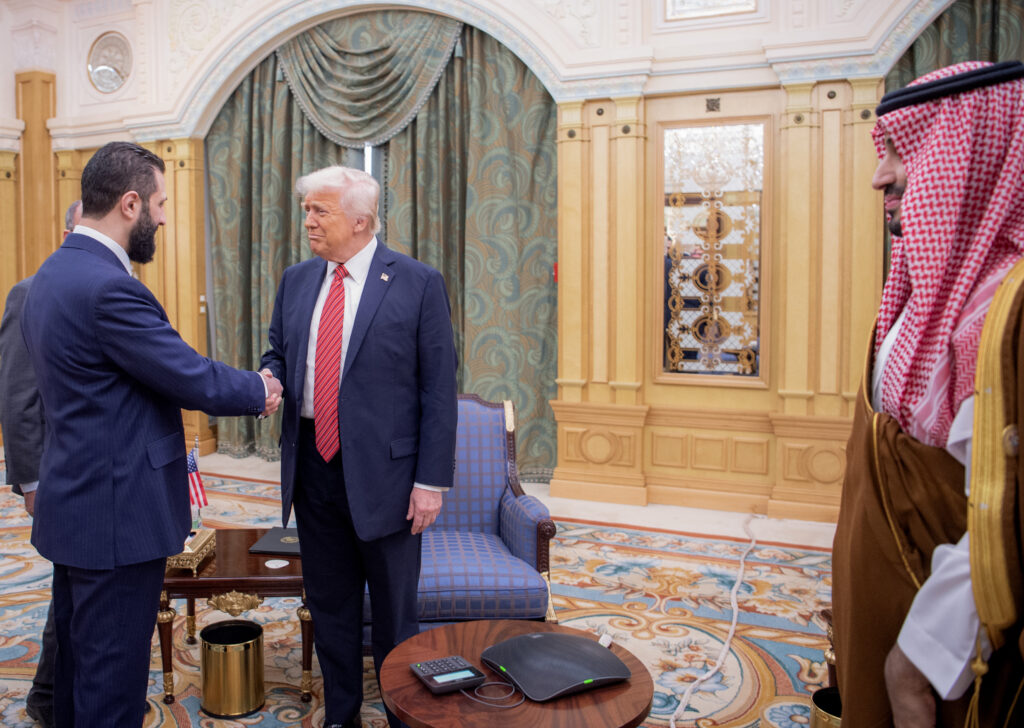
US President Donald Trump on Thursday closes a Middle East tour in the United Arab Emirates as he focuses squarely on seeking deals after billions of dollars of pledges from Saudi Arabia and Qatar.The first major trip of his second term had been scheduled to end Thursday but Trump, always ready with surprises, did not rule out continuing on to Turkey if Russian President Vladimir Putin shows up for talks with Ukraine.Trump will fly to the Emirati capital Abu Dhabi after a stop in Qatar, where the president hailed what he said was a record $200 billion deal for Boeing aircraft.He started the trip in Saudi Arabia which promised its own $600 billion in investment, including one of the largest-ever purchases of US weapons.The Gulf leaders’ largesse has also stirred controversy, with Qatar offering Trump a luxury aeroplane ahead of his visit for presidential and then personal use, in what Trump’s Democratic rivals charged was blatant corruption.Trump, who also chose Saudi Arabia for the opening visit of his first term, has been unabashed about seeking Gulf money and hailed the effect on creating jobs at home.In a speech in Riyadh, Trump attacked not only Democrats but also the traditional wing of his own Republican Party, which had championed US military intervention in Afghanistan and Iraq.Complimenting the skyline of the Saudi desert capital, Trump said: “The gleaming marvels of Riyadh and Abu Dhabi were not created by the so-called ‘nation-builders’, ‘neocons’ or ‘liberal non-profits’, like those who spent trillions failing to develop Kabul and Baghdad.””Instead, the birth of a modern Middle East has been brought about by the people of the region themselves,” he said.”In the end, the so-called ‘nation-builders’ wrecked far more nations than they built.”- Silent on rights -Trump steered clear of any hint of criticism of the Gulf monarchies on human rights.Trump’s predecessor Joe Biden had initially vowed to shun Saudi Arabia’s Crown Prince Mohammed bin Salman over US intelligence findings that he ordered the gruesome murder in 2018 of Jamal Khashoggi — a Saudi dissident writer who lived in the United States.Trump instead hailed the crown prince, who is Saudi Arabia’s de facto ruler, as a visionary due to the kingdom’s rapid economic investments.Trump also acceded to a key request by the crown prince in announcing a lifting of sanctions on Syria following the toppling of Bashar al-Assad in December.He met in Riyadh with Ahmed al-Sharaa, a former Islamist guerrilla once on the US wanted list who dressed in a suit and was complimented by Trump as a “young, attractive guy”.Trump was joined in the meeting by Prince Mohammed and, virtually, by Turkish President Recep Tayyip Erdogan, the key supporter of the former Syrian rebels.Trump said Wednesday he was willing to travel to Turkey if Putin accepts an offer by Ukrainian President Volodymyr Zelensky to meet on ending the war.Russia has given no indication that Putin will attend. Trump said that Secretary of State Marco Rubio would travel nonetheless to Istanbul for the potential talks.

Stocks drop as fresh trade news awaited, oil down on Iran hopes

Equities stuttered Thursday as investors await fresh developments in trade talks, with US partners looking to reach deals to avoid Donald Trump’s tariff blitz, while oil extended losses on hopes for an Iran nuclear deal.With excitement from the China-US detente running out of legs, the search is on for fresh catalysts to drive a rally that has pushed markets back above the levels seen before US President Trump’s April 2 “Liberation Day” bombshell.News that Beijing was suspending some non-tariff countermeasures on US entities for 90 days following the superpowers’ weekend truce did little to inject much more enthusiasm.With the tariffs crisis calmed for now, dealers can turn their attention to hard economic data, hoping for an idea about the initial impact of Washington’s trade policies.After figures Tuesday showing US inflation came in a little below forecasts in April, eyes are on wholesale prices and retail sales due later Thursday, as well as earnings from retail giant Walmart.However, analysts pointed out that the real impact would not be seen until May’s figures are released and warned that there were still plenty of bumps in the road ahead.”The trade truce may hold for now, but the tariffs announced — many still around 30 percent — are not disappearing,” said Charu Chanana, chief investment strategist at Saxo.”These are ‘sticky’ policies that can reshape supply chains, corporate margins, and even inflation. In fact, the market is now preparing for a second shock: weaker economic and earnings data in the third quarter as tariffs bite.”She added that “the muted market reaction the day after the truce suggests investors may be digesting the idea that ‘the best news may already be out'”.While Wall Street enjoyed a broadly positive day, with the S&P and Nasdaq up but the Dow down, Asia largely reversed.Tokyo, Hong Kong, Shanghai, Sydney, Seoul, Wellington, Taipei and Manila were all down.Oil prices sank around two percent on signs that Iran could agree to certain US demands to reach a nuclear deal.An adviser to supreme leader Ayatollah Ali Khamenei said Wednesday that Tehran could accept far-reaching curbs on its atomic programme in exchange for sanctions relief, according to NBC News.Ali Shamkhani said in an interview that his country could agree to never develop nuclear weapons, give up stockpiles of highly enriched uranium and allow inspectors to nuclear sites — among other steps — if economic sanctions were lifted, NBC said.The commodity had already dropped Wednesday on bets that demand would increase as tensions between China and the United States ease and the tariffs are wound back.- Key figures at around 0200 GMT -Tokyo – Nikkei 225: DOWN 1.2 percent at 37,670.38Hong Kong – Hang Seng Index: DOWN 0.5 percent at 23,518.02Shanghai – Composite: DOWN 0.2 percent at 3,397.09Euro/dollar: UP at $1.1198 from $1.1178 on WednesdayPound/dollar: UP at $1.3281 from $1.3268Dollar/yen: DOWN at 146.19 yen from 146.65 yenEuro/pound: UP at 84.31 pence from 84.21 penceWest Texas Intermediate: DOWN 2.0 percent at $61.88 per barrelBrent North Sea Crude: DOWN 1.9 percent at $64.89 per barrelNew York – Dow: DOWN 0.2 percent at 42,051.06 (close)London – FTSE 100: DOWN 0.2 percent at 8,585.01 (close)

Au procès de P. Diddy, Cassie s’apprête à vivre un contre-interrogatoire pénible

La chanteuse Cassie, qui a décrit durant deux jours les violences et sévices sexuels subis sous l’emprise de son ancien compagnon P. Diddy, s’apprête à vivre une nouvelle journée pénible jeudi où elle sera interrogée par les avocats de la défense.Casandra Ventura, de son vrai nom, est la pièce centrale de l’accusation au procès ultra médiatisé du rappeur et producteur de 55 ans, tombé de son piédestal depuis que les accusations de violences sexuelles se sont multipliées contre lui en 2023.La chanteuse américaine de R&B, 38 ans, a déjà longuement raconté mardi et mercredi comment, peu après le début de sa relation avec le rappeur, avec lequel elle est restée une dizaine d’années, elle a été contrainte de participer à des “freak-offs”: des marathons sexuels que P. Diddy, de son vrai nom Sean Combs, dirigeait et dont elle était le centre de l’attention mais aussi, selon elle, l’objet.Les avocats de la défense ont laissé entendre qu’ils allaient tenter d’appuyer sur le fait que la jeune femme prenait sciemment des drogues et avait un comportement erratique et parfois même violent.”Etre un participant consentant à votre propre vie sexuelle ne constitue pas du trafic sexuel”, a souligné en début de semaine Teny Geragos, avocate de P. Diddy, notamment poursuivi pour trafic sexuel et transport de personnes à des fins de prostitution.- “Flashbacks horribles” -Cassie a expliqué dans son témoignage que la prise de drogues lui permettait de se détacher, de se dissocier d’elle-même dans ces moments pénibles: “Cela me permettait d’être insensible, c’est pour ça que j’en consommais tant (…) c’était une sorte de fuite”.Le rappeur était en outre régulièrement violent avec elle, comme l’a notamment montré une vidéo accablante où on le voit se déchaîner contre elle dans un couloir d’hôtel en 2016.Le couple a définitivement rompu en 2018, une séparation ponctuée par un viol, selon la chanteuse. Celle-ci a affirmé avoir souffert de “flashbacks horribles” durant les années qui ont suivi.Mariée en 2019 avec Alex Fine, coach sportif et acteur, elle a raconté lui avoir confié, en 2023, avoir des idées suicidaires.”Je n’avais plus envie de vivre”, a-t-elle déclaré. “Je ne pouvais supporter la douleur que je ressentais.” Cela l’a incitée à entamer une thérapie et une cure de désintoxication.Cassie, qui a eu deux enfants avec Alex Fine, est enceinte d’un troisième.P. Diddy est accusé d’avoir profité de sa notoriété et de ses moyens financiers pour forcer des femmes à participer à de longues séances sexuelles avec des hommes prostitués, qu’il regardait, filmait, et dont il menaçait de diffuser les vidéos si les victimes parlaient.D’autres femmes sont attendues pour témoigner à ce procès au terme duquel Sean Combs, figure incontournable du hip-hop des trois dernières décennies, risque la prison à vie.L’équipe des avocats de P. Diddy, qui plaide non coupable, souligne que si certains de ses comportements étaient discutables, cela ne constituait pas du trafic d’êtres humains.Le témoignage de Cassie doit durer jusqu’à la fin de semaine, tandis que le procès se poursuivra jusqu’à cet été.