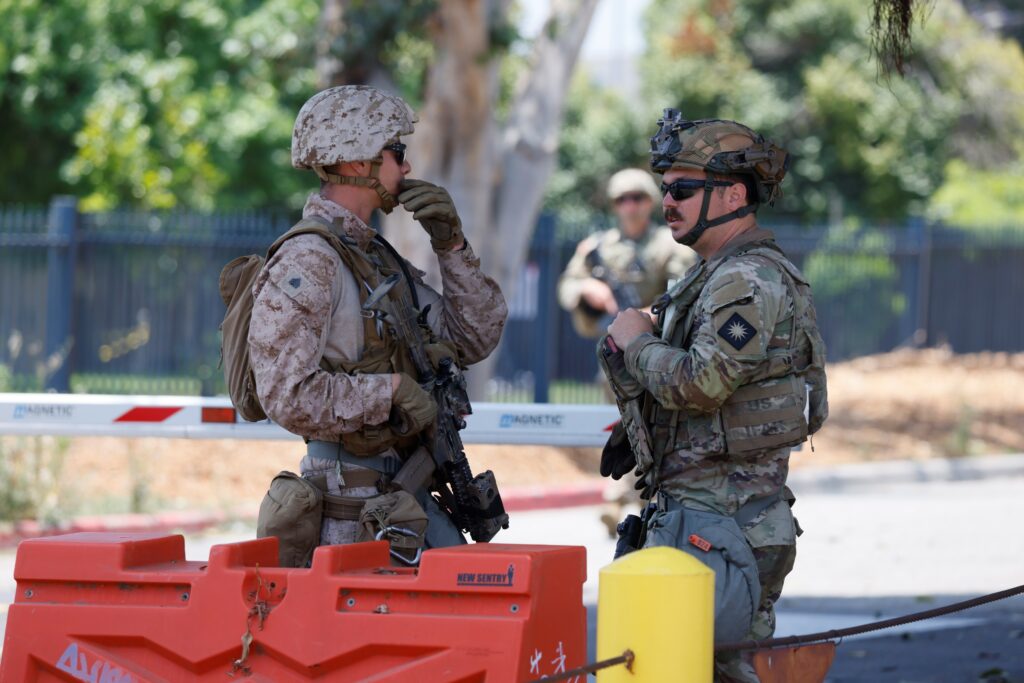
What will the US Marines do in Los Angeles?

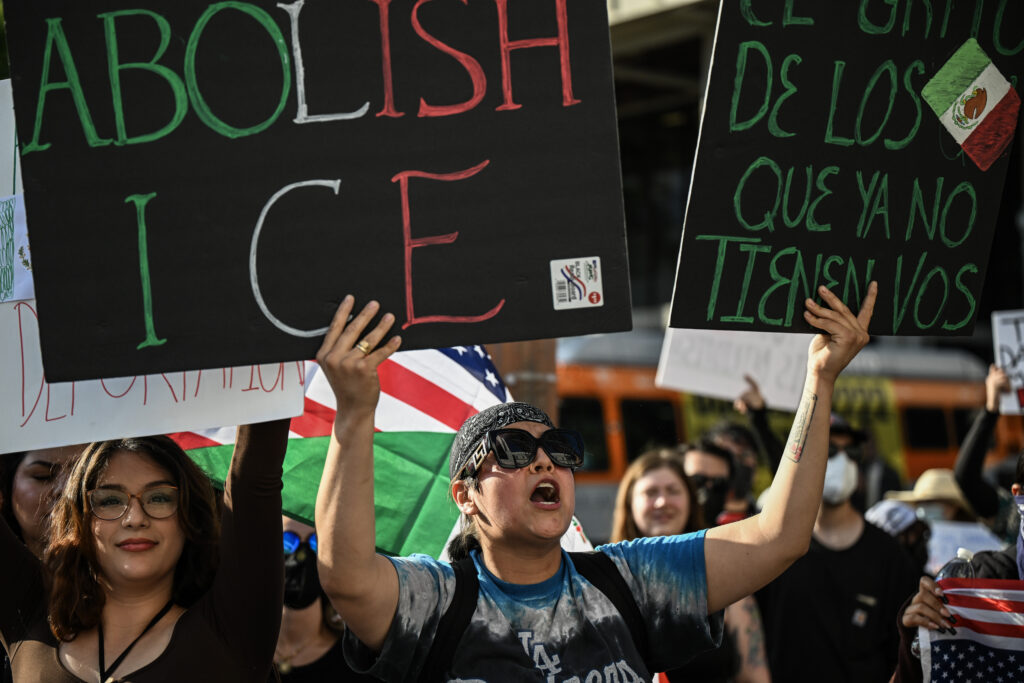
Roughly 200 US Marines took up position in Los Angeles on Friday to protect federal property and personnel after protests in the city against immigration raids. The deployment of the Marine Corps — typically deployed abroad as a rapid strike force — is highly unusual for domestic crowd-control scenarios inside the United States.- Why were they called? -Protests began last week after Immigration and Customs Enforcement (ICE) agents conducted raids in and around Los Angeles. The gatherings were mostly peaceful but there were also incidents of vandalism and aggression towards ICE agents and local police.Some demonstrators breached curfews as they rallied by the downtown Federal Building and the nearby Metropolitan Detention Center, a federal prison holding immigrants.President Donald Trump first took the controversial step of “federalizing” thousands of California National Guard troops — sending them to the area against the wishes of California Governor Gavin Newsom and Los Angeles Mayor Karen Bass.Shortly after, on Monday, the Trump administration announced that about 700 active-duty Marines would also be sent to Los Angeles.- What will they do? -US Northern Command (NORTHCOM), which has responsibility over US armed forces operating in North America, said the Marines will protect federal personnel and property.Major General Scott Sherman, who is leading the Los Angeles mission, said two companies of Marines were taking up position at the Wilshire Federal Building. Sherman said the Marines would “hold off crowds” as needed.Military members cannot arrest protesters as that is a law enforcement activity.But NORTHCOM said Marines could “temporarily detain an individual to stop an assault of, to prevent harm to, or to prevent interference with federal personnel performing their duties.”- Could they get more power? -The Posse Comitatus Act of 1878 prevents the use of US federal troops such as Marines for domestic law enforcement activities.But that would change if Trump invoked the Insurrection Act, which lets the president deploy federal troops to suppress a violent rebellion on US soil.It was last used during the Los Angeles riots in 1992 following the acquittal of police officers involved in the beating of motorist Rodney King.Under the Insurrection Act, federal troops have the power to conduct searches and arrest people suspected of breaking the law.Trump has notably not ruled out using the act.”If there’s an insurrection, I would certainly invoke it,” he said this week. “We’ll see.”
Les marchés financiers chahutés par l’escalade militaire au Moyen-Orient

Flambée des prix du pétrole, or qui se rapproche de son record, recul des actions, taux d’intérêt en hausse… Les marchés sont secoués vendredi par l’escalade militaire au Moyen-Orient, provoquée par les frappes aériennes d’Israël contre des infrastructures stratégiques en Iran et la riposte de Téhéran.Après avoir temporairement bondi de plus de 12% dans la nuit, le cours du baril de WTI nord-américain a gagné 7,26% à 72,98 dollars. Le baril de Brent de la mer du Nord a pris quant à lui 7,02% à 74,23 dollars.”Il y a des craintes quant au fait que le conflit ne s’aggrave et n’entraîne des perturbations dans l’approvisionnement en pétrole, étant donné qu’un tiers de l’approvisionnement mondial (…) provient du Moyen-Orient”, relèvent Carsten Fritsch et Barbara Lambrecht, de Commerzbank.Dans ce contexte, les valeurs refuges sont recherchées par les investisseurs. La première d’entre elles, l’or, grimpait ainsi vers 20H40 GMT de 1,43% à 3.434 dollars l’once (31,1 grammes). L’actif évoluait proche de son dernier record de 3.500 dollars l’once, atteint en avril dernier.Côté actions, les Bourses ont accusé le coup: à Wall Street, le Dow Jones a reculé de 1,79%, l’indice Nasdaq a perdu 1,30% et l’indice élargi S&P 500 a lâché 1,13%.Sur le Vieux Continent, Paris a reculé de 1,04%, Francfort 1,07% et Milan 1,28%. Londres a cédé 0,39%.Les investisseurs “réduisent leur exposition au risque, mais il ne s’agit pas d’une vente de panique”, estime auprès de l’AFP Steve Sosnick, d’Interactive Brokers.Reste que “lorsque ce type d’événement survient, il y a des craintes de stagflation sur les marchés, mélange de faible croissance et d’inflation provoquée par la hausse des prix des énergies fossiles”, relève Kevin Thozet, membre du comité d’investissement chez Carmignac, interrogé par l’AFP.Les rendements des emprunts d’État grimpaient, les investisseurs estimant que cette “stagflation” compromettrait de futures baisses des taux des grandes banques centrales, alors que la Réserve fédérale américaine (Fed) se réunit la semaine prochaine. Vers 20H40 GMT, le taux d’intérêt américain à dix ans atteignait ainsi 4,41%, contre 4,36% la veille en clôture. Son équivalent allemand, référence en Europe, atteignait 2,53%, contre 2,47%.Les investisseurs sont en partie dans “une approche attentiste vis-à-vis de ce qui se passera pendant le week-end parce que la situation est évidemment très instable”, d’autant que “les marchés actions ne sont pas vraiment efficaces pour évaluer le risque géopolitique”, estime Steve Sosnick.Le dollar s’est quelque peu repris face à l’euro, après les frappes d’Israël contre l’Iran.La devise souffre depuis plusieurs mois en raison du désamour des investisseurs envers les actifs américains à cause des menaces protectionnistes de Donald Trump.Vers 20H45 GMT, le billet vert prenait 0,31%, à 1,1548 dollar pour un euro.La devise américaine est “soutenue par une préférence pour des devises plus sûres, malgré des inquiétudes persistantes quant à sa stabilité à long terme”, constate Patrick Munnelly, analyste chez Tickmill.La monnaie unique européenne souffre du fait que “les Européens sont davantage exposés à une hausse des prix du pétrole, car ils importent la quasi-totalité de leurs hydrocarbures”, explique Kevin Thozet.L’aérien reculeDe nombreuses compagnies ont supprimé ou dérouté des dizaines de vols vendredi après les frappes israéliennes. Israël, l’Iran, mais aussi l’Irak et la Jordanie ont fermé leur espace aérien, provoquant l’annulation de nombreux vols vers et depuis le Moyen-Orient, ou survolant la région.Les groupes du secteur dévissaient donc en Bourse, à l’image de United Airlines (-4,43%), American Airlines (-4,86%) et Delta (-3,76%) à Wall Street. En Europe, Air France-KLM a perdu 4,74%, Lufthansa 2,74% et Easyjet 2,65%.

Trump tells Iran to make deal or face ‘more brutal’ attacks

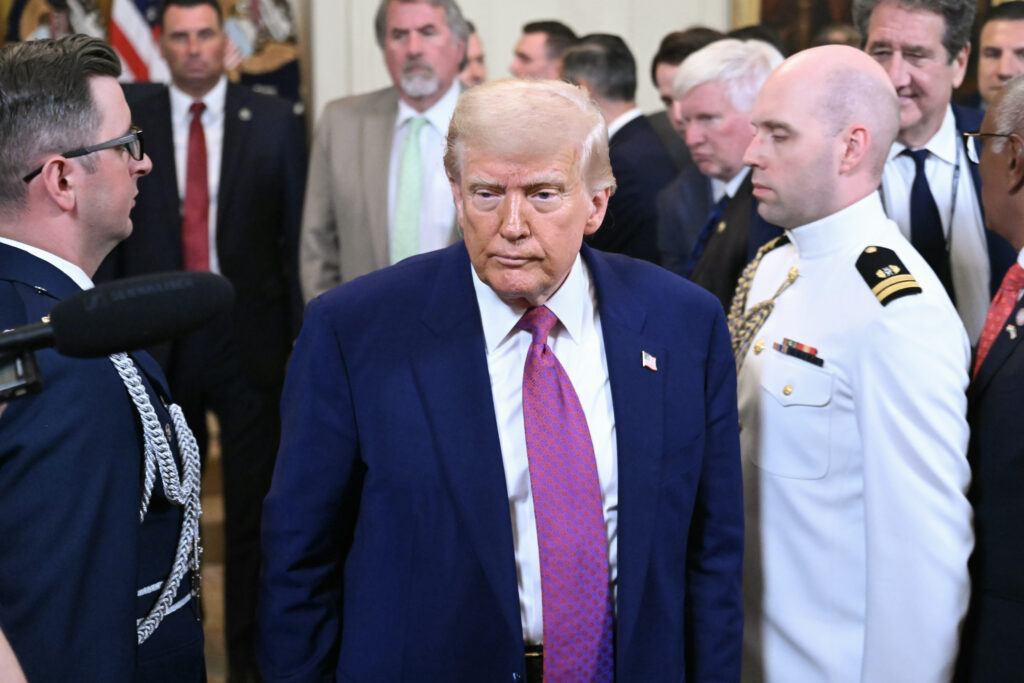
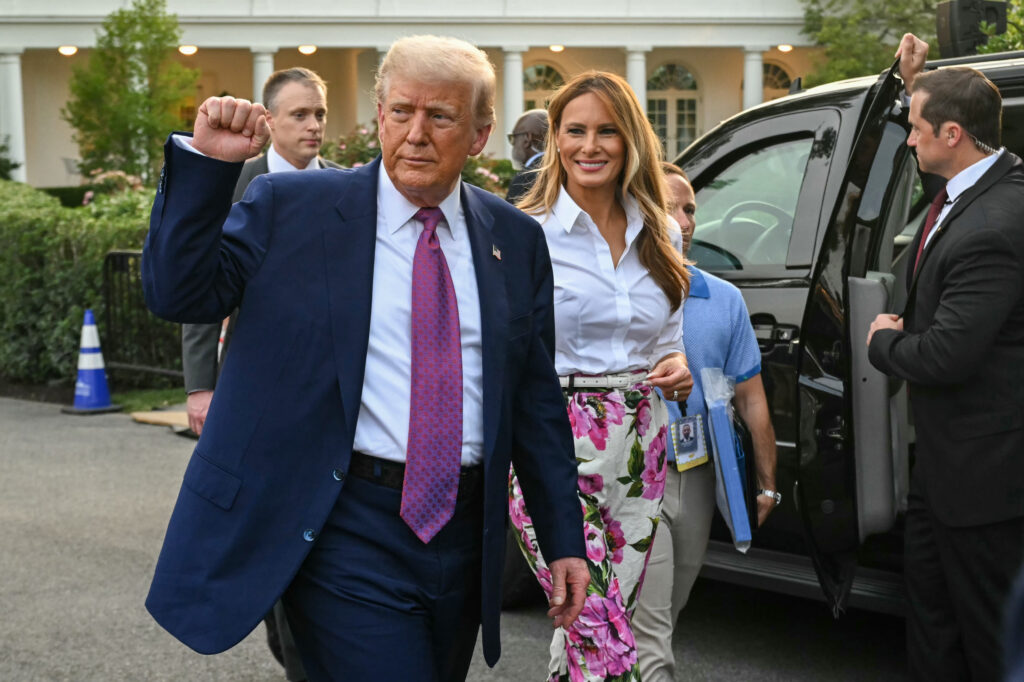
US President Donald Trump urged Iran Friday to make a deal or face “even more brutal” attacks by Israel, as Washington said it was helping its key ally defend itself against Iranian retaliation.But Trump also kept the door open for negotiations on Tehran’s nuclear program, as the president who boasted he had “no wars” in his first term tries to avoid getting dragged into one in his second.Trump and Israeli Prime Minister Benjamin Netanyahu spoke on Friday, a White House official told AFP. He said earlier that Israel had let him know in advance about its strikes on Iran’s military top brass and nuclear facilities.After Iran launched barrages of ballistic missiles on Friday, the United States was “assisting in shooting down missiles targeting Israel,” two US officials told AFP, without giving detail on the extent of Washington’s role.The US president also spoke to French President Emmanuel Macron and British Prime Minister Keir Starmer, who both stressed the need for dialogue. He also reportedly spoke to Saudi and Qatari leaders.Trump attended a National Security Council meeting in the White House Situation Room as his team worked on the crisis. An aide posted a black and white picture of a grim-faced, purse-lipped Trump striding through the West Wing.But the flurry of meetings and diplomatic calls came as Trump trod a tightrope between backing Israel and seeking the nuclear deal he promised he could reach with Iran.Israel struck Iran just hours after Trump publicly urged Netanyahu to hold off on an attack, with the first missiles landing as the US president hosted a picnic for lawmakers on the White House South Lawn.”There has already been great death and destruction, but there is still time to make this slaughter, with the next already planned attacks being even more brutal, come to an end,” Trump said on his Truth Social platform on Friday. – ‘Excellent’ -“Iran must make a deal, before there is nothing left… JUST DO IT, BEFORE IT IS TOO LATE,” he said. Trump said that he “gave Iran chance after chance to make a deal.” But in a series of calls with US media later, he wavered between backing Israel’s “excellent” strikes and calling for a return to the negotiating table.”I think it’s been excellent,” ABC News quoted him as saying about Israel’s offensive. “And there’s more to come. A lot more.”Then shortly afterwards he stressed the possibility of a second chance, in an interview with NBC: “They missed the opportunity to make a deal. Now, they may have another opportunity. We’ll see.”Trump also gave mixed signals about the extent of US involvement.Secretary of State Marco Rubio had said Thursday that the United States was “not involved” in the strikes and warned Iran not to retaliate against any US forces in the region.Trump, however, said on Truth Social on Friday that Israel had acted because a 60-day deadline that he had set for Iran had run out, implying that the two acted in concert.He also boasted about the “finest” US equipment that Israel had used — a day before a huge parade in Washington, on Trump’s 79th birthday, featuring US aircraft and tanks.Trump earlier told Fox News he had been aware of the Israeli strikes before they happened, and stressed that Tehran “cannot have a nuclear bomb.”During Trump’s first term, he pulled the United States out of a landmark agreement to relieve sanctions on Iran in return for curbs on its nuclear program.The United States and Iran have had several rounds of talks since Trump returned to the White House, but after initially striking an optimistic tone, the discussions have foundered in recent days.

Kanye West shows up to support Combs at sex trafficking trial

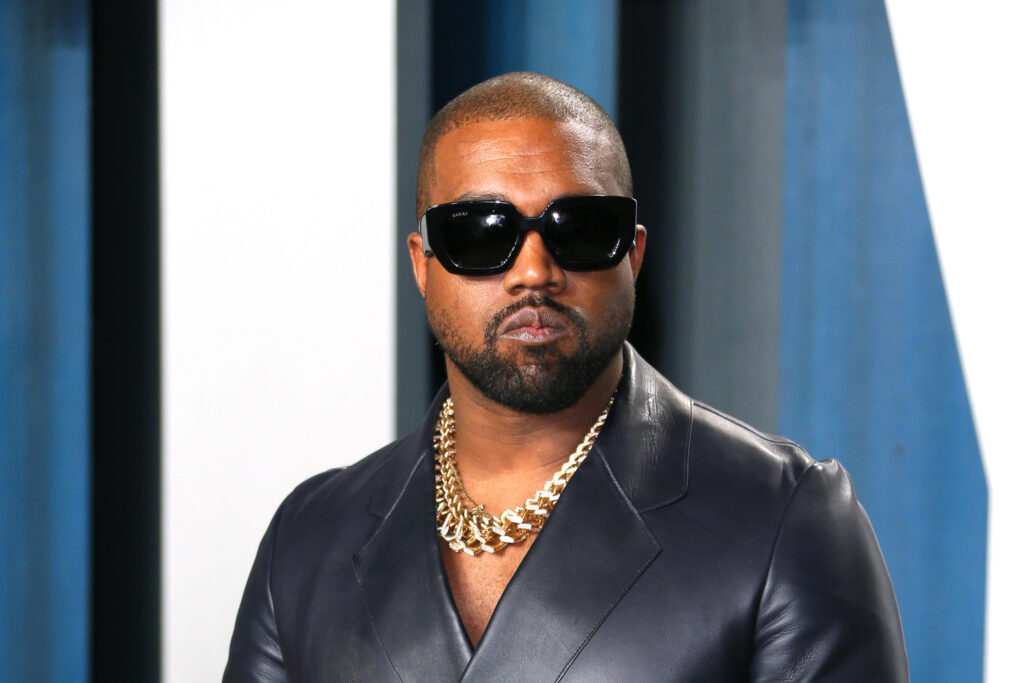
US rapper Kanye West showed up at a Manhattan federal courthouse Friday to support music mogul Sean Combs, who is on trial for alleged sex trafficking and racketeering.West, who has legally changed his name to Ye, never entered the courtroom; he briefly watched the proceedings in an adjacent room on closed-circuit video with one of Combs’s sons and then left.When asked by broadcaster ABC whether he was there to support Combs, the 48-year-old West nodded and replied: “Yes.”His brief appearance came one day after a former girlfriend of Combs wrapped up her testimony.The woman, speaking under the pseudonym Jane, delivered emotional, graphic details about how he allegedly pressured her into drug-fueled sex sessions with escorts.Her description closely tracked with the testimony of a previous star witness, Combs’s longtime girlfriend Casandra Ventura, who said the encounters were called “freak-offs.”In her testimony, Jane described traveling to Las Vegas last year on a well-known rapper’s private plane, and that she had recommended a male escort to that rapper and his girlfriend.For nearly a month, jurors in the Manhattan court have heard a series of witnesses describing the influence the 55-year-old Combs exerted over staff and ex-girlfriends. Combs faces life in prison if convicted of racketeering and sex trafficking.The music mogul has pled not guilty to the charges against him, with his lawyers arguing that what prosecutors deem to be sex trafficking was in fact consensual.The trial is expected to continue at least through June.

Israel attack on Iran tests Trump promise not to be dragged into war

For President Donald Trump, few goals on the world stage have been more explicit — he will not drag the United States into another “forever war.”Yet Israel’s massive strikes on Iran will test that promise as never before, potentially setting up a showdown with his base as Trump decides how much support the United States will offer.Trump had publicly called for Israel not to strike as he sought a negotiated solution, and his roving envoy Steve Witkoff had been scheduled to meet Iranian officials for the sixth time Sunday.Trump, who hours earlier warned that an attack would cause “massive conflict,” afterward praised Israeli strikes as “excellent.” He boasted that Israel had “the best and most lethal military equipment anywhere in the world” thanks to the United States — and was planning more strikes unless Iran agrees on a deal.Secretary of State Marco Rubio insisted that the United States was not involved in the strikes and warned Iran not to retaliate against the thousands of US troops stationed in nearby Arab countries.A US official, however, confirmed that the United States was helping Israel shoot down retaliatory missiles fired Friday by Iran.”The US has calculated that it can help Israel and that the Iranians will obviously be aware of this, but at the end of the day, at least at the public level, the US stays out,” said Alex Vatanka, founding director of the Iran program at the Middle East Institute in Washington.The hope is that “the Iranians will do a quick cost/benefit analysis and decide it is not worth the fight,” Vatanka said.He said Iranian leaders are for now focused on staying alive, but could decide either to swallow a tough deal — or to internationalize the conflict further by causing chaos in the oil-rich Gulf, potentially sending oil prices soaring and pressuring Trump.- ‘America First’ impulse -Most key lawmakers of Trump’s Republican Party quickly rallied behind Israel, whose prime minister, Benjamin Netanyahu, is a hero for many on the US right and has long called Iran an existential threat.But Trump’s populist “America First” base has been skeptical. Tucker Carlson, the prominent media commentator who counseled Trump against a US strike on Iran in the first term, has called fears of Tehran building a nuclear bomb overblown, saying neither Iran nor Ukraine warrants US military resources.Carlson wrote on X after the Israeli strike that there was a divide in Trump’s orbit between “those who casually encourage violence, and those who seek to prevent it — between warmongers and peacemakers.”Trump has brought outspoken non-interventionists directly into his administration.In an unusually political video this week, Trump’s director of national intelligence, Tulsi Gabbard, warned after a visit to Hiroshima that “warmongers” were putting the world at risk of nuclear catastrophe.In a speech in Riyadh last month, Trump denounced decades of US interventionism in the Middle East and said, “My greatest hope is to be a peacemaker and to be a unifier. I don’t like war.”- How far to back Israel? -Daniel Shapiro, who served as US ambassador to Israel under former president Barack Obama, said it had been certain the United States would back Israel’s defense against Iranian retaliation.But Trump will face a harder decision on “whether to use the United States’ unique capabilities to destroy Tehran’s underground nuclear facilities and prevent an Iranian nuclear weapon,” said Shapiro, now at the Atlantic Council.”The decision will split his advisers and political base, amid accusations, and perhaps his own misgivings, that Netanyahu is attempting to drag him into war.”Lawmakers of the rival Democratic Party widely revile Netanyahu, including over Israel’s bloody offensive in Gaza.”This attack by Netanyahu is pure sabotage,” said Democratic Representative Joaquin Castro.”What does ‘America First’ even mean if Trump allows Netanyahu to drag the country into a war Americans don’t want?” he wrote on social media.Sina Toossi, a senior fellow at the progressive Center for International Policy, said that China — identified by Trump as the top threat — could seize the moment, perhaps by moving on Taiwan, as it sees the United States as even more distracted.”Even without direct involvement, Washington now faces the prospect of indefinite resupply, intelligence and diplomatic backing for Israel, just as the war in Ukraine intensifies and global crises multiply,” Toossi said.”Wars are easy to ignite, but once unleashed, they tend to spiral beyond control, and rarely end on the terms of those who start them.”

Sarthe: quatre morts dans un accident de car, les deux chauffeurs ukrainiens en garde à vue

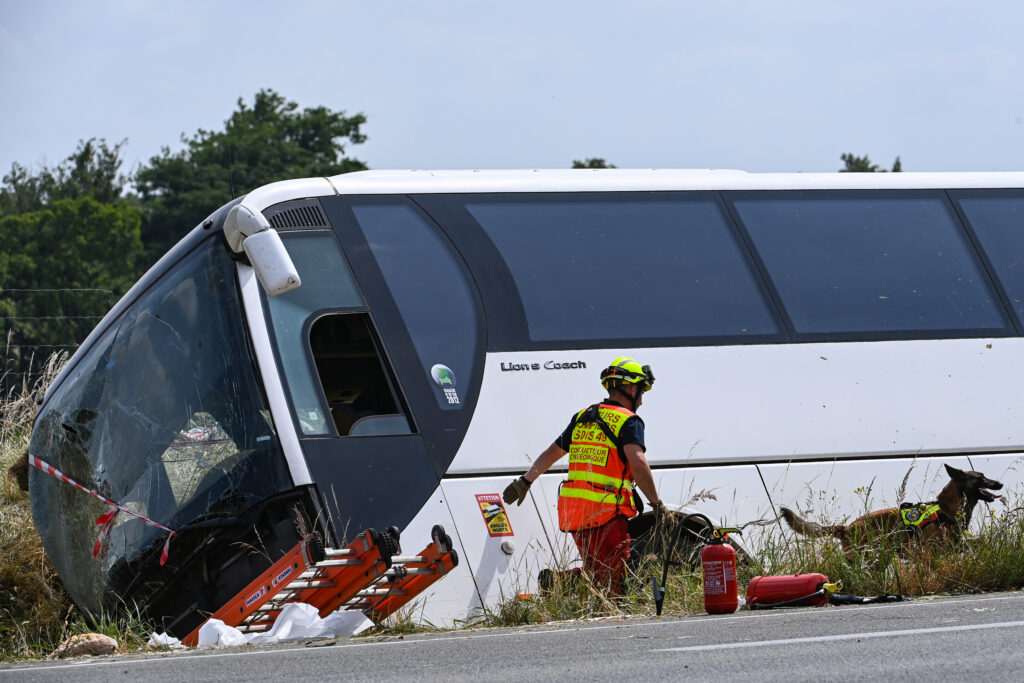
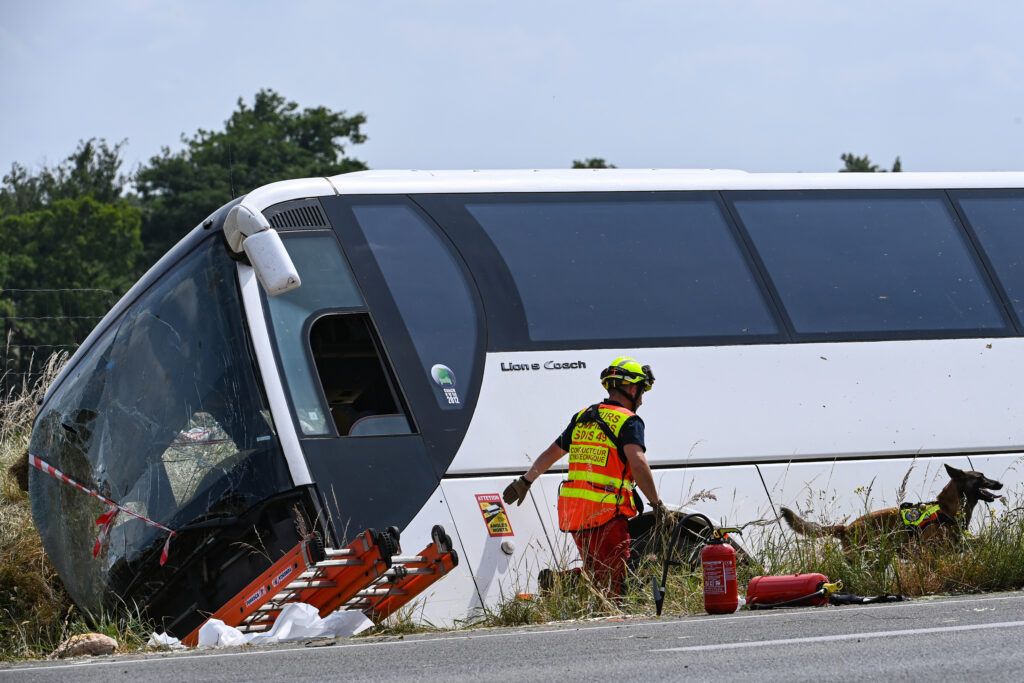
Les deux chauffeurs de l’autocar ukrainien qui s’est renversé vendredi dans un fossé sur l’autoroute A81 dans la Sarthe, faisant quatre morts, ont été placés en garde à vue pour “homicides et blessures involontaires”, a annoncé le parquet du Mans.L’accident de ce car, qui transportait “58 collégiens et lycéens” ukrainiens ainsi que leurs encadrants, a eu lieu “en fin de matinée” au point kilométrique 179 dans le sens Rennes-Le Mans de cette autoroute traversant la Sarthe, a indiqué la procureure de la République du Mans, Carine Halley.Outre les quatre personnes décédées, “sept victimes en urgence absolue et 21 victimes en urgence relative ont été évacuées dans les différents hôpitaux de la région”, selon la magistrate.”Les deux chauffeurs du car, de nationalité ukrainienne, ont été placés en garde à vue dans le cadre d’une enquête de flagrance des chefs d’homicides et blessures involontaires par conducteur d’un véhicule terrestre à moteur”, a ajouté Mme Halley.”Les quatre personnes décédées sont majeures”, a précisé le préfet de la Sarthe, Emmanuel Aubry lors d’un point presse à Degré, commune proche des lieux de l’accident et point névralgique de l’organisation des secours d’urgence et du Centre opérationnel départemental (COD).Selon le président ukrainien Volodymyr Zelensky, parmi les personnes décédées trois sont des “citoyens ukrainiens”. “Deux autres personnes sont dans un état critique”, a-t-il déclaré sur X, qualifiant cet accident d'”horrible nouvelle”.”Je suis reconnaissant aux autorités françaises pour la mobilisation massive des services de secours”, a-t-il dit, adressant ses “condoléances à toutes les familles des victimes”.- Echange scolaire -Les adolescents à bord du bus sont âgés de 15 à 17 ans et venaient de rencontrer des élèves du lycée agricole La Touche de Ploërmel (Morbihan), a indiqué à l’AFP l’ambassade de l’Ukraine en France.L’autocar avait quitté en matinée Ploërmel pour rentrer à Kitsman, dans l’ouest de l’Ukraine, d’où sont originaires ces adolescents, a-t-elle précisé.”Nous sommes en contact avec les familles des victimes. Des enfants ont réussi à joindre leurs parents”, a-t-elle ajouté.Sur le compte Instagram du lycée ukrainien où étaient scolarisés les victimes, des photos les montrent en train de découvrir la presqu’île de Rhuys (Morbihan), Paris, mais aussi dans l’autocar, souriants et insouciants.- Une messe aux 24 Heures -Selon la préfecture de la Sarthe, 125 sapeurs-pompiers dont certains venus en renforts des départements voisins ont été mobilisés, ainsi que 52 militaires de la gendarmerie et 24 secouristes.Une cinquantaine d’engins des Services départementaux d’incendie et de secours (SDIS) et deux hélicoptères sont intervenus. Les corps des quatre personnes décédées ont été transportés à l’Institut médico-légal d’Angers, a affirmé à l’AFP une source au sein de la gendarmerie.Une messe sera célébrée à leur intention, en même temps qu’aux victimes de l’accident survenu en 1955 pendant la course des 24 Heures du Mans, a annoncé l’évêque du Mans Mgr Vuillemin dans un communiqué.Les personnes blessées “légèrement ou impliquées” dans l’accident sont prises en charge dans la salle communale de Degré.”Il y a de l’eau, des brioches, des fruits” pour les “29 personnes à l’intérieur” de cette salle, a déclaré la première adjointe au maire de Degré, Céline Bouteloup. “On pense aux familles, à l’annonce qui va être faite”.Vers 18H00, des adolescents sont sortis de cette salle pour être auditionnés par les enquêteurs par groupes de cinq à six, a précisé la source au sein de la gendarmerie.La circulation, interrompue dans les deux sens sur l’A81 au niveau de l’accident, a repris dans les deux sens sur l’autoroute, a annoncé la préfecture à 20H30. 

Sarthe: quatre morts dans un accident de car, les deux chauffeurs ukrainiens en garde à vue

Les deux chauffeurs de l’autocar ukrainien qui s’est renversé vendredi dans un fossé sur l’autoroute A81 dans la Sarthe, faisant quatre morts, ont été placés en garde à vue pour “homicides et blessures involontaires”, a annoncé le parquet du Mans.L’accident de ce car, qui transportait “58 collégiens et lycéens” ukrainiens ainsi que leurs encadrants, a eu lieu “en fin de matinée” au point kilométrique 179 dans le sens Rennes-Le Mans de cette autoroute traversant la Sarthe, a indiqué la procureure de la République du Mans, Carine Halley.Outre les quatre personnes décédées, “sept victimes en urgence absolue et 21 victimes en urgence relative ont été évacuées dans les différents hôpitaux de la région”, selon la magistrate.”Les deux chauffeurs du car, de nationalité ukrainienne, ont été placés en garde à vue dans le cadre d’une enquête de flagrance des chefs d’homicides et blessures involontaires par conducteur d’un véhicule terrestre à moteur”, a ajouté Mme Halley.”Les quatre personnes décédées sont majeures”, a précisé le préfet de la Sarthe, Emmanuel Aubry lors d’un point presse à Degré, commune proche des lieux de l’accident et point névralgique de l’organisation des secours d’urgence et du Centre opérationnel départemental (COD).Selon le président ukrainien Volodymyr Zelensky, parmi les personnes décédées trois sont des “citoyens ukrainiens”. “Deux autres personnes sont dans un état critique”, a-t-il déclaré sur X, qualifiant cet accident d'”horrible nouvelle”.”Je suis reconnaissant aux autorités françaises pour la mobilisation massive des services de secours”, a-t-il dit, adressant ses “condoléances à toutes les familles des victimes”.- Echange scolaire -Les adolescents à bord du bus sont âgés de 15 à 17 ans et venaient de rencontrer des élèves du lycée agricole La Touche de Ploërmel (Morbihan), a indiqué à l’AFP l’ambassade de l’Ukraine en France.L’autocar avait quitté en matinée Ploërmel pour rentrer à Kitsman, dans l’ouest de l’Ukraine, d’où sont originaires ces adolescents, a-t-elle précisé.”Nous sommes en contact avec les familles des victimes. Des enfants ont réussi à joindre leurs parents”, a-t-elle ajouté.Sur le compte Instagram du lycée ukrainien où étaient scolarisés les victimes, des photos les montrent en train de découvrir la presqu’île de Rhuys (Morbihan), Paris, mais aussi dans l’autocar, souriants et insouciants.- Une messe aux 24 Heures -Selon la préfecture de la Sarthe, 125 sapeurs-pompiers dont certains venus en renforts des départements voisins ont été mobilisés, ainsi que 52 militaires de la gendarmerie et 24 secouristes.Une cinquantaine d’engins des Services départementaux d’incendie et de secours (SDIS) et deux hélicoptères sont intervenus. Les corps des quatre personnes décédées ont été transportés à l’Institut médico-légal d’Angers, a affirmé à l’AFP une source au sein de la gendarmerie.Une messe sera célébrée à leur intention, en même temps qu’aux victimes de l’accident survenu en 1955 pendant la course des 24 Heures du Mans, a annoncé l’évêque du Mans Mgr Vuillemin dans un communiqué.Les personnes blessées “légèrement ou impliquées” dans l’accident sont prises en charge dans la salle communale de Degré.”Il y a de l’eau, des brioches, des fruits” pour les “29 personnes à l’intérieur” de cette salle, a déclaré la première adjointe au maire de Degré, Céline Bouteloup. “On pense aux familles, à l’annonce qui va être faite”.Vers 18H00, des adolescents sont sortis de cette salle pour être auditionnés par les enquêteurs par groupes de cinq à six, a précisé la source au sein de la gendarmerie.La circulation, interrompue dans les deux sens sur l’A81 au niveau de l’accident, a repris dans les deux sens sur l’autoroute, a annoncé la préfecture à 20H30. 

US adversaries fuel disinformation about LA protests

Russia, China and Iran are amplifying disinformation about protests over immigration raids in Los Angeles, researchers said Friday, adding to a surge of domestically generated falsehoods and conspiracy theories.The findings from researchers at the disinformation watchdog NewsGuard illustrate how foreign adversaries of the United States are exploiting deep divisions in American society as a tactic of information warfare.NewsGuard said Russian, Chinese, and Iranian state-affiliated sources have published around 10,000 posts and articles about the demonstrations that recently erupted in Los Angeles, advancing false claims framing the city as “ground zero in an American apocalypse.”Seizing on the political rift between President Donald Trump and Governor Gavin Newsom, pro-China accounts on X and Chinese platforms such as Douyin and Weibo have peddled unfounded claims that California was ready to secede from the United States and declare independence.Meanwhile, Tehran-based newspapers have peddled the false claim that popular Iranian singer-songwriter Andranik Madadian had been detained by the National Guard in Los Angeles, in an apparent effort to portray the United States as an authoritarian state.NewsGuard quoted Madadian, better known by his stage name Andy, as denying the claim, stating: “I am fine. Please don’t believe these rumors.” Russian media and pro-Russian influencers, meanwhile, has embraced right-wing conspiracy theories, including the unfounded claim that the Mexican government was stoking the demonstrations against Trump’s immigration policies.”The demonstrations are unfolding at the intersection of multiple vulnerabilities such as eroded trust in institutions, AI chatbots amplifying false claims about the unrest, political polarization, and a rollback of safety and moderation efforts by major platforms,” McKenzie Sadeghi, a researcher with NewsGuard, told AFP.”As a result, foreign actors have a wide-open playing field to flood the zone with falsehoods at a faster rate and fewer barriers compared to previous moments of unrest,” she added.The apparent alignment across the three countries was noteworthy, Sadeghi said.”While Russia, China, and Iran regularly push their own unique forms of disinformation, it’s less common to see them move in such a coordinated fashion like this,” she said.”This time, state media outlets have escalated their messaging to advance their geopolitical interests and deflect attention from their own domestic crises.” The disinformation comes on top of false narratives promoted by US-based influencers.In recent days, conservative social media users have circulated two photographs of brick piles they claimed were strategically placed for the California protesters to hurl at police and inflame violence.The photos were cited as proof that the protests were fueled by nonprofit organizations supported by George Soros, the billionaire philanthropist who has long been a bogeyman for the far right.But AFP’s fact-checkers found that one photo was lifted from an online marketplace, where a Malaysian hardware dealer uploaded it years ago, while the other was snapped near a construction site in New Jersey.”Every time there’s a popular protest, the old clickbaity ‘pallets of bricks’ hoax shows up right on cue,” the Social Media Lab, a research center at the Toronto Metropolitan University, wrote on the platform Bluesky.”The fact that these types of fake images are used isn’t a coincidence. It’s part of a pernicious (and) persistent narrative that protests against government policies are somehow inauthentic.”

Oil prices soar, stocks slide after Israel strikes Iran

Oil prices soared and stocks sank Friday after Israel launched strikes on Iran, prompting retaliation from Tehran and stoking fears of a full-blown war.Oil futures rocketed more than 13 percent at one point before coming back to gains nearer seven percent, reigniting worries about a renewed spike to inflation.After a down day in Europe and Asia, Wall Street indices spent the entire day in the red before finishing the day down more than one percent.”After having a pretty solid run in May and the first part of June, markets found an excuse to take some profits,” said Art Hogan, chief market strategist of B. Riley Wealth.Shares in major airlines tumbled after flights around the Middle East were suspended.The dollar climbed higher, while gold — viewed as a safe haven investment — was close to its record high of above $3,500 an ounce set in April, having added around 30 percent since the start of the year.The drop in equities and rise in safe-haven assets “all go to show just how fragile sentiment remains in the face of major geopolitical events,” said David Morrison, senior market analyst at financial services provider Trade Nation. “The question now is whether investors view this flare-up as a relatively contained incident within the longstanding animosity between Israel and Iran, or if this is the spark that ignites a conflagration across the Middle East and then beyond?”On Friday, Iran fired a barrage of ballistic missiles at Israel in a counter-strike just hours after the Israeli strikes targeting the Islamic republic’s nuclear facilities and bases.Air raid sirens and explosions rang out across Israel after Prime Minister Benjamin Netanyahu took to the airways to issue a word of caution, saying he expected “several waves of Iranian attacks” in response.Smoke could later be seen billowing above the skyscrapers in downtown Tel Aviv, according to an AFP journalist, as Iran’s Revolutionary Guards said they had attacked dozens of targets in Israel.While Friday was a decisively negative day for equities, analysts described the selling as orderly.Investors “are paring back some risk, but this is hardly a panicky sell-off,” said Steve Sosnick of Interactive Brokers.The market is partially in “a wait and see approach to what happens over the weekend because it’s obviously a very fluid volatile situation,” Sosnick added.But further escalation would add more upward pressure to oil prices.Matthew Ryan, head of market strategy at global financial services firm Ebury, said: “The big fear for investors is that an escalation to the tensions will not only raise the risk of a prolonged conflict, but it could disrupt Iranian oil production.”Rising oil prices have “broader implications,” Ryan said, noting that they “could both weigh on the global growth outlook and keep inflationary pressures higher for longer.”This would complicate the decision-making of major central banks, which will have to decide between raising interest rates to curb inflation or cutting them to stimulate economies.- Key figures at around 2040 GMT -Brent North Sea Crude: UP 7.0 percent at $74.23 per barrelWest Texas Intermediate: UP 7.3 percent at $72.98 per barrelNew York – Dow:  DOWN 1.8 percent at 42,197.79 (close)New York – S&P 500: DOWN 1.1 percent at 5,976.97 (close)New York – Nasdaq Composite: DOWN 1.3 percent at 19,406.83 (close)London – FTSE 100: DOWN 0.4 percent at 8,850.63 (close)Paris – CAC 40: DOWN 1.0 percent at 7,684.68 (close)Frankfurt – DAX: DOWN 1.1 percent at 23,516.23 (close)Tokyo – Nikkei 225: DOWN 0.9 percent at 37,834.25 (close)Hong Kong – Hang Seng Index: DOWN 0.6 percent at 23,892.56 (close)Shanghai – Composite: DOWN 0.8 percent at 3,377.00 (close)Euro/dollar: DOWN at $1.1540 from $1.1584 on ThursdayPound/dollar: DOWN at $1.3560 from $1.3613Dollar/yen: UP at 144.04 yen from 143.48 yenEuro/pound: UP at 85.11 pence from 85.09 penceburs-jmb/sst