


Tremblement de terre de magnitude 6,5 en Colombie, fortement ressenti à Bogota
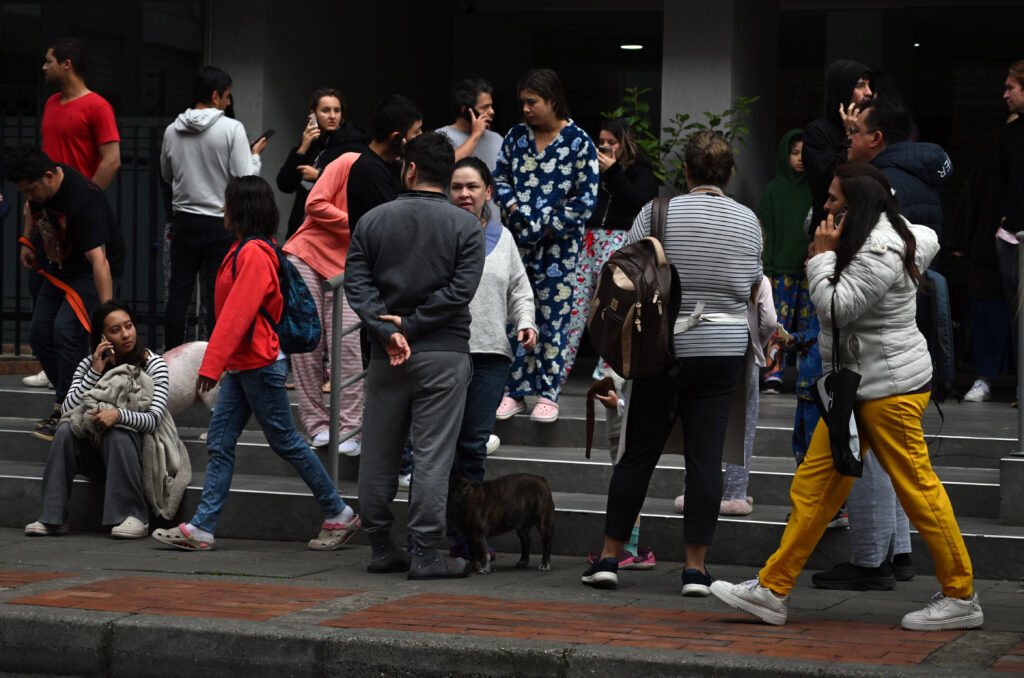
Les bâtiments ont tremblé, les sirènes ont retenti et les Colombiens paniqués se sont précipités dans les rues dimanche quand un séisme de magnitude 6,5 a secoué le centre du pays.Le tremblement de terre s’est produit à 08H08 (13H08 GMT), à environ 170 kilomètres à l’est de la capitale Bogota, et a été ressenti dans une grande partie du pays.Dans la ville de Paratebueno, non loin de l’épicentre, les journalistes de l’AFP ont vu plusieurs bâtiments partiellement effondrés. Le mur d’une église était notamment gravement endommagé.Les habitants des environs fouillaient les décombres de plusieurs structures au toit de zinc qui s’étaient effondrées.Aucun blessé grave n’a été signalé, mais les autorités enquêtaient sur des dégâts dans plusieurs autres villages.Il s’agit de l’un des tremblements de terre les plus forts ressentis ces dernières années dans la capitale colombienne, où il a suscité un vent de panique. La magnitude de ce tremblement de terre, également ressenti à Medellin et Cali (centre), a été évaluée à 6,3 par l’Institut américain de géophysique USGS.Les sirènes ont retenti dans les quartiers d’habitation de la capitale, dont les habitants se sont précipités dans les rues et les parcs, parfois encore en pyjama.”Ça nous a fait très peur”, a témoigné Carlos Alberto Ruiz, un homme de 54 ans sorti de son appartement avec sa femme, son fils et son chien. Le séisme a été “très fort”, a raconté à l’AFP à Bogota une dame âgée qui essayait de descendre un escalier. Les parents ont tenté de calmer leurs enfants terrifiés, les couples se sont enlacés et d’autres ont cherché leurs animaux domestiques qui s’étaient enfuis.Beaucoup avaient peur de rentrer chez eux, car plusieurs répliques ont été ressenties.”Ça a été très effrayant”, a déclaré Carlos Alberto Ruiz, 54 ans, qui a quitté son appartement avec sa femme, son fils et son chien.”Cela faisait longtemps que nous n’avions pas ressenti une secousse aussi forte ici à Bogota”, a déclaré Francisco Gonzalez, un avocat qui a également fui son domicile.Le maire de la capitale, Carlos Fernando Galán, a assuré que tous les organismes de gestion des catastrophes étaient en alerte. Des tremblements de terre se produisent à intervalles très réguliers en Colombie mais le plus souvent à une grande profondeur et sans provoquer de dégâts majeurs.Traversé par la cordillère des Andes, comptant une vingtaine de volcans (dont trois en activité), ce pays est situé à la croisée de la ceinture de feu du Pacifique et de la ceinture volcanique andine.
Tremblement de terre de magnitude 6,5 en Colombie, fortement ressenti à Bogota
Les bâtiments ont tremblé, les sirènes ont retenti et les Colombiens paniqués se sont précipités dans les rues dimanche quand un séisme de magnitude 6,5 a secoué le centre du pays.Le tremblement de terre s’est produit à 08H08 (13H08 GMT), à environ 170 kilomètres à l’est de la capitale Bogota, et a été ressenti dans une grande partie du pays.Dans la ville de Paratebueno, non loin de l’épicentre, les journalistes de l’AFP ont vu plusieurs bâtiments partiellement effondrés. Le mur d’une église était notamment gravement endommagé.Les habitants des environs fouillaient les décombres de plusieurs structures au toit de zinc qui s’étaient effondrées.Aucun blessé grave n’a été signalé, mais les autorités enquêtaient sur des dégâts dans plusieurs autres villages.Il s’agit de l’un des tremblements de terre les plus forts ressentis ces dernières années dans la capitale colombienne, où il a suscité un vent de panique. La magnitude de ce tremblement de terre, également ressenti à Medellin et Cali (centre), a été évaluée à 6,3 par l’Institut américain de géophysique USGS.Les sirènes ont retenti dans les quartiers d’habitation de la capitale, dont les habitants se sont précipités dans les rues et les parcs, parfois encore en pyjama.”Ça nous a fait très peur”, a témoigné Carlos Alberto Ruiz, un homme de 54 ans sorti de son appartement avec sa femme, son fils et son chien. Le séisme a été “très fort”, a raconté à l’AFP à Bogota une dame âgée qui essayait de descendre un escalier. Les parents ont tenté de calmer leurs enfants terrifiés, les couples se sont enlacés et d’autres ont cherché leurs animaux domestiques qui s’étaient enfuis.Beaucoup avaient peur de rentrer chez eux, car plusieurs répliques ont été ressenties.”Ça a été très effrayant”, a déclaré Carlos Alberto Ruiz, 54 ans, qui a quitté son appartement avec sa femme, son fils et son chien.”Cela faisait longtemps que nous n’avions pas ressenti une secousse aussi forte ici à Bogota”, a déclaré Francisco Gonzalez, un avocat qui a également fui son domicile.Le maire de la capitale, Carlos Fernando Galán, a assuré que tous les organismes de gestion des catastrophes étaient en alerte. Des tremblements de terre se produisent à intervalles très réguliers en Colombie mais le plus souvent à une grande profondeur et sans provoquer de dégâts majeurs.Traversé par la cordillère des Andes, comptant une vingtaine de volcans (dont trois en activité), ce pays est situé à la croisée de la ceinture de feu du Pacifique et de la ceinture volcanique andine.
National Guard deploys in LA as Trump warns of ‘troops everywhere’
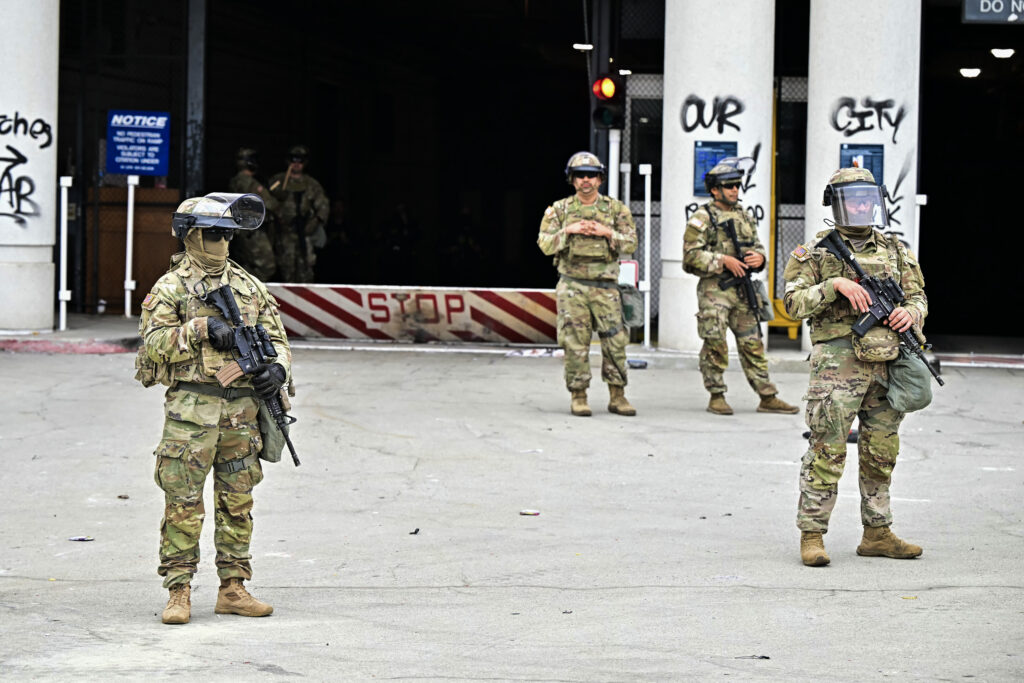
Security forces clashed with protesters outside a detention center in Los Angeles on Sunday as National Guard troops deployed by President Donald Trump fanned out across the city following two days of unruly protests over raids by immigration agents.Trump on Sunday vowed the troops would ensure “very strong law and order,” while appearing to leave the door open to deploying soldiers in other cities.The US military said 300 soldiers from the 79th Infantry Brigade Combat Team had been sent to three separate locations in the greater Los Angeles area, and were “conducting safety and protection of federal property & personnel.”Helmeted troops in camouflage gear and carrying guns were stationed at a federal detention center in downtown Los Angeles, where they joined Department of Homeland Security forces.Pepper spray and tear gas were fired into a small crowd — including journalists — as forces moved protesters back to allow a convoy of vehicles to enter the detention center. Trump, asked about the use of troops, appeared to leave the door open to a more widespread deployment in other parts of the country.”You have violent people, and we are not going to let them get away with it,” he told reporters. “I think you’re going to see some very strong law and order.”Responding to a question about invoking the Insurrection Act — which would allow the military to be used as a domestic police force — Trump said: “We’re looking at troops everywhere. We’re not going to let this happen to our country.”The deployment in California — the first over the head of a state governor since the Civil Rights era — was “purposefully inflammatory,” Governor Gavin Newsom said.”Trump is sending 2,000 National Guard troops into LA County — not to meet an unmet need, but to manufacture a crisis,” Newsom posted on X Sunday.”He’s hoping for chaos so he can justify more crackdowns, more fear, more control. Stay calm. Never use violence. Stay peaceful.”Newsom’s warning came after Los Angeles was rocked by two days of confrontations that saw federal agents firing flash-bang grenades and tear gas toward crowds angry at the arrests of dozens of migrants.- ‘Intimidation’ -Republicans lined up behind Trump to dismiss the pushback by Newsom and other local officials against the National Guard deployment.”I have no concern about that at all,” Republican House Speaker Mike Johnson told ABC’s “This Week”, accusing Newsom of “an inability or unwillingness to do what is necessary”.As for threats by Defense Secretary Pete Hegseth on Saturday to send in active-duty Marines on top of the Guard troops, Johnson said he did not see that as “heavy-handed.””We have to be prepared to do what is necessary,” he argued. Demonstrators told AFP the purpose of the troops was not necessarily to keep order.”I think it’s an intimidation tactic,” Thomas Henning said.”These protests have been peaceful. There’s no one trying to do any sort of damage right now and yet you have the National Guard with loaded magazines and large guns standing around trying to intimidate Americans from exercising our first amendment rights.”Estrella Corral said demonstrators were angry that hard-working migrants who have done nothing wrong were being snatched by masked immigration agents.”This is our community, and we want to feel safe,” she told AFP.”Trump deploying the National Guard is ridiculous. I think he’s escalating, he’s trying to make a show for his agenda.”Vermont Senator Bernie Sanders said the move demonstrated “Trump’s authoritarianism in real time.” “Conduct massive illegal raids. Provoke a counter-response. Declare a state of emergency. Call in the troops,” he wrote on social media, adding: “Unacceptable.”- ‘Good men and women’ -The National Guard — a reserve military — is frequently used in natural disasters, and occasionally in instances of civil unrest, but almost always with the consent of local authorities.Trump has delivered on a promise to crack down hard on undocumented migrants — who he has likened to “monsters” and “animals” — since taking office in January. Raids by the Immigration and Customs Enforcement (ICE) agency in other US cities have triggered small-scale protests in recent months, but the Los Angeles unrest is the biggest and most sustained against Trump’s immigration policies so far.A CBS News poll taken before the Los Angeles protests showed a slight majority of Americans still approved of the immigration crackdown.Mexico President Claudia Sheinbaum on Sunday defended migrants living north of the border.”Mexicans living in the United States are good men and women, honest people who went to the United States to seek a better life for themselves and to support their families. They are not criminals! They are good men and women!” she said.

Iran says no sanctions relief in US nuclear proposal
Iran’s parliament speaker said on Sunday that the latest US proposal for a nuclear deal does not include the lifting of sanctions, state media reported as negotiations appeared to have hit a roadblock.The two foes have held five rounds of Omani-mediated talks since April, seeking to replace a landmark agreement between Tehran and world powers that set restrictions on Iran’s nuclear activities in return for sanctions relief, before US President Donald Trump abandoned the accord in 2018 during his first term.In a video aired on Iranian state TV, parliament speaker Mohammad Bagher Ghalibaf said that “the US plan does not even mention the lifting of sanctions”.He called it a sign of dishonesty, accusing the Americans of seeking to impose a “unilateral” agreement that Tehran would not accept.”The delusional US president should know better and change his approach if he is really looking for a deal,” Ghalibaf said.On May 31, after the fifth round of talks, Iran said it had received “elements” of a US proposal, with officials later taking issue with “ambiguities” in the draft text.The US and its Western allies have long accused the Islamic republic of seeking to acquire nuclear weapons, a charge Iran has consistently denied, insisting that its atomic programme was solely for peaceful purposes.Key issues in the negotiations have been the removal of biting economic sanctions and uranium enrichment.Tehran says it has the right to enrich uranium under the nuclear Non-Proliferation Treaty, while the Trump administration has called any Iranian enrichment a “red line”.Trump, who has revived his “maximum pressure” campaign of sanctions on Iran since taking office in January, has repeatedly said it will not be allowed any uranium enrichment under a potential deal.On Tuesday, Iran’s top negotiator, Foreign Minister Abbas Araghchi, said the country “will not ask anyone for permission to continue enriching uranium”.- IAEA meeting -According to the UN nuclear watchdog, the International Atomic Energy Agency (IAEA), Iran is the only non-nuclear-weapon state in the world that enriches uranium up to 60 percent — close to the 90 percent threshold needed for a nuclear warhead.Iran’s supreme leader Ayatollah Ali Khamenei on Wednesday rejected the latest US proposal and said enrichment was “key” to Iran’s nuclear programme.The IAEA Board of Governors is scheduled to meet in Vienna starting Monday and discuss Iran’s nuclear activities.On Sunday the Atomic Energy Organization of Iran warned it could reduce its level of cooperation with the UN nuclear watchdog if it adopts a resolution against it.”Certainly, the IAEA should not expect the Islamic Republic of Iran to continue its broad and friendly cooperation,” the Iranian agency’s spokesman Behrouz Kamalvandi told state TV.Araghchi on Friday accused European powers of “opting for malign action against Iran at the IAEA Board of Governors”, warning on X that “Iran will react strongly against any violation of its rights”.A quarterly report from the IAEA issued last week cited a “general lack of cooperation” from Iran and raised concerns over undeclared nuclear material.Tehran has rejected the report as politically motivated and based on “forged documents” it said had been provided by its arch foe Israel.
LA unrest marks latest clash of US presidents, states over National Guard
Donald Trump’s deployment of California’s National Guard marks the first time in decades that a US president openly defied a state governor and sent troops to an emergency zone.By ordering 2,000 guardsmen to Los Angeles to help quell protests against raids by US immigration agents, Trump essentially mounted a takeover of the state’s military regiments to address “lawlessness” on the city’s streets.The National Guard is a reserve military rooted in the 17th century local militias created in the American colonies before the country’s founding.Since then the guard has had multiple responsibilities: domestic disaster relief and security, homeland defense and prevention of civil unrest; and acting as reserve forces for US military deployments overseas.Presidential orders to deploy guardsmen domestically are not uncommon.But clashes between a president and governor over deployments — or the lack thereof, such as during the US Capitol riot by Trump supporters on January 6, 2021 while he was still in office — have been rare. – Los Angeles, 2025 -The White House said Trump relied on a seldom used law, known as Title 10, that permits National Guard federalization in times of “a rebellion or danger of a rebellion against the authority of the Government of the United States.”California Governor Gavin Newsom called the decision “purposefully inflammatory.” But Trump’s order proceeded, and the guard troops were on LA streets Sunday.”This is the first time since 1965 that a president has deployed the National Guard without a request by a state governor,” Kenneth Roth, a longtime former Human Rights Watch executive director, posted on X.”Then it was (president Lyndon) Johnson protecting civil rights protesters. Now it’s Trump creating a spectacle so he can continue his immigration raids.”Elizabeth Goitein of the Brennan Center for Justice warned of a “shocking abuse of power” by Trump, whose memorandum authorizes federalization of National Guard troops “at locations where protests against (federal immigration) functions are occurring or are likely to occur.””Trump has authorized the deployment of troops anywhere in the country where protests against ICE activity might occur,” Goitein posted on X. “That is a huge red flag.”- Alabama, 1965 -A landmark civil rights moment led to a National Guard clash between a president and a segregationist governor.With demonstrators led by Martin Luther King Jr on a five-day march from Selma to Alabama’s capital Montgomery, governor George Wallace pledged National Guard security — but then reneged.The U-turn incensed Johnson who, in defiance of Wallace, called up the guard. The march was protected by thousands of Army soldiers and federalized guard members.- Arkansas, 1957 -When the Little Rock school system was ordered desegregated, Arkansas’ pro-segregationist governor Orval Faubus deployed the National Guard to surround a high school and prevent nine Black students from entering.President Dwight Eisenhower bristled at the standoff and told Faubus the guard must maintain order so the Black students could attend. Instead, Faubus pulled the guardsmen, leaving security to local forces.Eisenhower issued an executive order federalizing the Arkansas National Guard, and ordered 1,000 US Army troops to join them.- Kent State, 1970 -Perhaps no anti-Vietnam war protest was more pivotal than at Ohio’s Kent State University, where students slammed Richard Nixon’s war expansion.As unrest swelled, the National Guard opened fire, killing four students and wounding nine others.The shootings sparked outrage, but also led to reforms regarding how the guard handles civil unrest and use of force.- Hurricane Katrina, 2005 -The massive hurricane left much of New Orleans underwater, leading to the largest-ever peacetime deployment of the National Guard. But critics accused then-president George W Bush of favoring a militaristic response over humanitarian relief.Louisiana’s governor, Kathleen Blanco, warned that many among the thousands of National Guard and federal troops were battle-tested Iraq war veterans.”These troops know how to shoot and kill and I expect they will,” she reportedly said.- Outside White House, 2020 -June 1, 2020 saw a brutal crackdown on demonstrators following the police murder of African-American George Floyd.With people aggressively protesting near the White House, the National Guard joined police to maintain order. Flash grenades and tear gas were deployed. Unlike in the nation’s 50 states, the DC National Guard is under direct command of the US president, who at the time was Trump.