Skimming the Sun, probe sheds light on space weather threats

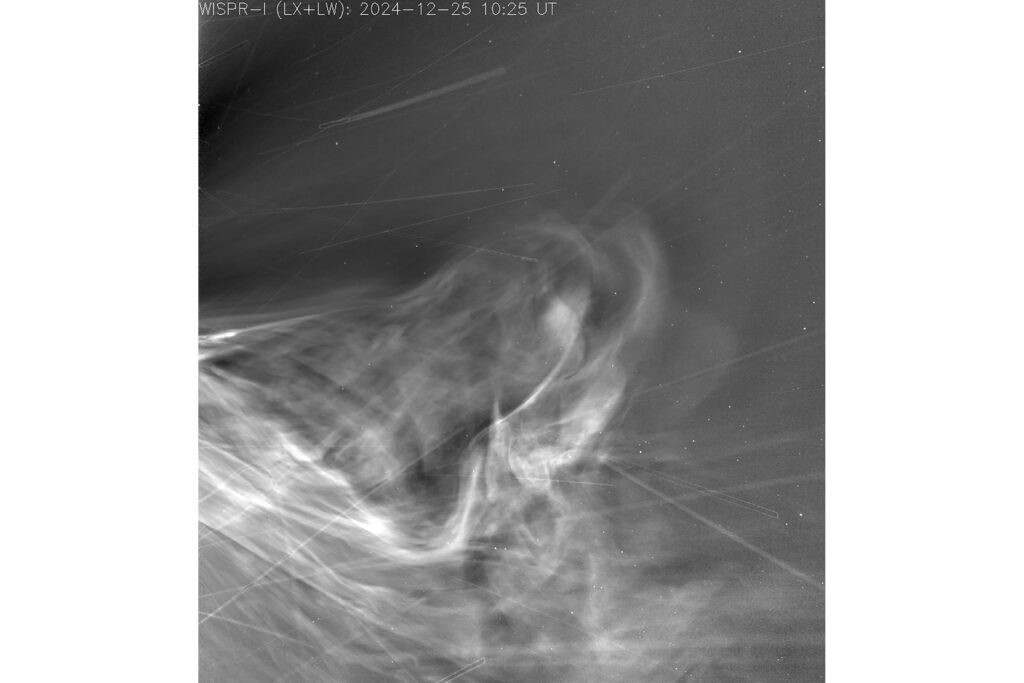
Eruptions of plasma piling atop one another, solar wind streaming out in exquisite detail — the closest-ever images of our Sun are a gold mine for scientists.Captured by the Parker Solar Probe during its closest approach to our star starting on December 24, 2024, the images were recently released by NASA and are expected to deepen our understanding of space weather and help guard against solar threats to Earth.- A historic achievement –”We have been waiting for this moment since the late Fifties,” Nour Rawafi, project scientist for the mission at the Johns Hopkins Applied Physics Laboratory, told AFP.Previous spacecraft have studied the Sun, but from much farther away. Parker was launched in 2018 and is named after the late physicist Eugene Parker, who in 1958 theorized the existence of the solar wind — a constant stream of electrically charged particles that fan out through the solar system.The probe recently entered its final orbit where its closest approach takes it to just 3.8 million miles from the Sun’s surface — a milestone first achieved on Christmas Eve 2024 and repeated twice since on an 88-day cycle.To put the proximity in perspective: if the distance between Earth and the Sun measured one foot, Parker would be hovering just half an inch away.Its heat shield was engineered to withstand up to 2,500 degrees Fahrenheit (1,370 degrees Celsius) — but to the team’s delight, it has only experienced around 2,000F (1090C) so far, revealing the limits of theoretical modeling. Remarkably, the probe’s instruments, just a yard (meter) behind the shield, remain at little more than room temperature.- Staring at the Sun –The spacecraft carries a single imager, the Wide-Field Imager for Solar Probe (WISPR), which captured data as Parker plunged through the Sun’s corona, or outer atmosphere.Stitched into a seconds-long video, the new images reveal coronal mass ejections (CMEs) — massive bursts of charged particles that drive space weather — in high resolution for the first time.”We had multiple CMEs piling up on top of each other, which is what makes them so special,” Rawafi said. “It’s really amazing to see that dynamic happening there.”Such eruptions triggered the widespread auroras seen across much of the world last May, as the Sun reached the peak of its 11-year cycle.Another striking feature is how the solar wind, flowing from the left of the image, traces a structure called the heliospheric current sheet: an invisible boundary where the Sun’s magnetic field flips from north to south.It extends through the solar system in the shape of a twirling skirt and is critical to study, as it governs how solar eruptions propagate and how strongly they can affect Earth.- Why it matters –Space weather can have serious consequences, such as overwhelming power grids, disrupting communications, and threatening satellites. As thousands more satellites enter orbit in the coming years, tracking them and avoiding collisions will become increasingly difficult — especially during solar disturbances, which can cause spacecraft to drift slightly from their intended orbits.Rawafi is particularly excited about what lies ahead, as the Sun heads toward the minimum of its cycle, expected in five to six years.Historically, some of the most extreme space weather events have occurred during this declining phase — including the infamous Halloween Solar Storms of 2003, which forced astronauts aboard the International Space Station to shelter in a more shielded area.”Capturing some of these big, huge eruptions…would be a dream,” he said.Parker still has far more fuel than engineers initially expected and could continue operating for decades — until its solar panels degrade to the point where they can no longer generate enough power to keep the spacecraft properly oriented.When its mission does finally end, the probe will slowly disintegrate — becoming, in Rawafi’s words, “part of the solar wind itself.”
Pentagon chief downsizes contentious LA troop deployment

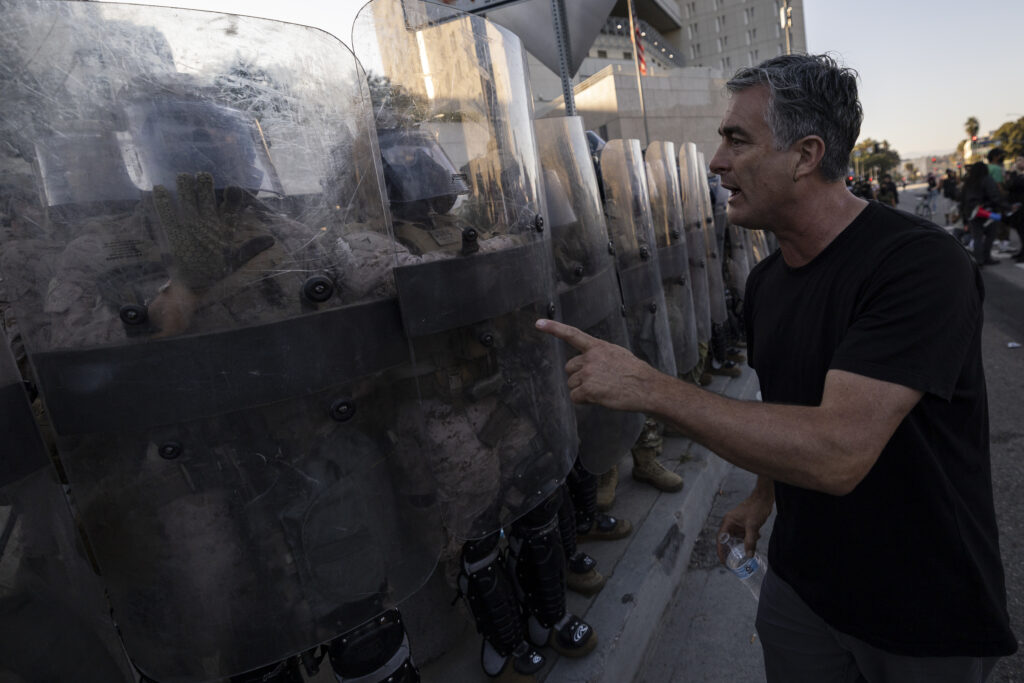
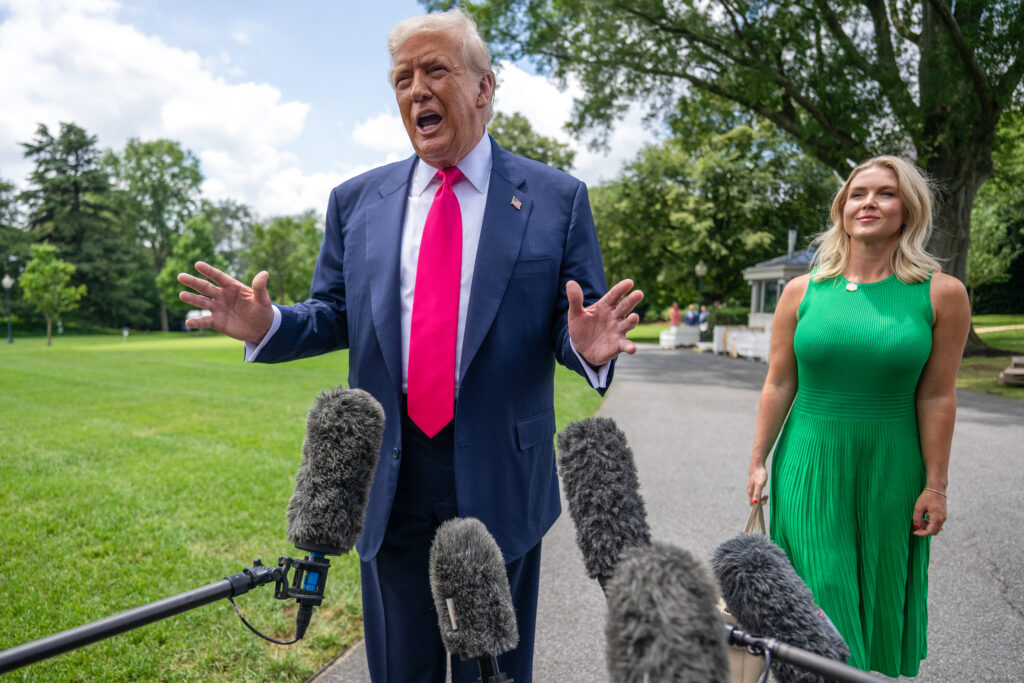
US Defense Secretary Pete Hegseth has ordered the withdrawal of 2,000 National Guard troops from Los Angeles, roughly halving the contentious deployment in the city, the Pentagon said Tuesday.President Donald Trump ordered thousands of National Guard and hundreds of Marines into Los Angeles last month in response to protests over federal immigration sweeps — a move opposed by city leaders and California’s Democratic Governor Gavin Newsom.”Thousands of members are still federalized in Los Angeles for no reason and unable to carry out their critical duties across the state,” Newsom wrote on X, referring to the Guard’s support of firefighting missions across the state. “End this theater and send everyone home,” Newsom said.Pentagon spokesman Sean Parnell on Tuesday confirmed the release “of 2,000 California National Guardsmen (79th IBCT) from the federal protection mission,” adding “the lawlessness in Los Angeles is subsiding.” Mayor Karen Bass credited peaceful protests and legal action for the withdrawal, which she termed a “retreat.””This happened because the people of Los Angeles stood united and stood strong. We organized peaceful protests, we came together at rallies, we took the Trump administration to court — all of this led to today’s retreat,” the Democratic mayor said. As a so-called “sanctuary city” with hundreds of thousands of undocumented people, Los Angeles has been in the crosshairs of the Trump administration since the Republican returned to office in January.After immigration enforcement raids spurred unrest and protests last month, Trump — who has repeatedly exaggerated the scale of the unrest — dispatched the National Guard and US Marines to quell the disruption.It was the first time since 1965 that a US president deployed the National Guard against the wishes of a state governor. Newsom has said the troops were not necessary to address the mostly peaceful protests. In late June, his office reported California National Guard firefighting crews were “operating at just 40% capacity due to Trump’s illegal Guard deployment” as fires were “popping up across the state.”California is fighting the Trump administration in court over the deployment, arguing that the president overstepped his authority, though the troops have been allowed to remain for now.

Trump says any ‘credible’ Epstein files should be released

President Donald Trump said Tuesday the US Justice Department should release all “credible” information from its probe into notorious sex criminal Jeffrey Epstein as he sought to douse a firestorm of criticism from his supporters over his handling of the case.Trump is facing the most serious split of his political career from his famously loyal right-wing base over suspicions that his administration is covering up lurid details of Epstein’s crimes to protect rich and powerful figures they say are implicated. “The attorney general has handled that very well,” the Republican leader said of Pam Bondi, who leads the Justice Department, when he was asked about the case at the White House.Trump repeated his claim that the Epstein files were “made up” by his Democratic predecessors in the White House — even though he said multiple times during the election campaign that he would “probably” release them.”She’s handled it very well, and it’s going to be up to her,” Trump said. “Whatever she thinks is credible, she should release.”Trump’s latest comments mark a softening of his stance — he had voiced frustration in the Oval Office and online about his supporters’ fixation on Epstein and pleaded with them to move on.”I don’t understand why the Jeffrey Epstein case would be of interest to anybody,” Trump told reporters Tuesday night, adding: “It’s pretty boring stuff.”The president’s “Make America Great Again” (MAGA) movement has long held as an article of faith that “Deep State” elites are protecting Epstein’s most powerful associates in the Democratic Party and Hollywood.Trump has faced growing outrage since his administration effectively shut down Epstein-related conspiracy theories, which have become MAGA obsessions.The Justice Department and FBI said in a memo made public earlier this month there is no evidence that the disgraced financier kept a “client list” or was blackmailing powerful figures.They also dismissed the claim that Epstein was murdered in jail, confirming his death by suicide, and said they would not be releasing any more information on the probe.- ‘Let the people decide’ -It marked the first time Trump’s officials had publicly refuted the stories — pushed for years by numerous right-wing figures, notably including the FBI’s top two officials, before Trump hired them.Beyond angering supporters, the issue has opened a schism within his administration, sparking a fiery blow-up between Bondi and Deputy FBI Director Dan Bongino, who is said to be considering resigning.Trump’s attempts to take the sting out of the controversy have largely failed, with far right influencers continuing to criticize him online.Even his daughter-in-law, Lara Trump, a Fox News host, has called for “more transparency” from the administration.Trump’s most powerful ally in the US Congress, House Speaker Mike Johnson, pushed Tuesday for the administration to release more information about the case, and his stance has been echoed by multiple Republicans. “We should put everything out there and let the people decide,” he told MAGA influencer Benny Johnson’s internet show, calling on Bondi to “come forward and explain” apparent discrepancies in her statements about the case.Bondi told Fox News in February a list of Epstein clients was on her desk for review, before backtracking and saying that no such list existed. Epstein died by suicide in a New York prison in 2019 after being charged with sex trafficking.Trump — who has denied visiting the US Virgin Islands home where prosecutors say Epstein sex trafficked underage girls — said ahead of his election he would have “no problem” releasing files related to the case.Asked whether Bondi had told him if his name appeared in a file related to Epstein, Trump said “no,” adding that Bondi has “given us just a very quick briefing.”

Trump dévoile des investissements pour alimenter l’IA en électricité

Donald Trump a annoncé mardi des investissements d’entreprises privées dans l’énergie et les infrastructures en Pennsylvanie, Etat industriel de l’est des Etats-Unis, au moment où le secteur de la tech est confronté aux besoins toujours croissants en électricité de l’intelligence artificielle (IA).En tout, plusieurs organisations vont injecter environ 92 milliards de dollars dans des projets de centres de données (36 milliards) et de sites de production d’énergie (56 milliards).Le secteur des technologies s’est jeté à corps perdu dans le développement de l’IA générative, mais craint que les besoins massifs en électricité ne puissent être satisfaits par l’infrastructure existante, en particulier aux Etats-Unis.L’IA générative demande d’énormes capacités de calcul informatique, principalement pour faire fonctionner les processeurs voraces en énergie de Nvidia, cette entreprise californienne de puces électroniques devenue la plus grosse capitalisation boursière au monde en surfant très tôt sur la vague de l’IA.Les autorités américaines s’attendent à ce que d’ici à 2028, les besoins en électricité des entreprises de la tech pour l’IA soient équivalents à ceux de 5 millions de foyers.”Nous sommes ici aujourd’hui parce que nous pensons que c’est le destin de l’Amérique de dominer toutes les industries et d’être la première dans toutes les technologies, y compris la première super puissance au monde dans l’IA”, a déclaré Donald Trump sur scène.”Et nous sommes largement en avance sur la Chine, je dois le dire. Et les usines arrivent, la construction commence”, a ajouté le président américain, lors du premier Sommet sur l’énergie et l’innovation de Pennsylvanie à l’université Carnegie Mellon de Pittsburgh.- Rester “leader” -Parmi les groupes présents, Google a annoncé un investissement sur deux ans de 25 milliards de dollars dans des centres de données et infrastructures d’IA dans des Etats du nord-est du pays, ainsi que 3 milliards de dollars pour moderniser deux centrales hydroélectriques en Pennsylvanie.”Nous soutenons l’appel clair et urgent du président Trump à investir dans les infrastructures, les technologies et la production d’énergie nécessaires à l’essor de l’IA, afin que les États-Unis restent leader dans ce domaine”, a déclaré Ruth Porat, directrice des investissements d’Alphabet et Google.”Alors que les États-Unis et la Chine se livrent une course pour dominer la guerre de l’intelligence artificielle, les géants technologiques investissent massivement pour gagner des parts dans cette quatrième révolution industrielle”, a commenté l’analyste Dan Ives de Wedbush.Il estime qu’environ 15 % des budgets informatiques sont désormais réservés à l’IA ou influencés par cette technologie.D’autres entreprises technologiques, sociétés énergétiques et firmes financières étaient présentes à Pittsburgh, dont Blackstone, qui a aussi promis 25 milliards de dollars pour des centres de données et infrastructures.Les groupes comptent en outre investir dans des programmes d’apprentissage. Pour le sénateur républicain David McCormick, ces investissements sont d’une “importance énorme” pour son Etat de Pennsylvanie, mais ils sont aussi “cruciaux pour le futur du pays”.- Course avec Pékin -Ses déclarations reflètent la tendance partagée par les deux bords politiques à Washington que les Etats-Unis doivent en faire davantage pour ne pas perdre du terrain face à la Chine dans cette course à l’intelligence artificielle.”Si les Etats-Unis ne mènent pas cette révolution sous nos propres conditions, nous céderons le contrôle de notre infrastructure, de nos données, de notre leadership, et de notre mode de vide à la Chine communiste”, a déclaré le sénateur McCormick dans une tribune à Fox News.Donald Trump a lancé le projet “Stargate” en janvier, qui vise jusqu’à 500 milliards de dollars d’investissements dans les infrastructures d’IA.La firme japonaise d’investissements dans la tech SoftBank, ainsi que les entreprises américaines de la Silicon Valley OpenAI (ChatGPT) et Oracle, ont décidé d’investir 100 milliards de dollars dans la phase initiale du projet.Depuis son retour à la Maison Blanche, Donald Trump a fait machine arrière sur de nombreuses réglementations adoptées sous Joe Biden pour cadrer le développement des puissants algorithmes d’IA et limiter les exportations de certaines technologies avancées à des pays alliés.Le président américain devrait dévoiler son propre programme-cadre pour le développement de l’intelligence artificielle au cours du mois de juillet.

Trump dévoile des investissements pour alimenter l’IA en électricité

Donald Trump a annoncé mardi des investissements d’entreprises privées dans l’énergie et les infrastructures en Pennsylvanie, Etat industriel de l’est des Etats-Unis, au moment où le secteur de la tech est confronté aux besoins toujours croissants en électricité de l’intelligence artificielle (IA).En tout, plusieurs organisations vont injecter environ 92 milliards de dollars dans des projets de centres de données (36 milliards) et de sites de production d’énergie (56 milliards).Le secteur des technologies s’est jeté à corps perdu dans le développement de l’IA générative, mais craint que les besoins massifs en électricité ne puissent être satisfaits par l’infrastructure existante, en particulier aux Etats-Unis.L’IA générative demande d’énormes capacités de calcul informatique, principalement pour faire fonctionner les processeurs voraces en énergie de Nvidia, cette entreprise californienne de puces électroniques devenue la plus grosse capitalisation boursière au monde en surfant très tôt sur la vague de l’IA.Les autorités américaines s’attendent à ce que d’ici à 2028, les besoins en électricité des entreprises de la tech pour l’IA soient équivalents à ceux de 5 millions de foyers.”Nous sommes ici aujourd’hui parce que nous pensons que c’est le destin de l’Amérique de dominer toutes les industries et d’être la première dans toutes les technologies, y compris la première super puissance au monde dans l’IA”, a déclaré Donald Trump sur scène.”Et nous sommes largement en avance sur la Chine, je dois le dire. Et les usines arrivent, la construction commence”, a ajouté le président américain, lors du premier Sommet sur l’énergie et l’innovation de Pennsylvanie à l’université Carnegie Mellon de Pittsburgh.- Rester “leader” -Parmi les groupes présents, Google a annoncé un investissement sur deux ans de 25 milliards de dollars dans des centres de données et infrastructures d’IA dans des Etats du nord-est du pays, ainsi que 3 milliards de dollars pour moderniser deux centrales hydroélectriques en Pennsylvanie.”Nous soutenons l’appel clair et urgent du président Trump à investir dans les infrastructures, les technologies et la production d’énergie nécessaires à l’essor de l’IA, afin que les États-Unis restent leader dans ce domaine”, a déclaré Ruth Porat, directrice des investissements d’Alphabet et Google.”Alors que les États-Unis et la Chine se livrent une course pour dominer la guerre de l’intelligence artificielle, les géants technologiques investissent massivement pour gagner des parts dans cette quatrième révolution industrielle”, a commenté l’analyste Dan Ives de Wedbush.Il estime qu’environ 15 % des budgets informatiques sont désormais réservés à l’IA ou influencés par cette technologie.D’autres entreprises technologiques, sociétés énergétiques et firmes financières étaient présentes à Pittsburgh, dont Blackstone, qui a aussi promis 25 milliards de dollars pour des centres de données et infrastructures.Les groupes comptent en outre investir dans des programmes d’apprentissage. Pour le sénateur républicain David McCormick, ces investissements sont d’une “importance énorme” pour son Etat de Pennsylvanie, mais ils sont aussi “cruciaux pour le futur du pays”.- Course avec Pékin -Ses déclarations reflètent la tendance partagée par les deux bords politiques à Washington que les Etats-Unis doivent en faire davantage pour ne pas perdre du terrain face à la Chine dans cette course à l’intelligence artificielle.”Si les Etats-Unis ne mènent pas cette révolution sous nos propres conditions, nous céderons le contrôle de notre infrastructure, de nos données, de notre leadership, et de notre mode de vide à la Chine communiste”, a déclaré le sénateur McCormick dans une tribune à Fox News.Donald Trump a lancé le projet “Stargate” en janvier, qui vise jusqu’à 500 milliards de dollars d’investissements dans les infrastructures d’IA.La firme japonaise d’investissements dans la tech SoftBank, ainsi que les entreprises américaines de la Silicon Valley OpenAI (ChatGPT) et Oracle, ont décidé d’investir 100 milliards de dollars dans la phase initiale du projet.Depuis son retour à la Maison Blanche, Donald Trump a fait machine arrière sur de nombreuses réglementations adoptées sous Joe Biden pour cadrer le développement des puissants algorithmes d’IA et limiter les exportations de certaines technologies avancées à des pays alliés.Le président américain devrait dévoiler son propre programme-cadre pour le développement de l’intelligence artificielle au cours du mois de juillet.

Trump unveils investments to power AI boom

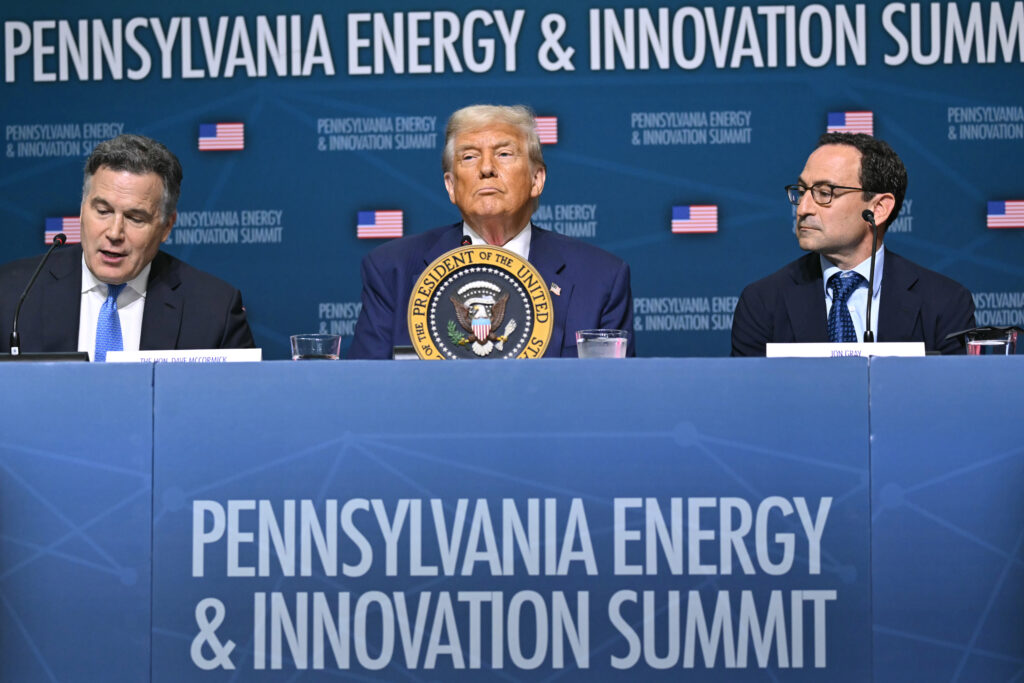
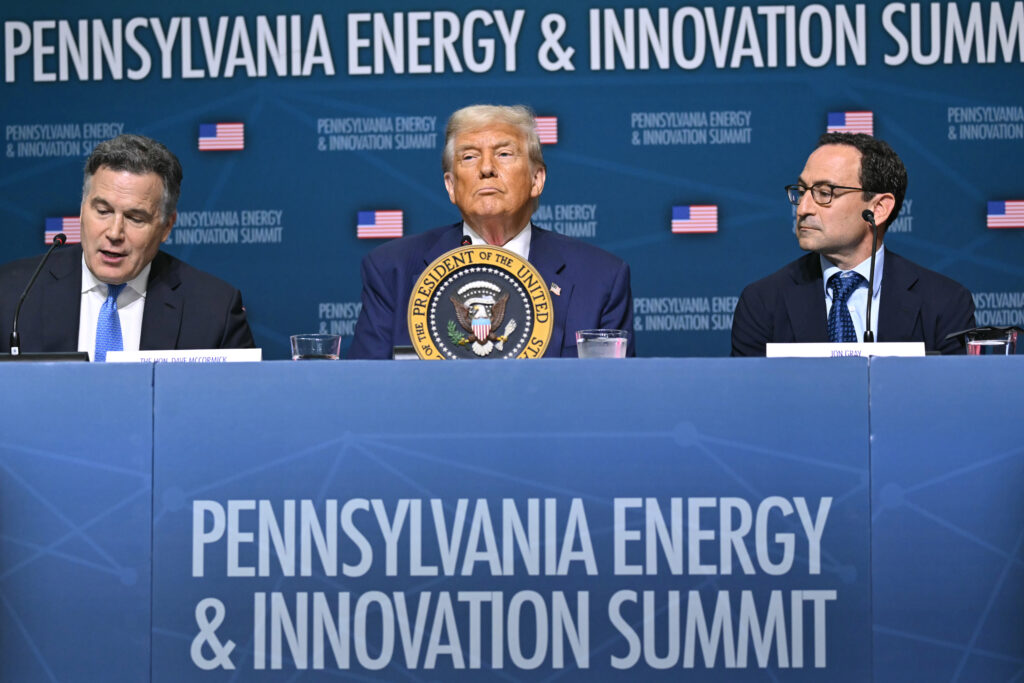
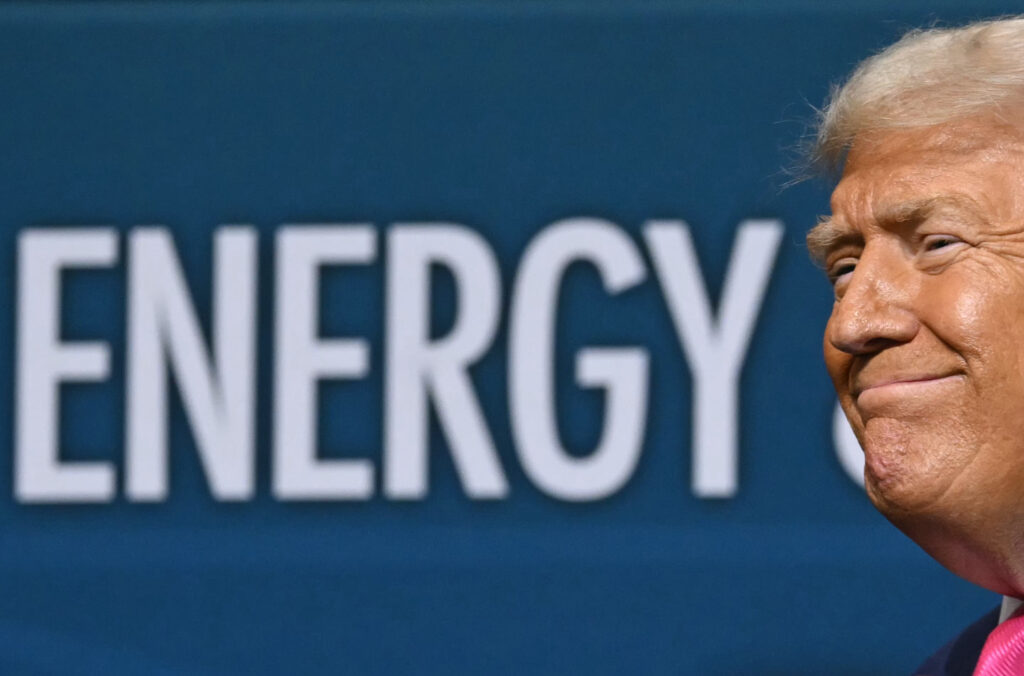
US President Donald Trump went to Pennsylvania on Tuesday to announce $92 billion in energy and infrastructure deals intended to meet big tech’s soaring demand for electricity to fuel the AI boom.Trump made the announcement at the inaugural Pennsylvania Energy and Innovation Summit at Carnegie Mellon University, with much of the talk about beating China in the global AI race.”Today’s commitments are ensuring that the future is going to be designed, built and made right here in Pennsylvania and right here in Pittsburgh, and I have to say, right here in the United States of America,” Trump said at the event.The tech world has fully embraced generative AI as the next wave of technology, but fears are growing that its massive electricity needs cannot be met by current infrastructure, particularly in the United States.Generative AI requires enormous computing power, mainly to run the energy-hungry processors from Nvidia, the California-based company that has become the world’s most valuable company by market capitalization.Officials expect that by 2028, tech companies will need as much as five gigawatts of power for AI — enough electricity to power roughly five million homes.Top executives from Palantir, Anthropic, Exxon and Chevron attended the event.The funding will cover new data centers, power generation, grid infrastructure, AI training, and apprenticeship programs.- Race to beat China -Among investments, Google committed $25 billion to build AI-ready data centers in Pennsylvania and surrounding regions.”We support President Trump’s clear and urgent direction that our nation invest in AI… so that America can continue to lead in AI,” said Ruth Porat, Google’s president and chief investment officer.The search engine giant also announced a partnership with Brookfield Asset Management to modernize two hydropower facilities in Pennsylvania, representing 670 MW of capacity on the regional grid.Investment group Blackstone pledged more than $25 billion to fund new data centers and energy infrastructure.US Senator David McCormick, from Pennsylvania, said the investments “are of enormous consequence to Pennsylvania, but they are also crucial to the future of the nation.”His comments reflect the growing sentiment in Washington that the United States must not lose ground to China in the race to develop AI.”We are way ahead of China and the plants are starting up, the construction is starting up,” Trump said.The US president launched the “Stargate” project in January, aimed at investing up to $500 billion in US AI infrastructure — primarily in response to growing competition with China.Japanese tech investor SoftBank, ChatGPT-maker OpenAI, and Oracle are investing $100 billion in the initial phase.Trump has also reversed many policies adopted by the previous Biden administration that imposed checks on developing powerful AI algorithms and limits on exports of advanced technology to certain allied countries.He is expected to outline his own blueprint for AI advancement later this month.

Wall Street termine sans direction claire, entre droits de douane et inflation

La Bourse de New York a terminé en ordre dispersé mardi, minée par les derniers développements sur le front commercial et par les chiffres de l’inflation américaine, le Nasdaq profitant pour sa part de la montée de Nvidia.L’indice Nasdaq, qui concentre les valeurs technologiques, a gagné 0,18% et a atteint un nouveau record, à 20.677,80 points. L’indice élargi S&P 500 a perdu 0,40% et le Dow Jones a reculé de 0,98%.Les actions “ont reculé en raison de nouvelles inquiétudes concernant les surtaxes douanières”, commente dans une note Jose Torres, d’Interactive Brokers.Donald Trump a annoncé mardi être parvenu à un accord commercial avec l’Indonésie, qui pourrait permettre au pays d’Asie du Sud-Est d’éviter de se voir imposer des droits de douane au-delà du plancher de 10% imposé par Washington.Le président américain a annoncé vouloir obtenir plusieurs dizaines d’accords commerciaux avant le 1er août, mais jusqu’ici, seulement trois accords (Royaume-Uni, Vietnam et Indonésie) ont été annoncés, alors que la Maison Blanche avait assuré être en capacité d’en signer jusqu’à 90.Les changements de cap de l’administration en matière de commerce ont été “assez chaotiques”, résume auprès de l’AFP Art Hogan, de B. Riley Wealth Management.”Les marchés sont déstabilisés par les mesures commerciales prises par Trump, avec plus de nouvelles négatives que positives ces derniers temps”, ajoute l’analyste.Côté indicateurs, les investisseurs ont digéré de nouvelles données sur l’inflation côté consommateurs qui a progressé en juin de 2,7% sur un an, contre 2,4% en mai, selon l’indice CPI.Si cette accélération est en ligne avec les attentes des analystes, c’est le deuxième mois consécutif de hausse sur un an, alors qu’elle avait eu tendance à se rapprocher auparavant de la cible de 2% de hausse sur un an, visée par la banque centrale américaine (Fed).”Le rapport est meilleur que ce que l’on craignait, mais pas assez pour dissiper la crainte que les droits de douane n’entraînent une hausse de l’inflation”, expliquent dans une note les analystes de Briefing.com.”Les attentes en matière de réduction des taux d’intérêt ont diminué de manière significative” après ces données, ajoutent-ils.Alors que l’essentiel des investisseurs anticipait une baisse lors de la réunion de septembre de la Fed, ils sont désormais presque autant à estimer que l’institution pourrait à nouveau prolonger son statu quo, selon l’outil CME, Fedwatch.La publication de l’indice a provoqué une hausse des taux obligataires américains: le rendement de l’emprunt à dix ans est passé de 4,43% à la clôture lundi à 4,48% vers 20H15 GMT.Mercredi est attendue l’inflation côté producteurs, là aussi pour le mois de juin.Ailleurs, à la cote, le géant des semiconducteurs Nvidia (+4,04% à 170,70 dollars) a soutenu le Nasdaq après avoir annoncé mardi reprendre les ventes à la Chine d’un modèle de puces électroniques avancées pour l’intelligence artificielle (IA).Début juillet, Nvidia a été la première entreprise à franchir le seuil historique de 4.000 milliards de dollars de valorisation. Cette annonce pourrait encore pousser le titre, selon les analystes.Les résultats trimestriels des banques n’ont pas tous convaincu Wall Street: JPMorgan Chase (-0,83% à 286,30 dollars) et Wells Fargo (-5,49% à 78,85 dollars) ont reculé malgré de meilleures performances qu’attendu. Blackrock, le plus gros gestionnaire d’actifs au monde, a reculé de 5,87% à 1.040,52 dollars, malgré un chiffre d’affaires et des bénéfices en hausse au deuxième trimestre.La banque américaine Citigroup a, elle, avancé (+3,61% à 90,66 dollars) après avoir dépassé les attentes des analystes grâce aux activités de marché et de gestion de fortune.Boeing a brièvement pris de la vitesse, avant de retomber (-0,23% à 229,98 dollars) après que Donald Trump a annoncé que l’accord commercial entre les Etats-Unis et l’Indonésie prévoit, entre autres, l’achat de cinquante avions du constructeur américain par le pays d’Asie du Sud-Est.

Nasdaq gains while Dow, S&P 500 fall as US inflation ticks higher

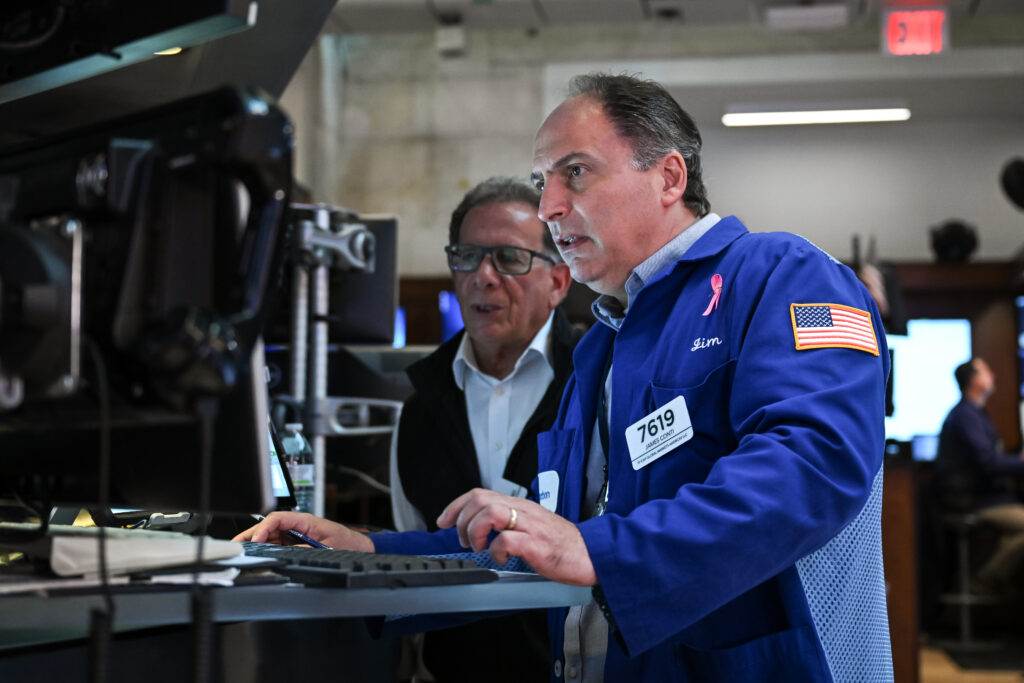
Most US and European share indices slid on Tuesday, as US inflation data indicated President Donald Trump’s tariffs could be feeding into his country’s economy.In New York, the Nasdaq edged higher to close at another record, propelled by buoyant news from tech darling Nvidia. But the blue-chip Dow and broader S&P 500 both retreated.The US consumer price index for June showed inflation rose 2.7 percent compared with a year earlier.Though in line with economists’ forecasts, the rate was above the Federal Reserve’s two-percent target and marked an acceleration from the prior month.Jochen Stanzl, an analyst at CMC Markets, said detail in the CPI report “points to a trend toward stagflation — an unwelcome topic for investors in an increasingly overvalued market.”Stephen Innes, managing partner at SPI Asset Management, said that “the CPI release showed some early signs of tariff pass-through but underlying inflation remains muted.”Since April, the United States has imposed a baseline 10-percent tariff on goods imported from most of its main trading partners, with steeper levies on steel, aluminum and cars. Trump has threatened big tariff hikes on August 1 on numerous countries if they do not reach deals.On Tuesday, Trump announced a trade agreement with Indonesia. Indonesian goods entering the United States would encounter a 19 percent tariff, below the 32 percent previously threatened.The Indonesia accord, however, comes as US negotiations remain unresolved with around two dozen other trading partners.High stock market prices “may be emboldening the administration to keep up the bluster on tariffs,” said Art Hogan of B. Riley Wealth Management.- Tariff threat to Russia -Most Asian indices closed higher before the US inflation report came out, except for those in Shanghai and Mumbai.China and India are both major trading partners of Russia — which Trump said would be hit with tariffs of up to 100 percent within 50 days if President Vladimir Putin did not end his war on Ukraine.China, which has negotiated a US tariff truce, had on Tuesday issued economic growth data that met expectations, largely thanks to an April-June export surge to get ahead of Trump’s levies.Even though Russia is a major crude producer, oil traders bid prices lower, not higher, following Trump’s announcement.”The fact that oil prices fell suggests investors are relieved that Trump has allowed sufficiently enough time for Putin to agree to a ceasefire,” said Fawad Razaqzada, analyst at Forex.com.”They are also getting used to Trump threatening tariffs, only to change his mind in the last minute and extend deadlines,” he said. In corporate news, US banks JPMorgan Chase, Wells Fargo and Citi posted strong second-quarter results.And Nvidia’s share price jumped after it said US export restrictions will be eased to allow it to sell its H20 artificial intelligence chips to China.- Key figures at around 2030 GMT -New York – Dow: DOWN 1.0 percent at 44,023.29 (close)New York – S&P 500: DOWN 0.4 percent at 6,243.76 (close)New York – Nasdaq Composite: UP 0.2 percent at 20,677.80 (close)London – FTSE 100: DOWN 0.7 percent at 8,938.32 (close) Paris – CAC 40: DOWN 0.5 percent at 7,766.21 (close) Frankfurt – DAX: DOWN 0.4 percent at 24,060.29 (close)Tokyo – Nikkei 225: UP 0.6 percent at 39,678.02 (close)Hong Kong – Hang Seng Index: UP 1.6 percent at 24,590.12 (close)Shanghai – Composite: DOWN 0.4 percent at 3,505.00 (close)Euro/dollar: DOWN at $1.1606 from $1.1664Pound/dollar: DOWN at $1.3383 from $1.3427Dollar/yen: UP at 148.85 yen from 147.72 yenEuro/pound: DOWN at 86.69 pence from 86.87 penceBrent North Sea Crude: DOWN 0.7 percent at $68.71 per barrelWest Texas Intermediate: DOWN 0.7 percent at $66.52 per barrelburs-jmb/aha

Trump envoy demands Israel action on killing of American

The US ambassador to Israel on Tuesday demanded an aggressive investigation and consequences after settlers beat to death a Palestinian-American, in rare public pressure against the ally by President Donald Trump’s administration.Ambassador Mike Huckabee, an outspoken supporter for years of Jewish settlement in the Palestinian territories, spoke out after an initial muted US official reaction to the death of Saif al-Din Abdul Karim Musalat.”I have asked Israel to aggressively investigate the murder of Saif Mussallet, an American citizen who was visiting family in Sinjil when he was beaten to death,” Huckabee wrote on X, using an alternative spelling.”There must be accountability for this criminal and terrorist act. Saif was just 20 yrs old,” Huckabee wrote.Musalat, who was born and raised in Florida and ran an ice cream parlor in Tampa, had planned to spend the summer in an area of the West Bank known for residents from the Palestinian diaspora in North America.Israeli settlers beat him to death on Friday, according to the Palestinian health ministry, amid a surge in violence by extremists in the West Bank in parallel to the Israeli offensive in Gaza.Musalat’s family said he was “protecting his family’s land from settlers who were attempting to steal it” and that settlers blocked an ambulance, with the young man dying before he could reach a hospital.Trump has staunchly supported Israel and in his first term the United States walked away from the international consensus that settlements on occupied land were illegal.Huckabee, a former governor of Arkansas and evangelical Christian, has previously rejected the idea of an occupation and had voiced support for settlements.Huckabee has said that Israel has “title deed to Judea and Samaria,” using a biblical term for the West Bank.Hakeem Jeffries, the top House lawmaker from the rival Democratic Party, early Tuesday also demanded action from Israel over the death of Musalat and called for a tougher response from Trump.”The Trump administration cannot continue to turn a blind eye to what is happening in the West Bank if it is truly committed to finding a just and lasting peace between Israel and the Palestinian people,” Jeffries said in a statement.

US banks see lower recession risk despite tariff fog

Large US banks reported results that topped estimates Tuesday as executives pointed to American economic resilience and said businesses were adapting to tariff uncertainty.Executives from JPMorgan Chase and Citigroup described US consumers as still fundamentally in good shape despite continued risks to the outlook. Both banks now see a lower risk of recession compared with April, when they last reported results.Top officials with the banks also characterized clients as less frazzled by President Donald Trump constantly changing trade policy compared with April, when financial markets were in turmoil.In the last week alone, Trump has threatened deep tariffs on some two dozen countries and spoken of new levies on copper and pharmaceuticals — announcements that many market watchers remain skeptical will be enacted in light of previous tariff pivots by the US president.”The corporate community … has sort of accepted that they just need to navigate through this and are kind of getting on with it,” JPMorgan Chief Financial Officer Jeremy Barnum told reporters on a conference call.Later on a call with Wall Street analysts, Barnum described US consumer spending as still fairly robust. “We continue to struggle to see signs of weakness,” Barnum said. “The consumer basically seems to be fine.”Citigroup CFO Mark Mason said businesses had acquired more “comfort with the uncertainty” compared to earlier in the year.”The general sentiment has improved a bit if you look at things like the prospect of a recession, that has fallen significantly from what it was earlier in the second quarter,” Mason told reporters on a conference call.- Soft landing eyed -At JPMorgan, second-quarter profits came in at $15 billion, down 17 percent from the year-ago period when results were boosted by a one-time equity item.But that translated into $4.96 per share, compared with $4.49 projected by analysts behind higher profits in operating divisions.Revenues were $44.9 billion, down 11 percent from the year-ago period.In the most recent quarter, JPMorgan benefited from higher asset management fees, as well as increased trading revenues amid financial market volatility during stretches of the quarter. These aspects helped offset higher technology expenses.JPMorgan chief executive Jamie Dimon said investment banking activity had started slowly in the quarter, “but gained momentum as market sentiment improved,” resulting in a seven percent gain.Dimon described the tax cut extensions Trump recently signed into law as “positive” for the economic outlook, along with “potential deregulation,” according to a statement.”However, significant risks persist –- including from tariffs and trade uncertainty, worsening geopolitical conditions, high fiscal deficits and elevated asset prices,” Dimon said. “As always, we hope for the best but prepare the firm for a wide range of scenarios.”During a conference call with reporters, Dimon said the cautious comments related to possible outcomes and were not a prediction.”The world is kind of pricing in a soft landing,” he said. “We’ve been in that soft landing and it may very well continue.”At Citi, profits came in at $4.0 billion, up 25 percent from the year-ago level, while revenues rose eight percent to $21.7 billion. Profits were boosted by higher markets revenue and investment banking fees, among other areas.Mason described the macroeconomic outlook as improved from April, which points to the “underlying strength” of the US private sector and capital markets.”We do anticipate further consumer cooling the second half (of 2025) as tariff effects play through,” Mason said, while adding that “the global economic performance has been quite resilient.”Shares of JPMorgan were decline 0.8 percent, while Citigroup rose 3.6 percent.