


Saudi Aramco profit drops for 10th straight quarter
Oil giant Saudi Aramco announced its 10th straight drop in quarterly profits on Tuesday as a slump in prices hit revenues, putting more pressure on the key driver of the Saudi economy.Second-quarter profits slid 22 percent year-on-year to 85 billion riyals ($22.67 billion), extending a decline that stretches back to late 2022.”The decrease in revenue was mainly due to lower crude oil prices and lower refined and chemical products prices,” Aramco said in its quarterly report.Aramco’s falling revenues come as Saudi Arabia pursues a costly revamp aimed at reducing its reliance on oil and pivoting towards tourism and business.Crown Prince Mohammed bin Salman’s Vision 2030 project includes flashy resorts, sprawling entertainment complexes and NEOM, a futuristic $500 billion new city in the desert.Aramco was trading at 23.97 riyals on Tuesday, 12 percent below the 27.35 riyals price of its secondary share offering last year.Since a high point of nearly $2.4 trillion in 2022, when oil prices soared following Russia’s invasion of Ukraine, Aramco has lost more than $800 billion in market value.Oil prices, currently around $70 a barrel, have remained low despite tensions roiling the Middle East, including the short-lived Israel-Iran war in June.However, Aramco president and CEO Amin H. Nasser remained optimistic, predicting higher demand in the rest of the year.”Market fundamentals remain strong and we anticipate oil demand in the second half of 2025 to be more than two million barrels per day higher than the first half,” he said in the report.On Sunday, Saudi Arabia, Russia and six other key members of the OPEC+ alliance announced a production hike of 547,000 barrels per day as they unwind cuts of 2.2 million bpd that were designed to prop up prices.- ‘More downwards than upwards’ -Last month, Saudi Arabia’s Jadwa Investment forecast a widening of the budget deficit to 4.3 percent of GDP this year. Oil revenues provided 62 percent of the budget last year.Aramco’s latest drop in profits was widely expected by industry analysts.”Oil market forces are more downwards than upwards in the first half of 2025, due to OPEC+ policy shifts and economic uncertainty stemming from the US trade war,” Abu Dhabi-based Ibrahim Abdul Mohsen told AFP.”This has impacted the profit margins of oil companies, including Aramco.”But he added: “Saudi Arabia has strong reserves capable of defending financial stability and supporting development projects in the short term.”Government-owned Aramco listed on the Saudi exchange in the world’s biggest initial public offering in 2019, selling 1.7 percent of its shares at $29.4 billion.A secondary offering of 0.64 percent of its issued shares raised a further $11.2 billion in June last year.Aramco has also transferred a 16 percent stake to the Public Investment Fund, the Saudi wealth vehicle that is driving much of Vision 2030.
Death of a delta: Pakistan’s Indus sinks and shrinks
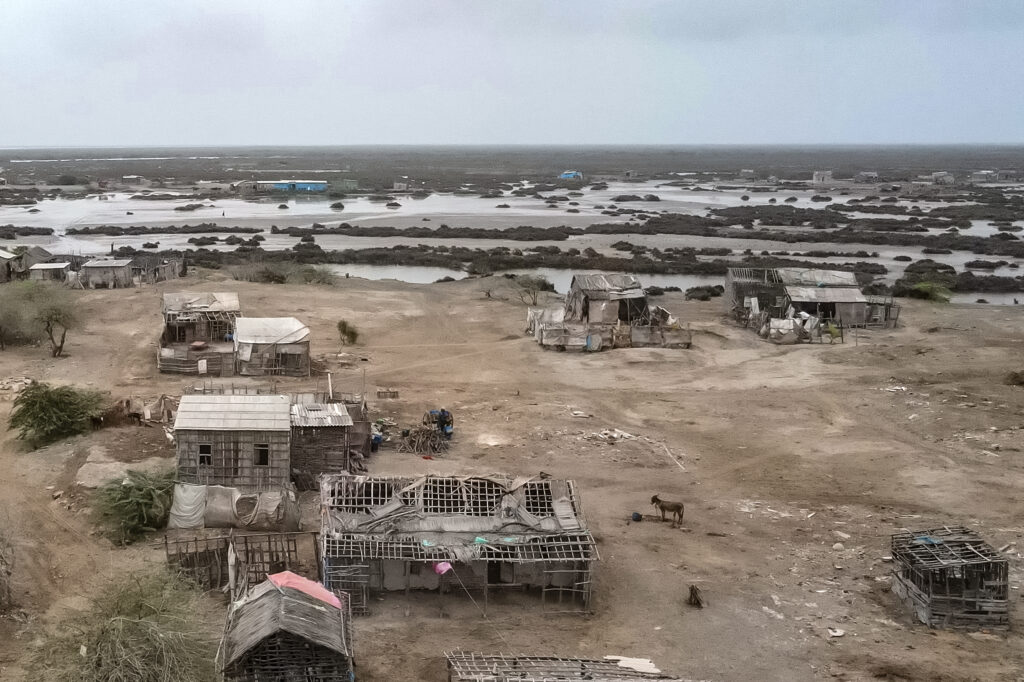
Salt crusts crackle underfoot as Habibullah Khatti walks to his mother’s grave to say a final goodbye before he abandons his parched island village on Pakistan’s Indus delta. Seawater intrusion into the delta, where the Indus River meets the Arabian Sea in the south of the country, has triggered the collapse of farming and fishing communities. “The saline water has surrounded us from all four sides,” Khatti told AFP from Abdullah Mirbahar village in the town of Kharo Chan, around 15 kilometres (9 miles) from where the river empties into the sea.As fish stocks fell, the 54-year-old turned to tailoring until that too became impossible with only four of the 150 households remaining. “In the evening, an eerie silence takes over the area,” he said, as stray dogs wandered through the deserted wooden and bamboo houses.Kharo Chan once comprised around 40 villages, but most have disappeared under rising seawater.The town’s population fell from 26,000 in 1981 to 11,000 in 2023, according to census data. Khatti is preparing to move his family to nearby Karachi, Pakistan’s largest city, and one swelling with economic migrants, including from the Indus delta.The Pakistan Fisherfolk Forum, which advocates for fishing communities, estimates that tens of thousands of people have been displaced from the delta’s coastal districts.However, more than 1.2 million people have been displaced from the overall Indus delta region in the last two decades, according to a study published in March by the Jinnah Institute, a think tank led by a former climate change minister.The downstream flow of water into the delta has decreased by 80 percent since the 1950s as a result of irrigation canals, hydropower dams and the impacts of climate change on glacial and snow melt, according to a 2018 study by the US-Pakistan Center for Advanced Studies in Water.That has led to devastating seawater intrusion.The salinity of the water has risen by around 70 percent since 1990, making it impossible to grow crops and severely affecting the shrimp and crab populations.”The delta is both sinking and shrinking,” said Muhammad Ali Anjum, a local WWF conservationist.- ‘No other choice’ -Beginning in Tibet, the Indus River flows through disputed Kashmir before traversing the entire length of Pakistan.The river and its tributaries irrigate about 80 percent of the country’s farmland, supporting millions of livelihoods.The delta, formed by rich sediment deposited by the river as it meets the sea, was once ideal for farming, fishing, mangroves and wildlife.But more than 16 percent of fertile land has become unproductive due to encroaching seawater, a government water agency study in 2019 found.In the town of Keti Bandar, which spreads inland from the water’s edge, a white layer of salt crystals covers the ground.Boats carry in drinkable water from miles away and villagers cart it home via donkeys.”Who leaves their homeland willingly?” said Haji Karam Jat, whose house was swallowed by the rising water level. He rebuilt farther inland, anticipating more families would join him. “A person only leaves their motherland when they have no other choice,” he told AFP.- Way of life -British colonial rulers were the first to alter the course of the Indus River with canals and dams, followed more recently by dozens of hydropower projects. Earlier this year, several military-led canal projects on the Indus River were halted when farmers in the low-lying riverine areas of Sindh province protested.To combat the degradation of the Indus River Basin, the government and the United Nations launched the ‘Living Indus Initiative’ in 2021.One intervention focuses on restoring the delta by addressing soil salinity and protecting local agriculture and ecosystems. The Sindh government is currently running its own mangrove restoration project, aiming to revive forests that serve as a natural barrier against saltwater intrusion. Even as mangroves are restored in some parts of the coastline, land grabbing and residential development projects drive clearing in other areas.Neighbouring India meanwhile poses a looming threat to the river and its delta, after revoking a 1960 water treaty with Pakistan which divides control over the Indus basin rivers.It has threatened to never reinstate the treaty and build dams upstream, squeezing the flow of water to Pakistan, which has called it “an act of war”.Alongside their homes, the communities have lost a way of life tightly bound up in the delta, said climate activist Fatima Majeed, who works with the Pakistan Fisherfolk Forum.Women, in particular, who for generations have stitched nets and packed the day’s catches, struggle to find work when they migrate to cities, said Majeed, whose grandfather relocated the family from Kharo Chan to the outskirts of Karachi.”We haven’t just lost our land, we’ve lost our culture.”
Gabon forest cave reveals clues about prehistoric central AfricaTue, 05 Aug 2025 06:17:35 GMT
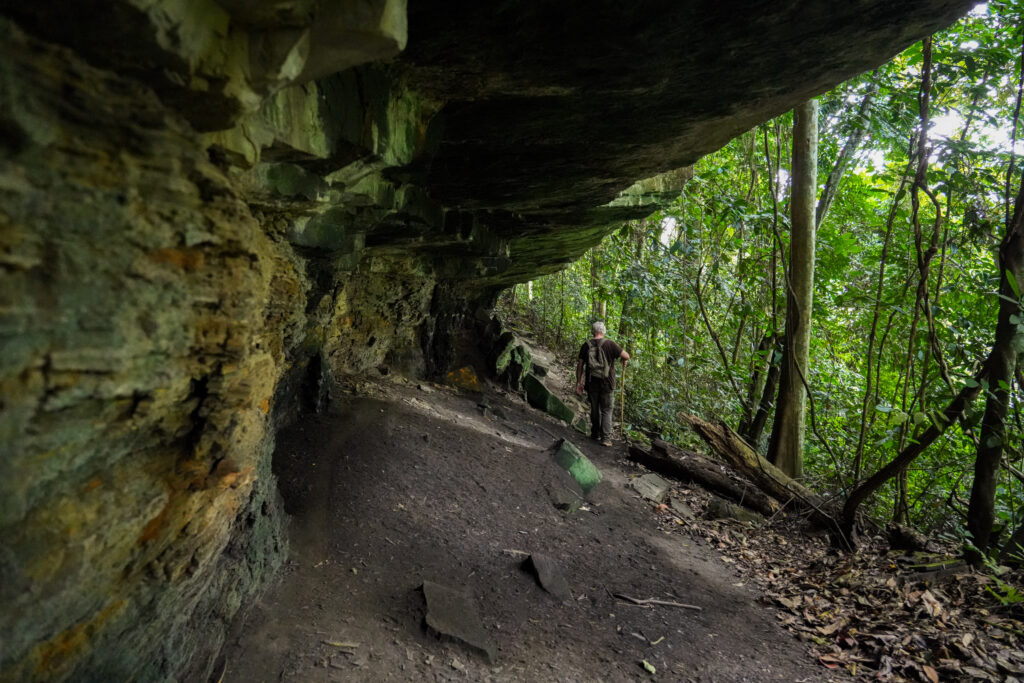
In Gabon’s sprawling forest, archaeologists dig for ancient clues that could unlock the secrets of how prehistoric humans lived and interacted in the changing landscape of central Africa.Two billion years ago, the eastern Gabonese region of Lastourville was covered by a vast ocean.But that has long given way to dense forest and dolomite cliffs dotted …

Après la fermeture de centaines de clubs, le Royaume-Uni veut retrouver le sens de la fête
La fin de la fête a-t-elle sonné ? Le Royaume-Uni tente d’enrayer le déclin de sa vie nocturne, mise à mal par le Covid et l’inflation, qui oblige aussi les clubs à se réinventer pour attirer sur la piste une nouvelle génération.Mi-juillet, le Pryzm Kingston, une discothèque du sud-ouest de Londres prisée des étudiants, où se sont produits Billie Eilish, Rod Stewart et Stormzy, a fermé ses portes.Selon ses propriétaires, il était temps de “se tourner vers l’avenir et réimaginer ce site”, niché dans un ancien cinéma, “pour la prochaine génération de fêtards”.Il renaîtra sous la forme d’un club à taille réduite et d’un bar dansant, des lieux plus “haut de gamme” qui “reflètent ce que les gens cherchent aujourd’hui”.Depuis 2020, près d’un tiers des clubs britanniques a baissé le rideau, soit environ 400 établissements, indique l’organisation du secteur, Night Time Industries Association (NTIA).”Même s’ils connaissaient un léger déclin avant la pandémie, celle-ci a fortement accéléré les choses”, indique à l’AFP Tony Rigg, consultant dans l’industrie musicale. Avant que la crise du coût de la vie ne fasse exploser les factures et loyers des discothèques – comme ceux de leurs clients.Rencontré à l’heure des premières pintes dans le centre de Londres, en début de soirée, Conor Nugent, chargé de clientèle de 26 ans, dit n’aller en boîte que pour les “occasions spéciales”, après s’être demandé “si ça vaut vraiment le coup”.Ce Londonien a réduit ses sorties pour des raisons financières – comme 68% des 18-30 ans, indique la NTIA -, et préfère se réserver pour “des concerts ou des événements”.Comme le souligne Tony Rigg, le Covid-19 a entraîné un “changement de culture” chez les jeunes de la “Gen Z”, nés entre 1997 et 2012, qui consomment généralement moins d’alcool et n’ont pas toujours “vécu le rite de passage consistant à découvrir les clubs”.- L’exemple de Paris -Invoquant toutes ces raisons, la société Rekom UK, propriétaire des emblématiques discothèques Pryzm et Atik, a déposé le bilan en 2024, fermant 17 établissements dans le pays.Une vingtaine d’autres, dont le Pryzm Kingston, ont été repris par Neos Hospitality, qui a décidé d’en transformer certains en bars dansants ou d’organiser des événements sans alcool. “Le secteur doit évoluer, ou il deviendra obsolète”, reconnaît Tony Rigg.Pour mettre fin à l’hémorragie de fêtards vers Berlin ou Paris, le maire de la capitale Sadiq Khan a lancé un groupe de travail indépendant baptisé “Nightlife Taskforce”, qui doit publier un rapport à l’automne.”Notre vie nocturne est l’une des raisons pour lesquelles les gens aiment Londres”, souligne M. Khan auprès l’AFP, se disant “jaloux des pouvoirs que possèdent les maires de Paris, New York ou Tokyo”, et particulièrement “envieux” de la capitale française, qui connaît un renouveau de sa nuit.Pour redynamiser celle de Londres, l’édile a reçu en mars la permission d’annuler certaines décisions d’autorités locales obligeant pubs, restaurants, salles de concert et boîtes de nuit à fermer tôt. Le gouvernement a de son côté annoncé vouloir modifier les règles en vigueur pour favoriser l’activité des établissements nocturnes dans certaines zones.”Nous avons tendance à trop insister sur les risques et la sécurité, sans prendre en compte les bénéfices pour la culture, l’économie et la vie locale”, souligne Michael Kill, président de la NTIA, qui plaide pour une meilleure reconnaissance de la musique électronique et de la culture club.”Nous sommes toujours confrontés à des problèmes de réputation”, dit-il à l’AFP, alors que cette industrie est “un moteur économique” rapportant 153 milliards de livres par an (176 milliards d’euros).Malgré tout, Carys Bromley, fraîchement arrivée de l’île de Guernesey, trouve que Londres reste “une ville très excitante”: “Il y a tellement de fêtes, de clubs (…) les lieux restent ouvert tard, c’est vivant, un peu fou aussi”, s’enthousiasme la jeune femme de 25 ans.