India celebrates clean energy milestone but coal still king

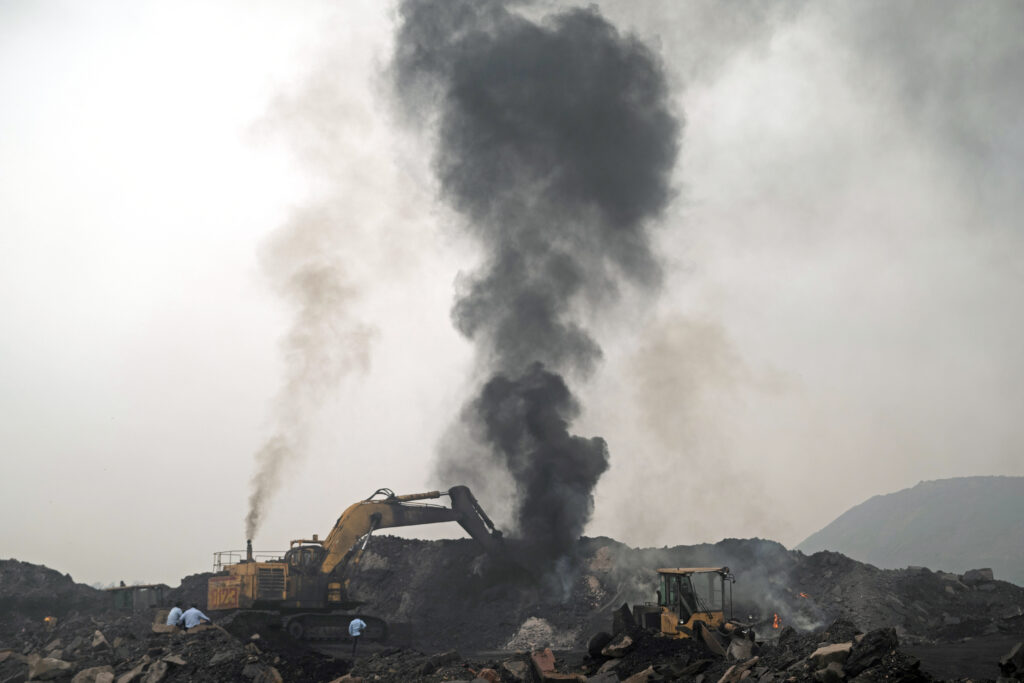
Non-fossil fuels now account for half of India’s installed energy capacity — years ahead of schedule — but the third-largest greenhouse gas polluter remains deeply reliant on coal for electricity generation.”A landmark in India’s energy transition journey,” Minister of Renewable Energy Pralhad Joshi proclaimed after the world’s most populous nation released figures in July.”Five years early,” he added, referring to India’s 2030 target under the Paris Agreement, and marking a step to the country’s stated goal of reaching net-zero emissions by 2070.But while the 50 percent milestone is significant, climate expert Avantika Goswami says the figures — which refer only to potential energy production — tell just part of the story.”Overall, actual generation from renewable sources is still quite low,” Goswami told AFP from the New Delhi-based Centre for Science and Environment (CSE).The reason is stark: nearly three-quarters of electricity continues to come from heavily polluting coal-burning power plants.- Coal paradox -The challenge becomes even more apparent when examining India’s continued dependence on coal. Far from decreasing its usage, the globe’s second-largest consumer of coal pushed up production of the dirty fossil fuel by five percent last year, mining one billion tonnes, according to the coal ministry.”Coal remains crucial,” the ministry said.The stance highlights the practical challenges of India’s energy transition. Coal is needed to fulfil power demands while storage capacity lags behind the surge in renewable sources of power.”The coal sector remains a crucial contributor to India’s energy mix, powering over 74 percent of the country’s electricity and sustaining key industries like steel and cement,” the coal ministry said, celebrating what it dubbed “India’s coal boom”.This reliance places India in a challenging position globally. The country ranks behind only China and the United States for carbon emissions overall.But analysts point out that in a country of 1.4 billion people, per capita emissions are only one-third of the global average, according to official figures.”Looking at India’s per capita emissions, the effort it is making, India is doing pretty well,” said activist Harjeet Singh, head of the Satat Sampada Climate Foundation.India has set itself the daunting challenge of reducing emissions by 45 percent by 2030.At the same time, electricity needs are expected to more than double by 2047, according to the country’s Center for Science and Environment.Supplying some of that demand “is likely to be met by the addition of renewables”, Goswami said.- ‘Waste that energy’ -Half of India’s 484.8 GW installed capacity is from non-fossil fuel sources.The majority comes from solar, totalling 119 GW — the third-largest level globally.India is building one of the world’s largest solar and wind energy farms, spread over a desert the size of Singapore.It is followed by hydro and wind, and also nuclear power — which makes up less than two percent of the total mix.But solar and wind create steady power only when the conditions are right, and India’s storage capacity is a meagre 505 MWh — far lower than it can generate.The storage bottleneck was not lost on the renewable energy minister.Speaking at the inauguration of a battery storage systems plant in June, Joshi said India’s renewable energy potential was “growing fast” and “adding 25–30 GW every year”. He added: “But without storage, we will either waste that energy or fall back on coal when renewables dip.”Building storage based on batteries requires rare earth metals, with rival and neighbour China controlling 70 percent of the world’s supplies.”We still remain dependent on China,” said Harjeet Singh, the climate activist. Chinese Foreign Minister Wang Yi was in New Delhi for talks on Tuesday, with the supply of rare earth metals on the agenda.One solution India is considering is pump-hydro energy storage projects. When wind and solar plants produce excess energy, water is pumped into high reservoirs. That stored energy can then be released to generate power when demand surges.But Goswami believes the transition to cleaner power requires a multi-pronged approach.The transition to cleaner power must come from “emission intensity reduction” of often inefficient coal plants, combined with better integrated renewable energy in the grid that “will actually make the shift happen”.
Israel demands release of all hostages after Hamas backs new truce offer

A senior Israeli official on Tuesday said the government stood firm on its call for the release of all hostages in any future Gaza ceasefire deal, after Hamas accepted a new truce proposal.Mediators are awaiting an official Israeli response to the plan, a day after Hamas signalled its readiness for a fresh round of talks aimed at ending nearly two years of war.Mediator Qatar expressed guarded optimism, noting the latest proposal was “almost identical” to an earlier version agreed to by Israel.Speaking on condition of anonymity, a senior Israeli official told AFP the government’s stance had not changed and demanded the release of all hostages in any deal.The two foes have held on-and-off indirect negotiations throughout the war, resulting in two short truces during which Israeli hostages were released in exchange for Palestinian prisoners, but they have ultimately failed to broker a lasting ceasefire. Qatar and Egypt, backed by the United States, have mediated the frequent rounds of shuttle diplomacy.Egypt said Monday that it and Qatar had sent the new proposal to Israel, adding “the ball is now in its court”. Qatari foreign ministry spokesman Majed al-Ansari said on Tuesday that Hamas had given a “very positive response, and it truly was almost identical to what the Israeli side had previously agreed to”.”We cannot make any claims that a breakthrough has been made. But we do believe it is a positive point,” he added.- Mounting pressure -According to a report in Egyptian state-linked outlet Al-Qahera News, the latest deal proposes an initial 60-day truce, a partial hostage release, the freeing of some Palestinian prisoners and provisions allowing for the entry of aid.Israeli Prime Minister Benjamin Netanyahu has yet to publicly comment on the plan, but said last week that his country would accept “an agreement in which all the hostages are released at once and according to our conditions for ending the war”.Senior Hamas official Mahmoud Mardawi said on social media that his group had “opened the door wide to the possibility of reaching an agreement, but the question remains whether Netanyahu will once again close it, as he has done in the past”. Hamas’s acceptance of the proposal came as Netanyahu faces increasing pressure at home and abroad.On Sunday, tens of thousands took to the streets in the Israeli city of Tel Aviv to call for an end to the war and a deal to free the hostages still held captive.Of the 251 hostages taken during Hamas’s October 2023 attack that triggered the war, 49 are still in Gaza, including 27 the Israeli military says are dead.The new proposal also comes after Israel’s security cabinet approved plans to conquer Gaza City, despite fears it will worsen the already catastrophic humanitarian crisis.On Tuesday, the new offensive was presented to the defence minister by the military’s top brass.Israel’s far-right National Security Minister Itamar Ben Gvir — who has staunchly opposed ending the war — slammed the plan, warning of a “tragedy” if Netanyahu “gives in to Hamas”.Senior Hamas official Bassem Naim said: “Unfortunately, today’s Zionist reactions reflect Netanyahu’s malicious intentions to continue the war, genocide and ethnic cleansing.”- ‘Unbearable’ -In Gaza, the civil defence agency reported Israeli strikes and fire killed 48 people across the territory on Tuesday.Agency spokesman Mahmud Bassal told AFP the situation was “very dangerous and unbearable” in the Zeitoun and Sabra neighbourhoods of Gaza City, where he said “artillery shelling continues intermittently”.The Israeli military declined to comment on specific troop movements, saying only that it was “operating to dismantle Hamas military capabilities” and took “feasible precautions to mitigate civilian harm”.The military later said a strike in Khan Yunis overnight targeted a Hamas militant.Media restrictions in Gaza and difficulties accessing swaths of the Palestinian territory mean AFP is unable to independently verify the tolls and details provided by the civil defence agency or the Israeli military.In the Zikim area of northern Gaza on Tuesday, an AFP journalist saw Palestinians hauling sacks of food aid along dusty roads lined with rubble and damaged buildings.Gazan Shawg Al-Badri said it took “three to four hours” to carry flour, what she called “white gold”, back to her family’s tent.”This bag is worth the whole world,” she said.Hamas’s October 2023 attack on Israel resulted in the deaths of 1,219 people, mostly civilians, according to an AFP tally based on official figures.Israel’s offensive has killed at least 62,064 Palestinians, most of them civilians, according to figures from the health ministry in Hamas-run Gaza, which the United Nations considers reliable.

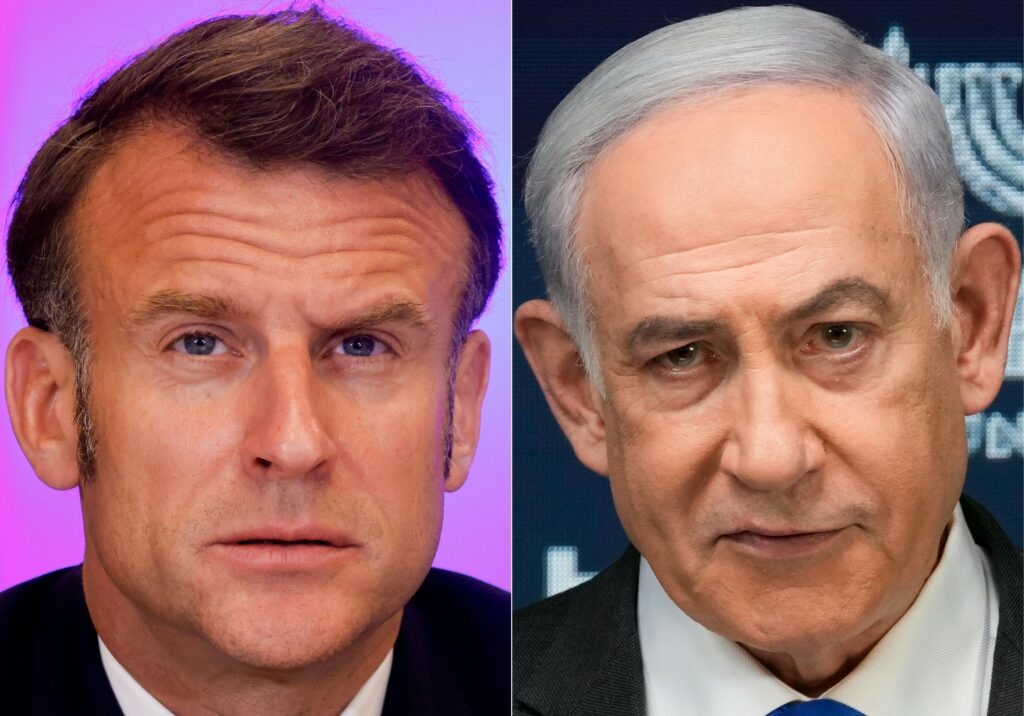
Nouvelle crise entre Netanyahu et Macron, accusé de nourrir l’antisémitisme

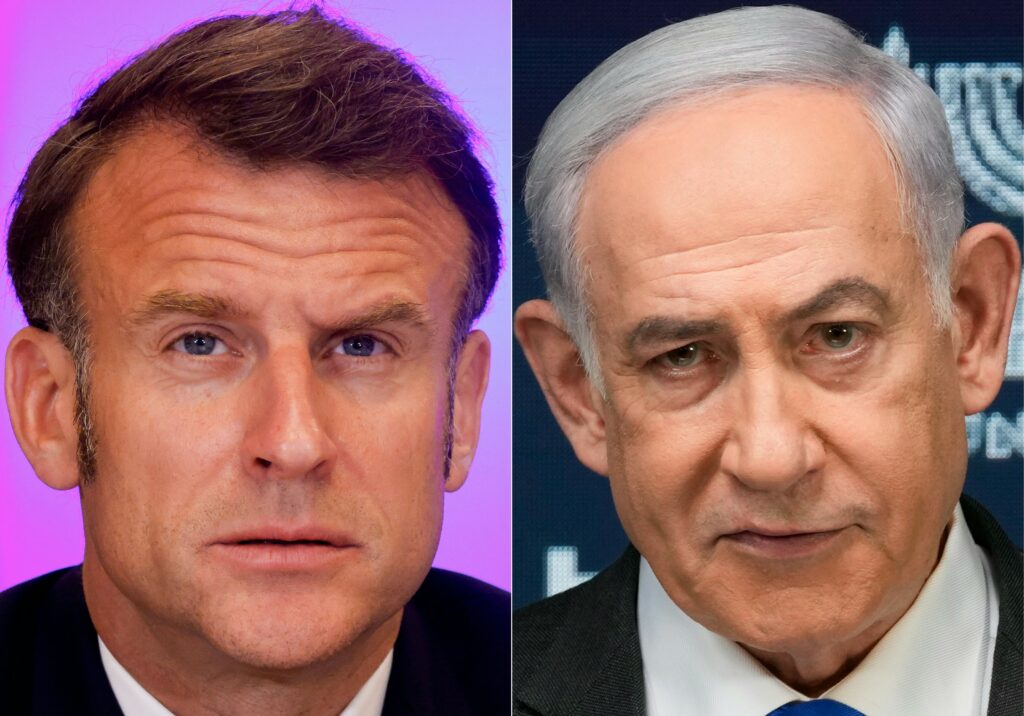
La relation entre la France et Israël est entrée dans une nouvelle zone de crise, cette fois-ci sur le sujet très sensible de l’antisémitisme, Benjamin Netanyahu accusant Emmanuel Macron de nourrir la haine contre les juifs avec son intention de reconnaître l’Etat palestinien.La charge très violente du Premier ministre israélien est contenue dans un courrier officiel adressé au président français. Elle a provoqué une réponse non moins ferme de l’Elysée.Accusant Emmanuel Macron “d’alimenter le feu antisémite” en France en appelant à la reconnaissance internationale de l’Etat de Palestine, Benjamin Netanyahu l’appelle “à remplacer la faiblesse par l’action, l’apaisement par la volonté, et à le faire avant une date claire: la nouvelle année juive, le 23 septembre 2025″.”Je suis préoccupé par la montée alarmante de l’antisémitisme en France et par le manque d’actions décisives de votre gouvernement pour y faire face. Ces dernières années, l’antisémitisme a ravagé les villes françaises”, écrit M. Netanyahu qui affirme qu’il a encore augmenté depuis la décision française sur l’Etat palestinien.Cette analyse “est erronée, abjecte et ne demeurera pas sans réponse”, a répliqué la présidence française, en précisant que le chef de l’Etat ferait une réponse écrite formelle au chef du gouvernement israélien.”La période exige gravité et responsabilité, pas amalgames et manipulations”, a encore indiqué la présidence française qui a ajouté que “la République protège et protègera toujours ses compatriotes de confession juive”.Le ministère des Affaires étrangères de l’Autorité palestinienne “considère cette attaque comme injustifiée et hostile à la paix et au consensus international sur le principe d’une solution à deux Etats”, a-t-il dit dans un communiqué. “Le vieux disque qui entretient la confusion entre la critique de l’occupation israélienne et ses crimes ou le soutien aux droits du peuple palestinien à la paix et l’indépendance avec l’antisémitisme ou la haine contre les juifs s’est rayé (…), personne n’est dupe”, a-t-il ajouté.Fin juillet, M. Macron a annoncé que la France allait reconnaître l’Etat de Palestine à l’Assemblée générale de l’ONU en septembre. Dans la foulée plus d’une dizaine de pays occidentaux parmi lesquels le Canada, ainsi que l’Australie, ont appelé d’autres nations du monde à faire de même.L’Assemblée générale de l’ONU prévue en septembre prend fin précisément le 23, date posée par M. Netanyahu dans son courrier.Selon la presse australienne, Benjamin Netanyahu a envoyé le 17 août un courrier similaire au Premier ministre australien, Anthony Albanese, qu’il accuse également “d’alimenter le feu antisémite”, et qu’il somme lui aussi d’agir. Dans sa lettre, le leader israélien loue en contre-exemple le président américain, Donald Trump, pour son “combat” contre les crimes antisémites et pour “protéger les juifs américains”.”Président Macron, l’antisémitisme est un cancer. Il se propage lorsque les dirigeants restent silencieux. Il recule lorsque les dirigeants agissent”, apostrophe encore M. Netanyahu.- Violences inadmissibles -Dans sa lettre, M. Netanyahu liste plusieurs incidents récents, notamment le saccage de l’entrée de bureaux de la compagnie aérienne israélienne El Al à Paris, l’agression d’un homme juif à Livry-Gargan, ou des rabbins “agressés dans les rues de Paris”. “Ces incidents ne sont pas isolés. Ils constituent une plaie”, souligne-t-il.Les actes antisémites sont en nette progression en France depuis le 7-Octobre 2023, date des attaques sans précédent du Hamas contre Israël et du déclenchement de la guerre à Gaza. Le contexte est  particulièrement délicat puisque vit en France la plus grande communauté juive d’Europe occidentale, avec environ 500.000 personnes, en même temps qu’une très importante communauté arabo-musulmane, très sensible au sort des Palestiniens de Gaza.”Les violences contre la communauté juive sont inadmissibles. C’est pourquoi, au-delà des condamnations, le chef de l’Etat a systématiquement demandé à tous ses gouvernements depuis 2017 -et encore davantage après les attentats terroristes du 7 octobre 2023- la plus grande fermeté à l’endroit des auteurs d’actes antisémites”, a ajouté l’Elysée.Après avoir affiché sa solidarité avec Israël après le 7-Octobre, Emmanuel Macron a depuis pris ses distances et multiplié les critiques à l’égard de la stratégie du gouvernement israélien à Gaza. Les appels téléphoniques entre les deux leaders, très fréquents au début de la période, se sont raréfiés.Désaccord sur les livraisons d’armes, critiques sur la tragédie humanitaire que vit le territoire palestinien qualifiée de “honte” et de “scandale” ou encore sur la politique de colonisation en Cisjordanie: les motifs de frictions et de différends se sont succédé.L’attaque du 7-Octobre a entraîné la mort côté israélien de 1.219 personnes, en majorité des civils, selon un décompte de l’AFP réalisé à partir de données officielles.L’offensive de représailles israélienne a fait 62.064 morts à Gaza, majoritairement des civils, selon les données du ministère de la Santé du Hamas, jugées fiables par l’ONU.

Nouvelle crise entre Netanyahu et Macron, accusé de nourrir l’antisémitisme

La relation entre la France et Israël est entrée dans une nouvelle zone de crise, cette fois-ci sur le sujet très sensible de l’antisémitisme, Benjamin Netanyahu accusant Emmanuel Macron de nourrir la haine contre les juifs avec son intention de reconnaître l’Etat palestinien.La charge très violente du Premier ministre israélien est contenue dans un courrier officiel adressé au président français. Elle a provoqué une réponse non moins ferme de l’Elysée.Accusant Emmanuel Macron “d’alimenter le feu antisémite” en France en appelant à la reconnaissance internationale de l’Etat de Palestine, Benjamin Netanyahu l’appelle “à remplacer la faiblesse par l’action, l’apaisement par la volonté, et à le faire avant une date claire: la nouvelle année juive, le 23 septembre 2025″.”Je suis préoccupé par la montée alarmante de l’antisémitisme en France et par le manque d’actions décisives de votre gouvernement pour y faire face. Ces dernières années, l’antisémitisme a ravagé les villes françaises”, écrit M. Netanyahu qui affirme qu’il a encore augmenté depuis la décision française sur l’Etat palestinien.Cette analyse “est erronée, abjecte et ne demeurera pas sans réponse”, a répliqué la présidence française, en précisant que le chef de l’Etat ferait une réponse écrite formelle au chef du gouvernement israélien.”La période exige gravité et responsabilité, pas amalgames et manipulations”, a encore indiqué la présidence française qui a ajouté que “la République protège et protègera toujours ses compatriotes de confession juive”.Le ministère des Affaires étrangères de l’Autorité palestinienne “considère cette attaque comme injustifiée et hostile à la paix et au consensus international sur le principe d’une solution à deux Etats”, a-t-il dit dans un communiqué. “Le vieux disque qui entretient la confusion entre la critique de l’occupation israélienne et ses crimes ou le soutien aux droits du peuple palestinien à la paix et l’indépendance avec l’antisémitisme ou la haine contre les juifs s’est rayé (…), personne n’est dupe”, a-t-il ajouté.Fin juillet, M. Macron a annoncé que la France allait reconnaître l’Etat de Palestine à l’Assemblée générale de l’ONU en septembre. Dans la foulée plus d’une dizaine de pays occidentaux parmi lesquels le Canada, ainsi que l’Australie, ont appelé d’autres nations du monde à faire de même.L’Assemblée générale de l’ONU prévue en septembre prend fin précisément le 23, date posée par M. Netanyahu dans son courrier.Selon la presse australienne, Benjamin Netanyahu a envoyé le 17 août un courrier similaire au Premier ministre australien, Anthony Albanese, qu’il accuse également “d’alimenter le feu antisémite”, et qu’il somme lui aussi d’agir. Dans sa lettre, le leader israélien loue en contre-exemple le président américain, Donald Trump, pour son “combat” contre les crimes antisémites et pour “protéger les juifs américains”.”Président Macron, l’antisémitisme est un cancer. Il se propage lorsque les dirigeants restent silencieux. Il recule lorsque les dirigeants agissent”, apostrophe encore M. Netanyahu.- Violences inadmissibles -Dans sa lettre, M. Netanyahu liste plusieurs incidents récents, notamment le saccage de l’entrée de bureaux de la compagnie aérienne israélienne El Al à Paris, l’agression d’un homme juif à Livry-Gargan, ou des rabbins “agressés dans les rues de Paris”. “Ces incidents ne sont pas isolés. Ils constituent une plaie”, souligne-t-il.Les actes antisémites sont en nette progression en France depuis le 7-Octobre 2023, date des attaques sans précédent du Hamas contre Israël et du déclenchement de la guerre à Gaza. Le contexte est  particulièrement délicat puisque vit en France la plus grande communauté juive d’Europe occidentale, avec environ 500.000 personnes, en même temps qu’une très importante communauté arabo-musulmane, très sensible au sort des Palestiniens de Gaza.”Les violences contre la communauté juive sont inadmissibles. C’est pourquoi, au-delà des condamnations, le chef de l’Etat a systématiquement demandé à tous ses gouvernements depuis 2017 -et encore davantage après les attentats terroristes du 7 octobre 2023- la plus grande fermeté à l’endroit des auteurs d’actes antisémites”, a ajouté l’Elysée.Après avoir affiché sa solidarité avec Israël après le 7-Octobre, Emmanuel Macron a depuis pris ses distances et multiplié les critiques à l’égard de la stratégie du gouvernement israélien à Gaza. Les appels téléphoniques entre les deux leaders, très fréquents au début de la période, se sont raréfiés.Désaccord sur les livraisons d’armes, critiques sur la tragédie humanitaire que vit le territoire palestinien qualifiée de “honte” et de “scandale” ou encore sur la politique de colonisation en Cisjordanie: les motifs de frictions et de différends se sont succédé.L’attaque du 7-Octobre a entraîné la mort côté israélien de 1.219 personnes, en majorité des civils, selon un décompte de l’AFP réalisé à partir de données officielles.L’offensive de représailles israélienne a fait 62.064 morts à Gaza, majoritairement des civils, selon les données du ministère de la Santé du Hamas, jugées fiables par l’ONU.

Asian markets dip after US tech slide

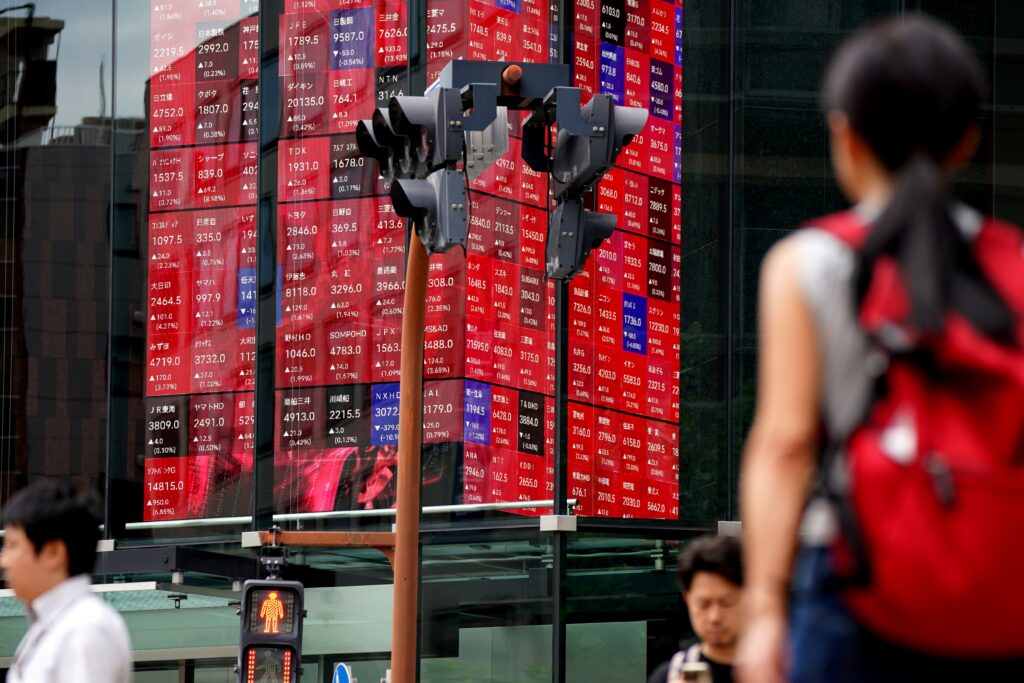
Asian markets mostly fell Wednesday morning, mirroring a rout of US tech titans the previous day as investors await signals of an interest rate cut in the world’s largest economy.The dips also came after top US and European military leaders met in Washington on Tuesday to discuss the mechanics of a possible Ukraine peace deal.Recent days have seen a whirlwind of diplomatic efforts to resolve the protracted war after President Donald Trump’s high-stakes meeting with Russian counterpart Vladimir Putin in Alaska.Eyes are now on potential face-to-face talks between Putin and Ukrainian President Volodymyr Zelensky, who has said he is ready for such a meeting.The negotiations have sparked volatility in oil markets, which fell back Tuesday from gains made on Monday.Tokyo’s Nikkei dropped sharply during Wednesday morning trading, while shares in Hong Kong, South Korea, Taipei and Bangkok also fell. Shanghai, Sydney and Manila rose.The previous day on Wall Street saw several major technology firms lose significant market share, including Nvidia, Palantir and Oracle.The selloffs come amid increasing unease over a prolonged rally in tech stocks this year despite a range of uncertainties facing the global economy.Among the challenges are biting tariffs unleashed by Trump on major US trading partners this year.Official data showed Wednesday morning that Japanese exports suffered their steepest drop in more than four years last month.Meanwhile, investors are eagerly awaiting a speech on Friday by US Federal Reserve Chair Jerome Powell at the annual retreat of global central bankers in Jackson Hole, Wyoming.Traders also hope Powell will provide more clues about a widely expected interest rate cut at the Fed’s next policy meeting in September, after data last week provided a mixed picture about inflation in the United States.”Powell’s Wyoming speech is being framed as a high-wire act,” wrote Stephen Innes of SPI Asset Management in a note.”Too dovish, and he risks stoking long-end inflation fears; too stern, and he risks yanking the oxygen mask off equities already trading in rarified air.”- Key figures at around 0215 GMT -Tokyo – Nikkei 225: DOWN 1.6 percent at 42835.84Hong Kong – Hang Seng Index: DOWN 0.3 percent at 25045.13Shanghai – Composite: UP 0.1 percent at 3,731.51Euro/dollar: DOWN at $1.1625 from $1.1646 on TuesdayPound/dollar: DOWN at $1.3465 from $1.3489Dollar/yen: DOWN at 147.60 yen from 147.64 yenEuro/pound: UP at 86.34 pence from 86.33 penceWest Texas Intermediate: UP 0.6 percent at $62.72 per barrelBrent North Sea Crude: UP 0.1 percent at $65.86 per barrelNew York – Dow: FLAT at 44,922.27 (close)London – FTSE 100: UP 0.3 percent at 9,189.22 (close)

City girls snub traditional Hindu face tattoos in Pakistan

Grinding charcoal with a few drops of goat’s milk, 60-year-old Basran Jogi peers at the faces of two small Pakistani sisters preparing for their first tattoos.The practice of elder women needling delicate shapes onto the faces, hands, and arms of younger generations stretches back centuries in the Hindu villages that dot the southern border with India.”First draw two straight lines between the eyebrows,” Jogi instructs her friend poised with a sewing needle.”Now insert the needle along the lines – but slowly, until it bleeds.”Six-year-old Pooja barely winces as dotted circles and triangles are tattooed onto her chin and forehead.On the outskirts of the rural town of Umerkot in Sindh province, her seven-year-old sister Champa declares eagerly beside her that “I am ready too”.In recent years, however, as rural Hindu communities in Muslim-majority Pakistan become more connected to nearby cities, many young women have opted out of the “old ways”.”These signs set us apart from others,” said 20-year-old Durga Prem, a computer science student who grew up in the nearby city of Badin.”Our generation doesn’t like them anymore. In the age of social media, young girls avoid facial tattoos because they think these marks will make them look different or unattractive.”Her sister Mumta has also refused to accept the tattoos that mark their mother and grandmothers.”But if we were still in the village, we might have had these marks on our faces or arms,” she reflects.- Ward off evil spirits -Just two percent of Pakistan’s 240 million people are Hindu, and the majority live in rural areas of southern Sindh province.Discrimination against minorities runs deep and Hindu activist Mukesh Meghwar, a prominent voice for religious harmony, believes younger generations do not want to be instantly identified as Hindu in public.Many Muslims believe tattoos are not permissible in Islam, and even those who have them rarely display them in public.”We can’t force our girls to continue this practice,” Meghwar told AFP. “It’s their choice. But unfortunately, we may be the last generation to see tattoos on our women’s faces, necks, hands, and arms,” he said.Few Hindus that AFP spoke with recalled the meaning behind the practice of tattoos or when it began, but anthropologists believe it has been part of their cultural heritage for hundreds of years.”These symbols are part of the culture of people who trace their roots to the Indus civilisation,” anthropologist Zulfiqar Ali Kalhoro told AFP, referring to a Bronze Age period that pre-dates modern religion.”These ‘marks’ were traditionally used to identify members of a community” and to “ward off evil spirits”, he adds. Admiring the work on the grinning faces of the two little sisters, elder Jogi agreed that it was an ancestral tradition that enhanced the beauty of women. “We don’t make them for any specific reason – it’s a practice that has continued for years. This is our passion,” she told AFP.The marks that begin dark black quickly fade to a deep green colour, but last a lifetime. “They belong to us,” said Jamna Kolhi, who received her first tattoos as a young girl alongside Jogi. “These were drawn by my childhood friend –- she passed away a few years ago,” 40-year-old Jamna Kolhi told AFP.”Whenever I see these tattoos, I remember her and those old days. It’s a lifelong remembrance.”