Tabac, alcool, cannabis: les ados sont de moins en moins accro

Un seul shot en 12 jours, bu “par politesse”: le bilan des vacances à Malte entre amis de Martin, 18 ans, pour la fin du lycée, semble représentatif de la consommation de plus en plus d’adolescents français. Sans drogues, ni tabac, et presque sans alcool.Seuls 20% des Français de 16 ans déclaraient en 2024 avoir déjà consommé du tabac et 8,4% du cannabis, selon une étude européenne sur la consommation des jeunes, relayée début septembre par l’Observatoire français des drogues et des toxicomanies (OFDT).Par rapport à 2015, on trouve ainsi cinq fois moins de fumeurs quotidiens et trois fois moins de jeunes ayant expérimenté le cannabis, pointe l’étude.Si Martin n’a jamais touché à une cigarette, il a déjà “testé” l’alcool et le cannabis, à la fin du collège. “Les premières fois où tu consommes, c’est soit sous la pression sociale, soit pour faire le grand”, estime l’étudiant tout juste entré en première année de droit à Paris. Depuis le lycée, il prône cependant la sobriété, avec pour motifs sa foi chrétienne, sa pratique sportive ou encore tout simplement sa capacité à s’amuser avec ses amis sans recours à une substance psychoactive.Cela semble aller dans le sens d’une tendance générale, celle d'”une prise de conscience dans la société (…) des effets délétères de ces comportements”, juge Nicolas Prisse, président de la Mission interministérielle de lutte contre les drogues et les conduites addictives. Une vaste enquête menée en 2022 par l’OFDT sur 23.000 Français de 17 ans pointait déjà une tendance à la baisse de leur consommation de substances psychoactives, démontrant selon le médecin de santé publique que “la bataille de la dénormalisation” est en passe d’être gagnée.- “Super cher” -Au premier plan, le tabac: Charlotte, 16 ans, boit de temps en temps en soirée ou en boîte, mais pas question de “tomber” dans “la dépendance à la nicotine”. Sa mère, elle-même fumeuse, le lui a d’ailleurs interdit. “Elle y est tombée hyper jeune et maintenant, c’est vraiment une addiction”, déplore la lycéenne scolarisée en banlieue toulousaine, soulignant que “ça coûte super cher”. Et en effet, l’augmentation constante du prix, le paquet neutre, l’interdiction de vente aux mineurs, constituent un “arsenal de régulation” pouvant expliquer que la consommation de tabac ne soit “plus populaire chez les jeunes”, entraînant avec elle celle du cannabis, autre “produit à fumer”, selon M. Prisse. Une autre explication à cette évolution pourrait être la “dégradation de la santé mentale” observée chez les jeunes, entraînant un “repli sur soi”, à l’âge où la consommation est liée à une “conformité sociale du groupe”, selon le médecin.  Parmi les amis de Ruben, 17 ans, par exemple, on sort assez peu. Ce lycéen de Toulouse n’a jamais essayé ni tabac, ni cannabis, ni cigarette électronique, pour lesquels il n’a “pas tellement de curiosité”. En revanche, il se voit consommer de l’alcool “plus tard”, quand il aura “plus d’occasions d’en boire”.Car l’alcool reste central dans la socialisation des adolescents. Sept sur dix l’avaient déjà essayé en 2024, selon l’étude européenne relayée par l’OFDT, avec une fréquence notable d'”alcoolisations ponctuelles importantes” (binge drinking), soit au moins cinq verres d’alcool lors d’une même occasion. “Être bourrée, ça me fait un peu peur, parce que j’ai des copines qui ont déjà été pas très bien, au point de devoir appeler l’hôpital”, raconte Clara (prénom modifié), 15 ans. Dans les soirées de cette élève de seconde scolarisée à Saint-Mandé (Val-de-Marne), “il y a de l’alcool” et certains jeunes de son âge “ne savent pas vraiment leurs limites”.- Industriels “très inventifs” -Tout n’est donc pas encore gagné et “il faut rester prudent”, estime Nicolas Prisse. “Les industriels -ou d’ailleurs parfois les groupes criminels, quand il s’agit de stupéfiants et de produits interdits- sont très inventifs en termes de tendances et de propositions d’offres sur le marché”, ajoute-t-il. Les “puffs”, cigarettes électroniques jetables, en sont un bon exemple. Interdites à la vente depuis février en France mais qui continuent d’être vendues notamment dans les petites épiceries, elles restent une tendance bien réelle chez les adolescents, comme en témoignent les jeunes interrogés par l’AFP.”C’est aux fruits, ça sent bon”, contrairement aux cigarettes, explique Clara. “Ca a pas l’air très dangereux”, estime la lycéenne, pourtant consciente de leur nocivité.

Botox under burqas: Cosmetic surgery in vogue in Afghanistan

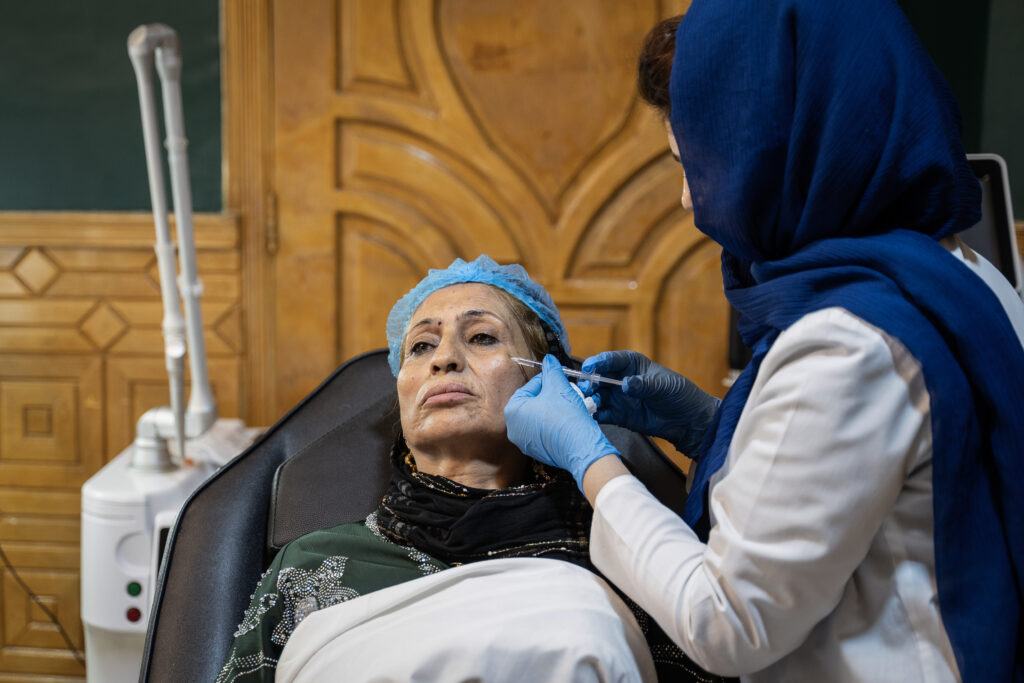
Decked out with fake crystal chandeliers and velvet sofas, cosmetic surgery clinics in Afghanistan’s capital are a world away from the austerity of Taliban rule, where Botox, lip filler, and hair transplants reign.Despite the Taliban authorities’ strict theocratic rule and prevailing conservatism and poverty in Afghanistan, the 20 or so clinics in Kabul have flourished since the end of decades of war in the country.Foreign doctors, especially from Turkey, travel to Kabul to train Afghans, who equally undertake internships in Istanbul, while equipment is imported from Asia or Europe.In the waiting rooms, the clientele is often well-off and includes men with thinning hair. But the majority are women, sometimes heavily made up and always covered from head to toe, more rarely in an all-enveloping burqa.At 25, Silsila Hamidi decided to get a second facelift, convinced her skin had suffered from the stress of being a woman in Afghanistan.”Even if others can’t see us, we see ourselves: looking beautiful in the mirror gives us energy,” said Hamidi, before she went under the knife to lift the upper part of her face, which “was starting to sag”.Skirting details, the medical school graduate said her skin suffers from the “many pressures” faced by Afghan women.Under Taliban government restrictions, women’s access to work has been severely constrained. They can no longer travel long distances without a male guardian, must not raise their voices outside the home and are banned from universities, parks and gyms. – Salons banned, but not Botox – While surgical cosmetic interventions may be booming, hair salons and beauty parlours catering to women have been banned.”If they were open… our skin wouldn’t be in this state, we wouldn’t need surgery,” said Hamidi, who, at 23, had work done on the lower part of her face.The Taliban authorities, who ordinarily forbid altering physical characteristics in accordance with their interpretation of Islamic law, did not reply for multiple requests for comment on cosmetic surgery.Those in the sector said it is allowed as it is considered medicine. The government does not interfere with their work, clinic workers told AFP, but morality police check that gender segregation is respected: a male nurse for a male patient, a female nurse for a female patient.Some claim that even Taliban members are clients. “Here, having no hair or beard is considered a sign of weakness,” said Sajed Zadran, deputy director of the Negin Asia clinic, which boasts state of-the-art Chinese-made equipment.Since the Taliban ordered men to grow their beards at least the length of a fist, transplants have become fashionable, said Bilal Khan, co-director of the EuroAsia clinic, which is about to open a second facility.And because not all clients are wealthy, some “borrow money to have hair before their wedding”, Khan added.In the four-storey villa transformed into a clinic, the methods are the same as those used abroad and pose “no risk”, said Abdul Nassim Sadiqi, a dermatologist. At his clinic, it costs $43-87 for Botox and $260-509 for hair implants. – Instagram effect -The sums are a fortune for many Afghans — nearly half of whom live in poverty, according to the World Bank — but a boon for those like Mohammed Shoaib Yarzada, an Afghan restaurateur based in London.Put off by the thousands of pounds (dollars) required in Britain for the same operation, he took advantage of his first visit to Afghanistan in 14 years to have his scalp replenished.”When I enter the clinic, it’s as if I am abroad, in Europe,” he said. To attract new customers, each clinic floods its social media pages with promises of beauty: smoothed skin, plump lips and abundant hair.Afghanistan, like the West, is not exempt from the sway of social media influencers, said Lucky Khaan, 29, co-director of Negin Asia, which registers dozens of new patients every day.”Many patients come without real problems but want to have surgery because they have seen trends on Instagram,” said Khaan, a Russian doctor of Afghan origin, whose face is wrinkle-free.While according to the UN, 10 million Afghans suffer from hunger and one in three lacks access to basic medical care, some, “who lack money for food, prefer to invest in their beauty”, added the surgeon. 

EU business lobby head says China rare earths snag persists

European firms still face challenges in securing access to crucial rare earths from China, a business lobby warned Wednesday, despite a July deal to speed up exports.China dominates the global industry for extracting and refining the strategic minerals, giving it vital leverage in a renewed trade war this year with Washington.Since April, Beijing has required licences for certain exports, sending ripple effects across worldwide manufacturing sectors.Following a tense summit in July hosted by Beijing, European Union chief Ursula von der Leyen said that leaders had agreed to an improved mechanism for Chinese exports of rare earth minerals to the bloc.But in its annual position paper released Wednesday, the European Union Chamber of Commerce in China said that “many companies — particularly small and medium-sized enterprises (SMEs) — are still experiencing significant supply chain disruptions”.”No long-term, sustainable solution has been put forward,” it said, adding that the Chamber is in “regular contact” with Chinese authorities on the matter.”We have a number of members who are right now suffering significant losses because of these bottlenecks,” Chamber president Jens Eskelund told journalists.”We have raised with our members more than 140 applications and it’s a fraction of these so far that have been resolved,” he said.”So this has not gone away.”In its latest publication, the lobby representing over 1,600 member companies put forward 1,141 recommendations to Chinese policymakers, aimed at smoothing over various obstacles faced by European firms in the country.Chief among those hurdles this year, Eskelund said, is a wavering Chinese economy that has struggled to mount a robust rebound since the end of the Covid-19 pandemic.Sluggish consumption, a manufacturing glut and prolonged woes in the country’s vast property sector are among the main challenges now vexing Beijing policymakers and businesses.In a sign of entrenched woes facing the world’s second-largest economy, data released this week showed factory output and consumption rising in August at their weakest pace in around a year. “I actually see a greater convergence in terms of the challenges Chinese companies have and the challenges foreign companies have,” said Eskelund.”The big enemy here — that’s the state of the domestic economy and supply-demand balance,” he said.”I think we see completely eye-to-eye with the vast majority of Chinese companies.”