Mondial-2026: le patron de la Fifa serein malgré les violences au Mexique

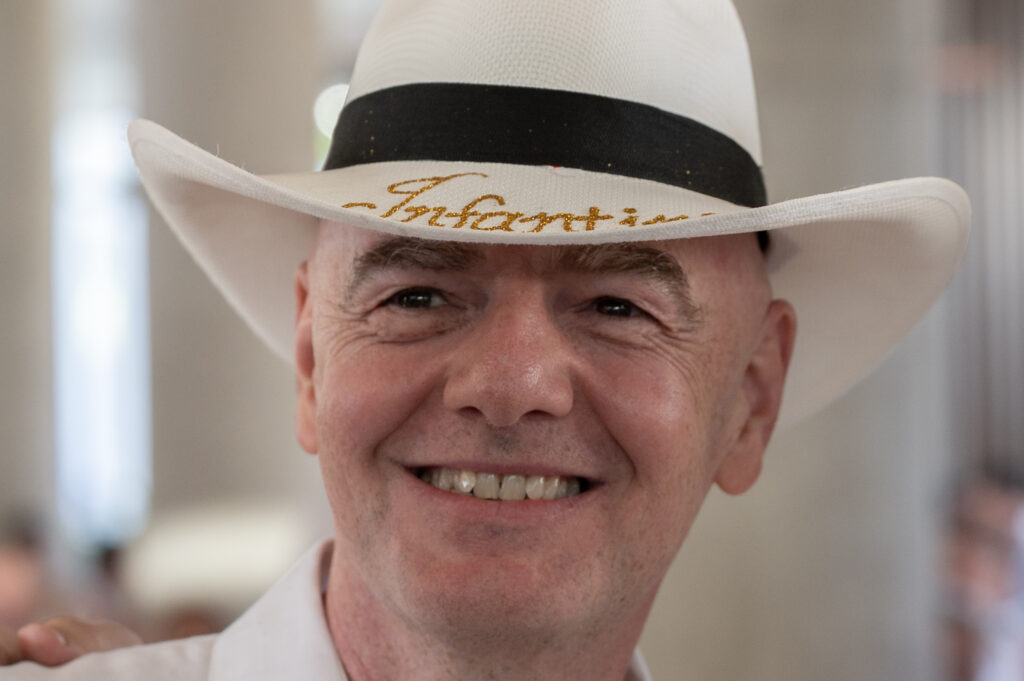
Le président de la Fifa, Gianni Infantino, s’est dit mardi serein au sujet de l’accueil par le Mexique de certains matches de la Coupe du monde de football 2026, après une vague de violence dans le pays liée à la mort d’un puissant baron de la drogue.Des dizaines de morts, des véhicules incendiés, des commerces fermés, des routes bloquées et un climat de terreur ont paralysé une grande partie du pays latino-américain dimanche, après la mort de Nemesio Oseguera, alias “El Mencho”, chef du puissant cartel Jalisco Nueva Generacion (CJNG), lors d’une opération militaire.Mais le patron de la Fédération internationale de football s’est voulu rassurant à moins de quatre mois du début du Mondial, que le Mexique co-organise avec les Etats-Unis et le Canada du 11 juin au 19 juillet.Interrogé par l’AFP à Barranquilla, dans le nord de la Colombie à l’occasion d’un événement de la fédération nationale de football, Gianni Infantino s’est dit “très tranquille” et a assuré que “tout va très bien, tout sera fantastique”.”Nous avons pleinement confiance en le Mexique et en sa présidente (Claudia Sheinbaum)”, a-t-il ajouté, affirmant être “en contact régulier” avec les autorités locales et suivre “la situation”.Il s’agit de ses premières déclarations après les violences qui ont éclaté dimanche dans une grande partie du Mexique, dont Guadalajara (ouest) qui doit accueillir quatre rencontres du Mondial-2026.Lors de l’opération militaire pour la capture du baron de la drogue et les représailles émanant du cartel qui ont suivi, 25 membres de la garde nationale, ainsi qu’un agent de sécurité, un fonctionnaire du parquet et une civile ont été tués, ainsi que 46 membres présumés de l’organisation criminelle.Quelque 10.000 soldats ont été déployés pour rétablir l’ordre.La présidente mexicaine, Claudia Sheinbaum, a écarté mardi tout risque pour les supporters de foot se rendant à Guadalajara, assurant que “toutes les garanties” de sécurité seraient réunies.En plus des quatre rencontres du Mondial, dont un match Uruguay-Espagne en phase de poule, Guadalajara accueillera en mars, conjointement avec Monterrey (nord-est), les barrages qui désigneront les deux dernières des 48 sélections qualifiées.A Mexico et Monterrey, les deux autres villes mexicaines hôtes de la Coupe du monde, aucun incident violent n’a été signalé.La fédération portugaise de football a remis en question la participation de son équipe à un match amical en mars à Mexico, en raison de “la situation délicate” que traverse le pays, selon un communiqué.Mais Javier Aguirre, le sélectionneur de l’équipe mexicaine, s’est dit confiant. “Tout se passe comme prévu” concernant la bonne tenue du match, a-t-il déclaré lors d’une conférence de presse.Deux matchs de foot avaient été suspendus dimanche dans le Jalisco et l’Etat de Querétaro, situé dans le centre du Mexique.- Retour à la normale -Nemesio Oseguera, alias El Mencho, 59 ans, était le narcotrafiquant le plus recherché par le gouvernement des Etats-Unis, qui offrait pour sa capture une récompense de 15 millions de dollars. Sa mort a déclenché une flambée de violence dans 20 des 32 Etats du pays, notamment dans des villes de l’Etat de Jalisco telles que Puerto Vallarta, une station balnéaire très fréquentée de la côte pacifique, prisée des Canadiens et Américains. “On a l’impression de se trouver dans une zone de guerre”, a témoigné auprès de l’AFP Javier Pérez, un habitant de 41 ans, en parcourant le parking d’un supermarché où gisaient des voitures calcinées.Mme Sheinbaum a assuré mardi que la situation revenait “peu à peu à la normale” et que les aéroports de Puerto Vallarta et Guadalajara fonctionnaient sans difficulté, après l’annulation de plusieurs vols.- Honda à l’arrêt -Le gouvernement de l’Etat de Jalisco a, de son côté, fait savoir que les activités économiques avaient repris mardi, et les écoles doivent rouvrir mercredi. Honda a néanmoins suspendu lundi ses activités à Guadalajara pour une durée non précisée. Une porte-parole du constructeur automobile japonais, interrogée mardi par l’AFP, a évoqué une “mesure de précaution”.Le Mexique abrite les usines de nombreux constructeurs automobiles comme Ford, General Motors, BMW et Audi, un secteur qui représente 3,6% du PIB du pays.
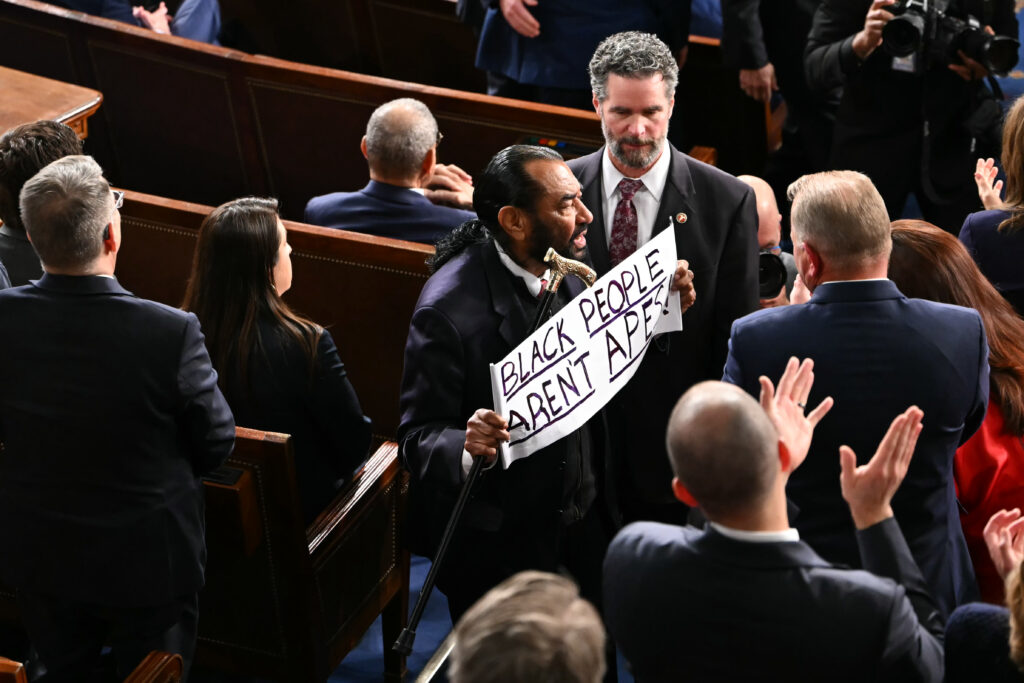
Lawmaker waves ‘Black people aren’t apes!’ sign at Trump address

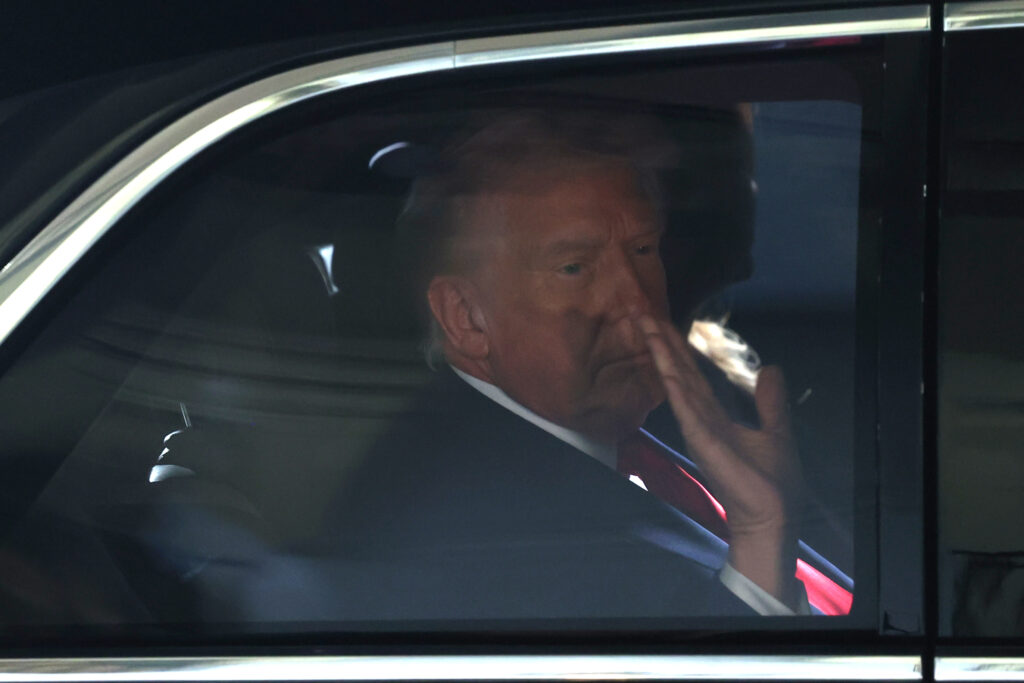
A Democratic lawmaker was ejected from US President Donald Trump’s State of the Union address Tuesday after holding up a sign reading “Black people aren’t apes!”, referencing a racist video of the Obamas posted on Trump’s social media account.The footage posted and then deleted on Trump’s Truth Social account earlier this month showed Barack and Michelle Obama — the first Black president and first lady in US history — depicted as monkeys, sparking outrage across the US political spectrum.Veteran congressman Al Green of Texas stood up as Trump arrived to address the joint session of Congress, waving the protest sign before someone in the crowd appeared to try and grab it from him.Green, who is Black, stood his ground and was still holding up the sign as Trump started his prime-time address. But the lawmaker was eventually escorted out of the chamber amid chants of “USA! USA! USA!”Last year Green shook his cane at Trump and shouted at him as the president addressed Congress, prompting jeers from Republicans across the aisle and leading congressional aides to escort him out as Trump looked on.

Nepali migrant workers influence polls, but can’t vote

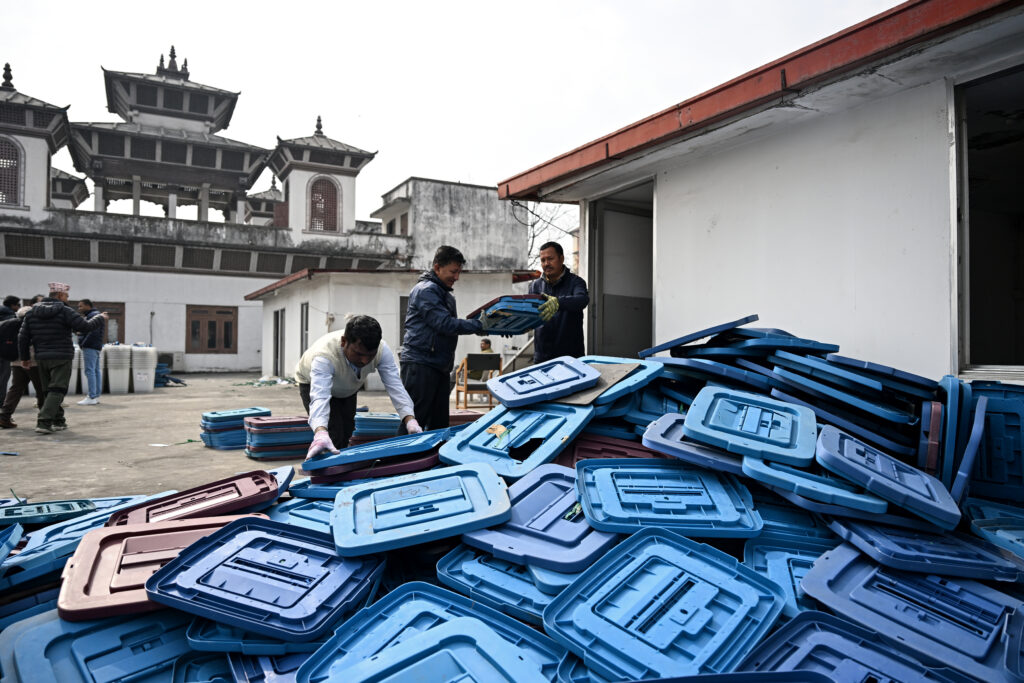
Overseas Nepali workers bankroll their families and buttress the economy, making them a key constituency in elections next week — but they cannot vote themselves.The Himalayan republic votes on March 5 in the first parliamentary elections since deadly youth-led protests toppled the government in September, fuelled by anger at a woeful economy and lack of opportunities.Unable to find jobs at home, some 2.5 million Nepalis — 7.5 percent of the population — work abroad to support their families, according to government figures.Political parties court migrants for the powerful influence they wield over voters back home.”As they are the main breadwinner of their families, they have a lot of influence,” said Ganesh Gurung, chief of Nepal’s Policy Research Institute.”Migrant workers are very active on social media,” he added, noting that online commentary has long shown “a lot of frustration” with successive governments.Nearly 90 percent of overseas workers have a “strong interest” in voting, according to a survey published in a report by Nepali migrant rights groups after last year’s uprising.”Indirect participation — such as recommending family voting choices or supporting campaigns online — is common,” read the report by migrant rights groups Shramik Sanjal and the Law and Policy Forum for Social Justice (LAPSOJ). The money they send back, from the Gulf and Saudi Arabia, or India and Malaysia, is equivalent to more than a third of GDP, according to the World Bank.”I have never exercised my voting rights because I was abroad when I turned 18,” Pradip Bagale, 43, a hotel worker in Qatar with two sons in Nepal, told AFP.”After the Gen Z movement, I thought the government would finally allow us to vote… but it did nothing.”- Stalled efforts -But legal efforts to challenge a 2017 election have made little progress. There is no system for them to cast ballots at embassies, by mail or electronically.The interim government — which took over after the September uprising — said it backed overseas voting, but reforms did not come in time.”The procedure couldn’t be changed without a legal basis and proper training,” said Prakash Nyaupanem, an Election Commission spokesman, adding that polls were “organised in a very short time”.In 2018, the Supreme Court ordered the government to “take measures”, but there has been no “significant development” since then, said human rights lawyer Barun Ghimire.Lawmakers drafted a new act in 2023, but budget constraints and security concerns about electronic voting meant “it never materialised”, a former member of the Electoral Commission said on condition of anonymity.In 2022 elections, the Rastriya Swatantra Party (RSP) made it a key issue — and shocked traditional parties by becoming the fourth-largest force in parliament.The same year, Balendra Shah, 35, drew on the support of migrants to be elected Kathmandu’s mayor.Shah is the RSP’s prime ministerial candidate next week.”He was elected mayor because of the pressure from Nepali nationals living abroad,” said Nilambar Badal, from the National Network for Safe Migration. “They influenced people in Kathmandu to vote for him.”- ‘Inevitable’ change -Shah told AFP that migrants “should get voting rights”, saying he would tackle the issue “if we reach government”.Other countries allow citizens based overseas to vote.”If both the government and the Election Commission had the willingness, they could have extended the election timeline and included Nepalis living abroad,” said Neil Kantha Uprety, a former chief election commissioner. Lawyer Ghimire said he believed such a change was “inevitable”, adding that the mere fact the issue was being debated made him “optimistic”.Once expatriates were included, their voice would aid democracy, he said.”Imagine a million people voting for a single political party,” he said. “That changes the entire political landscape. They could hold those elected accountable.”

Trump to promise ‘turnaround for the ages’ in State of the Union

US President Donald Trump was to deliver a high-stakes State of the Union address Tuesday, boasting of a “turnaround for the ages” and vowing to confront threats to America as conflict with Iran looms.In what promises to be a marathon speech to a joint session of Congress, Trump will seek to sell voters on the achievements of a breakneck and deeply divisive first year back in power.But the 79-year-old Republican faces a major challenge to reverse his dismal approval ratings and convince Americans ahead of crucial midterm elections in November.Republicans fear Trump’s unpopularity could lose them their wafer-thin majority in the House — paralyzing the rest of Trump’s second term and exposing him to a possible third impeachment.Trump however was set to strike a defiant tone in the first official State of the Union of his second term.”Tonight, after just one year, I can say with dignity and pride that we have achieved a transformation like no one has ever seen before, and a turnaround for the ages,” Trump was to say, according to excerpts released by the White House.Trump is expected to focus in particular on the economy, having promised a “golden age” despite their concerns about the cost of living.- ‘Confront threats to America’ -On the international front, the man who complained that he did not win last year’s Nobel peace prize is now mulling military strikes on Iran over its nuclear program and crackdown on protesters.”As president, I will make peace wherever I can — but I will never hesitate to confront threats to America wherever we must,” Trump was to say, according to the excerpts.His spokeswoman posted a picture of Trump with his Iran negotiators Steve Witkoff and Jared Kushner shortly before the speech.The president himself warned on Monday that the first official State of the Union of his second term was “going to be a long speech because we have so much to talk about.”Speculation mounted that the speech could be as long as three hours — far outstripping the hour and 40 minutes that Trump gave in the longest ever speech to lawmakers last year.But Trump has been battered by a series of blows in the second year of his second term, most recently when the Supreme Court struck down the tariffs at the heart of his economic agenda.In an extra touch of drama, the same justices Trump branded “fools and lapdogs” over the tariff ruling will be sitting right in front of him in the chamber of the House of Representatives.The billionaire has also been rocked by a backlash by the killing of two US citizens in immigration raids in Minneapolis, the Jeffrey Epstein scandal and a new partial government shutdown. A Washington Post-ABC News-Ipsos poll published on Sunday showed his approval rating at 39 percent. Only 41 percent approved of his handling of the economy overall, and just 32 percent on inflation.- Democrat boycott -Democrats are lining up responses including boycotts and silent protests for the address. The New York Times said at least 40 Democrats were set to skip the speech.The State of the Union speech is mandated by the US Constitution, which says that the president shall “from time to time give to the Congress information of the State of the Union.” Adding to the interest will be the guests that both Republicans and Democrats bring to watch the address from the gallery, part of a long tradition.Trump has invited the US men’s ice hockey team after they won Olympic gold. But the women’s team said they were declining Trump’s invitation, US media reported.The president was also inviting Erika Kirk, the widow of assassinated right-wing activist Charlie Kirk.Two Democratic members of the House of Representatives said they were bringing as guests the family members of a victim of disgraced late financier Jeffrey Epstein.Trump has denied any links to sex offender Epstein but the scandal continues to nag at his presidency.

Alexandria bids farewell to historic tram in latest urban upheaval

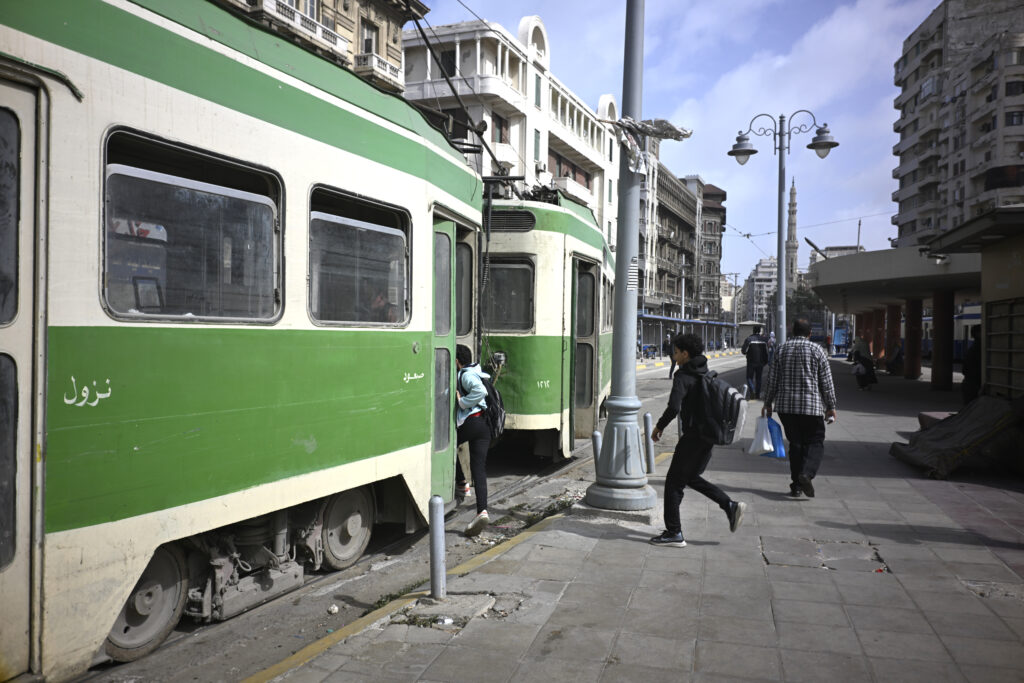
Along Egypt’s Mediterranean coast, the oldest tram in Africa and the Middle East rumbles for a final few weeks before its removal — the latest urban upheaval Alexandrians say is hollowing out their city’s identity.Government plans to replace the colourful streetcars on one of the city’s routes with a partially elevated light rail line have angered Alexandrians, for whom the 163-year-old track is “heritage, not just a means of transport”, local urban researcher Nahla Saleh told AFP.Inaugurated in 1863, the tram is one of the world’s oldest, and among only a few to operate double-decker cars.In the 19th and 20th centuries, it helped the city become a bustling metropolis, home to sizable European diasporas and a distinct cosmopolitan culture.Now, Egyptians young and old have flocked for farewell rides, before the streetcars come to a halt in April.As one locomotive screeches into the old El-Raml Station, commuters and visitors crane their necks out of giant windows at the historic neo-Venetian buildings overhead.”We’re not against progress,” psychologist and writer on culture Mona Lamloum told AFP.She and other Alexandrians agree the tramway needs work: inside the hand-calligraphied blue exterior, grime covers every surface. Underfoot, the rubber flooring is torn and strewn with trash.”We just have bad experiences of everything they call ‘progress’ becoming synonymous with destruction,” Lamloum said.In recent years, development projects in Egypt’s second city have razed historic parks and — most egregiously to locals — privatised and obstructed much of its Mediterranean coastline.- Heart of Alexandria -For over 160 years, the tram has cut through Alexandria’s heart, in an 11-kilometre stretch that includes many of the city’s schools and main universities.The new project, led by Egyptian and international companies including Systra, Hyundai and Hitachi, promises to double speed and triple capacity.Over half of it will be elevated — a major concern for Alexandrians who fear the tree-lined track will be replaced by eyesore concrete stilts.Ahead of the first phase of suspension, the transport ministry said the new project was the “only solution to the city’s traffic problems”.Locals like Saleh and Lamloum disagree, saying government plans are making the city more car-dependent and worsening traffic.Already, because so many students rely on the tram, the city has staggered school and university hours to pick up the slack of the partial shutdown.”Traffic’s getting worse, people can’t get anywhere, when we’ve already lost the inner-city train,” said Saleh, referring to another project under construction for the past two years, the new Alexandria Metro Line.”Besides, it being slow was always an advantage,” she added, making it safe for “the most vulnerable in society: children and the elderly”.Retired science teacher Hisham Abdelwahab, 64, has been riding the tram since he was a child.”I don’t want it to go fast, I like watching the world go by,” he told AFP on a station bench.”Our parents never thought twice about sending us out on the tram alone. Now I have a car, I just like leaving it parked to come ride the tram.”When the next streetcar rolls in, the upper deck fills with a gaggle of schoolgirls, squabbling over who gets the window seat closest to the sea breeze.- The old tram and the sea -“This tram is our heritage,” Abdelwahab said, his sentiment shared by those several decades younger.Engineering student Mahmoud Bassam, 24, has visited Alexandria just to ride the streetcar “since our tram in Cairo was removed”, he told AFP.With a controversial slew of bridges and widened streets completed in 2020, Cairo’s historic Heliopolis neighbourhood lost its last tram tracks, along with many of its trees.”Now the same is happening here,” Bassam lamented.Many Alexandrians are feeling the loss, intermingled with their other most treasured heritage.”It’s like the sea. We used to go for long scenic drives on the corniche, but now we’re losing both the sea and the tram,” Abdelwahab said.Parallel to the tramway, much of Alexandria’s iconic corniche is now hidden behind overpasses, private businesses and beachside food courts.By 2024, over half of the city’s Mediterranean coastline had disappeared from view, according to a study by the Human and the City for Social Research centre.Four-lane highways now dominate long stretches of the seaside, where the landmark sight of fishermen perched over the waves grows ever-rarer.For many, the waterfront that Lebanese singer Fairouz immortalised in 1961 — crooning about “the coast of Alexandria, coast of love” — is no more.”Now all you see is concrete,” said Lamloum.Saleh calls it “short-sighted” that the city could lose its charm to sprawling concrete.”Tourists used to love coming to see the tram and sit by the sea, why take away both?”

The veteran ‘insider’ shaping Iran’s nuclear policy

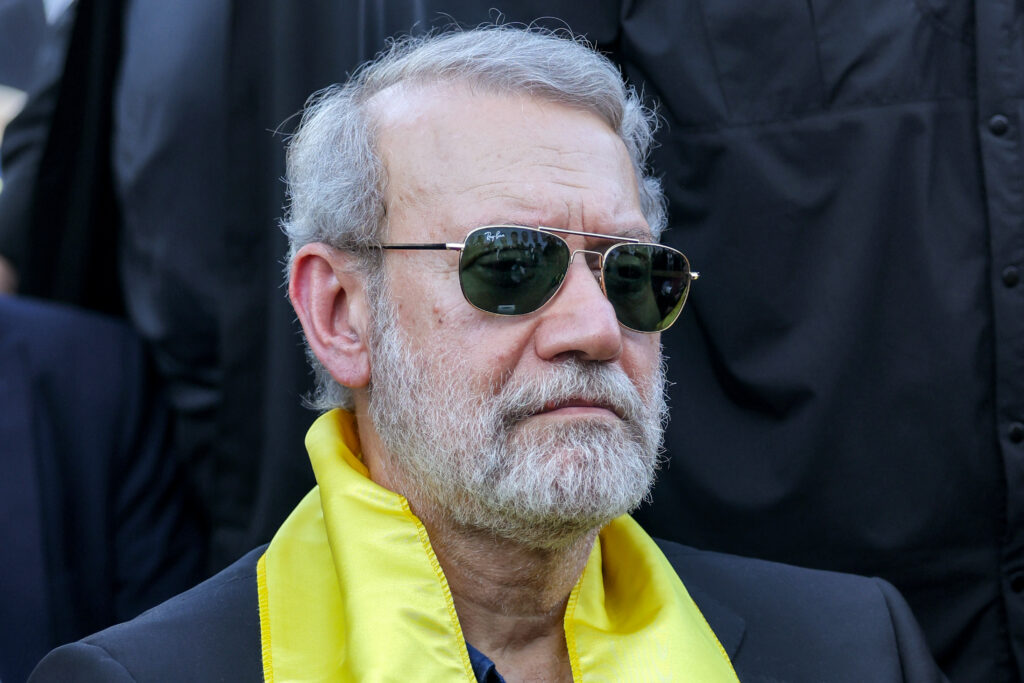
When US and Iranian negotiators meet on Thursday in Geneva, Iran’s top security chief Ali Larijani will be Tehran’s key player behind the scenes.Adept at balancing ideological loyalty with pragmatic statecraft, Larijani will not attend the talks, but is central to Tehran’s nuclear policy and strategic diplomacy.At the end of January, Larijani was Tehran’s choice to meet Russian President Vladimir Putin in Moscow, and this month he has met with Gulf officials trying to mediate in the stand-off with the United States.Bespectacled and known for his measured tone, the 68-year-old is believed to enjoy the confidence of Iran’s supreme leader Ayatollah Ali Khamenei, after a long career in the Islamic republic’s military, media and legislature.Weeks after the Iran-Israel war in 2025, he was appointed as head of Iran’s top security body, the Supreme National Security Council — a position he had held nearly two decades earlier — coordinating defence strategies and overseeing nuclear policy.He has since become increasingly visible in the diplomatic arena, travelling to Gulf states such as Oman and Qatar as Tehran cautiously restarted nuclear negotiations with Washington against the backdrop of massive US military deployments in the region.- ‘Canny operator’ -“He is now playing a more prominent role than most of his predecessors,” said Ali Vaez, the International Crisis Group’s project director for Iran.”Larijani is a true insider, a canny operator, familiar with how the system operates and familiar with the supreme leader’s inclinations.”Born in Najaf, Iraq in 1957 to a prominent Shiite cleric who was close to the Islamic Republic’s founder Ayatollah Ruhollah Khomeini, Larijani’s family has been influential within Iran’s political system for decades.Some of his relatives have been the targets of corruption allegations over the years, which they denied. He holds a PhD in Western Philosophy from the University of Tehran.A veteran of the Islamic Revolutionary Guard Corps during the Iran-Iraq war, Larijani later headed state broadcasting IRIB for a decade from 1994 before serving as parliamentary speaker from 2008 to 2020.In 1996, he was appointed as Khamenei’s representative to the Supreme National Security Council (SNSC). He later became secretary of the SNSC and chief nuclear negotiator, leading talks with Britain, France, Germany and Russia between 2005 and 2007. He ran in the 2005 presidential elections, losing to populist candidate Mahmoud Ahmadinejad, with whom he later had disagreements over nuclear diplomacy.Larijani was then disqualified from running for president in both 2021 and 2024.Observers have viewed his return as the head of the SNSC as signalling a pragmatic turn in security management, reflecting his reputation as a conservative capable of combining ideological commitment with pragmatism.A proponent of nuclear negotiations, Larijani supported the landmark 2015 nuclear deal with world powers which unravelled three years later after Trump withdrew the US from the accord.In March 2025, ahead of five rounds of Iran-US nuclear talks which ended with the 12-day war with Israel, he warned that sustained external pressure could alter Iran’s nuclear posture.”We are not moving towards (nuclear) weapons, but if you do something wrong in the Iranian nuclear issue, you will force Iran to move towards that because it has to defend itself,” he told state television.After the conflict with Israel, he described Western concerns over Iran’s nuclear programme as a “pretext” for broader confrontation, arguing that subsequent calls to address Iran’s missile programme and regional role reflected shifting political demands.He has repeatedly insisted negotiations with Washington should remain confined to the nuclear file and defended uranium enrichment as Iran’s sovereign right.”We want a speedy resolution to this issue,” he said in a recent interview with Al Jazeera, referring to the talks with the US.- ‘Violent repression’ -He said a war between Iran and the United States was unlikely, as Washington would realise it had little to gain and much to lose from a conflict.Larijani was among officials sanctioned by the US in January over what Washington described as “violently repressing the Iranian people”, following nationwide protests which erupted weeks earlier due to the rising cost of living.He recently acknowledged that economic pressures had “led to the protests”, but blamed the violence which ensued on foreign involvement by the United States and Israel.Vaez believes that Larijani’s political calculus is shaped by long-term ambitions.”He is an ambitious man who has eyes for higher office. Larijani certainly wants to become president,” Vaez said. “That creates two incentives, one is to preserve the system and second is to also not burn his cards.”