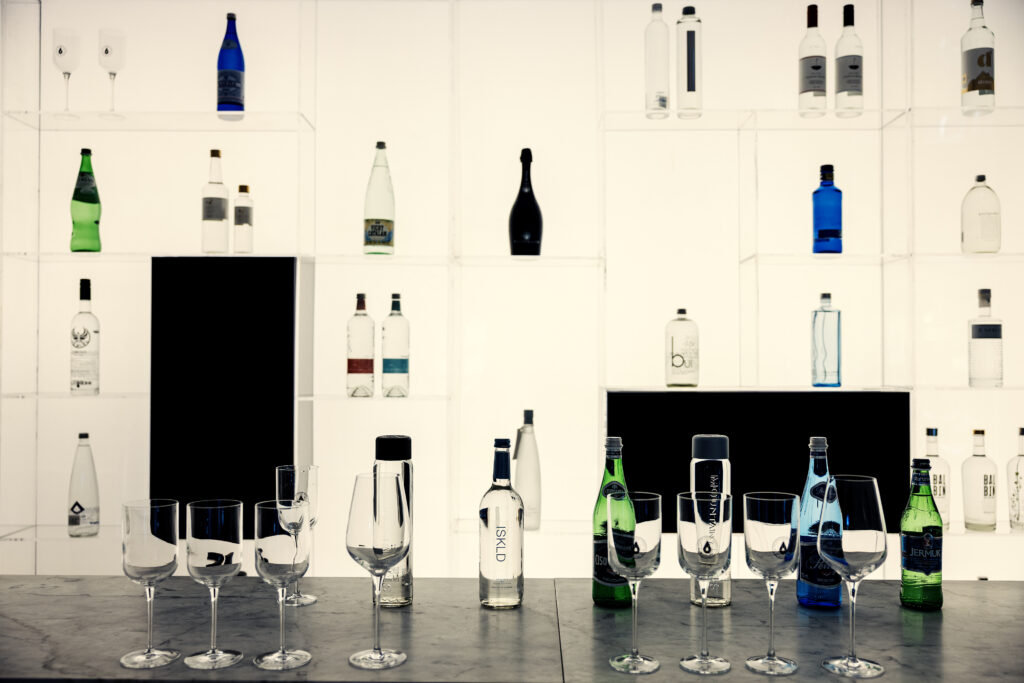
Most tourists to Stellenbosch come for the wine but this small group was here for the water, sampling a selection of the world’s finest varieties in an experience new to South Africa. In a tasting room lined with elegant glass bottles from across the globe, water sommelier Nico Pieterse extolled the qualities and even “emotional connection” of a resource many South Africans take straight from the tap.”They are mainly award-winning waters,” Pieterse said of his collection at his Fine Water Tasting Room, which he describes as the world’s first such venue dedicated solely to water.Around 40 kilometres (25 miles) east of Cape Town, Stellenbosch is a major draw for international and domestic tourists, who flock to sample its internationally recognised wines on a variety of tasting menus.But Pieterse’s passion is water and he boasts a “library” of 40 brands drawn from Armenian volcanic springs to ancient Czech glaciers.Many are from Europe, he told AFP on the sidelines of a tasting, but there is also one from Himalayan springs in Bhutan and another from a mineral water mecca in Mexico.A bottle of Ice Age glacial water from the Czech mountains contains dazzling specks of 24‑carat gold. A bottle from Colombia carries the names of species newly identified in the rainforest.A tasting session lasting around an hour was a surprise for South African visitor Dere Vermeulen, 19, who normally drinks tap water.”I am the kind of person who says water is water,” she told AFP. “But it was very interesting to actually be able to taste the different flavours in the water — I didn’t think I was going to.”- From beer to water – Pieterse, previously a brewer, developed an interest in water during the Covid‑19 pandemic when South Africa banned the sale and distribution of alcohol.It led him to become one of only two certified water sommeliers in South Africa and fewer than 100 worldwide, he said.As an international water judge, Pieterse blind‑tastes more than 100 still and 100 sparkling waters at an annual fine water summit that draws connoisseurs from around the world.At his Stellenbosch tasting room, guests sample six waters — three still and three sparkling — served in stemware at between 14 and 18 degrees Celsius (57.2 to 64.4 degrees Fahrenheit), while discussing the minerality, “total dissolved solids” and filtration.Plastic or glass packaging and nitrate levels — which can indicate pollution at source — are other factors, Pieterse said, against a backdrop of Stellenbosch’s expansive vineyards and warm mountainscapes.Some bottlers sell tap water purified through reverse‑osmosis filtration which removes the minerals and flavour, he said. “It takes everything out of the water so that water is completely dead.”The most expensive item is a German water sold in champagne‑style bottles for around 5,000 rands ($310). Alongside the luxury offerings is a high-mineral South African brand priced on his website at 50 rands for 750 millilitres.Tap water is generally considered safe to drink in South Africa but — in one of the most unequal countries in the world — just 45 percent of households had piped drinking water in their dwellings in 2023, according to national statistics.Another 30 percent were able to drink from a tap in their yards, while others depended on communal taps and rainwater tanks.Failing infrastructure causes regular supply disruptions and has sparked angry protests by communities forced to rely on water tanks brought in by municipalities or NGOs.The water-stressed nation has also been through severe droughts and periods of low rainfall with entire towns warned their taps could run dry.”Being in a country where water is already not readily available, it’s important to showcase and educate about water and its scarcity,” said Pieterse.”We have to add value to water, so people take care of it.”