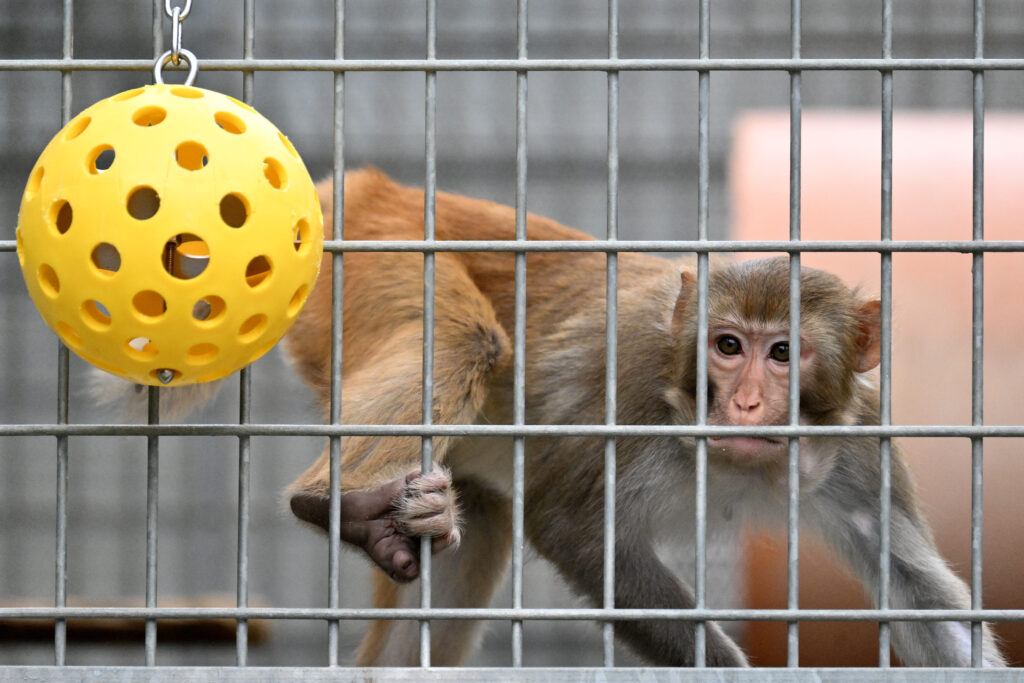
The United States will scale back certain drug-safety testing requirements on monkeys, federal regulators said Tuesday, as President Donald Trump’s administration pushes ahead with its pledge to reduce animal use in research.Under new draft guidance from the Food and Drug Administration (FDA), computer models, lab-grown mini-organs, and human studies will replace six-month repeat-dose toxicity tests in monkeys for monoclonal antibodies — lab-engineered proteins used to treat cancers, autoimmune conditions and more.”We are delivering on our roadmap commitment to eliminate animal testing requirements in drug evaluation and our promise to accelerate cures and meaningful treatments for Americans,” FDA Commissioner Marty Makary said in a statement.The statement added that typical nonclinical programs involving monoclonal antibodies could include more than 100 macaque monkeys — apes are no longer used in any invasive research in the US — yet often do not yield human-approved treatments.The move was welcomed by animal-advocacy groups.Zaher Nahle, a former animal researcher who is now the senior scientific advisor for nonprofit Center for a Humane Economy, told AFP the move was an “important step.””These primates are not reliable in terms of predicting the toxicity, so you can get at least equal or better results in terms of your accuracy in predicting toxicology using other approaches,” he added.What’s more, he noted, studies show that more than 90 percent of drugs deemed safe and effective in animals fail to win approval for human use.The FDA’s announcement follows a report in the journal Science last month that the Centers for Disease Control and Prevention (CDC) would close its primate labs, and comes amid broader efforts by federal agencies to shift animal research toward newer technologies.It “moves us one step closer to wiping out the federal government’s wasteful monkey business,” Justin Goodman of White Coat Waste Project told AFP.But the National Institutes of Health (NIH) — the country’s primary biomedical research agency — remains a notable “outlier,” he added. According to public data collected by his organization, 7,700 primates are confined in federal government labs and breeding facilities, of which 6,700 are at NIH.- ‘We still need animals’ -Among researchers, the move sparked concern about moving too far, too fast.Deborah Fuller, director of the Washington National Primate Research Center — one of seven such centers established by the NIH in the 1960s — said the FDA’s decision to reduce antibody-toxicity testing in monkeys was “very reasonable” noting that non-animal methods are suitable for this purpose.But she warned that moving too quickly in other areas could jeopardize drug development.”This needs to be driven by the science and the data, not by (the) ideology of people just wanting to suddenly end animal research because it feels good and sounds good,” she told AFP.”In terms of the next cures and biomedical advances, we still need animals,” she said, adding that non-animal methods aren’t yet as capable and that preclinical animal safety testing is the reason “you’re not hearing about people dying” during clinical trials.Proponents of animal testing also argue the research has been indispensable for major medical advances, including vaccines for diphtheria, yellow fever, measles and Covid-19.Critics counter that decades-old laws have created regulatory lock-in, that publication incentives reward animal studies in top journals, and that a lucrative “animal-industrial complex” has helped entrench the status quo.
The United States will scale back certain drug-safety testing requirements on monkeys, federal regulators said Tuesday, as President Donald Trump’s administration pushes ahead with its pledge to reduce animal use in research.Under new draft guidance from the Food and Drug Administration (FDA), computer models, lab-grown mini-organs, and human studies will replace six-month repeat-dose toxicity tests in monkeys for monoclonal antibodies — lab-engineered proteins used to treat cancers, autoimmune conditions and more.”We are delivering on our roadmap commitment to eliminate animal testing requirements in drug evaluation and our promise to accelerate cures and meaningful treatments for Americans,” FDA Commissioner Marty Makary said in a statement.The statement added that typical nonclinical programs involving monoclonal antibodies could include more than 100 macaque monkeys — apes are no longer used in any invasive research in the US — yet often do not yield human-approved treatments.The move was welcomed by animal-advocacy groups.Zaher Nahle, a former animal researcher who is now the senior scientific advisor for nonprofit Center for a Humane Economy, told AFP the move was an “important step.””These primates are not reliable in terms of predicting the toxicity, so you can get at least equal or better results in terms of your accuracy in predicting toxicology using other approaches,” he added.What’s more, he noted, studies show that more than 90 percent of drugs deemed safe and effective in animals fail to win approval for human use.The FDA’s announcement follows a report in the journal Science last month that the Centers for Disease Control and Prevention (CDC) would close its primate labs, and comes amid broader efforts by federal agencies to shift animal research toward newer technologies.It “moves us one step closer to wiping out the federal government’s wasteful monkey business,” Justin Goodman of White Coat Waste Project told AFP.But the National Institutes of Health (NIH) — the country’s primary biomedical research agency — remains a notable “outlier,” he added. According to public data collected by his organization, 7,700 primates are confined in federal government labs and breeding facilities, of which 6,700 are at NIH.- ‘We still need animals’ -Among researchers, the move sparked concern about moving too far, too fast.Deborah Fuller, director of the Washington National Primate Research Center — one of seven such centers established by the NIH in the 1960s — said the FDA’s decision to reduce antibody-toxicity testing in monkeys was “very reasonable” noting that non-animal methods are suitable for this purpose.But she warned that moving too quickly in other areas could jeopardize drug development.”This needs to be driven by the science and the data, not by (the) ideology of people just wanting to suddenly end animal research because it feels good and sounds good,” she told AFP.”In terms of the next cures and biomedical advances, we still need animals,” she said, adding that non-animal methods aren’t yet as capable and that preclinical animal safety testing is the reason “you’re not hearing about people dying” during clinical trials.Proponents of animal testing also argue the research has been indispensable for major medical advances, including vaccines for diphtheria, yellow fever, measles and Covid-19.Critics counter that decades-old laws have created regulatory lock-in, that publication incentives reward animal studies in top journals, and that a lucrative “animal-industrial complex” has helped entrench the status quo.