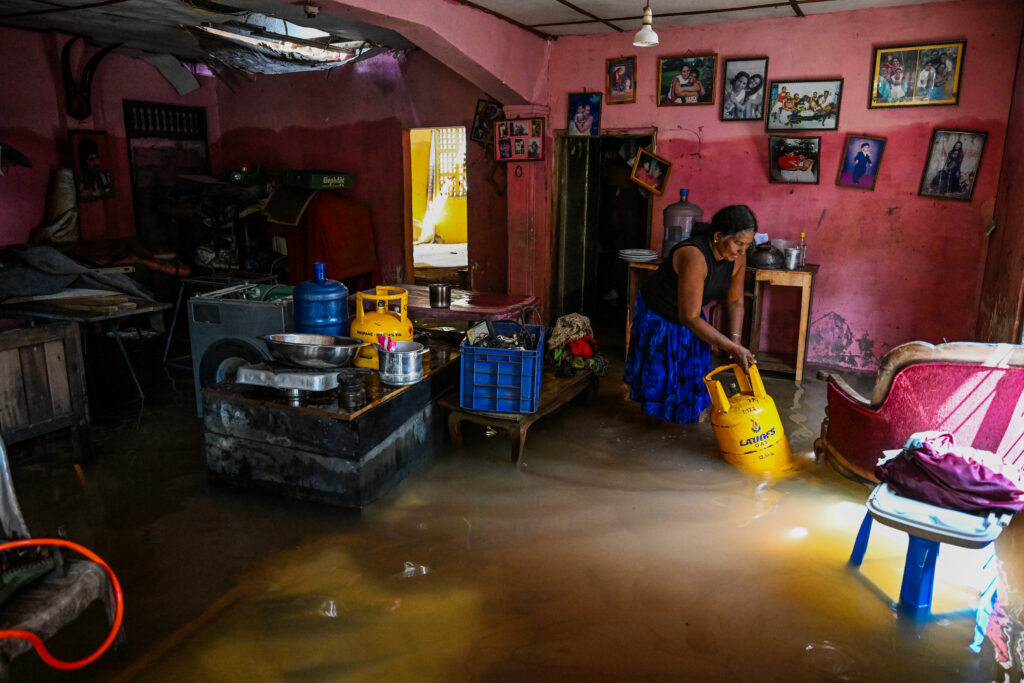
Survivors of Cyclone Ditwah that has ravaged Sri Lanka in recent days began returning to their devastated homes on Wednesday, faced with a massive clean-up as they start rebuilding their lives.The powerful storm brought record rains that triggered landslides and floods across the island country, killing at least 474 people, according to disaster officials, with another 366 still unaccounted for.Soma Wanniarachchi, 69, had stayed behind as long as she could, “but when the water level reached about eight feet (2.5 metres), I decided to leave,” she told AFP.Back in her village of Kotuwila, near the capital Colombo, she was shocked to see the damage to her catering equipment rental business.Chafing dishes and woks have disappeared, and “my stainless steel utensils are now probably in the Indian Ocean,” she said.”At least three buffet sets have gone,” added the business owner, who has asked neighbours for help with the daunting clean-up.Inside the house, there was still about a foot of flood water.IT lecturer Sanjaya Tissara, 31, returned to his two-storey house in Angoda, on the eastern outskirts of Colombo, to find a muddy mess and oily sludge.”I had several electronic components for my computer business I operate when I am not teaching. Some of the equipment was saved because I had time to move it upstairs, but a lot was lost in the floods,” he told AFP.He said that when the Kelani River overflowed last week in the area of the capital, it was worse than a major flood in 2016 that killed 71 people.”We experienced a big flood in 2016, when the water levels here were about four feet, but this time it went to above six feet,” Tissara said.His neighbour, oil company executive R. M. V. Lalith, 51, has called on relatives to help clear layers of mud on everything that survived the floods.”It’s not possible to do this clean-up alone,” Lalith told AFP.”We managed to salvage some furniture by moving it upstairs, but the kitchen is a mess.”He said local volunteers had provided cooked food, which was distributed by boats, some operated by the security forces.The government said it was increasing clean-up assistance, giving each household 25,000 rupees ($83) due to the scale of the devastation.Following previous floods, the standard government allowance was 10,000 rupees.Prabath Chandrakeerthi, Sri Lanka’s commissioner general for essential services and the top official in charge of recovery, said authorities were also handing out up to 2.5 million rupees for rebuilding homes.”Our initial estimate is that we will need about six to seven billion dollars for the reconstruction,” Chandrakeerthi told reporters.Some of the worst-affected areas in the central hills, hit by deadly landslides, remain inaccessible, and authorities were working to clear roads and restore communications.
Survivors of Cyclone Ditwah that has ravaged Sri Lanka in recent days began returning to their devastated homes on Wednesday, faced with a massive clean-up as they start rebuilding their lives.The powerful storm brought record rains that triggered landslides and floods across the island country, killing at least 474 people, according to disaster officials, with another 366 still unaccounted for.Soma Wanniarachchi, 69, had stayed behind as long as she could, “but when the water level reached about eight feet (2.5 metres), I decided to leave,” she told AFP.Back in her village of Kotuwila, near the capital Colombo, she was shocked to see the damage to her catering equipment rental business.Chafing dishes and woks have disappeared, and “my stainless steel utensils are now probably in the Indian Ocean,” she said.”At least three buffet sets have gone,” added the business owner, who has asked neighbours for help with the daunting clean-up.Inside the house, there was still about a foot of flood water.IT lecturer Sanjaya Tissara, 31, returned to his two-storey house in Angoda, on the eastern outskirts of Colombo, to find a muddy mess and oily sludge.”I had several electronic components for my computer business I operate when I am not teaching. Some of the equipment was saved because I had time to move it upstairs, but a lot was lost in the floods,” he told AFP.He said that when the Kelani River overflowed last week in the area of the capital, it was worse than a major flood in 2016 that killed 71 people.”We experienced a big flood in 2016, when the water levels here were about four feet, but this time it went to above six feet,” Tissara said.His neighbour, oil company executive R. M. V. Lalith, 51, has called on relatives to help clear layers of mud on everything that survived the floods.”It’s not possible to do this clean-up alone,” Lalith told AFP.”We managed to salvage some furniture by moving it upstairs, but the kitchen is a mess.”He said local volunteers had provided cooked food, which was distributed by boats, some operated by the security forces.The government said it was increasing clean-up assistance, giving each household 25,000 rupees ($83) due to the scale of the devastation.Following previous floods, the standard government allowance was 10,000 rupees.Prabath Chandrakeerthi, Sri Lanka’s commissioner general for essential services and the top official in charge of recovery, said authorities were also handing out up to 2.5 million rupees for rebuilding homes.”Our initial estimate is that we will need about six to seven billion dollars for the reconstruction,” Chandrakeerthi told reporters.Some of the worst-affected areas in the central hills, hit by deadly landslides, remain inaccessible, and authorities were working to clear roads and restore communications.