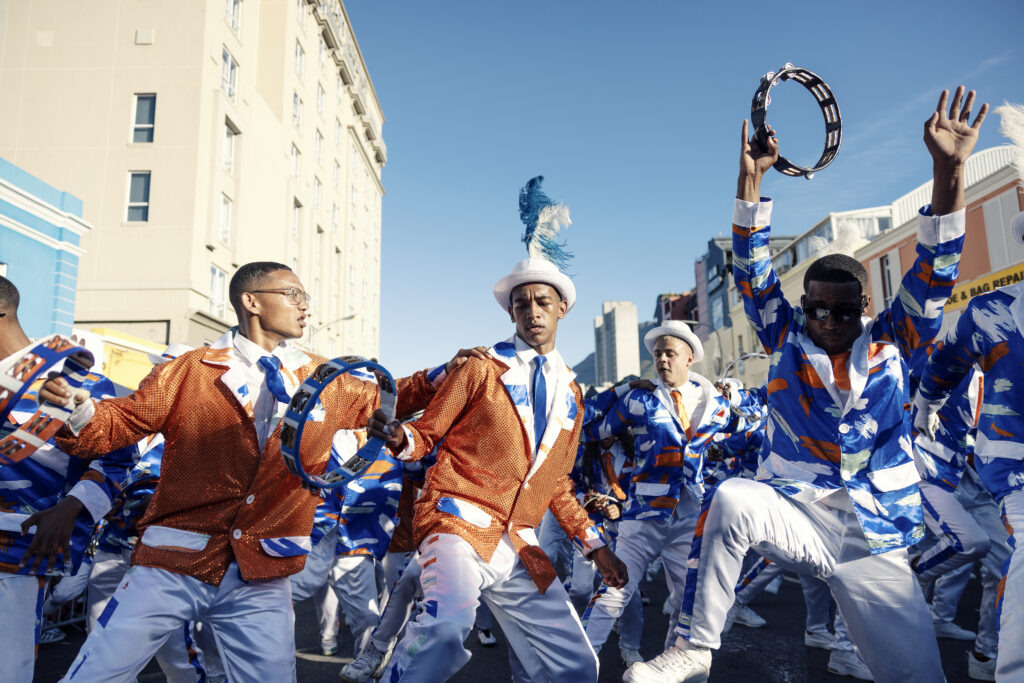
As a girl, Fatima Dulvie would spend New Year’s Day perched on the wall of her home in Cape Town’s historic District Six area in feverish anticipation of the minstrels’ parade that would pass the following day.Now aged 77, Dulvie has herself become a dedicated participant in the roughly 140-year-old parade of Tweede Nuwe Jaar (Second New Year) as one of an army of seamstresses who spend months making costumes for the thousands of minstrels.”We didn’t sleep at that time,” she told AFP, recalling her childhood excitement that started the day before the parade — one of the biggest cultural events in South Africa — and lasted well into the following evening.Dulvie missed no detail of the exuberant spectacle of traditional goema beats and banjos, marching brass bands, dancing and dazzling costumes that started in the 19th century when enslaved people were given a day off on January 2 to hold their own New Year celebrations.But she does admit to hiding at the approach of the renowned Atcha troupes with their frightening masks and fierce drummers, who are still a highlight today.”If you hear the drums, you scatter because at that time the Atchas were evil,” joked Dulvie, a sun-yellow headscarf tucked neatly around her cheerful face.She was among more than 60,000 people forcibly removed from District Six after it was declared a whites-only area in 1966, in one of the apartheid government’s most notorious enactments of its racial segregation policy.She maintained the link to the neighbourhood and the parade as a seamstress for the Original District Six Hanover Minstrels troupe, sewing more than 900 costumes over the past three decades and winning the “Best Dressed” category several times in the parade’s competition.Dulvie’s five children have joined in the sewing marathon that starts around May and can last from 8:00 am to midnight in the countdown to the parade, also known as the Kaapse Klopse (Cape Minstrels). “Every year I say I’m going to retire, but the next year I start again… We grew up in District Six, we grew up with this, so it’s still in me,” Dulvie said. The income has also been useful, helping to pay for her pilgrimage to Mecca in 1999, the only time she has missed a parade.- Celebration, changes –The first carnival is believed to have taken place in 1887, rooted in the cultural mix of enslaved Africans and Southeast Asians, indigenous Khoi and San, and black South Africans.With some people of European descent, they formed a population still largely known as Cape Coloureds that today makes up 35 percent of Cape Town’s population and around eight percent nationally.For many, the minstrels’ parade has become a proud assertion of this community’s unique heritage and identity.Around 20,000 performers and 150,000 spectators are expected on the upcoming parade day, exceptionally scheduled for January 5 for logistical reasons, according to the main organisers, the Kaapse Klopse Karnival Association (KKKA).Tensions have flared within the broader minstrel fraternity over the later-than-usual date as well as the KKKA’s choice of a route away from District Six and Bo-Kaap, omitting historically significant points along the way, and towards the coastal Green Point area — which the association argues also has cultural significance.After some heated exchanges and even plans for a breakaway parade, there have also been accusations that the event is being commercialised after it adopted a sponsor and hiked entry fees into a stadium for the final march and competition. But KKKA director Muneeb Gambeno counters that rising costs have meant the carnival has had to evolve, with several older and smaller troupes already forced out over the past decade. Seventeen troupes will perform at the upcoming event, compared to more than 40 in previous years. Gambeno said the parade carries deep historical meaning related to race, cultural and gender identity, and class.With young people making up more than two-thirds of participants, the modern version is also an opportunity for youth to empower themselves to resist the lure of gangs, crime and drugs afflicting the city’s poorer suburbs.The minstrels spend months practising music, routines and songs ahead of the big day but most only see their costumes at the last minute to avoid any leaks about the highly competitive designs, said Original District Six Hanover Minstrels troupe owner Ziyaad Williams.The glitzy final look includes elaborate face make-up, said Williams, who has been part of the minstrels since he was a toddler, and accessories like hats, walking sticks or umbrellas. “It came from our forefathers. This is what they loved. We fell into it, and we are still in it. So for us, we’re keeping it alive,” he said.