
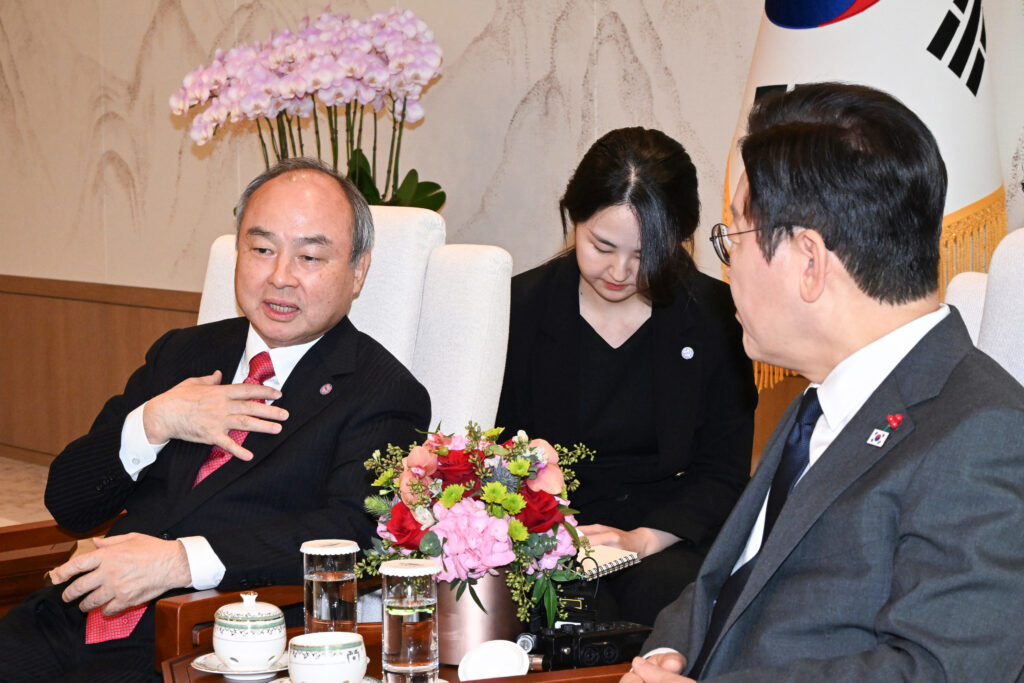
SoftBank CEO and AI investor Masayoshi Son said Friday that advanced artificial intelligence could surpass humans to the extent that “we become fish” and could even win the Nobel Prize in Literature.Meeting South Korean President Lee Jae Myung in Seoul, Son, whose SoftBank is a major backer of ChatGPT maker OpenAI, described a future in which an advanced AI surpasses humans by a magnitude of 10,000.”The difference between the human brain and the… goldfish in the pot — the difference is 10,000 times,” he said.”But it’s going to be different — we will become fish, they (the AI) become like humans,” he said.”They will be 10,000 times smarter than us,” he told President Lee, who has vowed to turn South Korea into an AI powerhouse.Son compared the relationship between this artificial super intelligence (ASI) and humankind to relations between human beings and their pets.”We try to make them happy… we try to live in peace with them,” he said.”We don’t need to eat them… ASI does not eat protein. They don’t need to eat us — don’t worry.”Lee responded laughing that he was “a bit concerned now”.He asked Son whether ASI could win a Nobel Prize in Literature, won last year by South Korean author Han Kang.”I do not believe this is a desirable situation,” Lee said.”I think it will,” Son replied.ASI has been described as a hypothetical scenario when AI overtakes humans.Scientists still consider it a long way off, but say a crucial first step — artificial general intelligence (AGI), which would outperform humans across most tasks — could arrive within a decade.Lee said last month that Seoul would triple spending on AI next year — a move “aimed at propelling South Korea into the ranks of the world’s top three AI powers” behind the United States and China.Also on Friday, Lee’s office said South Korea would partner with Arm, SoftBank’s British semiconductor design unit, to train 1,400 chip professionals.The initiative would provide help in “strengthening areas where South Korea’s semiconductor industry is relatively weak,” said presidential policy adviser Kim Yong-beom.