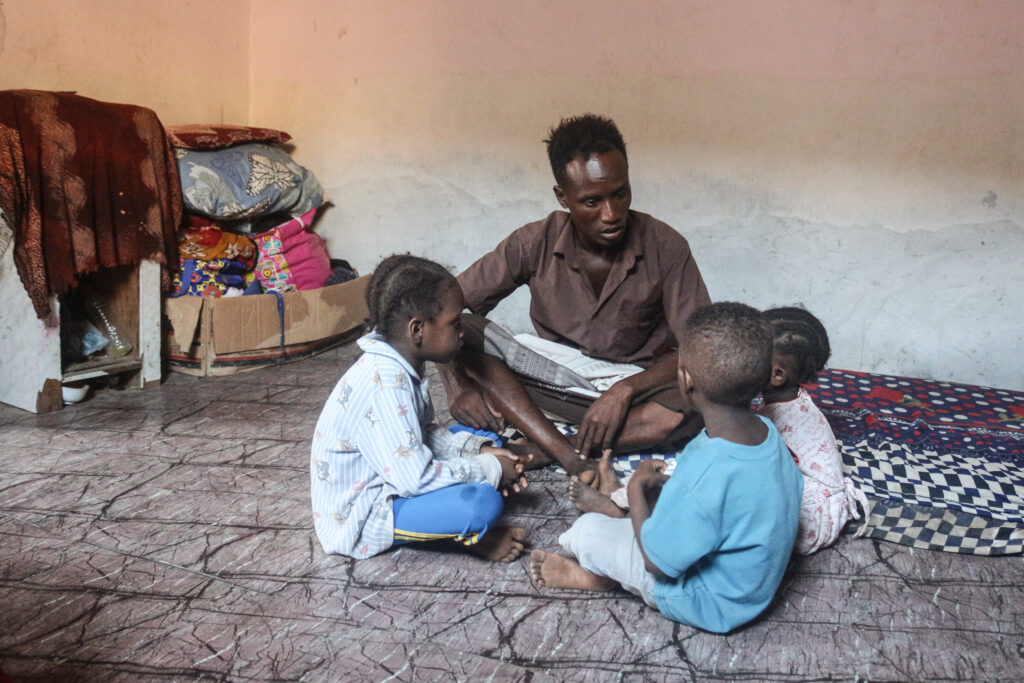
In makeshift homes lacking even the most basic necessities surrounded by piles of rubbish and flanked by dirt roads, thousands of Somalis in Yemen live in soul-crushing poverty in Aden’s “Little Mogadishu”.Yemen, the Arabian Peninsula’s poorest country, is not a destination in itself for migrants but a way station for those leaving East Africa in the hopes of reaching the oil-rich Gulf states and working in construction or as domestic staff.But with security along its borders tight, many struggle to make it out of Yemen. During the day, the men fan out across the city and line the roads looking for work in the de facto capital of government-controlled Yemen, where more than a decade of war has led to mass unemployment and food insecurity. To make ends meet, many search for odd jobs or scavenge rubbish heaps, looking for any food that can be salvaged to feed themselves and their families. “Some days we eat, some days it’s up to God. That’s life,” said Abdullah Omar, a 29-year-old Somali father of four in Aden. Over a year ago, Omar decided to take his chances, shelling out $500 to traffickers to board a boat with his family in hopes of escaping Somalia’s instability and finding a better life abroad. But in Yemen, it has only been misery. To survive, Omar washed cars, making the equivalent of just a few dollars a day.After years working in construction in Mogadishu, Omar had hoped to find better conditions and pay in Yemen — where he had passed through as a teenager en route to Saudi Arabia. But that was before years of civil war killed hundreds of thousands of civilians, destroyed vast amounts of infrastructure and left the country effectively partitioned between the Houthi rebels and Yemen’s internationally recognised government.”Here I have nothing,” he told AFP, while explaining his decision to enrol in a UN programme that paved the way for his repatriation to Somalia. “There’s no work, no money and no schooling for the children.”- Unemployment -Despite the poor conditions roughly 17,000 Africans arrived in Yemen in October, mostly from nearby Djibouti and Somalia, an increase of 99 percent from the month prior, according to the UN.Somalis make up about 63 percent of the 61,000 registered refugees and asylum seekers in Yemen, UN data shows.Across Aden, where unemployment is already staggeringly high among Yemenis, African migrants are hard-pressed to gain a foothold.Nearly 19.5 million people in Yemen — more than half its population — are in need of humanitarian aid, including 4.8 million internally displaced people, according to early 2025 UN data.The economic situation has only worsened in recent months due to the currency’s depreciation, the halt of oil exports, and a dearth of international funding.Somalia remains ravaged by its own civil war, with the Islamist insurgents of Al-Shabaab still in control of vast swathes of the country.But relative peace in the capital Mogadishu in recent years has brought a degree of stability and allowed a lucrative construction boom in parts of the city — though the situation remains shaky.- ‘If peace returns’ -According to a UN Refugee Agency (UNHCR) survey, 56 percent of Somalis who are repatriated cited a “lack of income opportunities” in Yemen as their main reason for returning home.”Many refugees want to go back to Somalia, but they can’t afford smugglers or plane tickets,” said Oweis Al-Azzan, who oversees the head of the UN’s voluntary return programme, which helps migrants.The programme provides families with free transportation and cash to help ease their transition once they are back home. The UN has repatriated more than 500 Somalis so far this year and plans three more flights by the end of the year carrying around 450 more people.Among those set to return is Somali contractor Ahmed Abu Bakr Marzouk, who came to Yemen 25 years ago, where he married twice and started a family.For years he prospered, sending money home regularly and financing the building of two homes in Mogadishu. Then came the war. “For the past three or four years, there’s been no work,” said the 58-year-old. With no relief in sight in Yemen, Marzouk said conditions in Somalia were now more favourable.”My brothers work in farming there. If peace returns, I’ll come back,” he told AFP.”If not, I won’t.”