
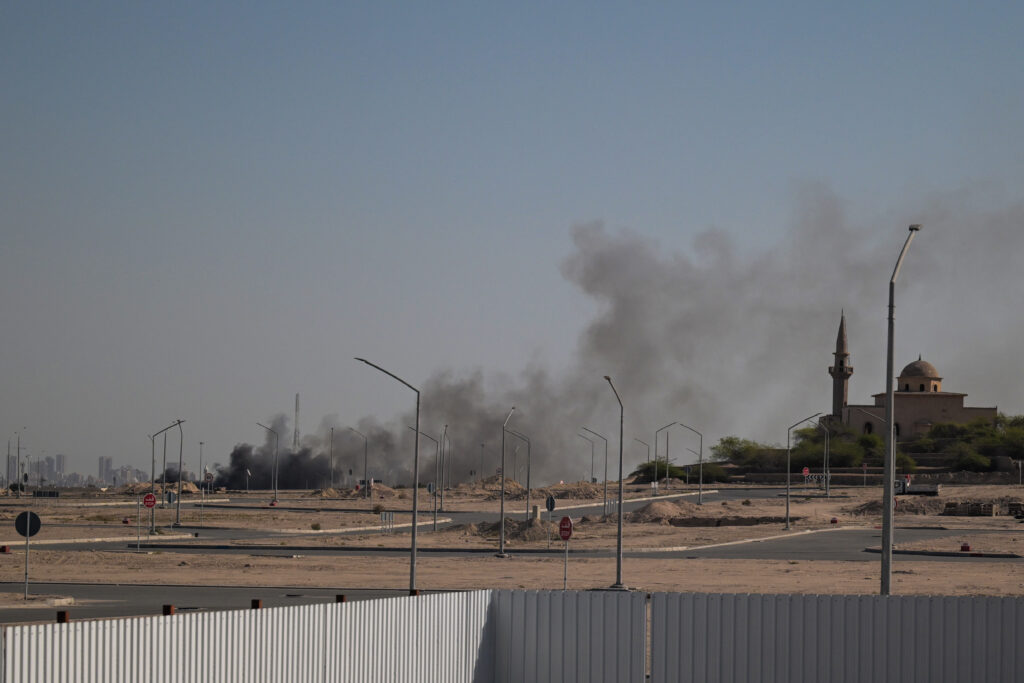
Workers stayed home and Ramadan prayers were cancelled in Kuwait on Monday as the tiny Gulf emirate was left on edge following Iranian attacks that marked its biggest upheaval in decades.Home to a major US military presence, Kuwait has been sucked into Iran’s war against the United States and Israel, with the US embassy apparently hit, three American warplanes mistakenly shot down by its military, and a power station struck.The violence is the most dramatic escalation for the oil-rich country since the 2003 US invasion of neighbouring Iraq and Saddam Hussein’s attempt to take over Kuwait in 1990.Despite calm on the streets, Kuwaitis expressed anxiety to AFP on Monday as the sound of explosions intermittently rang out overhead and sirens sounded in some areas.”It compels people to follow the news around the clock,” said Khaled Walid, who works in logistics, adding that the bombing was reminiscent of the Iraqi invasion in 1990.Black smoke could be seen rising from the US embassy, though the Americans did not confirm it had been hit.
Iranian strikes have so far killed one person in Kuwait and injured more than 50.Three American fighter jets were also mistakenly shot down by Kuwait’s air defences on Sunday night, the US military said, but all six crew safely ejected.The government told many state employees to stay home, saying the number on site would be reduced to 30 percent of the total workforce.- Plans -Some in Kuwait were making plans to leave, with a travel agency telling AFP it had been issuing a higher number of transit visas for Saudi Arabia to Jordanians and Egyptians, allowing them to cross into the kingdom through the land border as flights were cancelled. Others had applied for visas to carry out the Umrah pilgrimage to Mecca as another way into Saudi, said travel agency manager Yahya Hussein.Nestled in the northwestern corner of the Gulf, Kuwait’s strategic location and massive oil reserves have made it one of the world’s richest countries per capita.The emirate of just five million people drew world attention in 1990 when Iraqi forces invaded and attempted to annex the country.Kuwaitis still bear the scars of that conflict, when the retreating invaders, pushed out by a US-led coalition, looted the country and set fire to most of its oil wells.But since then, Kuwait has been an oasis of peace in the turbulent Middle East, backed up by the presence of US troops and defence agreements with several other countries, including Britain and France.Though life was largely functioning as normal on Monday, the streets were quiet and Kuwait cancelled Ramadan prayers at mosques, restricting worship to Isha, the fifth and final daily obligatory prayer in Islam.Dana Abbas, an engineer in Kuwait City, said she feared a further escalation in the fighting and had rushed to fill up her car with petrol and stock up on basic necessities.”Developments are causing concern for many families,” she told AFP.