
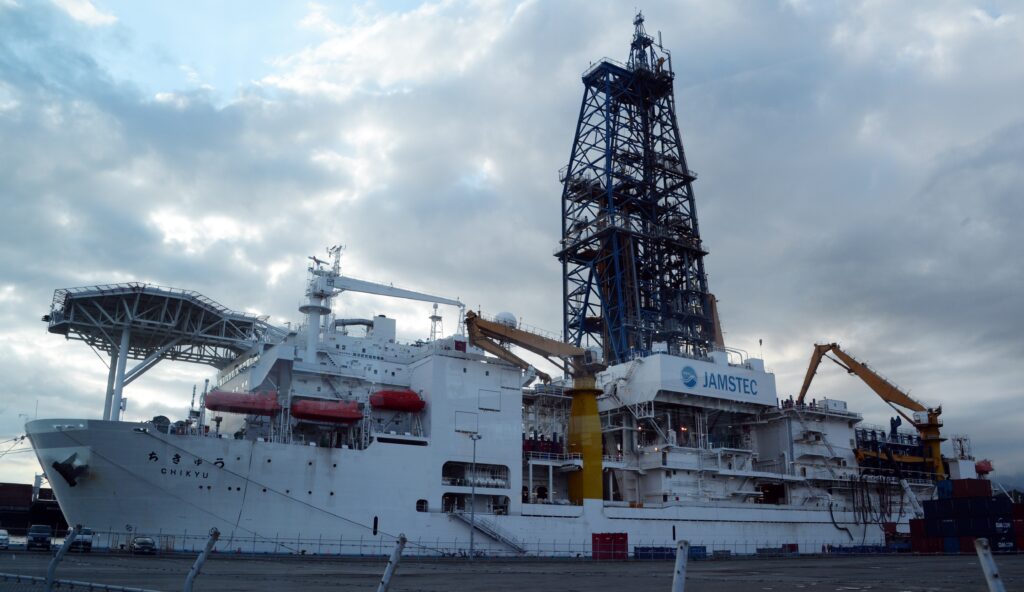
Japan embarks Sunday on what it says is the world’s first bid to tap deep sea rare earths at a depth of 6,000 metres — greater than the height of Mount Fuji — to curb dependence on China.A Japanese deep-sea scientific drilling boat called the Chikyu will set sail for the remote island of Minami Torishima in the Pacific, where surrounding waters are believed to contain a rich trove of valuable minerals.The test cruise comes as China — by far the world’s biggest supplier of rare earths — ramps up pressure on its neighbour after Prime Minister Sanae Takaichi suggested in November that Tokyo may react militarily to an attack on Taiwan, which Beijing has vowed to seize control of by force if necessary.Rare earths — 17 metals difficult to extract from the Earth’s crust — are used in everything from electric vehicles to hard drives, wind turbines and missiles.The mission by the Chikyu is “a first step toward our country’s industrialisation of domestic rare earths”, the Japan Agency for Marine-Earth Science and Technology (JAMSTEC) said in a statement last month.The agency touted the test as the world’s first at such depths.The area around Minami Torishima, which is in Japan’s economic waters, is estimated to contain more than 16 million tons of rare earths, which the Nikkei business daily says is the third-largest reserve globally.These rich deposits contain an estimated 730 years’ worth of dysprosium, used in high-strength magnets in phones and electric cars, and 780 years’ worth of yttrium, used in lasers, Nikkei said.”If Japan could successfully extract rare earths around Minami Torishima constantly, it will secure domestic supply chain for key industries,” Takahiro Kamisuna, research associate at The International Institute for Strategic Studies (IISS), told AFP.”Likewise, it will be a key strategic asset for Takaichi’s government to significantly reduce the supply chain dependence on China.”- Threat to sea life -Beijing has long used its dominance in rare earths for geopolitical leverage, including in its trade war with US President Donald Trump’s administration.China accounts for almost two-thirds of rare earth mining production and 92 percent of global refined output, according to the International Energy Agency.Media reports this week said Beijing was delaying Japanese imports as well as rare-earth exports to Tokyo, as their two-month-old spat escalates. China on Tuesday blocked exports to Japan of “dual-use” items with potential military uses, fuelling worries in Japan that Beijing could choke supplies of rare earths, some of which are included in China’s list of dual-use goods.An earlier spat in 2010 saw Japan move to lessen its dependence on Beijing for rare earths but more than 70 percent still come from China, according to Tokyo — a stat it is looking to change.During the test mission, the Chikyu will send a pipe beneath the water to ensure a “mining machine” attached to its tip can reach the seabed and retrieve the rare earth-rich muds, JAMSTEC said. The cruise is scheduled to last until February 14. Deep-sea mining has become a geopolitical flashpoint, with anxiety growing over a push by US President Donald Trump to fast-track the practice in international waters.Environmental campaigners warn it threatens marine ecosystems and will disrupt the sea floor.The International Seabed Authority (ISA), which has jurisdiction over the ocean floor outside national waters, is pushing for the adoption of a global code to regulate mining in the ocean depths.