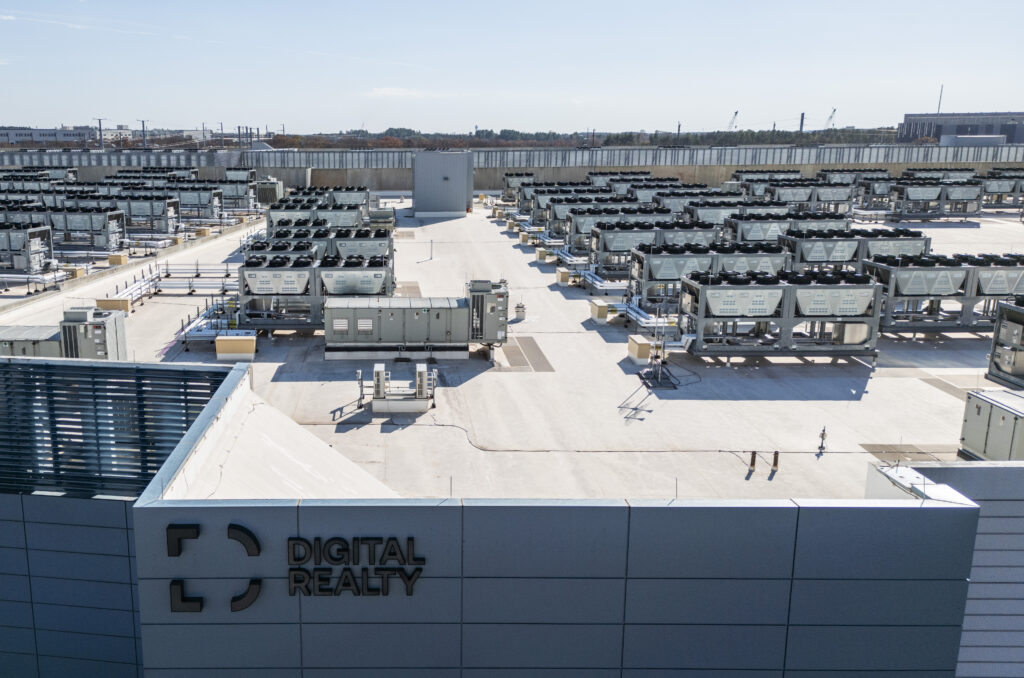
As planes make their final approach to Washington DC’s Dulles Airport, just below lies Ashburn, a town otherwise known as Data Center Alley — where an estimated 70 percent of all global internet traffic at any moment finds its way.Decades ago, the expanse of empty lots, forest and farmland in this corner of northern Virginia was slowly filled with suburban development. Then came the advent of the internet and an influx of data center builders. They emerged with pledges of tax revenue and investment in return for building structures that, while not pleasing to the eye, were the backbone of a digitally connected world.Why here? A combination of strategic location, robust infrastructure, pro-business policies, and affordable energy helps explain it. The Pentagon and the US government are just down the road, as were the headquarters of AOL, the early web giant that once defined being online.The benefits to Ashburn from these anonymous buildings over the past two decades are undeniable.Woven through the expanse of data centers are new stores, residential neighborhoods, an ice skating rink and public facilities that prove this town is in no way short of money.Ashburn is in Loudoun County, the richest county per capita in the United States, with towns the world over looking at the Washington suburb as a way to win the future — even if others see it as a cautionary tale.Among its 40,000 citizens, Ashburn alone has 152 data centers currently in operation over its 40 square kilometers (15.4 square miles), with more bursting from the ground, part of an AI investment boom creating a race for ever more massive structures.In 2025, private companies are spending roughly $40 billion a month on data center construction in the United States, according to the US Census Bureau, much of that for megaprojects by the major AI players: Google, Amazon, Microsoft and OpenAI.This compares to just $1.8 billion a decade ago.- Off limits -AFP reporters were given a tour of a typical data center facility by Digital Realty, a specialized real estate company that operates 13 data centers in Ashburn.”We provide not only the space that you see here, but the power, the cooling and the connectivity,” said Chris Sharp, Chief Technology Officer at Digital Realty.The servers in any given data center give life to basically anything we do online.Computer rooms here — which are strictly off limits to outsiders — are filled with racks of servers for a single client or broken into separate “cages” serving smaller clients. The emergence of AI has catapulted the industry to another dimension, creating new challenges as tech giants, caught in a bitter AI rivalry, scour the globe to build AI-capable data centers quickly.These new generation buildings require unprecedented levels of power, cooling technology and engineering: servers running Nvidia’s graphics processing units, necessary for training AI, are incredibly heavy, requiring bigger and sturdier structures that need massive amounts of electricity.”If we think about Virginia alone, just the data centers last year used about as much electricity as all of New York City,” said Leslie Abrahams, deputy director of the Energy Security and Climate Change program at the Center for Strategic and International Studies.Data servers deploying ChatGPT-like technologies run very hot and require new-generation liquid cooling—air conditioning will no longer do the job—and in most cases this means access to local water.Not surprisingly, the new necessities have made new constructions a harder sell.”Growing up, we started to see a few data centers, but honestly, not at this accelerated pace — they’re just popping up everywhere,” said Makaela Edmonds, a 24-year-old who grew up in Ashburn.Her family’s home is part of a suburban development that abuts a massive construction site.Another issue is that jobs in data centers are mostly found at the construction phase. Teams in hard hats work the sites, often around the clock. But once operational, many sites betray very little human activity.”The benefits of data centers tend to be more regional, national and global than local,” Abrahams said. – ‘Monumental growth’ -In a major shift, local politicians in northern Virginia are now running campaigns to slow the expansion instead of promising to attract more construction.For companies like Digital Realty, the challenge is to work with communities to prepare them for what bringing in data centers entails.Despite any doubts, the demand is not abating.”The growth and demand in this market is monumental,” said Sharp.
As planes make their final approach to Washington DC’s Dulles Airport, just below lies Ashburn, a town otherwise known as Data Center Alley — where an estimated 70 percent of all global internet traffic at any moment finds its way.Decades ago, the expanse of empty lots, forest and farmland in this corner of northern Virginia was slowly filled with suburban development. Then came the advent of the internet and an influx of data center builders. They emerged with pledges of tax revenue and investment in return for building structures that, while not pleasing to the eye, were the backbone of a digitally connected world.Why here? A combination of strategic location, robust infrastructure, pro-business policies, and affordable energy helps explain it. The Pentagon and the US government are just down the road, as were the headquarters of AOL, the early web giant that once defined being online.The benefits to Ashburn from these anonymous buildings over the past two decades are undeniable.Woven through the expanse of data centers are new stores, residential neighborhoods, an ice skating rink and public facilities that prove this town is in no way short of money.Ashburn is in Loudoun County, the richest county per capita in the United States, with towns the world over looking at the Washington suburb as a way to win the future — even if others see it as a cautionary tale.Among its 40,000 citizens, Ashburn alone has 152 data centers currently in operation over its 40 square kilometers (15.4 square miles), with more bursting from the ground, part of an AI investment boom creating a race for ever more massive structures.In 2025, private companies are spending roughly $40 billion a month on data center construction in the United States, according to the US Census Bureau, much of that for megaprojects by the major AI players: Google, Amazon, Microsoft and OpenAI.This compares to just $1.8 billion a decade ago.- Off limits -AFP reporters were given a tour of a typical data center facility by Digital Realty, a specialized real estate company that operates 13 data centers in Ashburn.”We provide not only the space that you see here, but the power, the cooling and the connectivity,” said Chris Sharp, Chief Technology Officer at Digital Realty.The servers in any given data center give life to basically anything we do online.Computer rooms here — which are strictly off limits to outsiders — are filled with racks of servers for a single client or broken into separate “cages” serving smaller clients. The emergence of AI has catapulted the industry to another dimension, creating new challenges as tech giants, caught in a bitter AI rivalry, scour the globe to build AI-capable data centers quickly.These new generation buildings require unprecedented levels of power, cooling technology and engineering: servers running Nvidia’s graphics processing units, necessary for training AI, are incredibly heavy, requiring bigger and sturdier structures that need massive amounts of electricity.”If we think about Virginia alone, just the data centers last year used about as much electricity as all of New York City,” said Leslie Abrahams, deputy director of the Energy Security and Climate Change program at the Center for Strategic and International Studies.Data servers deploying ChatGPT-like technologies run very hot and require new-generation liquid cooling—air conditioning will no longer do the job—and in most cases this means access to local water.Not surprisingly, the new necessities have made new constructions a harder sell.”Growing up, we started to see a few data centers, but honestly, not at this accelerated pace — they’re just popping up everywhere,” said Makaela Edmonds, a 24-year-old who grew up in Ashburn.Her family’s home is part of a suburban development that abuts a massive construction site.Another issue is that jobs in data centers are mostly found at the construction phase. Teams in hard hats work the sites, often around the clock. But once operational, many sites betray very little human activity.”The benefits of data centers tend to be more regional, national and global than local,” Abrahams said. – ‘Monumental growth’ -In a major shift, local politicians in northern Virginia are now running campaigns to slow the expansion instead of promising to attract more construction.For companies like Digital Realty, the challenge is to work with communities to prepare them for what bringing in data centers entails.Despite any doubts, the demand is not abating.”The growth and demand in this market is monumental,” said Sharp.