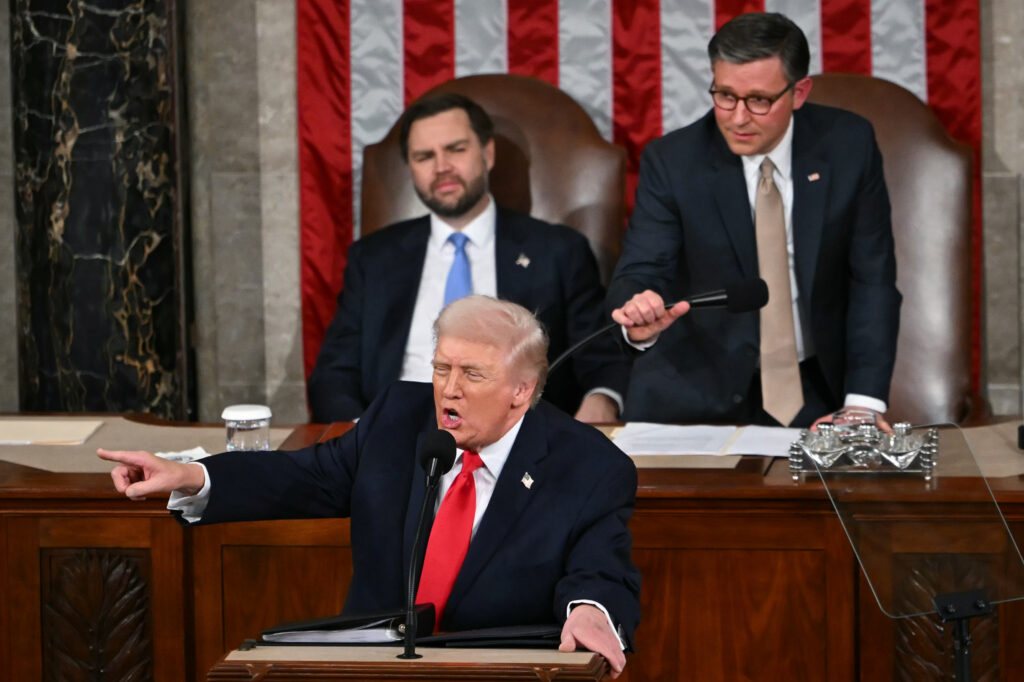
If Donald Trump was worried about a hostile reception over his breakneck remaking of presidential norms, he did not show it — striding in six minutes late, with the unhurried confidence of a man who knew the evening belonged to him.Republicans rose in successive waves, while many Democrats remained seated with fixed expressions.Only later, when the US men’s Olympic ice hockey team was introduced, would the entire chamber rise together.On nights like these, the US House of Representatives is less a legislature than a stage. The choreography is simple — one side applauds, the other scowls, and the republic survives another evening.The Supreme Court justices occupied their usual front-row spot — their black robes lending the scene the air of a quietly disapproving jury. This year, however, the proximity was unusually charged as merely days earlier, three of the justices present had struck down the global tariffs that Trump had made his signature economic policy.Attendance was thinner than usual, with dozens of Democrats boycotting, though the empty seats gave the spectacle the breathing room lost in the chaos of Trump’s protest‑hit 2025 appearance.- Hope, loss, fear -The president began as he nearly always does: with victory. The economy was thriving, America was respected and the nation had, under his guidance, become richer and more formidable.Polls suggest most Americans disagree, but the State of the Union is an exercise in imagination, not measurement.Trump lingered on inflation, which he said was falling, and jobs, which he said were rising. He praised the stock market with proprietary warmth. When he turned to tariffs, however, the chamber stiffened. The Supreme Court ruling, he said, was mistaken.The guests supplied the emotional punctuation — watching the address with expressions that carried stories into the room: pride, passion, hope, loss, fear, accusation. They included survivors of notorious sex criminal Jeffrey Epstein, as well as the hockey players, fresh from victory and somewhat bewildered by the grandeur. For a moment, when the Olympians were recognized, the chamber roared “USA! USA!” and the country remembered that it liked itself.- Crescendo -Democrats had been told by their leaders to be on their best behavior: protest, but elegantly. Several wore white in homage to the Suffragettes, or pins demanding more accountability over Epstein.Democratic Congressman Al Green, expelled over disruptions last year, held up a sign berating Trump for sharing a racist video of the Obamas — “Black people aren’t apes,” it read — and was swiftly ejected again. There were heckles and a smattering of jeers from the wings as Trump hit the hour mark — earning a slapdown from the Republican leader — but the main protest was the weaponized silence of half the chamber withholding applause. Outside, rival versions of the republic unfolded. Activists staged their own “People’s State of the Union,” while lawmakers issued rebuttals before the speech had even finished — an innovation reflecting the modern preference for simultaneity over suspense.The address built, as they tend to, towards a crescendo of certainty: America had never been stronger. Republicans rose, Democrats remained seated, and the justices, bound by institutional restraint, tried their best to do neither.
If Donald Trump was worried about a hostile reception over his breakneck remaking of presidential norms, he did not show it — striding in six minutes late, with the unhurried confidence of a man who knew the evening belonged to him.Republicans rose in successive waves, while many Democrats remained seated with fixed expressions.Only later, when the US men’s Olympic ice hockey team was introduced, would the entire chamber rise together.On nights like these, the US House of Representatives is less a legislature than a stage. The choreography is simple — one side applauds, the other scowls, and the republic survives another evening.The Supreme Court justices occupied their usual front-row spot — their black robes lending the scene the air of a quietly disapproving jury. This year, however, the proximity was unusually charged as merely days earlier, three of the justices present had struck down the global tariffs that Trump had made his signature economic policy.Attendance was thinner than usual, with dozens of Democrats boycotting, though the empty seats gave the spectacle the breathing room lost in the chaos of Trump’s protest‑hit 2025 appearance.- Hope, loss, fear -The president began as he nearly always does: with victory. The economy was thriving, America was respected and the nation had, under his guidance, become richer and more formidable.Polls suggest most Americans disagree, but the State of the Union is an exercise in imagination, not measurement.Trump lingered on inflation, which he said was falling, and jobs, which he said were rising. He praised the stock market with proprietary warmth. When he turned to tariffs, however, the chamber stiffened. The Supreme Court ruling, he said, was mistaken.The guests supplied the emotional punctuation — watching the address with expressions that carried stories into the room: pride, passion, hope, loss, fear, accusation. They included survivors of notorious sex criminal Jeffrey Epstein, as well as the hockey players, fresh from victory and somewhat bewildered by the grandeur. For a moment, when the Olympians were recognized, the chamber roared “USA! USA!” and the country remembered that it liked itself.- Crescendo -Democrats had been told by their leaders to be on their best behavior: protest, but elegantly. Several wore white in homage to the Suffragettes, or pins demanding more accountability over Epstein.Democratic Congressman Al Green, expelled over disruptions last year, held up a sign berating Trump for sharing a racist video of the Obamas — “Black people aren’t apes,” it read — and was swiftly ejected again. There were heckles and a smattering of jeers from the wings as Trump hit the hour mark — earning a slapdown from the Republican leader — but the main protest was the weaponized silence of half the chamber withholding applause. Outside, rival versions of the republic unfolded. Activists staged their own “People’s State of the Union,” while lawmakers issued rebuttals before the speech had even finished — an innovation reflecting the modern preference for simultaneity over suspense.The address built, as they tend to, towards a crescendo of certainty: America had never been stronger. Republicans rose, Democrats remained seated, and the justices, bound by institutional restraint, tried their best to do neither.