AFP USA

Trump’s ‘God squad’ holds increasing sway at White House

Donald Trump said at his inauguration that he had been “saved by God.” Now he appears to be returning the favor with an increasingly conservative, religious focus in his second term as US president.The three-times-married billionaire signed an executive order on Friday to open a “Faith Office” at the White House, led by the televangelist Paula White, Trump’s so-called spiritual advisor.A day earlier Trump had unveiled a task force under new Attorney General Pam Bondi to root out what he called the “persecution” of Christians in the United States.The Republican has also appointed several cabinet members with links to Christian nationalists, including Vice President JD Vance and Secretary of Defense Pete Hegseth.All of this comes despite the fact that Trump has long had an ambiguous relationship with religion. Unlike his predecessor Joe Biden, a devout Catholic, Trump rarely appears in Church. He was confirmed into the Presbyterian church but said he was “non-denominational.”Then there are the sexual scandals — and a criminal conviction for in a porn star hush money case — and the selling of $60 Trump-branded Bibles on the campaign trail.Yet evangelical Christians continued to back him in the 2024 election, just as they did in 2016.- ‘Changed something’ -During his first term Trump certainly dabbled with religion. He posed with a Bible outside a church near the White House after security forces cleared out “Black Lives Matter” protesters, and had prayer meetings in the Oval Office with evangelicals.But now Trump claimed to have had what amounts to a religious awakening.The 78-year-old said that he had become more religious since he narrowly escaped death when a gunman’s bullet hit him in the ear at an election rally in Butler, Pennsylvania last year.”It changed something in me,” Trump told a prayer breakfast at the US Capitol on Thursday. “I believed in God, but I feel much more strongly about it.”Not that this stopped Trump lashing out at the bishop who gave the sermon at his inauguration service, Mariann Budde, after she called on him to show “mercy” to immigrants and LGBTQ people.But the people Trump has chosen to surround himself in the White House are also telling.A number have ties to the New Apostolic Reformation church — a Christian nationalist movement that calls for the levers of government and society to come under Christian control.Republican House Speaker Mike Johnson has been linked to the movement, as has Paula White, who will head up his new Faith Office.White hit the headlines in 2020 when she led a marathon — and widely mocked — prayer session to call for Trump to win the US election against Joe Biden.Vance converted to Catholicism in his 30s and appeared at a town hall hosted by a leading figure in the New Apostolic Reformation Church.- ‘Bring religion back’ -Former Fox contributor and military veteran Hegseth, meanwhile, belongs to a church affiliated to the right-wing Communion of Reformed Evangelical Churches (CREC), a Christian nationalist group.The movement wants to reestablish Biblical law, with some of its adherents calling for the repeal of women’s right to vote, US media reported.While Trump has not expressed support for such views, he has increasingly adopted positions that have delighted America’s religious right.He repeatedly boasted that the Supreme Court justices he picked in his first term helped lead to the 2022 overturning of the nationwide right to abortion.Since his inauguration he has sent a video message to a huge anti-abortion march attended by far-right groups and signed a series of executive orders tackling liberal causes, from diversity to transgender rights and abortion.His prayer breakfast speech at the US Capitol this week was unusually explicit in its call for an increased role for religion.”We have to bring religion back,” said Trump. “Let’s bring God back into our lives.”

Handcuffs and beach clean-ups: a Cuban migrant’s seven months in Guantanamo Bay

Yeilis Torres, a 38-year-old Cuban woman, knows all too well the loneliness and anguish facing the migrants flown by the United States this week to its notorious military base in Guantanamo Bay in Cuba.Torres was picked up at sea by the US Coast Guard while fleeing Cuba in mid-2022 and held for seven months at Guantanamo Bay before being transferred to the United States, where she was eventually granted asylum.In a rare firsthand account of life at the base, Torres, who now lives in Miami, told AFP: “The hardest part…is the uncertainty and the wait for the long process” of seeking asylum.For the past two decades Guantanamo Bay naval base, leased by Washington from Havana under a 1903 treaty, has been synonymous with the Pentagon prison, where the United States kept hundreds of people it suspected of being “terrorists” for years after the September 11, 2001 attacks by Al-Qaeda.Some suffered waterboarding, sleep deprivation and other forms of torture. Fifteen people, including 9/11 mastermind Khalid Sheikh Mohammed, are still imprisoned there.President Donald Trump’s plans to detain up to 30,000 migrants at a separate center on the base has caused an outcry, with rights groups fearing they could be kept there indefinitely, far from public scrutiny.The NGO Human Rights Watch warned that prolonged detention without proper oversight “violates human rights and may amount to torture.”- No legal aid -During her seven months at Guantanamo Bay, surrounded by the sea on one side and a mined buffer zone separating the base from communist Cuba on the other three, Torres claims she was never given access to a lawyer.She was allowed calls of just “five or six minutes every three days” with her two young children, who stayed behind with her parents in Havana.She was part of a group of 17 Cubans that set sail across the Gulf of Mexico on a makeshift raft in mid-2022, fleeing Cuba’s economic meltdown or, in her case, persecution by the authorities.The group’s raft had been adrift for days when they were picked up by a Coast Guard ship.She was the only member of the group to be brought to Guantanamo Bay, which has for decades been used to hold Caribbean migrants intercepted at sea.- Handcuffs and black goggles -The other migrants were returned directly to Cuba — a fate she avoided by pleading she was in danger in her homeland, where she was jailed on charges of assaulting a Communist Party grandee.On arrival at Guantanamo Bay, she said migrants were handcuffed and forced to wear black goggles “so that we couldn’t see anything” while being transferred around the site.They were kept in isolation while waiting to be interviewed by State Department officials — in her case for three days but “some people were confined to their rooms for around three, four months.”Of the 21 migrants who were held alongside her, 18 were Cubans, two were Haitian and one from the Dominican Republic. There were two families with children and one pregnant woman.The children faced especially harsh conditions, Torres said, with no schooling provided for them and no interaction allowed with the children of US troops stationed at the base. – ‘Opportunity to work’ -Despite the grim conditions, Torres opposes calls to close the migrant center, fearing that without it, Caribbean migrants would never get a chance to make their case for asylum.”They gave us the opportunity to work,” she added, describing how she earned money by taking part in beach clean-ups.After seven months at the base, Torres was transferred to a migrant detention center in Broward County, Florida where she was held for a further four months before being granted asylum.The trained manicurist, who now works in a Florida cotton factory, was one of the few of the 21 migrants from her group in Guantanamo to gain entry to the United States, where she hopes to be reunited with her family.The other migrants accepted asylum offers from third countries such as Canada and Australia.

Trump demands US aid agency closure despite tumult

President Donald Trump on Friday called for USAID to be shuttered, escalating his unprecedented campaign to dismantle the humanitarian agency.”THE CORRUPTION IS AT LEVELS RARELY SEEN BEFORE. CLOSE IT DOWN!” Trump wrote on his Truth Social app as part of a drive that has triggered chaos in the agency’s global network and allegations of weakening American influence on the world stage.In the three weeks since he began his new term, Trump has launched a crusade led by his top donor and world’s richest person, Elon Musk, to downsize or dismantle swaths of the US government.The most concentrated fire has been on the United States Agency for International Development, which distributes US humanitarian aid globally.On Friday, Musk — who along with Trump has spread blatantly false information about USAID’s finances — reposted photos on social media of the agency’s signage being taken down from its Washington headquarters.The Trump administration has already frozen foreign aid and ordered thousands of foreign-based staff to return to the United States, with reported impacts on the ground steadily growing.On Thursday, a union official confirmed reports that the USAID headcount of 10,000 employees would be reduced to around only 300.Labor unions are challenging the legality of the onslaught, including a separate government-wide offer of buyouts by Musk’s team.Democrats in Congress say it would be unconstitutional for Trump — who has also expressed intent to close the Department of Education — to shut down government agencies without the legislature’s greenlight.- Soft power -The United States’ current budget allocates about $70 billion for international assistance.However while Washington is the biggest aid donor in the world, the money has only amounted to between 0.7 and 1.4 percent of total US government spending in the last quarter century, according to the Pew Research Center.USAID runs health and emergency programs in around 120 countries, including the world’s poorest regions.It is seen as a vital source of soft power for the United States in its struggle for influence with rivals including China.Samantha Power, the USAID chief under former president Joe Biden, dubbed the agency “America’s superpower” in a scathing New York Times opinion piece Friday.”We are witnessing one of the worst and most costly foreign policy blunders in US history,” said Power.Unless the dismantling is halted, Power wrote, “future generations will marvel that it wasn’t China’s actions that eroded US standing and global security” but rather “an American president and the billionaire he unleashed to shoot first and aim later.”Hard-right Republicans and libertarians have long questioned the need for USAID and criticized what they say is wasteful spending abroad.Those criticisms have been supercharged since Trump’s return with the administration demonizing USAID employees and claiming — without evidence — that the aid agency is rife with fraud.- Racist social posts -Musk and his so-called Department of Government Efficiency, or DOGE, have rampaged through agencies that most Americans have for decades taken for granted or ignored.While Democrats have struggled to find footing to halt the moves, court challenges are slowly taking shape.An attempt by Trump to overturn the constitutional guarantee to birthright citizenship has been blocked by a judge, and on Thursday another judge paused the federal worker buyouts program, pending arguments on Monday.Musk, the South African-born CEO of SpaceX and Tesla, ran into controversy last week with reports he and his team were accessing sensitive Treasury Department data and systems.An internal assessment from the Treasury called the DOGE team’s access to federal payment systems “the single biggest insider threat the Bureau of the Fiscal Service has ever faced,” US media reported.Adding to the drama, one member of the DOGE team resigned after it emerged that he had advocated racism and eugenics on social media.On Friday, following backing for the sacked 25-year-old from Trump, Musk said he would reinstate the staffer.The staffer, according to posts uncovered by the Wall Street Journal, said just last year that he was “racist before it was cool.”Vice President JD Vance weighed in Friday saying he did not not think “stupid social media activity should ruin a kid’s life,” while criticizing the reporter for trying to “destroy people.””So I say bring him back.”

Sport and politics entwine as Trump makes historic Super Bowl visit

Donald Trump will make history on Sunday when he becomes the first sitting US President to attend the Super Bowl, writing a new chapter in an often-strained relationship with the NFL that has been marked by decades of animosity.A keen sports fan, Trump’s links to America’s most popular sport stretch back to the early 1980s, when he first sought to join the exclusive club of NFL team owners by attempting to purchase the Baltimore Colts.Thwarted on that occasion, he went on to buy a team in the United States Football League (USFL), set up as a spring-summer alternative to the autumn-winter NFL. Trump was subsequently the driving force behind an acrimonious lawsuit filed by the USFL which accused the NFL of operating a monopoly, with the goal of forcing a USFL-NFL merger.Although a jury found in favor of Trump’s USFL, the league was awarded only $3 in damages, effectively leading to the league’s decision to close in 1986 amid multi-million dollar losses.Trump’s first presidential term, meanwhile, witnessed a series of running battles against the NFL and its players, most notably following Colin Kaepernick’s decision to kneel during the playing of the US national anthem in protest at racial injustice.”Wouldn’t you love to see one of these NFL owners, when somebody disrespects our flag, to say, ‘Get that son of a bitch off the field right now. He’s fired!'” Trump roared at a September 2017 rally in Alabama.That led to a wave of player protests across the NFL, with more than 200 players kneeling during the national anthem in solidarity with Kaepernick and in defiance of Trump’s rhetoric.”Divisive comments like these demonstrate an unfortunate lack of respect for the NFL, our great game and all of our players,” NFL commissioner Roger Goodell said in response to Trump’s remarks.Several teams from the NFL and other sports opted to skip the traditional White House reception offered to championship-winning teams in a snub to Trump. The Philadelphia Eagles, Super Bowl winners in the 2017-2018 season, were disinvited by the White House after several players said they would not attend. – Sporting foothold -Yet just like the expansion of his electoral base during the presidential campaign, Trump has gradually found a foothold in sport over the past year.On Monday he welcomed the Florida Panthers ice hockey team to the White House in recognition of their National Hockey League championship victory last season.A day later, the White House confirmed that Trump would become the first US president to attend the Super Bowl in person, joining around 74,000 other fans at Sunday’s showpiece between the Kansas City Chiefs and Philadelphia Eagles.Amy Bass, a professor of sports studies at Manhattanville University in New York, says Trump’s decision to attend the Super Bowl is “political.””Even if he is going because he loves football … it is a political move because he is the president of the United States and everything he does is political,” Bass told AFP.Some have interpreted the NFL’s decision to remove the words “End Racism” from the end zone at this weekend’s Super Bowl as a concession to the “anti-woke” stance of the new Trump administration.However NFL chief Goodell insisted on Monday that the league remained firmly committed to diversity programs, despite the Trump administration’s calls for similar initiatives in government and elsewhere to be scrapped.”We got into diversity efforts because we felt it was the right thing for the National Football League … we’ve proven to ourselves that it does make the NFL better,” Goodell said.Players at Sunday’s Super Bowl have reacted positively to Trump’s attendance, with Chiefs tight end Travis Kelce calling it a “great honor.”That could potentially lead to some awkwardness between Kelce and his pop icon girlfriend, Taylor Swift. Swift endorsed Trump’s election rival Kamala Harris last year, prompting Trump to write on social media: “I hate Taylor Swift.”The Super Bowl’s high-profile halftime concert on Sunday could also be an opportunity for anti-Trump sentiment, with rapper Kendrick Lamar, who has been critical of the president in the past, headlining the show.  Bass wonders how fans at the Superdome might respond on Sunday, given the Eagles’ recent history with Trump following the 2018 row.”Here’s the thing about using a stadium or a ball park as a political arena: you have absolutely no idea what the crowd is going to do, because you, the politician, are not why anyone is there,” Bass said.”You’d be hard pressed to find a city that hates Donald Trump more than Philadelphia, so….might they be disrespectful? Yes. And that’s a shame. Because the office of the president deserves respect.”But Donald Trump changed the rules on respect, so all’s fair.”

Musk vows to rehire deputy who quit over racist posts

US tech billionaire Elon Musk said Friday he was reinstating a deputy who quit a job giving him access to the sensitive personal data of millions of Americans after the staffer was linked to a racist social media account.Marko Elez, 25, resigned from Musk’s self-styled Department of Government Efficiency (DOGE) Thursday when The Wall Street Journal uncovered a welter of offensive posts on the account, including a boast from last July that “I was racist before it was cool.” Musk — US President Donald Trump’s close confidante and point man on spending cuts — asked his 216 million X followers if he should reinstate “@DOGE staffer who made inappropriate statements via a now deleted pseudonym.” More than three-quarters of the 385,000 respondents voted “yes,” prompting Musk to announce: “He will be brought back. To err is human, to forgive divine.”X relaxed its enforcement of offensive rhetoric — reinstating many banned far-right figures — after it was acquired in 2022 by Musk, whose infamous raised-arm salute during Trump’s inauguration drew comparisons to a Nazi salute.The world’s richest man has drawn criticism at home and in Europe for his vocal support for the far-right Alternative for Germany (AfD) party and repeatedly insulting the US ally’s political leaders.”Normalize Indian hate,” the account associated with Elez posted in September, as Musk was facing a barrage of criticism from the Trumpist far right for his support for hiring skilled foreign workers in the tech sector.In another post, it reportedly said it “would not mind at all if Gaza and Israel were both wiped off the face of the Earth.”Elez’s resignation came after a court ruled that he and another DOGE worker could continue to access the personal information of millions of Americans kept in Treasury payment systems.His prospects for redemption quickly improved as Vice President JD Vance — whose wife and children have Indian heritage — wrote a post blaming the media for the disgraced official’s downfall.”Here’s my view: I obviously disagree with some of Elez’s posts, but I don’t think stupid social media activity should ruin a kid’s life,” said Vance. “We shouldn’t reward journalists who try to destroy people. Ever. So I say bring him back. If he’s a bad dude or a terrible member of the team, fire him for that.”Trump — who has embarked on an aggressive purge of initiatives to counter discrimination in government — later told reporters in the White House he supported Vance’s stance.

Japan PM, Trump play nice despite tariff threat

Japanese Prime Minister Shigeru Ishiba and US President Donald Trump struck a warm tone at their first meeting on Friday, with Tokyo avoiding tariffs that Trump has slapped on other allies — for now.Heaping praise on each other at the White House, the two leaders pledged to stand together against Chinese “aggression” and said they found a solution for a blocked deal for troubled US Steel.Trump however pressed Ishiba to cut the US trade deficit with Japan to zero, and warned that Tokyo could still face tariffs on exported goods if it fails to do so.Ishiba, an avowed “geek” and model warship fan, has been under pressure to replicate Trump’s close relationship with former premier and golf buddy Shinzo Abe. Both leaders insisted they had struck up a rapport during what was only the second visit by a foreign leader of Trump’s new term.- ‘Frightening’ -“I was so excited to see such a celebrity on television in person,” Ishiba told their joint press conference — while saying he was not trying to “suck up.” “On television he is frightening and has a very strong personality. But when I met with him actually he was very sincere and very powerful.”As they exchanged photographs, Trump praised the 68-year-old Japanese premier as “good looking” — typically one of the former reality TV star’s highest orders of praise.And the US president laughed and said “that’s a very good answer” when Ishiba said he could not respond to a “theoretical question” about whether he would retaliate to any US tariffs.Trump meanwhile said that Japan’s Nippon Steel will make a major investment in US Steel, but not take over the troubled company as previously negotiated.Trump said “they’ll be looking at an investment rather than a purchase.” His predecessor Joe Biden had blocked the deal.The two leaders also doubled down on decades-old US ties in security and trade — despite fears that Trump could turn on Tokyo as he has with other US allies.- Chinese ‘aggression’ -Trump said they had agreed to fight “Chinese economic aggression” and in a joint statement they condemned Beijing for “provocative activities” in the contested South China Sea.They also called for a denuclearized North Korea, although Trump — who met its leader Kim Jong-un during his first term — said he wanted to have “relations” with Pyongyang.Behind Trump’s expressions of support were Japan’s promises of a 1 trillion dollar investment in the United States and to boost Japanese purchases of US defense equipment. Ishiba said his country was the biggest investor in the United States and would step up its spending.The soft-spoken, cigarette-smoking Ishiba had rushed to Washington hoping to blunt the edge of Trump’s “America First” policies.Under Abe, Japan was shielded from some of Trump’s more punishing tendencies, such as sudden trade wars and pressure to increase financial contributions towards hosting US soldiers.Days after Trump’s first election victory, Abe rushed to deliver to him a gold-plated golf club. Trump also hosted Abe’s widow Akie for dinner at his Mar-a-Lago resort in Florida this past December.So far the US president has slapped tariffs on China and ordered them on Mexico and Canada before halting them for a month.He has also pledged tariffs on the European Union and said Friday that he would announce unspecified “reciprocal tariffs” next week.

Brazil receives second plane of deported migrants after row with US

Brazil on Friday received a second plane of migrants deported from the United States, after a row between the countries last month over the treatment of a first group of people, who arrived cuffed and shackled.A Brazilian government source told AFP that 111 passengers were on the civilian aircraft which left from Louisiana and arrived in northeastern Fortaleza — confirmed by an AFP photographer on the scene.”The information we have is that they are all Brazilian,” the source said.Shortly after taking office last month, US President Donald Trump ordered a battery of measures against undocumented immigrants, including mass raids and deportations, and the deployment of troops on the border with Mexico.As observers attempt to separate fact from White House rhetoric, however, the Brazilian government source said that the flights that have arrived so far were a result of a 2017 deal with Washington which has resulted in multiple deportations over the years.According to federal police statistics, 94 flights carrying over 7,500 deportees arrived in Brazil from the United States between 2020 and 2024.However, the first flight under Trump saw 88 Brazilians arriving in handcuffs and with shackles on their feet, complaining they had not been given water or allowed to use the bathroom.In response, Brazil summoned the top US envoy to explain what the government called the “flagrant disregard” for the migrants’ rights.President Luiz Inacio Lula da Silva decided that when the latest flight enters Brazil it “has to land in the closest location so that Brazilians are not left handcuffed on the plane,” the governor of Ceara state, Elmano de Freitas, told a press conference Thursday.The passengers would then be transported from Fortaleza to southeastern Belo Horizonte by a Brazilian Air Force aircraft.Brazil this week formed a working group with US representatives to “guarantee the humane reception” of deportees, authorities said.

International ire over Trump sanctions against ICC

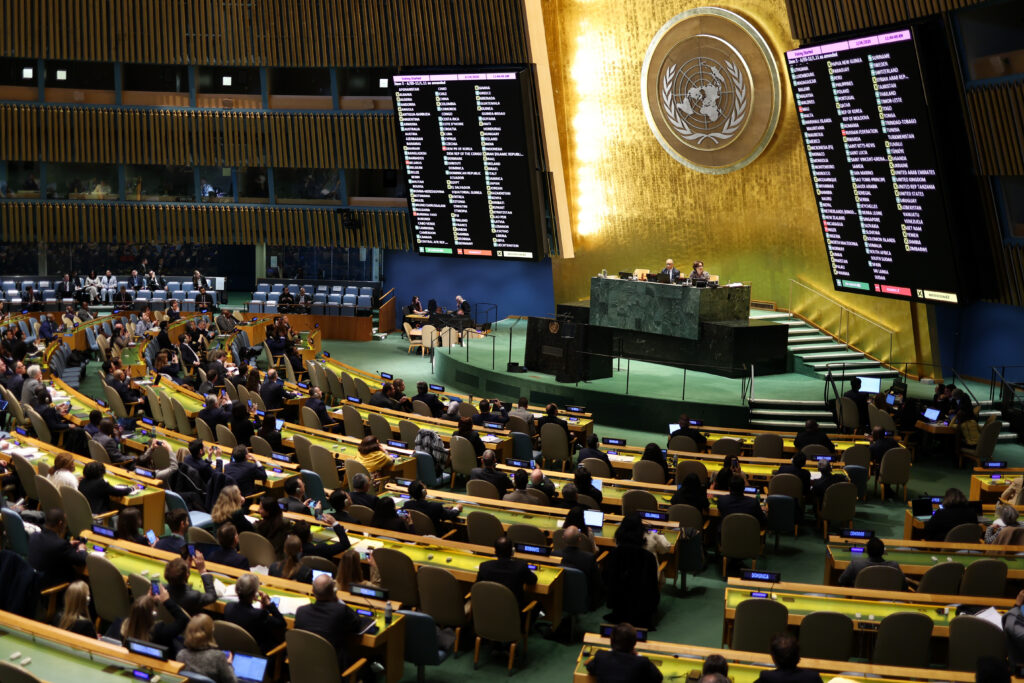
The International Criminal Court and dozens of countries on Friday condemned sanctions imposed by US President Donald Trump over probes targeting America and Israel as a threat to “law based international order”.The United Nations and the European Union urged Trump to reverse the asset freezes and travel bans against ICC officials, employees and their families and anyone deemed to have helped ICC investigations.US allies, including Britain, France and Canada, were among 79 of the 125 ICC member states who said the US action “could jeopardize” the safety of victims, witnesses and court officials. Trump on Thursday signed an executive order saying that the court, which was founded in 2002 to investiate genocide, war crimes and crimes against humanity, had “abused its power” by issuing an arrest warrant for Israeli Prime Minister Benjamin Netanyahu, who held talks with the US president on Tuesday.The ICC, which is based in The Hague, said the sanctions sought to “harm its independent and impartial judicial work”. It vowed to stand “firmly” with staff “providing justice and hope to millions of innocent victims of atrocities across the world”.Court president Tomoko Akane said: “Such threats and coercive measures constitute serious attacks against the court’s states parties, the rule of law based international order and millions of victims.”- ‘Undermines’ justice system -The United Nations urged Trump to reverse the move.”The court should be fully able to undertake its independent work,” OHCHR UN human rights office spokeswoman Ravina Shamdasani said in an email statement.”The rule of law remains essential to our collective peace and security. Seeking accountability globally makes the world a safer place for everyone.”Antonio Costa, who heads the European Council representing the EU’s 27 member states, wrote on X that the move “undermines the international criminal justice system”.The European Commission expressed “regret” and stressed the ICC’s “key importance in upholding international criminal justice and the fight against impunity”.The 79 ICC member countries said Trump’s sanctions increased the “risk of impunity” for serious crimes and “threaten to erode the international rule of law”.That statement was led by Slovenia, Luxembourg, Mexico, Sierra Leone and Vanuatu but Brazil, Britain, Canada, France and Germany were among the signatories.The court has pursued investigations in several conflict zones and Ukraine’s foreign ministry spokesman Georgiy Tykhy was quick to express concern over the sanctions.”We hope that they will not affect the court’s ability to achieve justice for the victims of Russian aggression,” he said. The Kremlin only reaffirmed that it does not recognise the ICC.- ICC ‘illegitimate’: Trump -The names of individuals affected by sanctions were not immediately released, but previous US sanctions under Trump targeted the court’s prosecutor.Trump’s order said that the tribunal had engaged in “illegitimate and baseless actions targeting America and our close ally Israel”, referring to ICC probes into alleged war crimes by US service members in Afghanistan and Israeli troops in Gaza.Israel’s foreign minister Gideon Saar strongly applauded Trump and called the court’s actions against Israel “immoral” and without “legal basis”.Neither the United States nor Israel are members of the court.Following a request by ICC prosecutor Karim Khan, judges issued arrest warrants on November 21 for Netanyahu, his former defence minister Yoav Gallant, and Hamas’s military chief Mohammed Deif, who was killed last year.The court said it had found “reasonable grounds” to believe Netanyahu and Gallant bore “criminal responsibility” for the war crime of starvation in Gaza, as well as crimes against humanity of murder, persecution, and other inhumane acts.Netanyahu accused the court of anti-Semitism.During his first term, Trump imposed financial sanctions and a visa ban on the ICC’s then-prosecutor Fatou Bensouda, and other senior officials in 2020. His administration acted after Bensouda launched an investigation into allegations of war crimes against US soldiers in Afghanistan. She opened a probe into events in the Palestinian territories in 2019.Current prosecutor Khan later effectively dropped the US from the Afghan investigation and focused on the Taliban instead.  President Joe Biden lifted the US sanctions after taking office in 2021.burs-tw/bc

US Postal Service halts China suspension after stoking trade fear

The US Postal Service (USPS) said Wednesday it would continue accepting packages from China and Hong Kong, hours after an order to suspend shipments over President Donald Trump’s new tariffs sparked fears of major trade disruptions.Tensions between the US and China have soared in recent days as the world’s two largest economies slapped a volley of tariffs on each others’ imports, hitting hundreds of billions of dollars in trade.As part of Trump’s tariffs — which he enacted citing drug trafficking concerns — the United States on Tuesday scrapped a duty-free exemption for low-value packages.The “de minimis” exemption allows goods valued at $800 or below to enter the United States without paying duties or certain taxes, but it has faced scrutiny due to a surge in shipments in recent years.The US Customs and Border Protection agency said last month that exemption shipments rose to over 1.36 billion in fiscal year 2024, creating challenges for its enforcement of trade laws, health and safety requirements, intellectual property rights, and consumer protection rules.US officials have pointed to the growth of Chinese-founded online retailers Shein and Temu as a key factor behind the increase — and Tuesday’s halt threatened major delays to parcels from both companies from entering the country.The developments at the USPS came as the latest data showed the US trade deficit swelled last year to its second-largest on record, a metric that Trump has used in the past to justify trade battles with China and others.In an apparent climbdown, the USPS on Wednesday morning said it would “continue accepting all international inbound mail and packages from China and Hong Kong Posts.””The USPS and Customs and Border Protection are working closely together to implement an efficient collection mechanism for the new China tariffs to ensure the least disruption to package delivery,” it added, without further details.Beijing had responded with fury to the move, accusing the United States of “politicizing trade and economic issues and using them as tools.”Vowing to “take necessary measures to resolutely safeguard the legitimate rights and interests of Chinese companies,” foreign ministry spokesman Lin Jian accused Washington of “unreasonable suppression.”AFP has reached out to Shein and Temu for comment.Other retailers such as Amazon might also be impacted by the “de minimis” removal.The low-cost retailers took another hit Wednesday as the European Commission announced it would seek to impose new fees on e-commerce imports — the bulk of which come from China.The measures are part of efforts to tackle a surge of “harmful” products into the bloc.- Tariff standoff -Tuesday saw Beijing say it would impose levies on imports of US energy, vehicles and equipment in a return salvo minutes after Trump’s threatened tariffs on Chinese goods came into effect.A day earlier, Trump suspended duties on Mexico and Canada for a month after both countries vowed to step up measures to counter flows of the drug fentanyl and the crossing of undocumented migrants into the United States.Beijing’s moves hit roughly $20 billion worth of US goods per year — roughly 12 percent of total American imports into China, according to calculations by Capital Economics.But their impact is a far cry from US tariffs announced over the weekend, which will affect some $450 billion worth of goods.Although earlier it appeared that US parcels could still be sent from Macau, by Wednesday evening the semi-autonomous Chinese city’s post office announced that its service was also suspended.Trump had signalled earlier that the talks with Xi could take place early this week, but addressing reporters at the White House Tuesday afternoon, he said he was in “no rush.”

Despite Trump, Mexico avocado farmers see no end of Super Bowl demand

Despite Donald Trump’s tariff threats, Mexican farmers working flat out to meet Super Bowl fans’ appetite for guacamole believe that, as long as they keep growing avocados, people will keep buying them.”In the end, the trees are here, the avocados are there, and the customer will either want them or not,” said Agustin del Rio, a producer in the western state of Michoacan.”Fortunately, they always do,” the 49-year-old told AFP.The farmers who harvest the fruit beloved for its creamy green flesh are no strangers to adversity.Michoacan is one of Mexico’s most dangerous states, and ultra-violent drug cartels battle for a share of its agricultural riches through robbery, kidnapping and extortion.Trump’s vow to impose 25-percent tariffs on Mexican goods — he cites illegal migration and drug smuggling as his motive — are another headache for the industry.”Am I worried? Of course, just like anyone would be,” Del Rio said in his orchard in Uruapan.”How is it our fault? We’re a bargaining chip,” he added.- Free trade in doubt -Mexican avocado shipments are worth more than three billion dollars a year, with consumption in the United States set to peak on Sunday when the Kansas City Chiefs will take on the Philadelphia Eagles in New Orleans in the climax of the NFL season.Trade between the neighboring countries has flourished under a North American free trade deal whose future has been plunged into uncertainty by Trump’s tariff threats.Michoacan — which covers an area as big as Costa Rica — will have exported some 110,000 tons of the fruit for the Super Bowl by the time it kicks off, according to Mexico’s association of avocado producers and exporters.It is the importers in the United States who would be responsible for paying the tariffs and most probably try to pass the extra cost on to the consumer.For now, Trump has agreed to delay the levies for a month, until early March, after Mexico pledged to deploy 10,000 more troops to its border with the United States to combat drug and migrant flows.As the Super Bowl approached, farmers were working at full capacity to meet demand.Near Del Rio’s orchard, dozens of employees packed avocados using a mechanized process allowing shipments to reach the border in one day.Machines selected the fruits by size and quality before workers arranged them in cardboard boxes.Some 150 tons of the fruit are processed daily at this location alone with the label: “Avocados from Mexico. The world’s finest.”The boxes, which are kept in cold storage, have codes that allow the entire production chain to be tracked.A sample is selected from each shipment to be checked by an inspector from the US Department of Agriculture.In 2022, the United States briefly suspended avocado imports from Michoacan after one such inspector checking shipments before the Super Bowl received phone threats. Industry sources said at the time that the incident was believed to be linked to attempts by some producers to surreptitiously export avocados from regions other than Michoacan to the United States.Drivers of the trucks that transport avocados must also be vigilant for potential robberies.For now, however, avocado farmers can at least breathe a sigh of relief that tariffs were avoided at their busiest time of the year.And whatever the future holds, few expect demand for the fruit to wither away.”It’s a good product, a reliable product, a healthy product. So at a higher or lower price, they will sell — I’m sure of it,” Del Rio said.