AFP USA

Trump threatens to invoke Insurrection Act over Minnesota protests

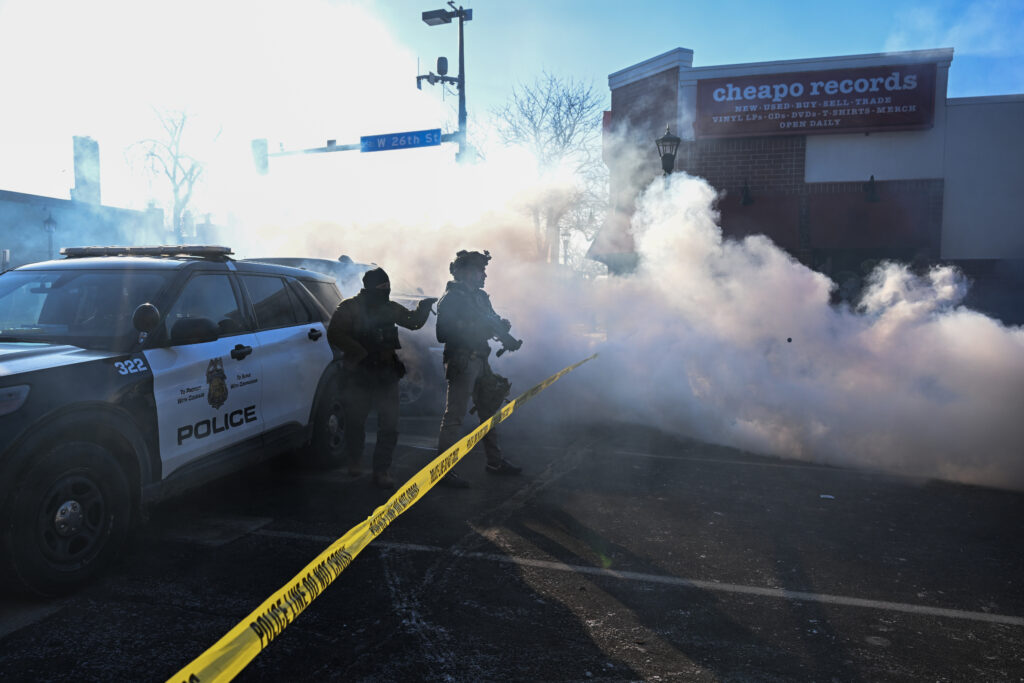
US President Donald Trump on Thursday threatened to invoke an emergency law that allows the domestic deployment of the military, after federal agents killed one person and injured another in Minnesota, sparking mass protests.Protesters have denounced the aggressive tactics of Trump’s broad-reaching immigration raids in rallies in the Midwestern city, which is a Democratic stronghold.Federal agents fired their weapons in two separate incidents, wounding a man from Venezuela Wednesday and killing an American woman last week.The Insurrection Act allows a president sidestep the Posse Comitatus Act to suppress “armed rebellion” or “domestic violence” and use the armed forces “as he considers necessary” to enforce the 19th century law.”If the corrupt politicians of Minnesota don’t obey the law and stop the professional agitators and insurrectionists from attacking the Patriots of ICE, who are only trying to do their job, I will institute the INSURRECTION ACT,” Trump warned on Truth Social.Democratic Minnesota Governor Tim Walz accused federal agents of waging “a campaign of organized brutality against the people of Minnesota,” in a video posted to X Wednesday night. In the short clip, Walz noted a number of violent incidents, including “breaking windows, dragging pregnant women down the street,” and the January 7 killing of 37-year-old Renee Good as examples.”We must protest loudly, urgently, but also peacefully,” Walz said, calling on Trump and Homeland Security Secretary Kristi Noem to “end this occupation.”Walz also urged people to record any interaction they may have with ICE for future prosecution. Noem told reporters at a White House press briefing Thursday that it’s up to Trump if he decides to invoke the law. Demonstrations against ICE in Minneapolis have stretched into the night in recent days and protesters have clashed with federal agents, who have deployed pepper spray and tear gas to disperse crowds.- Shots fired -Minneapolis Police Chief Brian O’Hara said the shooting late Wednesday resulted from a struggle between an ICE agent and a man he was trying to apprehend.”During the struggle, the federal agent discharged his weapon, striking one adult male,” O’Hara told a press conference.Amid the tussle, two people emerged from a nearby residence and attacked the federal agent with a snow shovel and a broom handle, the Department of Homeland Security said, identifying the wounded man as an illegal immigrant from Venezuela.The man suffered a non-life-threatening gunshot wound to his leg and was taken to hospital, while the two others were taken into custody, officials said.The Insurrection Act was last invoked in 1992 by President George H.W. Bush at the request of the Republican governor of California, who was facing unprecedented riots in Los Angeles following the acquittal of police officers who had beaten Rodney King, a Black motorist, the previous year.Senior White House official Stephen Miller on Thursday accused Minnesota officials of “deliberately, willfully and purposefully” inciting a “violent insurrection.”White House spokeswoman Karoline Leavitt also lashed out at journalists, saying “media is absolutely complicit in this violence.”But concerns about the tactics used by ICE are not limited to incidents of violent street enforcement and have raised questions about inadequate training and oversight of agents.Mexican authorities said Thursday they were also seeking details about the death of one of their citizens at an ICE facility in the southern state of Georgia this week.ICE broke its record for people dying in detention in 2025 with 30 deaths, according to data released by the agency. The number of people detained in recent years has similarly increased.

Spanish singer Julio Iglesias says abuse allegations ‘absolutely false’

Spain’s veteran singer and cultural icon Julio Iglesias on Friday rejected allegations of abuse lodged against him by two women ex-employees, in a case that has dominated headlines.”I deny having abused, coerced, or disrespected any woman. These accusations are absolutely false and deeply sadden me,” the 82-year-old wrote on his Instagram account.Iglesias, one of the most successful Latin artists of all time, is a Grammy winner with more than 300 million records sold in a career spanning decades.Two women — a domestic worker and a physiotherapist — alleged they suffered sexual and other forms of abuse while working at Iglesias’s properties in the Dominican Republic and the Bahamas in 2021.Advocacy groups Women’s Link Worldwide and Amnesty International said a complaint filed with Spanish prosecutors on January 5 outlined alleged acts that could be considered “a crime of human trafficking for the purpose of forced labour” and “crimes against sexual freedom”.Iglesias subjected them to “sexual harassment, regularly checked their mobile phones, restricted their ability to leave the home where they worked, and required them to work up to 16 hours a day without days off”, according to testimony collected by the two groups.In the message posted on Instagram, Iglesias wrote: “It is with profound sadness that I respond to the accusations made by two people who previously worked for me.””I have never felt such malice, but I still have the strength to let people know the whole truth and to defend my dignity against such a serious accusation,” he said, thanking the “so many dear people” who have sent him messages of support.The allegations against the beloved crooner have sparked strong reactions in Spain, with members of the leftist government backing the complainants and demanding that an investigation establishes the truth.The head of the conservative opposition Popular Party, Alberto Nunez Feijoo, who is friends with Iglesias, told Telecinco television on Wednesday he was “very, very, very surprised” but urged against “speculating”.Iglesias’s former manager Fernan Martinez told Telecinco that he was “very affectionate” and enjoyed “physical contact” but stressed he never saw the music icon “behave aggressively”.

Fraudsters flee Cambodia’s ‘scam city’ after accused boss taken down

Hundreds of people dragged away suitcases, computer monitors, pets and furniture as they fled a suspected Cambodian cyberfraud centre, after the country’s most wanted alleged scam kingpin was arrested and deported.Boarding tuk-tuks, Lexus SUVs and tourist coaches, an exodus departed Amber Casino in the coastal city of Sihanoukville, one of the illicit trade’s most notorious hubs.”Cambodia is in upheaval,” one Chinese man told AFP. “Nowhere is safe to work anymore,” he said Thursday.Similar scenes played out at alleged scam compounds across Cambodia this week as the government said it was cracking down on the multibillion-dollar industry.But residents said many of the people working inside the tightly secured buildings moved out several days before the arrival of authorities, and an analyst dubbed it “anti-crime theatre”.From hubs across Southeast Asia, scammers lure internet users globally into fake romantic relationships and cryptocurrency investments.Initially largely targeting Chinese speakers, transnational crime groups have expanded operations into multiple languages to steal tens of billions annually from victims around the world.Those conducting the scams are sometimes willing con artists, sometimes trafficked foreign nationals who have been trapped and forced to work under threat of violence.AFP journalists visited several alleged internet scam sites in Sihanoukville, in the wake of the high-profile arrest in Cambodia and extradition to China of internationally sanctioned accused scam boss Chen Zhi.Few of those departing the casinos, hotels and other facilities were willing to speak with AFP, and none were willing to be identified due to concerns for their safety.”Our Chinese company just told us to leave straight away,” said a Bangladeshi man outside Amber Casino.”But we’ll be fine. There are plenty of other job offers,” he added.Studded with casinos and unfinished high-rises, the glitzy resort of Sihanoukville has become a cyberscam hotbed, where thousands of people involved in the black market are believed to operate cons from fortified compounds.Before Chen was indicted last year by US authorities who said his firm Prince Group was a front for a transnational cybercrime network, the Chinese-born businessman ran multiple gambling hotels in Sihanoukville.A 2025 Amnesty International report identified 22 scam locations in the coastal resort, out of a total of 53 in the country.The UN Office on Drugs and Crime estimates global losses to online scams reached up to $37 billion in 2023, and that at least 100,000 people work in the industry in Cambodia alone. – Tipped off -But the Cambodian government claims the lawless era has come to an end, with Prime Minister Hun Manet pledging on Facebook to “eliminate… all the problems related to the crime of cyber scams”.Cambodia’s anti-scam commission says it has raided 118 scam locations and arrested around 5,000 people in the last six months.Following Chen’s deportation to China, the Cambodian government has tightened the screws on some Prince Group affiliates, ordering Prince Bank into liquidation and freezing home sales at several of its luxury properties.In recent months, China has stepped up its pursuit of the scam industry, sweeping up Chen and other key figures from across Southeast Asia to try them on its own soil.But while Cambodia says it is “cracking down”, there are suspicions over the timing.A tuk-tuk driver in Sihanoukville told AFP hundreds of Chinese people left one compound this week before police arrived.”Looks like they were tipped off,” said the 42-year-old, declining to give his name.Mark Taylor, former head of a Cambodia-based anti-trafficking NGO, said the “preemptive shifting of scam centre resources”, including workers, equipment and managers, had been seen ahead of law enforcement sweeps.It was “seemingly the product of collusion”, he added, in a strategy with “dual ends” of boosting the government’s anti-crime credentials while preserving the scamming industry’s ability to survive and adapt.Amnesty has accused the Cambodian government of “deliberately ignoring” rights abuses by cybercrime gangs, which sometimes lure workers with offers of high-paying jobs before holding them against their will.AFP journalists saw several coachloads of Mandarin speakers leaving Sihanoukville on the main highway to the capital Phnom Penh.Multiple people said they “didn’t know” where they were going or what their plans were, but appeared anxious as they anticipated law enforcement closing in.Outside the Amber Casino, holding a fake designer hold-all, the Bangladeshi man fell in with the crowd, saying: “This is about survival now.”

Japan and US agree to expand cooperation on missiles, military drills

Tokyo and Washington agreed Friday to boost joint production of defence equipment including missiles, and expand their military presence in waters southwest of mainland Japan, as China ramps up pressure on its Asian neighbour.The agreement came after Japanese defence minister Shinjiro Koizumi met Pentagon chief Pete Hegseth in Washington, where they also pledged to further cooperation on supply chains including critical minerals.Japan is embroiled in a heated diplomatic spat with China, triggered by Prime Minister Sanae Takaichi’s suggestion in November that Japan could intervene militarily if China attacks Taiwan.China, which regards Taiwan as its own territory, reacted angrily, blocking exports to Japan of “dual-use” items with potential military applications, fuelling worries in Tokyo that Beijing could choke supplies of much-needed rare earths.As the “security environment is rapidly growing severe” in Asia, “the two ministers confirmed the Japan-US alliance remains absolutely unwavering”, the statement released by Tokyo’s defence ministry said. They agreed to further advance joint production of air-to-air missiles and surface-to-air interceptors.The allies also agreed to work on the expansion of “more sophisticated and practical joint drills in various locations including the Southwest region”, the statement said. Beefing up defence around the so-called “Southwest” region, which includes areas such as the subtropical island of Okinawa, is one of Japan’s top priorities.Okinawa, home to the vast majority of American military bases in Japan, serves as a key US outpost to monitor China, the Taiwan Strait and the Korean peninsula, with both Tokyo and Washington stressing its strategic importance.Tokyo has also been steadily increasing its military budget, including in December when the right-leaning government of Takaichi approved a record nine trillion yen in defence spending for the upcoming fiscal year.At the top of his meeting with Koizumi, Hegseth praised Japan for this effort, calling it “hard-nosed realism; practical, common-sense approach that puts both of our vital national interests together”, according to the US Department of War, recently re-branded from the Department of Defense.Their meeting was preceded by a joint morning workout session at a military gym. “The American military-style training was very tough,” Koizumi wrote on X.”But I did my best to labour my way through it, telling myself: ‘this is all for the sake of strengthening the Japan-US alliance.'”  

US says reached deal with Taiwan to lower tariffs, boost investments

The United States said Thursday that it has signed a deal with Taiwan to reduce tariffs on goods from the democratic island, while increasing Taiwanese semiconductor and tech companies’ investments in America.The agreement, the US Commerce Department said, “will drive a massive reshoring of America’s semiconductor sector.”Under the deal, Washington will lower tariffs on Taiwanese goods to 15 percent, down from a 20 percent “reciprocal” rate meant to address US trade deficits and practices it deems unfair.Taiwanese Premier Cho Jung-tai praised negotiators on Friday for “delivering a well-executed home run”.”These results underscore that the progress achieved so far has been hard-won,” Cho said.Sector-specific tariffs on Taiwanese auto parts, timber, lumber and wood products will also be capped at 15 percent, while generic pharmaceuticals and certain natural resources will face no “reciprocal” duties, the US Commerce Department added.Meanwhile, Taiwanese chip and tech businesses are set to make “new, direct investments totalling at least $250 billion” in the United States to build and expand capacity in areas like advanced semiconductors and artificial intelligence, the department said.Taiwan will also provide “credit guarantees of at least $250 billion to facilitate additional investment by Taiwanese enterprises,” the department said adding that this would support the growth of the US semiconductor supply chain.Taiwan’s government said the new tariff will not stack on top of existing duties, which had been a major concern for local industries.”Of course it’s good that the reciprocal tariff has been lowered to 15 percent — at least it puts us on par with our main competitors South Korea and Japan,” said Chris Wu, sales director for Taiwanese machine tool maker Litz Hitech Corp. But, given the company’s single-digit profit margins, “there is no way we can absorb the tariff” for US customers, he said. The department’s announcement did not mention names, but the deal has key implications for Taiwanese chipmaking titan TSMC, the world’s biggest contract maker of microchips used in everything from Apple phones to Nvidia’s cutting-edge AI hardware.In an interview with CNBC, Commerce Secretary Howard Lutnick said TSMC has bought land and could expand in Arizona as part of the deal.”They just bought hundreds of acres adjacent to their property. Now I’m going to let them go through it with their board and give them time,” he said.TSMC did not immediately respond to a request for comment.Taiwanese producers who invest in the United States will also be treated more favorably when it comes to future semiconductor duties, the Commerce Department said.Firms building new US chip capacity may import up to 2.5 times their planned capacity without paying sector-specific duties during construction. The quota lowers to 1.5 times once projects are completed.A day prior, US officials held off imposing wider chip tariffs, instead announcing a 25 percent duty on certain semiconductors meant to be shipped abroad — a key step in allowing Nvidia to sell advanced AI chips to China.Ryan Majerus, a former US trade official, told AFP that although chip tariffs are currently narrowly targeted, Washington “signaled there is certainly potential for it to grow.”Majerus, now a partner at law firm King & Spalding, added that the deal had parallels to those with other US partners. The European Union and Japan, for example, both also secured a 15-percent tariff rate.- ‘Self-sufficient’ -“The objective is to bring 40 percent of Taiwan’s entire supply chain and production, to domestically bring it into America,” Lutnick told CNBC.”We’re going to bring it all over, so we become self-sufficient in the capacity of building semiconductors,” he added.The agreement comes after months of negotiations.Taiwanese President Lai Ching-te had pledged to boost investments in the United States and increase defense spending as his government tried to lower US duties, and avoid a toll on its semiconductor chip exports.Taiwan is a powerhouse in the manufacturing of semiconductor chips, which are the lifeblood of the global economy, as well as other electronics.But US President Donald Trump previously accused Taiwan of stealing the US chip industry, and his administration had made clear it wants more of the critical technology made on American soil.Taiwan’s trade surplus in goods with the United States was around $74 billion in 2024. More than half of its exports to the United States are information and communications technology products — including semiconductors.

Venezuela’s Machado says she ‘presented’ Trump with Nobel medal

Venezuelan opposition leader Maria Corina Machado said Thursday she “presented” her Nobel Peace Prize medal to Donald Trump, in a bid to win over the US president who had sidelined her since overthrowing Nicolas Maduro.Her “wonderful gesture of mutual respect,” as Trump called it Thursday, comes after the Republican said the award should have gone to him instead — and after he refused to back Machado following the January 3 US military operation to capture Maduro.”He deserves it, and it was a very emotional moment,” Machado later told broadcaster Fox News in an interview.Despite the gesture, Trump has backed Maduro’s vice president Delcy Rodriguez over Machado — so long as she toes Washington’s line, particularly on access to Venezuela’s vast oil reserves.”I presented the president of the United States the medal of the Nobel Peace Prize,” Machado told reporters outside the US capitol, where she met with lawmakers after having lunch with Trump at the White House.Machado, 58, said it was “recognition for his unique commitment with our freedom.”It was not immediately clear if Trump actually kept the award following the closed-door meeting.The Norwegian Nobel committee says its prizes cannot be transferred.- ‘Not afraid’ – Trump had campaigned hard to win last year’s Nobel Peace Prize for what he says are his efforts to stop eight wars.Instead it went to Machado, who appeared in Oslo last month to collect her prize — following a daring escape from Venezuela by boat — and then dedicated it to Trump.Venezuela’s opposition has argued and presented evidence that Maduro stole the 2024 election from the candidate of Machado’s party, Edmundo Gonzalez Urrutia — claims supported by Washington.But Trump has said that Machado does not have enough support among Venezuelans, and opted to stick with former Maduro loyalist Rodriguez.Trump and Rodriguez had their first telephone call on Wednesday and the White House said Thursday he “likes what he’s seeing” with Venezuela’s interim leaders.Rodriguez said however that Thursday her government was “not afraid” of a diplomatic clash with Washington.”We know they are very powerful. We know they are a lethal nuclear power…we are not afraid to confront them diplomatically, through political dialogue,” said Rodriguez.Rodriguez was delivering Maduro’s state of the nation address to parliament while the toppled Venezuelan leader is in a New York jail facing drug trafficking charges.By contrast Machado, who campaigned for years to end leftist Maduro’s rule, was greeted by jubilant supporters as she left the White House.White House Press Secretary Karoline Leavitt said as the lunch started that Machado was a “remarkable and brave voice for many of the people of Venezuela.”But while Leavitt said Trump was “committed to hopefully seeing elections in Venezuela one day,” she would not give a timeline.- Sixth tanker seizure -Since Maduro’s capture, Trump has said the United States will “run” Venezuela — exerting pressure through a naval blockade and threats of further attacks — but has appeared content to let Rodriguez remain in power so long as oil keeps flowing.US forces on Thursday seized a sixth oil tanker in its campaign to control the South American country’s critical fossil fuel sector.Separately, the first US-brokered sale of Venezuelan oil, worth around $500 million, has been finalized, a US official told AFP on Thursday without identifying the buyer.Rodriguez in her speech also announced plans for legal reforms to Venezuela’s oil sector — which currently limit the involvement of foreign entities — but did not give specific details.Washington has also hailed the release of dozens of political prisoners in the past week, though hundreds remain behind bars.Meanwhile the shockwaves from the lightning US raid that toppled Maduro continue to reverberate.Cuba paid tribute on Thursday to 32 soldiers killed in the operation, some of whom had been assigned to Maduro’s protection team, in a ceremony attended by revolutionary leader Raul Castro.burs-dk/sla/jgc

As Trump turns screws, how long can Europe play nice?

One headspinning year down, three more to go. Buffeted by a US superpower turned hostile under Donald Trump, Europe is struggling to set red lines as its once-close ally attacks its laws, eggs on the far-right — and threatens its sovereignty in Greenland.Any lingering doubts over the shifting winds in Washington were laid to rest with the release of last month’s US security strategy taking most virulent aim not at China or Russia, but at the European Union.Europe had barely absorbed that shock when it was blindsided by the US president’s vow to wrest mineral-rich Greenland from EU and NATO member Denmark — by force if need be.European nations scrambled a military mission to Greenland to try to defuse Trump’s threat — but pushing back at the US president is easier said than done.”Telling Trump ‘You can’t do that,’ is not language that he understands,” summed up one EU diplomat, granted anonymity to discuss the sensitive matter.”We must appease Trump, not poke the beast.”The bottom line is that Europe’s hands are tied: the continent is surging defence spending to break its security reliance on the United States — but for now, it still needs US help to end the Ukraine war, and deter the looming Russian threat to its east.In that spirit leaders have stopped well short of calling out Trump’s threats — levied right as the Europeans held crunch talks with US envoys on locking in post-war security guarantees for Ukraine.  Instead they have reached for their now-familiar Trump playbook: avoid escalation at all costs, and work to mollify the US president — until the next time.The half-dozen Europeans with a direct line to Trump, from France’s Emmanuel Macron and Italy’s Giorgia Meloni to NATO chief Mark Rutte, can claim some successes with this strategy, namely in clawing back a seat at the table of talks to end the Ukraine war.But as Denmark’s leader Mette Frederiksen warned this week, with three quarters of Trump’s presidency left to run, there is reason to expect “the most challenging part” is yet to come.And Europe may not be able to play nice forever.- Election tests loom -Trump’s threats to Greenland are just one part of the picture.Last year’s trade standoff with Washington saw Europe strong-armed into what was widely seen as a lopsided deal.Since then Team Trump has pressed an all-out assault branding Europe’s civilisation moribund, imposing sanctions over digital rules it calls censorship, and vowing to boost political forces aligned with the president’s MAGA ideology.Strongman Viktor Orban can expect the weight of US foreign policy behind him in Hungary’s April elections, with Elon Musk’s X acting as a force multiplier for hard-right narratives.And France’s 2027 election looms as a key test.Trump’s camp has “formulated quite clearly” it would welcome a far-right win in the nuclear-armed EU heavyweight, said Tara Varma, European policy expert at the German Marshall Fund of the United States.”We have to take them at their word,” she warned, saying Europe needs to rethink tools designed to counter political meddling from regimes like Russia — to meet the new US threat.- A ‘bazooka’ for Greenland? -The spectre of MAGA-fuelled interference feeds into the critical issue of whether the EU has the mettle to keep US tech giants in check.So far the EU has stared down threats of US retaliation to keep enforcing its laws against online abuses and disinformation, with fines on X and others.But even penalties in the hundreds of millions are seen as small fry for the likes of Musk — who pours expletive-laden scorn on the EU and its rules.So what more can Europe do to try to turn the tables?Simple, say advocates of tougher action: play the economic card, as America’s biggest bilateral trade partner.When it comes to Greenland, European law professor Alberto Alemanno says the bloc’s “most tangible threat” to deter Trump is freezing the US trade deal — an idea gaining ground in the EU parliament.The tough question is where to draw the line.”Do we need the territorial integrity of the European Union to be breached? Do we need to see boots on the ground, to see the Americans entering into Greenland, in order to justify this?” asked Alemanno.Beyond that, the bloc has a powerful weapon called the anti-coercion instrument — never used before — that allows for curbing imports of goods and services and has been invoked as a way to push back over tech and trade, and now Greenland.Deploying the trade “bazooka,” as it is dubbed, is one idea being brainstormed in Brussels but still seen as a long shot.”Europe has a number of cards up its sleeve — and it’s chosen consciously or unconsciously not to use them,” said the German Marshall Fund’s Varma.But at some point, she warned, “it might have to.”

Trump announces ‘board of peace’ formed for Gaza

US President Donald Trump on Thursday announced the formation of a Gaza “board of peace,” a key phase two element of a US-backed plan to end the war in the Palestinian territory.”It is my Great Honor to announce that THE BOARD OF PEACE has been formed,” Trump posted on his Truth Social platform, adding that the members of the body will be announced “shortly.””I can say with certainty that it is the Greatest and Most Prestigious Board ever assembled at any time, any place,” Trump said.The board’s creation comes shortly after the announcement of a 15-member Palestinian technocratic committee, charged with managing the day-to-day governance of post-war Gaza.The committee will work under the supervision of the board of peace, which Trump said Thursday he will lead as its chair.The plan also calls for the deployment of an International Stabilisation Force to help secure Gaza and train vetted Palestinian police units.”The ball is now in the court of the mediators, the American guarantor and the international community to empower the committee,” Bassem Naim, a senior Hamas leader, said in a statement on Thursday.The US-backed Gaza peace plan first came into force on October 10, facilitating the return of all the hostages held by Hamas and an end to the fighting between the Palestinian militant group and Israel in the besieged territory.The plan’s second phase is now underway, though clouded by ongoing allegations of aid shortages and violence. Gaza’s Hamas-run health ministry has said Israeli forces have killed 451 people since the ceasefire ostensibly took effect.For Palestinians, the central issue remains Israel’s full military withdrawal from the Gaza Strip — a step included in the plan’s framework but for which no detailed timetable has been announced.Hamas, meanwhile, has refused to publicly commit to a full disarmament, a non-negotiable demand from Israel.In a Truth Social post Wednesday, Trump’s special envoy Steve Witkoff said Washington expects Hamas to “comply fully with its obligations.” Hamas is preparing to hold internal elections to rebuild its leadership, which has been decimated by Israeli killings during the war in Gaza. That vote is expected “in the first months of 2026,” a Hamas leader told AFP Monday.Trump shared Witkoff’s post Thursday, adding “These Palestinian leaders are unwaveringly committed to a PEACEFUL future!” in reference to the transitional government he selects.”With the support of Egypt, Turkey and Qatar, we will secure a COMPREHENSIVE Demilitarization Agreement with Hamas, including the surrender of ALL weapons, and the dismantling of EVERY tunnel,” Trump said.

Venezuela’s Machado says she ‘presented’ her Nobel medal to Trump

Venezuelan opposition leader Maria Corina Machado said Thursday she “presented” her Nobel Peace Prize medal to US President Donald Trump, who has openly coveted the award that the Nobel committee says cannot be transferred.”I presented the president of the United States the medal of the Nobel Peace Prize,” Machado told reporters outside the US Capitol following her White House meeting with Trump.Machado, whom Trump had earlier dismissed as unfit to lead Venezuela, did not clarify if Trump kept it.She drew a comparison to the Marquis de Lafayette, the French officer who helped the United States in the Revolutionary War against Britain, saying he handed a medal with the image of first US president George Washington to Simon Bolivar, the Venezuelan who led a wave of successful independence fights against Spain.”Two hundred years in history, the people of Bolivar are giving back to the heir of Washington a medal — in this case, the medal of the Nobel Peace Prize as a recognition for his unique commitment with our freedom,” she said.The Norwegian Nobel Committee earlier wrote in a statement on X that the prestigious prize “cannot be revoked, shared or transferred to others” and that the name of the winner “stands for all time” even if the medal physically changes hands.Trump — who has relished military action and on Thursday was threatening greater force against protesters in the US state of Minnesota — has loudly said he deserves the Nobel Peace Prize and was dismissive of Machado when she won it.Trump on January 3 ordered a deadly military raid into oil-rich Venezuela that removed Nicolas Maduro, the leftist president long described as illegitimate by the United States and several other countries due to elections riddled with reported irregularities.But after the operation, Trump said that Machado — whose opposition forces were considered by Washington to have won the last election — does not command the “respect” to lead Venezuela.Machado offered a positive account of their closed-door conversation, saying, “We are counting on President Trump for freedom in Venezuela.””President Trump knows the situation in Venezuela; he cares about how the people of Venezuela are suffering,” she said.She said she told him that Venezuelans “want to live with freedom, with dignity, with justice, we want our children back home, and for that to happen, there has to be democracy in Venezuela.”Trump has previously vowed to work not with Machado but with Maduro’s vice president turned interim president, Delcy Rodriguez, by threatening her with force if she does not comply on key US demands starting with benefitting US oil firms.

Venezuelan interim leader vows oil sector reform after Maduro ouster

Venezuela’s interim president on Thursday announced pending legal reforms to the country’s critical fossil fuel sector, as she seeks to recalibrate ties with Washington following the US military ouster of her predecessor, Nicolas Maduro.Since the January 3 capture of Maduro, US President Donald Trump has asserted that the United States essentially controls Venezuela, while making clear that accessing its vast oil reserves is a key goal of the intervention.Sanctioned by Washington since 2019, Venezuela sits on about a fifth of the world’s oil reserves and was once a major crude supplier to the United States.But it produced only around one percent of the world’s total crude output in 2024, according to OPEC, having been hampered by years of underinvestment, sanctions and embargoes.Without providing details, interim president Delcy Rodriguez told parliament Thursday there would be reforms to Venezuela’s Hydrocarbons Law, which limits the involvement of foreign entities in exploiting the nationalized resources.The changes would also touch on so-called anti-blockade provisions which give the government tools to counteract US sanctions in place since 2019.Trump has recently pressed top oil executives to invest in Venezuela.Exxon Mobil and ConocoPhillips exited in 2007 after refusing demands by then-president Hugo Chavez to cede majority control to the state. They have been fighting to recoup billions of dollars they say Venezuela owes them.Chevron is the only US firm operating in Venezuela, under a special sanctions exemption license.The US Department of Energy has unveiled a plan to develop Venezuela’s oil industry and has begun marketing Venezuelan crude.US Energy Secretary Chris Wright has said Washington will control the sales of Venezuelan oil “indefinitely.”Rodriguez said the envisioned legal reform would result in money for “new fields, to fields where there has never been investment, and to fields where there is no infrastructure.”The South American country produced over one million barrels of oil per day (bpd) in 2025 — up from a historic low of about 360,000 — but still far from the three million bpd it was pumping 25 years ago.Oil exports are Venezuela’s main source of revenue.