AFP USA

US Supreme Court to hear pivotal minority voting rights case

The US Supreme Court hears a case involving Black voters on Wednesday that could have lasting repercussions on whether Democrats or Republicans control the House of Representatives.The case touching on the thorny issues of race and politics is a challenge to a congressional map adopted by the Louisiana state legislature creating a second Black majority district.The conservative-dominated top court actually heard the case last term, but in an unusual move it decided not to issue a ruling and scheduled it for re-argument during the current session.African-Americans tend to overwhelmingly vote Democratic and they make up one-third of the population of Louisiana, which has six congressional districts.Following the 2020 census, Louisiana created a new congressional map that included only one Black majority district instead of the previous two.The American Civil Liberties Union (ACLU) and others filed suit claiming the new map diluted Black voting power and violated the Voting Rights Act, which was passed during the civil rights movement in 1965 to remedy historic racial discrimination.The Louisiana legislature released a new map last year with two Black majority districts that was met with the legal challenge from a group of “non African-American” voters. It has now reached the Supreme Court, where conservatives hold a 6-3 majority.The opponents of the redrawn map argue that using race to design congressional districts is racial gerrymandering prohibited by the equal protection clause of the 14th Amendment to the US Constitution.”The stakes are incredibly high,” said ACLU attorney Sophia Lin Lakin. “The outcome will not only determine the next steps for Louisiana’s congressional map, but may also shape the future of redistricting cases nationwide.”Republicans currently hold a slim majority in the House and an increase or decrease in the number of Black majority districts could help tip the balance in the November 2026 midterm elections, when all 435 seats in the chamber will be up for grabs.- ‘One-party control’ -According to a report by two voting advocacy groups, Fair Fight Action and Black Voters Matter, a Supreme Court ruling striking down Voting Rights Act protections for minorities could lead to Republicans picking up an additional 19 seats in the House.”It’s enough to cement one-party control of the US House for at least a generation,” they said.The Louisiana voting case is being heard against a backdrop of redistricting moves in both Republican- and Democratic-ruled states. Republican-led Texas is drawing new congressional district maps that are expected to flip up to five House seats from Democrats to Republicans.Several mainly Latino or Black districts which Republican Donald Trump lost in the 2024 election in Texas were broken up to dilute support for Democrats.Democratic leaders in California responded with a redistricting push to offset potential Republican gains in Texas, though it will first be put to a state-wide referendum.

Celebrated soul musician D’Angelo dead at 51: US media

Grammy-winning musician D’Angelo has died at the age of 51 after “a prolonged and courageous battle with pancreatic cancer,” his family told US media Tuesday.The R&B icon and neo-soul pioneer melded genres and opened doors as he stretched the boundaries of Black pop traditions while producing sensuous hits including “Brown Sugar” and the “Untitled (How Does It Feel).”The risque, shirtless music video for the latter track catapulted the artist to superstardom, though he struggled with the weight of his newfound pop culture fame. “The shining star of our family has dimmed his light for us in this life,” his family said in a widely reported statement. “After a prolonged and courageous battle with cancer, we are heartbroken to announce that Michael D’Angelo Archer, known to his fans around the world as D’Angelo, has been called home.” Fellow artist Lauryn Hill, who dueted with him in “Nothing Even Matters” on her Grammy-winning debut album, shared praise and prayers on Instagram Tuesday.The similarly reclusive singer wrote of D’Angelo’s “undeniable beauty and talent,” noting his ability to present an image of “strength and sensitivity in Black manhood to a generation that only saw itself as having to be one or the other.”On her website, singer Beyonce called him a “pioneer of neo-soul” who “changed and transformed rhythm and blues forever.”- ‘Rare and beautiful voice’ -Known as a creative perfectionist with a silky voice who could play piano and guitar, D’Angelo released three albums with RCA Records: his 1995 debut “Brown Sugar,” “Voodoo” in 2000 and “Black Messiah” in 2014. The record label said in a statement Tuesday D’Angelo “was a peerless visionary who effortlessly blended the classic sounds of soul, funk, gospel, R&B and jazz with a hip hop sensibility.” Voodoo’s lead single “Untitled (How Does It Feel)” won him the Grammy for Best Male R&B Vocal Performance and the album was named Best R&B Album.Red Hot Chili Peppers bassist Flea lamented the loss of D’Angelo Tuesday, saying “no one did anything funkier over the last 30 years,” adding “what a rare and beautiful voice and an inimitable approach to songwriting.”D’Angelo was a fan of analog production and favored long jam sessions, and was a sought-after collaborator. “Such a sad loss to the passing of D’Angelo. We have so many great times. Gonna miss you so much. Sleep Peacefully D’ Love You KING,” DJ Premier wrote on X in tribute.D’Angelo and DJ Premier collaborated on the 1998 single “Devil’s Pie.” Music industry bible Pitchfork credited D’Angelo with helping to “define the neo-soul movement.”Born Michael Eugene Archer in Virginia, the son of a Pentecostal preacher, D’Angelo was something of a recluse, periodically surfacing to release music or perform.In 2016, he was featured on a playlist used by then US president Barack Obama, alongside other musical greats such as pop superstar Janet Jackson, soul singer Janelle Monae and blues rocker Gary Clark Jr.Tyler, The Creator posted a black and white photograph of D’Angelo on X, while The Alchemist wrote simply “Man. Rest in peace D’Angelo.”

Asian markets rally as Fed cut hopes trump trade war fears

Stocks jumped Wednesday as trade war fears were overshadowed by comments from Federal Reserve boss Jerome Powell that suggested the bank would cut interest rates again this month.After a volatile couple of days characterised by a fresh flare-up in China-US tensions, investors took the opportunity to jump back into the market and resume a months-long, tech-fuelled rally.Powell has for most of the year walked a fine line between trying to keep a cap on US inflation while also supporting the labour market, even as he faced a barrage of abuse from President Donald Trump for not lowering borrowing costs soon enough.And while price gains continue to outpace the bank’s target pace, a series of weak readings has forced him to turn his focus on jobs, and last month announced the first rate cut since December.And on Tuesday he indicated more were on the way.”In this less dynamic and somewhat softer labour market, the downside risks to employment appear to have risen,” said Powell, adding that longer-term inflation expectations remained aligned with the Fed’s two-percent goal.”Rising downside risks to employment have shifted our assessment of the balance of risks,” he said, adding there was “no risk-free path for policy as we navigate the tension between our employment and inflation goals.”Powell also hinted that monetary policymakers could soon stop reducing the size of its holdings of bonds and other instruments bought in vast quantities during the pandemic to keep borrowing rates low and support the economy.The bank has a dual mandate from Congress to act independently to tackle both inflation and employment.No official jobs data has been published for September because of the US government shutdown, but private sector figures point to a marked slowdown in hiring last month.US markets ended mostly down but well off their morning lows, and Asia was on the front foot.Hong Kong, Tokyo, Taipei and Seoul all climbed more than one percent, while Sydney, Seoul, Singapore and Wellington also advanced.Shanghai rose, with little negative reaction to data showing Chinese consumer prices fell in September, indicating consumer sentiment remains weak.Powell’s remarks helped investors turn from the latest trade salvos between Washington and Beijing, with Trump last week threatening 100-percent tariffs owing to Chinese rate earth measures.While the US president tempered his rhetoric Sunday, China appeared to stoke the row by imposing sanctions on five American subsidiaries of South Korean shipbuilder Hanwha Ocean, accusing them of supporting Washington’s investigation into the shipping industry.Still, there are hopes the row can be defused, with Trump telling reporters at the White House that “we have a fair relationship with China, and I think it’ll be fine. And if it’s not, that’s OK too.””We have a lot of punches being thrown, and we’ve been very successful.”Meanwhile, US Trade Representative Jamieson Greer told CNBC that senior officials had spoken Monday on the rare earth dispute, and gave a broadly upbeat view.”We’ve been pretty successful in finding a path forward with them in the past so we think we’ll be able to work through it,” he said in an interview.  – Key figures at around 0230 GMT -Tokyo – Nikkei 225: UP 1.3 percent at 47,463.31 (break)Hong Kong – Hang Seng Index: UP 1.5 percent at 25,826.42Shanghai – Composite: UP 0.4 percent at 3,881.03Euro/dollar: UP $1.1621 from $1.1604 on TuesdayPound/dollar: UP at $1.3348 from $1.3319Dollar/yen: DOWN at 151.17 yen from 151.74 yenEuro/pound: DOWN at 87.06 pence from 87.13 penceWest Texas Intermediate: FLAT at $58.71 per barrelBrent North Sea Crude: FLAT at $62.40 per barrelNew York – Dow: UP 0.4  percent at 46,270.46 (close)London – FTSE 100: UP 0.1 percent at 9,452.77 (close)

Cuban opposition hobbled by leading dissident’s exile

Cuba’s opposition, browbeaten by the communist government, has been further weakened by the US exile of dissident figurehead Jose Daniel Ferrer, colleagues and analysts say.After refusing for years to leave the one-party state despite repeated imprisonment, Ferrer finally yielded and boarded a flight for Miami on Monday. He was released from prison — where he said he had been tortured — at Washington’s request, according to Havana.”Even in prison, he (Ferrer) was an inspiration. Now that inspiration is gone,” fellow dissident Martha Beatriz Roque, 80, told AFP.Ferrer’s exile, she added, “has left the Cuban opposition without a leader.”The 55-year-old founder of the Patriotic Union of Cuba (UNPACU) has for years been the face of the fight for democracy in the Caribbean nation where opposition politics is illegal and the act of protest has seen hundreds locked up.Ferrer himself has been repeatedly imprisoned, most recently in April after a brief period of freedom under a landmark deal struck with Washington that saw Cuba removed from a list of terrorism sponsors.He was sent back to jail after Donald Trump took office and returned Cuba to the list.During his brief spell of freedom, Ferrer defied the authorities by criticizing Cuba’s leadership on social media, setting up a soup kitchen funded by exiled Cubans at his home, and meeting the head of the US diplomatic mission.Upon his arrival in Miami, a US stronghold of Cuban anti-communist sentiment, Ferrer — dubbed a “mercenary” of the United States by Havana — vowed to “keep up the fight.””But fighting from the outside is not the same as fighting from the inside,” said Roque, who was arrested with Ferrer and 73 other dissidents during a wave of political repression in 2003 known as Cuba’s “Black Spring.”She is still in Cuba.- ‘Move beyond protest’ -Observers say Ferrer’s departure has robbed Cuba’s already fractured opposition of its most prominent and unifying figure.In a letter announcing his pending exile, Ferrer said he had lost faith in some of his comrades because of their “disunity, dogmatic nature and lack of effectiveness.”Analyst Roberto Veiga of the Inter-American Dialogue think tank told AFP there was “a deficit of real political weight” in the Cuban opposition, with little “capacity to implement solid and realistic strategies.” Cuban dissident Manuel Cuesta agreed the opposition has been unable to capitalize on widespread public discontent and “move beyond protest” to real change in a country also battling a historic economic downturn and mass emigration.Standing up to the government in Havana is not easy: dissidents and protesters are regularly detained, harassed, or, like Ferrer, pressured to leave the country.After historic protests in 2021 — the biggest since Fidel Castro’s 1959 revolution that overthrew a US-backed dictator and paved the way for communist rule — hundreds of people including Ferrer were locked up.Rapper Maykel Castillo is serving a nine-year prison sentence, while performance artist Luis Manuel Otero Alcantara received five years, both on “contempt” charges for criticizing the government through their art.Rights groups view them as “political prisoners.”Other dissenters such as playwright Yunior Garcia and visual artist Tania Bruguera opted for exile under government pressure.If ever Cuba’s opposition needed strong leadership, it is now, said Veiga.”If the political time for change runs out, the island could become entrenched” in its political and economic crisis, he added.

Trump says FIFA chief would back moving World Cup games

US President Donald Trump said Tuesday that FIFA chief Gianni Infantino would support moving 2026 World Cup games from US cities for security reasons if necessary.In September, Trump raised the possibility of moving games amid his crackdown on Democratic-run cities, but at the time FIFA said that it was up to football’s governing body to decide where games are held.”If somebody is doing a bad job and if I feel there’s unsafe conditions, I would call Gianni, the head of FIFA, who’s phenomenal, and I would say, let’s move it to another location. And he would do that,” Trump told reporters at the White House when asked if games could be moved from Boston, one of the host cities.”Very easily he would do it.”Trump’s comments came a day after he met close friend Infantino in Egypt at a summit on a Gaza ceasefire, where the FIFA boss joined more than two dozen world leaders who were discussing peace in the Middle East.The US president also suggested that, if necessary, events for the 2028 Los Angeles Olympics could also be moved. “I could say the same thing for the Olympics,” Trump said. “If I thought LA was not going to be prepared properly, I would move it to another location.”Republican Trump’s administration has deployed national guard troops to Democratic-run US cities this year over the objections of local and state leaders, saying they are needed to counter crime and left-wing activism.Boston is hosting seven games at next year’s World Cup. San Francisco and Seattle are both hosting six matches each at the tournament while Los Angeles is hosting eight.The United States is co-hosting next year’s World Cup with Mexico and Canada, but will be hosting the bulk of the games in the tournament, which has been expanded to include 48 teams.Trump earlier this year appointed himself as chairman of a White House task force for the World Cup.

Major media outlets reject Pentagon reporting rules

US and international news outlets including The New York Times, AP, AFP and Fox News on Tuesday declined to sign new restrictive Pentagon media rules, meaning they will be stripped of their press access credentials.The new rules come after the Defense Department restricted media access inside the Pentagon, forced some outlets to vacate offices in the building and drastically reduced the number of briefings for journalists.The media policy “gags Pentagon employees” by threatening retaliation against reporters who seek out information that has not been pre-approved for release, the Pentagon Press Association (PPA) said.AFP said in a statement Tuesday that it “cannot sign up to the terms of the Pentagon document that would require media to acknowledge insufficiently clear new policies that appear to fly in the face of US constitutional principles and of the basic tenets of journalism.””We shall continue to cover the Pentagon and the US military freely and fairly, as we have done for decades,” the agency added.TV networks ABC, CBS, CNN, Fox and NBC issued a joint statement saying they will not sign the new rules, which would “restrict journalists’ ability to keep the nation and the world informed of important national security issues.”Alongside Fox, other conservative outlets the Washington Times and Newsmax are also reportedly refusing to agree to the new policy, which could see a total of some 100 press passes revoked.The new rules are the latest in a series of moves that restrict journalists’ access to information from the Pentagon, the nation’s single largest employer with a budget in the hundreds of billions of dollars per year.The Defense Department announced earlier this year that eight media organizations including the Times, the Washington Post, CNN, NBC and NPR had to vacate their dedicated office spaces in the Pentagon, alleging that there was a need to create room for other — predominantly conservative — outlets.It has also required journalists to be accompanied by official escorts if they go outside a limited number of areas in the Pentagon — another new restriction on the press.And it has drastically reduced the number of briefings for journalists — holding some half a dozen this year, compared to an average of two or more per week under president Joe Biden’s administration, which left office in January.Pentagon chief Pete Hegseth — a former Fox News host and Army National Guard veteran — has campaigned against leaks from the Defense Department.But he was inadvertently involved in the release of sensitive information earlier this year, sharing details about upcoming strikes against Yemen’s Huthi rebels in a chat on messaging app Signal to which a journalist had been mistakenly added.Hegseth has also reportedly used Signal to discuss US strikes on Yemen with his wife and other people not usually involved in such discussions.His use of Signal has prompted an investigation by the Pentagon inspector general’s office.

US set to carry out four executions this week

A Florida man convicted of murdering two women he hired for sex was put to death by lethal injection on Tuesday, one of four executions to be carried out in the United States this week.Samuel Smithers, 72, was sentenced to death in 1999 for the 1996 killings of Christy Cowan and Denise Roach in Tampa. They had been beaten and strangled and their bodies were found in a pond.Smithers was executed at a Florida state prison at 6:15 pm (2215 GMT), the 14th execution in the southern state this year.Another convicted murderer was also put to death by lethal injection in the midwestern state of Missouri on Tuesday.The execution of Lance Shockley, 48, was carried out at 6:13 pm (2313 GMT) for the 2005 murder of a police sergeant, Carl Graham.Graham was gunned down in an ambush at his home. The officer had been investigating a fatal car accident involving Shockley at the time.Shockley maintained his innocence but his appeals were rejected by numerous courts, including the Supreme Court. Missouri Governor Mike Kehoe rejected his clemency request on Monday.Two other executions are scheduled this week.Charles Crawford, 59, is to be put to death by lethal injection in Mississippi on Wednesday for the 1994 rape and murder of Kristy Ray, a 20-year-old college student.Richard Djerf, 55, is to be executed by lethal injection in Arizona on Friday for the brutal 1993 murders of four members of a Phoenix family.In a letter last month apologizing for the crime, Djerf said he was ready to die and would not seek clemency.”If I can’t find reason to spare my life, what reason would anyone else have?” he wrote.There have been 37 executions in the United States this year, the most since 2013, when 39 inmates were put to death.Florida has carried out the most executions with 14, followed by Texas with five and South Carolina and Alabama with four.Thirty-one of this year’s executions have been carried out by lethal injection, two by firing squad and four by nitrogen hypoxia, which involves pumping nitrogen gas into a face mask, causing the prisoner to suffocate.The use of nitrogen gas as a method of capital punishment has been denounced by United Nations experts as cruel and inhumane.The death penalty has been abolished in 23 of the 50 US states, while three others — California, Oregon and Pennsylvania — have moratoriums in place.President Donald Trump is a proponent of capital punishment and, on his first day in office, called for an expansion of its use “for the vilest crimes.”

Trump hails ‘martyr’ Charlie Kirk at posthumous medal ceremony

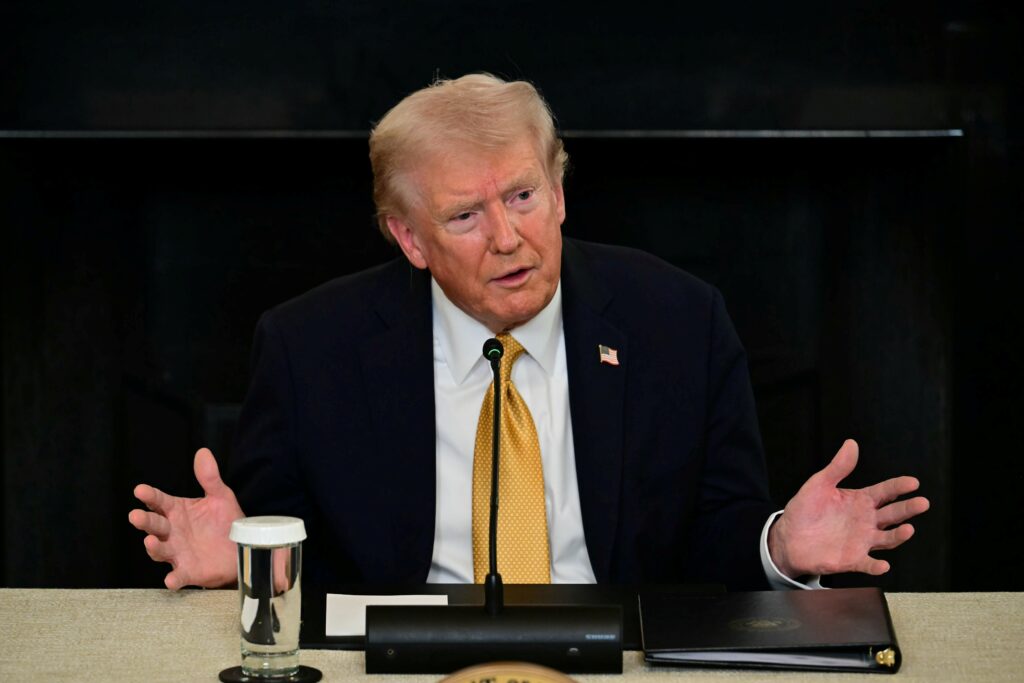
US President Donald Trump hailed assassinated ally Charlie Kirk as a “martyr for truth and freedom” Tuesday as he posthumously awarded the right-wing activist America’s highest civilian honor.Handing the Presidential Medal of Freedom to Kirk’s tearful widow, Trump compared the 31-year-old conservative to Socrates, Saint Peter, Abraham Lincoln and Martin Luther King.Trump, 79, also used the somber ceremony at the White House to vow to redouble his crackdown on what he calls radical left-wing groups that he launched following Kirk’s shooting.”In the wake of Charlie’s assassination, our country must have absolutely no tolerance for this radical left violence, extremism and terror,” Trump told an audience of the country’s conservative elite.”We’re done with the angry mobs, and we’re not going to let our cities be unsafe.”The US State Department on Tuesday said it had revoked visas of at least six foreign nationals who had “celebrated the heinous assassination” on social media. In posts to X, the department shared offending posts allegedly by citizens of Argentina, South Africa, Mexico, Brazil and Paraguay who had called Kirk “racist,” “xenophobic” or other characterizations.One German apparently lost their US visa for writing “When fascists die, democrats don’t complain,” according to the State Department.The Trump administration has controversially cited political reasons in stripping others of their visas, including several hundred people involved in Gaza war protests on US universities campuses. Father-of-two Kirk was shot dead on a Utah college campus last month, sparking a wave of grief among conservatives and promises of a clampdown from Trump that has seen National Guard troops sent to several Democrat-run cities. Guests at the ceremony included visiting Argentinian President Javier Milei, a libertarian firebrand, and a host of conservative US media personalities.Kirk’s widow Erika thanked Trump for flying back from a Middle East peace trip for the medal ceremony, which fell on what would have been her late husband’s 32nd birthday.”You have given him the best birthday gift he could ever have,” she said, dabbing away tears and occasionally pausing to collect herself.She added that Kirk, who used huge audiences on TikTok, Instagram and YouTube to build support for conservative talking points, “would probably have run for president” if he had not been assassinated.Tyler Robinson, 22, has been charged with Charlie Kirk’s murder. He faces the death penalty if convicted.

Brash Trump approach brings Gaza deal but broader peace in question

A new US president, focused on domestic priorities, criticizes his predecessor as too hard on Israel but soon takes on the mantle of peace and reaches a deal heralded around the world.In September 1993, it was Bill Clinton, who brought Israeli and Palestinian leaders together at the White House for the landmark first Oslo accord which marked the beginnings of Palestinian self-governance.This weekend it was Donald Trump who sealed an agreement to end two years of devastating war in Gaza and hailed a “historic dawn of a new Middle East.” But despite his typically immodest language, Trump has quickly drawn questions about whether he is ambitious and committed enough for a broader agreement to solve one of the world’s most intractable conflicts.On his way back from a lightning trip to Israel and Egypt, Trump said vaguely that he will “decide what I think is right” on the Palestinians’ future “in coordination with other states.””A lot of people like the one-state solution, some people like the two-state solution. We’ll have to see,” Trump told reporters.Trump’s brash approach marks a sharp change from the Oslo process, in which Israeli and Palestinian negotiators met quietly with help from Norway and set up a roadmap that was eventually supposed to settle heated disputes such as permanent borders and the status of Jerusalem.Trump had firmly backed Israel despite growing international outrage over its Gaza offensive launched in response to Hamas’s October 7, 2023 attack.But Trump then forcefully pushed Prime Minister Benjamin Netanyahu after Israel attacked Hamas leaders meeting in Qatar, a key US partner.”In a lot of ways, the easy part is what was just accomplished, but what would be necessary to move this conflict toward resolution is going to take so much more than the very vague details that are presented in the plan,” said Mona Yacoubian, director of the Middle East program at the Center for Strategic and International Studies.This 20-point plan released by the White House speaks only of an eventual “credible pathway” to Palestinian statehood.It also has little on the West Bank, where Israel has ramped up construction and extremist settlers have attacked Palestinians in the wake of the attack from Gaza-based Hamas.”Maybe it’s the failure of Oslo that gave rise to the rather unconventional approach that Trump has taken, where he has short-circuited any sort of process and simply pressured and cajoled,” Yacoubian said.”The problem, of course, is in the implementation. And that was the problem with Oslo,” she said.If there is no “sustained commitment to seeing through an actual solution to the conflict, rather than kicking the can down the road, then we see how those these processes fall apart.”Other Western powers including France and Britain in their own way also broke with Oslo’s model of painstaking diplomacy and last month recognized a Palestinian state.- Netanyahu long resistant on state -Clinton, who negotiated in meticulous detail, had sparred with Netanyahu, Israel’s long-serving prime minister who has adamantly opposed the prospect of a Palestinian state and the Oslo process.After Netanyahu lost power, Clinton at the end of his term sought to end the conflict with his Camp David summit, which failed.Ghaith al-Omari, who was an advisor to Palestinian negotiators at the time of Clinton’s Camp David summit, said he did not believe any of the current leaders were capable of reaching a lasting peace deal.Netanyahu, he said, is widely mistrusted, even among Arab leaders who want better relations with Israel.Powers from the Arab and Islamic worlds have considered sending troops to stabilize Gaza, but it remains uncertain if they would do so without stability, and Netanyahu has opposed a role for the Palestinian Authority, the West Bank-based rival of Hamas.Mahmud Abbas, the leader of the Palestinian Authority, turns 90 next month and, beyond his age, is “just too discredited” after his “last 30 years has been associated with failure,” said al-Omari, a senior fellow at the Washington Institute for Near East Policy.Al-Omari said Lebanon could show the future ahead, with Israel repeatedly carrying out strikes against Hezbollah since a ceasefire took hold nearly a year ago but without full-scale war.As for Trump, he has shown skill in seizing the moment but has not put in place staff that would indicate sustained diplomacy, he said.”I would be very skeptical if we see the level of engagement we have seen over the last few weeks,” al-Omari said.”We’re nowhere near the kind of kumbaya moment that was projected.”

Strong dealmaking boosts profits at US banking giants

Robust dealmaking activity and strong trading results helped boost US bank earnings Tuesday despite lingering worries about a softening job market and a potentially overvalued stock market.Profits rose in the third quarter at JPMorgan Chase and three other US lending giants, reflecting strength in core business areas and the still-healthy condition of many consumers even after a lengthy stretch of persistently high costs that have stretched low-income households.At JPMorgan, profits were $14.4 billion, up 12 percent from the year-ago level, with revenues of $46.4 billion, up 9 percent.The bank, the biggest US lender in terms of assets, reported somewhat higher credit costs in the quarter as it disclosed details about a $170 million hit from the bankruptcy of Tricolor, a subprime auto lender. But JPMorgan executives reiterated that consumers remain generally “resilient” and mostly on time with credit card payments, a tone echoed by other large banks. “We’ve been waiting for the so-called consumer recession, but it doesn’t materialize,” said investment banker and author Christopher Whalen of Whalen Global Advisors.The large banks “don’t do business with subprime” customers, said Whalen, who suspects more troubles involving banks’ corporate lending will surface in time. – Stock market ‘frothiness’ -More bank earnings will be released in the coming days, but Tuesday’s batch showed increases all around with Citigroup profits rising 16 percent to $3.8 billion, Goldman Sachs up 39 percent to $3.9 billion and Wells Fargo up 9 percent to $5.6 billion.Goldman Sachs pointed to its role as the “exclusive advisor” to Electronic Arts in a $55 billion deal to go private as it confidently described its merger and acquisition “pipeline” of pending and future deals. Other banks also touted strong demand for financial advisory service. But they expressed concern about weakening US job data.”While there have been some signs of a softening, particularly in job growth, the US economy generally remained resilient,” said JPMorgan chief executive Jamie Dimon.”However, there continues to be a heightened degree of uncertainty,” said Dimon, pointing to tariffs, the risk of “sticky” inflation and other factors.Executives also acknowledged concerns that sky-high equity valuations for artificial intelligence companies may be out of hand.Citigroup Chief Financial Officer Mark Mason said the stream of stock market records suggests “some frothiness in different sectors,” adding, “we’ll have to see how that ultimately evolves.”- Problem loans limited so far -Heading into the results, one overhang facing the sector was the question of exposure to a pair of recent high-profile bankruptcies.Accounts of the collapse of Texas-based Tricolor have pointed to “apparent or alleged fraud,” JPMorgan Chief Financial Officer Jeremy Barnum said on a conference call with reporters. Barnum said it can be difficult to avert all cases where a “motivated party” is committed to deception, but that the firm was looking at fortifying its controls.”This is not our finest moment,” added Dimon, who said colleagues would “scour every issue” in light of the revelations on the case.Citigroup also disclosed what it called “idiosyncratic downgrades” that more than doubled its corporate non-accrual loans compared with last year.Mason said Citi had not experienced broad problems within its portfolio, noting the bank was not exposed to Tricolor or to First Brands, a US auto supply firm whose bankruptcy has hit some other lenders, including UBS and Jefferies.”There’s no particular concentration of exposure that I’m worried about,” he said.While the damage from such examples has been limited so far, more cases of problem corporate lending could surface. Whalen said the financial system is still flush from a period of great liquidity due to central bank actions.”There’s been so much credit available,” he said. “It’s just that they haven’t gotten to the point where they’re cleaning house.”