AFP USA

Trump said ‘not allowed’ to run for third term, ‘too bad’

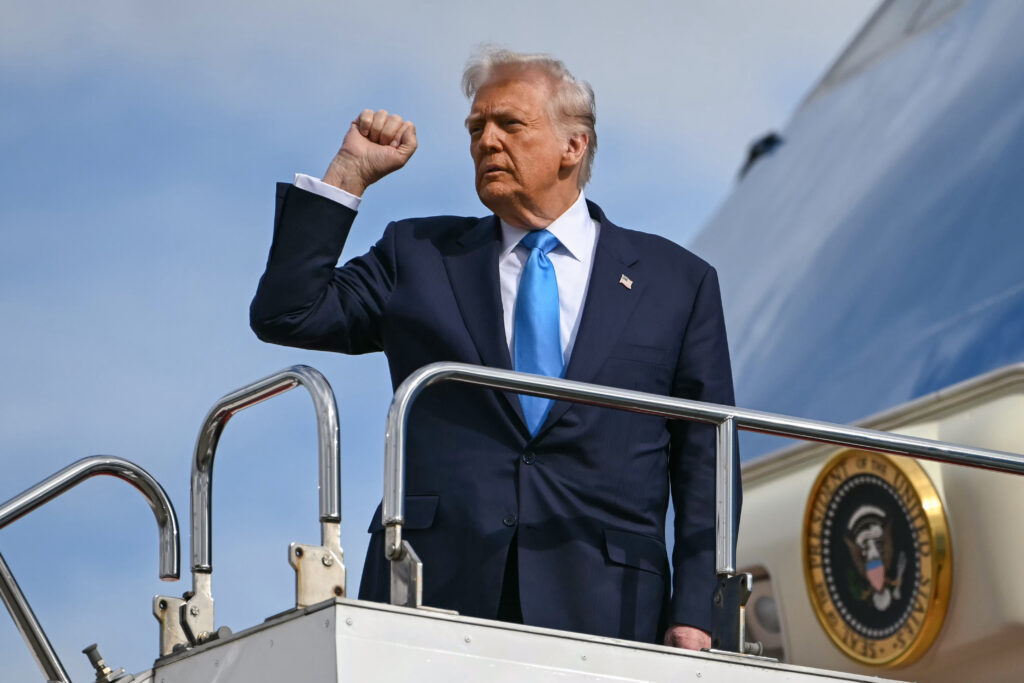
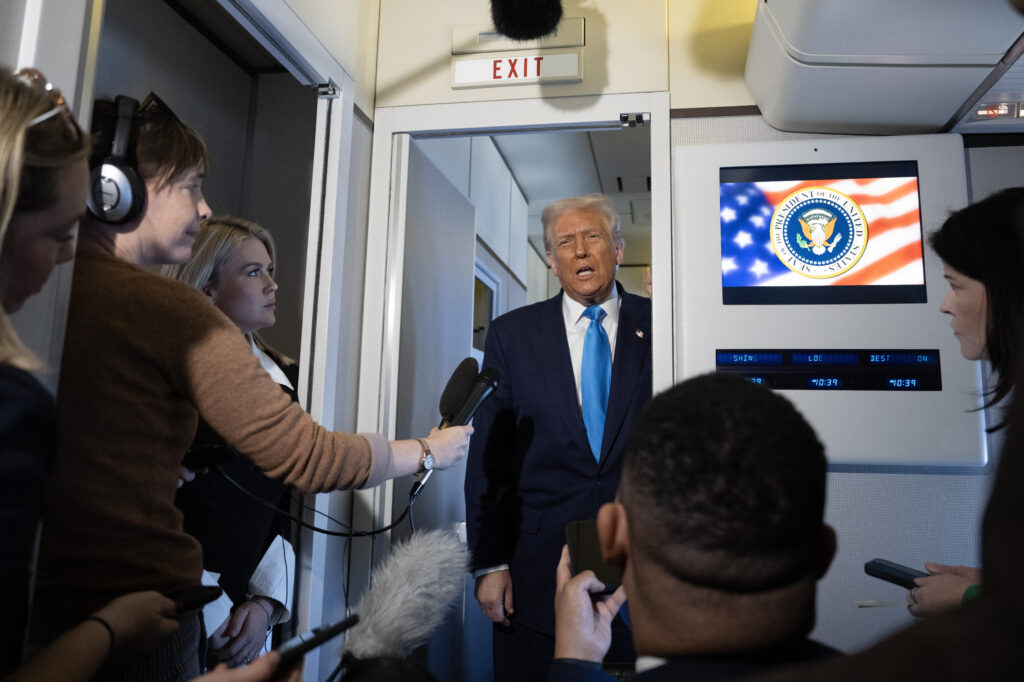
President Donald Trump said Wednesday he is “not allowed” to run for a third term, acknowledging the limits laid out in the US Constitution.Trump and his supporters have repeatedly raised the question of a 2028 presidential run for the 79-year-old, drawing concern from his foes and cheers from backers.”I have my highest poll numbers that I’ve ever had and, you know, based on what I read, I guess I’m not allowed to run, so we’ll see what happens… It’s too bad,” Trump said on Air Force One.The US Constitution limits presidents to two terms, and Trump began his second in January.Trump, who served his initial term from 2017 to 2021, often mentions that his supporters have called for him to govern beyond his current tenure despite the constitutional restriction.The former reality TV star has also recently displayed red hats emblazoned with the slogan “Trump 2028” on a desk in the Oval Office.A popular theory among his supporters is that Vice President JD Vance could run for president in 2028 on a ticket with Trump.Trump ruled that idea out this week, and said on Wednesday it was “pretty clear” he couldn’t run again.”But we have a lot of great people,” he said.House Speaker Mike Johnson told a news conference at the Capitol on Tuesday that he spoke with Trump about seeking a third term but doesn’t “see the path for that.””It’s been a great run, but I think the president knows, and he and I’ve talked about, the constrictions of the Constitution,” Johnson said.”There is the 22nd Amendment,” Johnson added, saying that the Constitution is clear even though Trump enjoys taunting Democrats with slogans and hats emblazoned with “Trump 2028″.”I don’t see a way to amend the Constitution because it takes about 10 years,” Johnson said.”You’d need two-thirds of Congress and three-fourths of the states to ratify (it).”Talk of a third term came after Steve Bannon, Trump’s former advisor and one of the key ideologues of the Make America Great Again movement, said last week “there is a plan” to keep him in the White House.”He is going to get a third term… Trump is going to be president in ’28. And people just ought to get accommodated with that,” Bannon told The Economist.Asked about the 22nd Amendment, which mandates term limits, Bannon said: “There’s many different alternatives. At the appropriate time, we’ll lay out what the plan is.”This isn’t the first time confusion swelled over the US President’s return for a third term.In May, Trump openly raised the possibility in a highly political address to US troops in Qatar.Speaking at the Al Udeid Air Base, Trump again falsely claimed to have won the 2020 election against Joe Biden.”We won three elections, ok? And some people want us to do a fourth. I don’t know. We’ll have to think about that,” Trump said.
South Korea gifts Trump replica of ancient golden crown

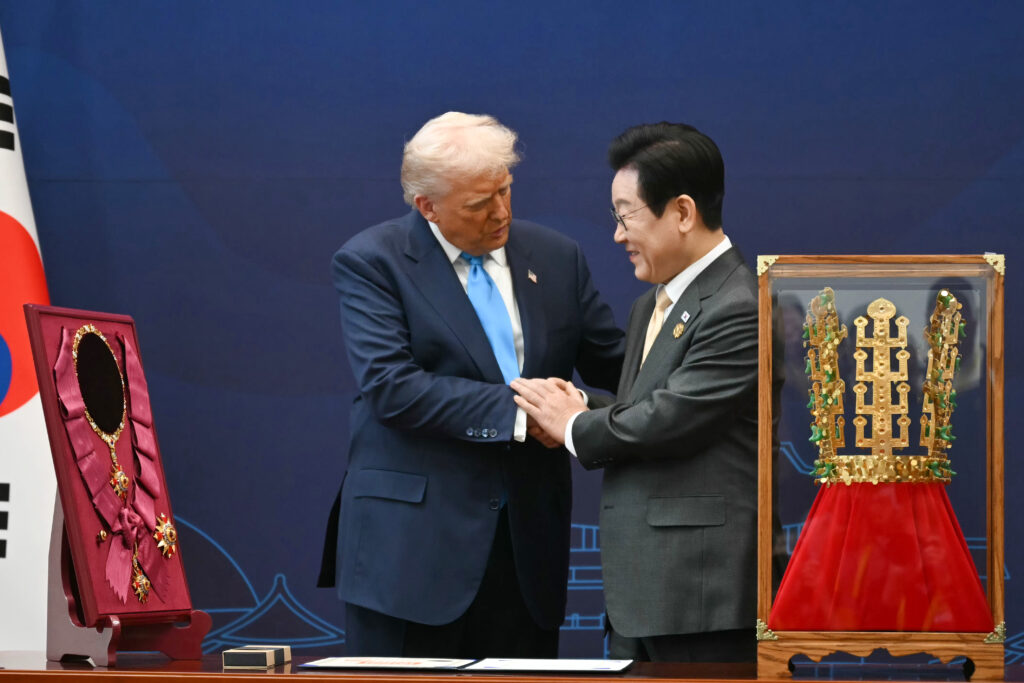
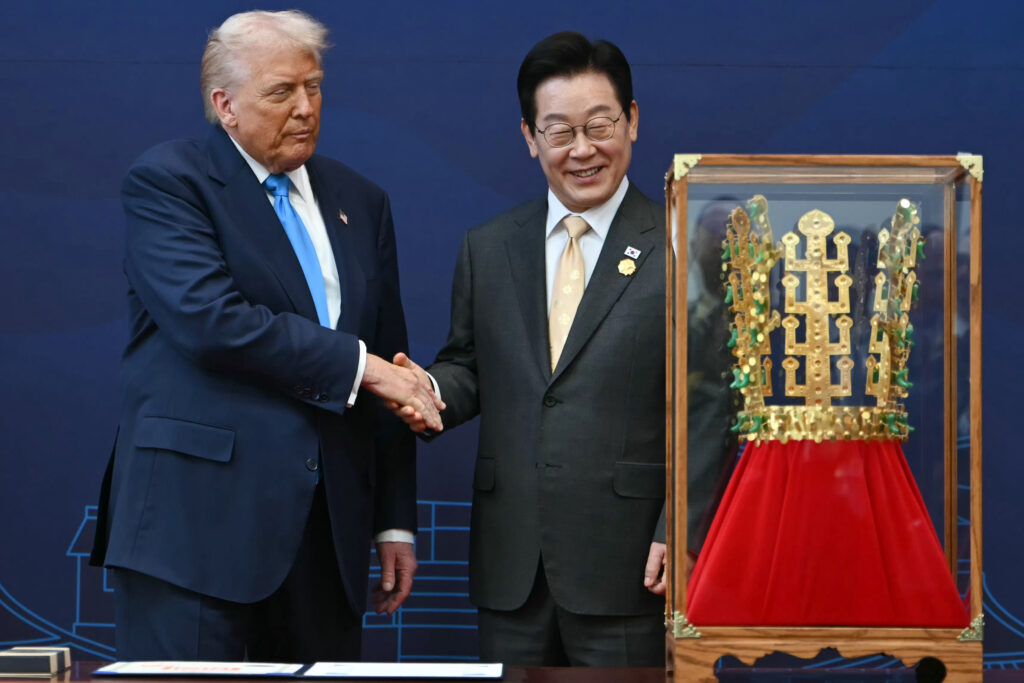
US President Donald Trump may be facing “no kings” protests back home, but in South Korea officials had the perfect gift for the monarch-loving magnate — a replica golden crown.Trump met South Korean counterpart Lee Jae Myung on Wednesday, part of a visit in which he is expected to hold tense trade talks with China’s Xi Jinping.And capping a lavish welcome ceremony in the historic capital Gyeongju, Trump was presented with a replica of a crown worn by the kings of Silla, the dynasty that ruled from 57 BC to 935 AD.The gift was a replica of “the largest and most extravagant of the existing gold crowns” from the Silla period, Trump was told.It represented “the divine connection between heavenly and earthly leadership”.Seoul’s presidential office said the headgear symbolises “peace, coexistence, and shared prosperity on the peninsula — values that mirror the Silla dynasty’s long era of stability”.Trump has made no secret of his love of monarchies the world over.Americans rallied across the country this month in opposition to what organisers call Trump’s “king-like” presidency and erosion of democratic norms in the United States.Trump mocked the rallies on social media, sharing AI-generated posts showing himself wearing a crown while flying a fighter jet emblazoned with the words “King Trump” dumping faeces on protesters.The US leader was also presented in South Korea with the Grand Order of Mugunghwa — the country’s highest decoration.The medal had a laurel leaf design that symbolises prosperity and it was given “in anticipation of the peace and prosperity you will bring to the Korean peninsula”, Trump was told.”It’s a great honour,” the US president said. “I’d like to wear it right now.”Trump’s love of gold is also well-known.He has bedecked the Oval Office with gold the White House described as “of the highest quality”.And he was gifted a gold-plated golf ball during a visit to Tokyo this week.President Lee wore a gold tie to his meeting with Trump symbolising the “golden future” of the alliance between the two countries.The Silla crown replica was also chosen in light of Trump’s “known preference for gold decorations at the White House”, the presidential office said. Seoul also said Wednesday’s state luncheon for Trump will include a “gold-themed dessert” symbolising the “alliance’s enduring trust and the two nations’ shared commitment to peace and prosperity”.The golden citrus dessert dish will include a “gold adorned brownie and seasonal fruits served with buckwheat tea”.The dessert plate will feature the word “PEACE!”, Seoul’s presidential office said, echoing the two leaders’ first meeting when they pledged to act as a “peacemaker” and a “pacemaker” for peace on the Korean Peninsula.But tensions with North Korea remain high after Pyongyang brushed aside Lee’s outreach and instead deepened military and economic links with Russia.And Trump said Wednesday he was not able to arrange a meeting with North Korean leader Kim Jong Un during his visit to the South, ending fierce speculation over a possible summit after years of diplomatic deadlock.

US aid flows to Nigeria anti-landmine efforts – for now

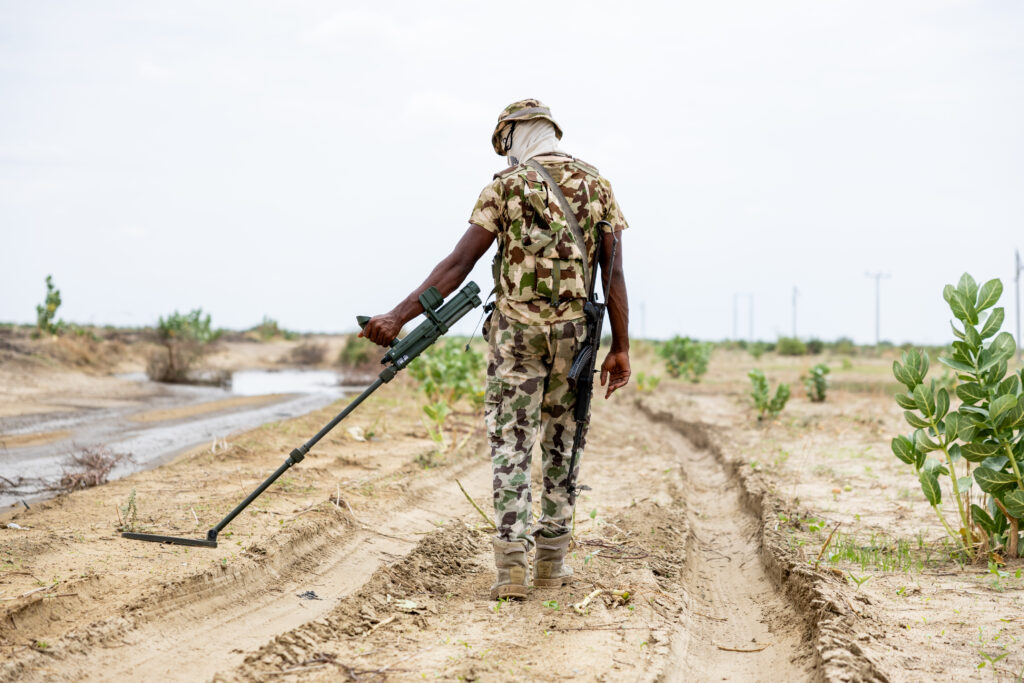
When the United States suddenly moved to dismantle its foreign aid system earlier this year, the UN’s landmine safety and removal project in Nigeria braced for impact.Improvised explosive devices (IEDs) and unexploded ordnance killed or injured 418 civilians in northeast Nigeria in 2024, more than double the year prior — but workers knew the severity of the crisis was no guarantee that the programme would survive. US President Donald Trump’s cuts came for everything, from malaria treatment to emergency food for starving people.But then, nothing happened.”We were very surprised,” said Edwin Faigmane, programme chief for the UN Mine Action Service in Nigeria, noting USAID accounted for 20 percent of its funding. The dismantling of USAID, Washington’s main foreign aid arm, has been catastrophic for people across the world. It has also been confusing. Faigmane said he “couldn’t really get an answer” for why UNMAS survived cuts in Nigeria, where a violent jihadist insurgency has been raging since Boko Haram’s 2009 uprising. Earlier this year, AFP reported that malaria clinics in Borno state, the epicentre of the violence, had shut down after USAID funding stopped.UNMAS’s mission in Mali ended when USAID — its sole sponsor — cut its funding. Washington also clawed back funding for UNMAS in Sudan.Earlier this year, UNMAS pre-emptively stopped its USAID-funded operations, until Faigmane got confirmation from USAID officials in Abuja, the capital, that they could continue as normal.”We were able to deploy some other teams in the areas that we were supposed to cover with the USAID funding” during the pre-emptive suspension, Faigmane told AFP. “We were able to survive because of our other donors.”US funds help UNMAS provide education for rural farmers and displaced persons on how to detect mines, IEDs and unexploded ordnance from the conflict — and how to report them for removal.With funds from other donors, UNMAS also trains security personnel on disposal — a crucial job as Nigeria builds up a fledgling National Mine Action Centre established in 2024. The US State Department did not respond to a request for comment.- Civilians on the frontlines -At the El-Miskin displacement camp in Maiduguri, the Borno state capital, workers from the local nonprofit The Big Smile Foundation gather groups for education sessions. This camp’s activities are funded by other donors, but the Americans’ presence is still felt: USAID logos adorn education materials, including a chutes-and-ladders style game for children. “We’ve learned how to stay safe… how to mark (suspected) ordnance from a distance, and report it to the community leader,” said Hauwa Inusa, a 60-year-old camp resident who fled her home a decade ago.She might be forced to use her training soon: the Borno state government has marked the camp for closure. With violence down from its peak a decade ago, the government in recent years has been shutting down camps and sending people back to the countryside.But swathes of the rural northeast remain outside of government control.The long-abandoned town of Darul Jamal, near the Cameroonian border, was recently repopulated with its former residents only for jihadists to massacre scores of them in a September raid.UNMAS meanwhile isn’t out of the woods yet. After some initial uncertainty, Faigmane said, another tranche of US funding, some $225,000, arrived a few weeks ago, which should last until March 2026.But if the United States eventually pulls out, “our reach collapses.”

Monarch-loving Trump gifted golden crown once worn by South Korean kings

President Donald Trump may be facing protests back home calling for “no kings” in the United States, but in South Korea officials had the perfect gift for the monarch-loving magnate — a replica golden crown.Trump met South Korean counterpart Lee Jae Myung on Wednesday, part of a visit in which he is expected to hold tense trade talks with China’s Xi Jinping.And capping a lavish welcome ceremony in the historic South Korean capital of Gyeongju, Trump was presented with a replica of a crown worn by the kings of Silla, the dynasty that ruled from 57 BC to 935 AD.The gift from South Korea was a replica of “the largest and most extravagant of the existing gold crowns” from the Silla period, Trump was told.It represented “the divine connection between heavenly and earthly leadership”.Seoul’s presidential office said the crown symbolises “peace, coexistence, and shared prosperity on the peninsula — values that mirror the Silla dynasty’s long era of stability”.Trump has made no secret of his love of monarchies the world over.Americans rallied across the country this month in opposition to what organisers call Trump’s “king-like” presidency and erosion of democratic norms in the United States.Trump mocked the rallies on social media, sharing AI-generated posts showing himself wearing a crown while flying a fighter jet emblazoned with the words “King Trump” dumping faeces on protesters.The US leader was also presented in South Korea with the Grand Order of Mugunghwa — the country’s highest decoration.The medal had a laurel leaf design that symbolises prosperity and it was given “in anticipation of the peace and prosperity you will bring to the Korean peninsula”, Trump was told.”It’s a great honour,” the US president said. “I’d like to wear it right now.”Trump’s love of gold is also well-known and he was gifted gold-plated golf balls during a visit to Tokyo this week.South Korea’s presidential office said Wednesday’s state dinner for Trump will include a “gold-themed dessert” symbolising the “alliance’s enduring trust and the two nations’ shared commitment to peace and prosperity”.

Unruffled by Trump, Chinese parents chase ‘American dream’ for kids

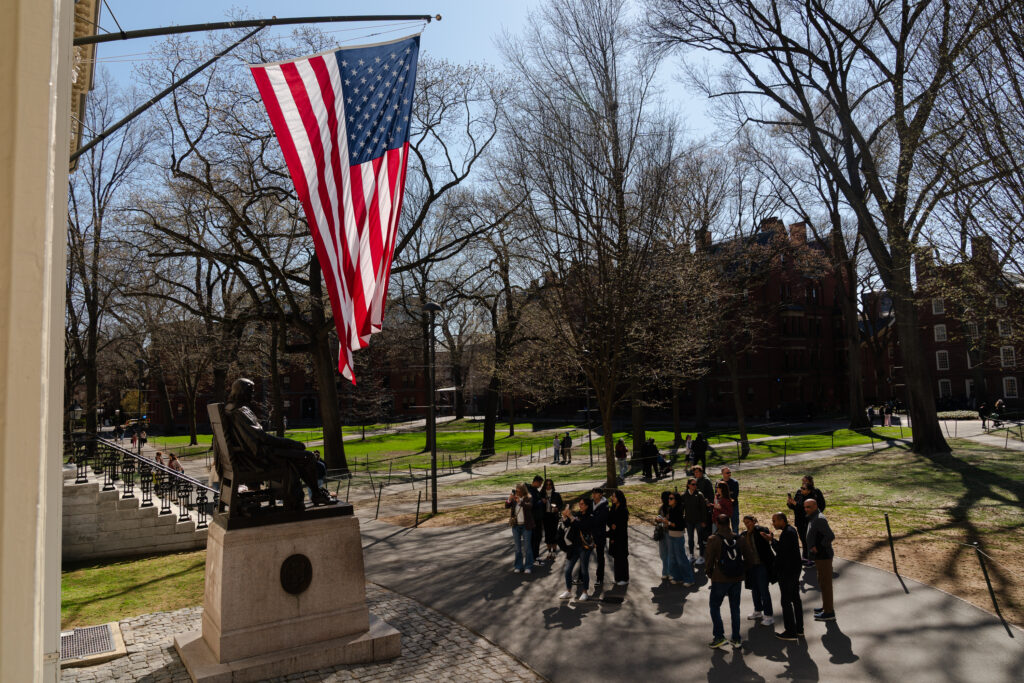
Despite plummeting relations between Beijing and Washington, Shanghai resident Huang is determined that her daughter will complete her costly education in the United States.Even as the two sides have spent much of this year locked in a blistering trade row, US schools and universities remain hugely popular with parents who are chasing what they see as better opportunities and an international outlook for their children. They will be among many hoping an expected meeting between presidents Donald Trump and Xi Jinping in South Korea on Thursday — their first encounter since the former’s return to the White House — could pave the way to stabilising ties. “Even though there’s a lot of drama going on right now… this is just temporary,” Huang told AFP. “This is something I firmly believe in.”Her 17-year-old daughter has been enrolled in high school in the United States for three years and is hoping to study computer science at university there. Trump’s mercurial nature and his “America First” policies have spooked some of Huang’s friends, who are considering sending their children to Europe or Australia instead. But for Huang, the benefits of a US education far outweigh the cons.”We feel that the United States is a country that can provide our child with more opportunities, and education is definitely more diverse,” said Huang, who did not give her full name due to privacy concerns.There is a hefty price tag, though, with Huang estimating she currently pays more than $100,000 a year in education and living expenses.- Wealthiest parents ‘not worried’ -Young Chinese people have long been crucial to US universities’ balance sheets. After Indians, they made up the second-largest nationality of international students for the 2023-24 academic year, according to the Institute of International Education. But Trump has introduced policies aimed both at curbing immigration and weakening universities, which he sees as a power base of the left.Secretary of State Marco Rubio said in May that Washington would “aggressively revoke visas for Chinese students”. However, just a few months later, Trump said the country was going to allow 600,000 Chinese students to “come in”. The uncertainty doesn’t seem to have put off many Chinese parents, according to Godot Han, who works for a Beijing tutoring agency. Her wealthiest clients, especially, “have not been worried”.They “won’t just read a single news article and then suddenly make changes” to long-held plans, she said. Teachers at her school, part of a thriving domestic industry, prepare some 200 Chinese students yearly for the tests needed for US university admission. A one-on-one session ranges from $112 to $210 an hour, with some students attending several a day.Some parents worry for their children’s safety, because of school shootings in the United States and the policies of the Trump administration.But many have just always “had that kind of American dream”, Han told AFP. – Never a ‘honeymoon period’ -The enduring appeal of a US education rests on its “perceived quality and historical reputation”, said Dylan Loh from Singapore’s Nanyang Technological University.”This reputation and prestige are longstanding and despite the obvious difficulties, still remain and will remain for a long time,” he said. Another parent, Ping Jiaqi, told AFP that US universities could help foster “independent thinking” in his 17-year-old daughter, who is studying at an international high school in China’s eastern Zhejiang province. She attended summer school at Brown University last year and visited several other campuses in the United States, hoping to move there for university.Her father expects her entire tertiary education will cost more than $400,000. Ping, who runs an education consultancy for Chinese students hoping to study abroad, said daily life for his US-based friends and students “hasn’t been affected much” by Trump.”When I think about it, US-China relations haven’t really been good at any point over the past decade,” he said.”There was never really a honeymoon period.”

White House axes panel overseeing Trump’s building plans in Washington

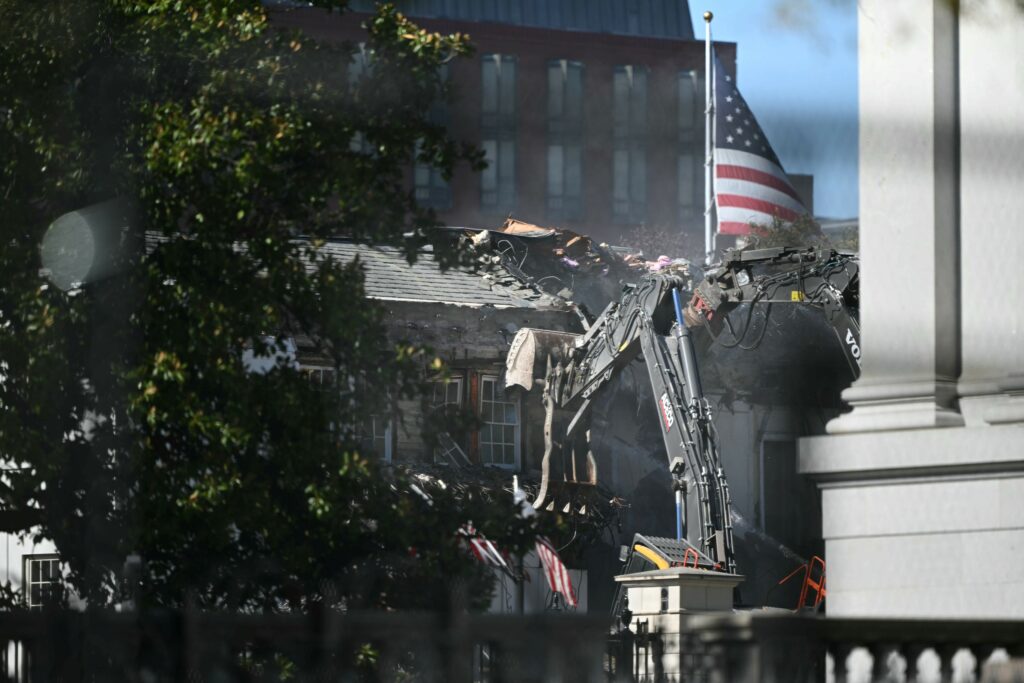
The White House has fired all six members of an independent federal agency that reviews construction work in Washington, US media reported Tuesday, as President Donald Trump pushes to remodel the capital in his style.The Commission of Fine Arts was expected to review some of Trump’s current projects, including a new ballroom at the White House and a triumphal arch, according to the Washington Post. Tuesday’s firing of the panel members, also reported by the New York Times and CNN, removes a potential barrier to the president’s ambitions which architectural historians and political opponents have heavily criticized.Trump, 79, has enthusiastically embarked on a series of renovation and building projects since returning to power in January.The Commission of Fine Arts was established by Congress in 1910 and is formed of architects and urban planners. It gives advice on design and preservation in Washington — focusing on government buildings and monuments in the strictly managed area.White House officials have traditionally sought the agency’s approval, the Washington Post reported, but Trump has ignored such formalities. Last week, construction crews tore down part of the White House to build a new ballroom. The Republican has also mulled building an arch resembling the famed Arc de Triomphe in Paris across from the Lincoln Memorial. Calling the White House “one of the most important historic buildings in the United States,” the Society of Architectural Historians issued a statement October 16 expressing “great concern,” adding Trump’s plans for the White House “should follow a rigorous and deliberate design and review process.”His plans have also drawn backlash from Democrats, including former presidential secretary of state and presidential candidate Hillary Clinton, who has accused Trump of “destroying” the White House. Then-president Joe Biden, a Democrat, had appointed all the now-purged members of the Commission of Fine Arts — having himself removed members appointed by Trump in his first term. The New York Times reported that the White House would now appoint a new panel aligned with Trump’s policies.In July, the White House also fired Biden appointees from the National Capital Planning Commission, another urban planning agency. Biden similarly axed Trump nominees in 2021 in an apparent effort to diversify the panel.

Trump heads to South Korea with all eyes on Xi meeting

US President Donald Trump headed Wednesday for South Korea, where a key meeting with Chinese leader Xi Jinping could produce a truce in the blistering trade war between the world’s two largest economies.Trump’s two-day visit to key US ally South Korea is the third leg of a trip to Asia that has seen him lauded at a regional summit in Malaysia and flattered as a “peacemaker” by Japan’s Prime Minister Sanae Takaichi.But the eyes of the world — and of global markets — will be on a meeting set for Thursday, the first time in six years Trump sits down with Xi.It could determine whether the United States and China can halt a trade war that has sent international supply chains into panic.Negotiators from Beijing and Washington have both confirmed a “framework” has been agreed.It is now up to Trump and Xi, who will meet on the sidelines of the Asia-Pacific Economic Cooperation (APEC) summit in the city of Gyeongju, to nail it down.William Yang, an analyst at the International Crisis Group, said however that there appeared to be a “mismatch” in expectations.The United States “is eager to reach any trade deal that Trump could declare as a victory”, while China is focused on “building more mutual trust, managing longstanding differences, and steadying the bilateral trade relationship”, he added.- ‘Complicated’ -Trump’s trip to South Korea follows two days in Japan, where new conservative premier Takaichi hailed a “golden age” in bilateral ties.Takaichi lavished Trump with praise, saying she would nominate Trump for the Nobel Peace Prize and giving him a golf club owned by assassinated former premier Shinzo Abe, a close friend of Trump. In Korea, Trump was expected to receive a replica of a gold crown from the ancient Silla era.Just hours before Trump’s arrival, North Korea announced it had test launched sea-to-surface cruise missiles off its western coast in a show of strength against Pyongyang’s “enemies”.Trump has extended an invitation to North Korean leader Kim Jong Un to meet while he is on the peninsula.Kim was not reported to have attended Tuesday’s launch.The US president will head to Gyeongju for a summit with South Korean President Lee Jae Myung — their second in-person talks just two months after a meeting in Washington.Discussion will likely be focused on trade, with the two sides still deadlocked over a deal between the major economic partners.In July, Trump said Washington had agreed to cut tariffs on South Korean imports to 15 percent in exchange for a $350 billion investment pledge by Seoul.Steep auto tariffs, however, remain in place, and the two governments remain divided over the structure of the investment pledge.US Treasury Secretary Scott Bessent admitted Monday there was still “a lot of details to work out” in what he said was a “complicated” deal, while Trump has denied that there was a “snag” in the talks.Activists plan to welcome the US leader, whose sweeping tariffs triggered the trade war, with anti-Trump demonstrations in Gyeongju condemning his “predatory investment demands”.- DMZ meeting? -Adding to the diplomatic high drama, Trump has said that he would “love to meet” the North Korean leader during his visit and even suggested sanctions could be a topic for conversation.They last met in 2019 at the Demilitarised Zone (DMZ), the fraught Cold War frontier that has separated North and South Korea for decades.But North Korea is yet to respond publicly to the invitation. Officials in Seoul appear divided as to whether it will go ahead.Kim said last month he had “fond memories” of his meetings with Trump.He also expressed openness to talks if the United States dropped its “delusional” demand that Pyongyang give up its nuclear weapons.”Trump’s made it clear he wants to meet,” Chad O’Carroll, founder of the specialist website NK News, told AFP.”The ball is in Kim Jong Un’s court.”But the US leader now faces a different Kim than in 2019 — one emboldened with crucial backing from Russia after sending thousands of North Korean troops to fight alongside Moscow’s forces.”North Korea has time on its side and isn’t as isolated as before,” said Hong Min, a senior analyst at the Korea Institute for National Unification.burs-oho/stu/tc

Hurricane Melissa takes aim at Cuba after roaring across Jamaica

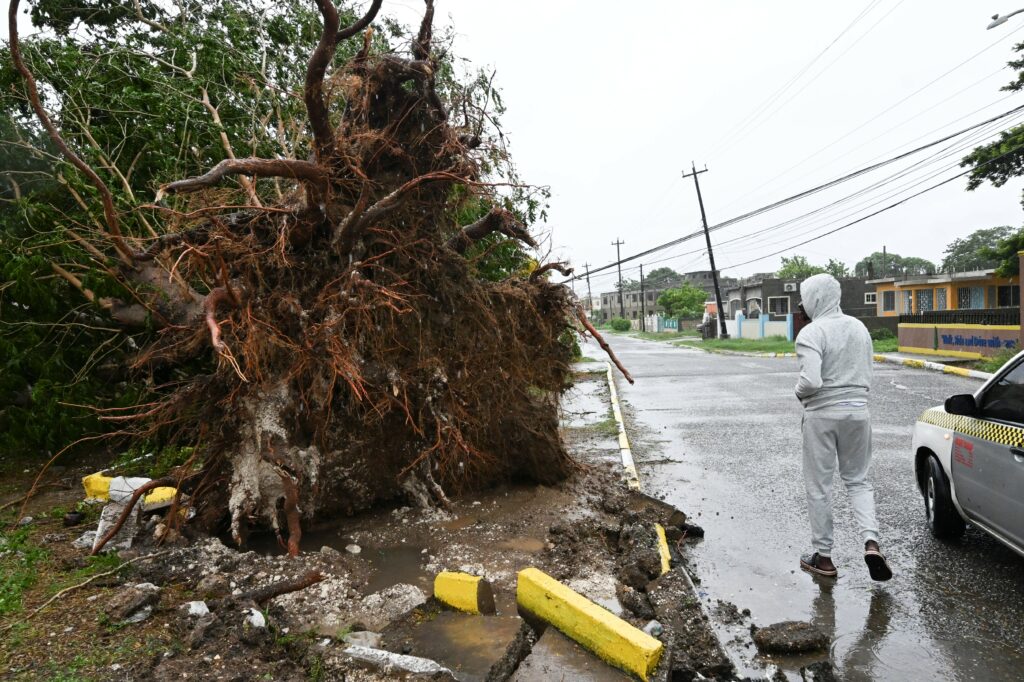
Hurricane Melissa ripped a path of destruction through Jamaica after making landfall as one of the most powerful hurricanes on record Tuesday, lashing the island nation with brutal winds and torrential rain before heading towards Cuba.Prime Minister Andrew Holness declared the island a “disaster area” and authorities warned residents to remain sheltered over continued flooding and landslide risk, as dangerous weather persisted even as the hurricane’s worst moved on. The scale of Melissa’s damage in Jamaica wasn’t yet clear, as a comprehensive assessment could take days and much of the island was still without power, with communications networks badly disrupted.At its peak, the storm packed ferocious sustained winds of 185 miles (300 kilometers) per hour. Immediate details regarding casualty figures were not available.Government minister Desmond McKenzie said several hospitals had been damaged, including in the hard-hit southwestern district of Saint Elizabeth, a coastal area he said was “underwater.””The damage to Saint Elizabeth is extensive, based on what we have seen,” he told a briefing.”Saint Elizabeth is the bread basket of the country, and that has taken a beating. The entire Jamaica has felt the brunt of Melissa.”The hurricane was the worst to ever strike Jamaica, hitting land with maximum wind speeds even more potent than most of recent history’s most brutal storms, including 2005’s Katrina, which ravaged the US city of New Orleans.The storm took hours to cross over the Caribbean nation, a passage over land that diminished its winds, dropping by Tuesday evening down to a Category 3 storm from the top-level of 5.But the still-powerful Melissa was set to hit Cuba as soon as Tuesday night and later the Bahamas.- ‘Severely damaged infrastructure’ -Even before Melissa slammed into Jamaica, seven deaths — three in Jamaica, three in Haiti and one in the Dominican Republic — had been blamed on the deteriorating conditions.Jamaica’s climate change minister told CNN that Hurricane Melissa’s effect was “catastrophic,” citing flooded homes and “severely damaged public infrastructure” and hospitals.And as if that weren’t enough: health authorities were urging vigilance against crocodiles displaced by the torrential rains.”Rising water levels in rivers, gullies, and swamps could cause crocodiles to move into residential areas,” the South East Regional Health Authority (SERHA) posted in a public service announcement on Instagram.Mathue Tapper, 31, told AFP from Kingston that those in the capital were “lucky” but feared for fellow Jamaicans in the island’s more rural areas.”My heart goes out to the folks living on the Western end of the island,” he said.The mammoth storm could leave devastation on the scale of some of the worst hurricanes in recent memory like Katrina, Maria or Harvey.- Climate change impact -Broad scientific consensus says human-driven climate change is responsible for intensified storms like Melissa that are occurring with increased frequency and higher potential for destruction and deadly flooding.Melissa lingered over Jamaica long enough that the rains were particularly dire.”Human-caused climate change is making all of the worst aspects of Hurricane Melissa even worse,” said climate scientist Daniel Gilford.The Jamaican Red Cross, which was distributing drinking water and hygiene kits ahead of infrastructure disruptions, said Melissa’s “slow nature” exacerbated the anxiety.The UN is planning an airlift of some 2,000 relief kits to Jamaica from a relief supply station in Barbados once air travel is possible. Assistance is also planned to other impacted countries including Cuba and Haiti, UN spokesperson Stephane Dujarric told journalits.Jamaican officials said some 25,000 tourists were in the country famed for its normally crystalline waters.Olympian sprinter Usain Bolt, one of Jamaica’s most famous figures, meanwhile was posting regularly on social media with messages for his home country: “Pray for Jamaica.”

Florida man executed for neighbor’s murder

A 65-year-old man convicted of raping and murdering his neighbor was executed by lethal injection in Florida on Tuesday.Norman Grim had dropped appeals against his death sentence and was put to death at 6:14 pm (2214 GMT) at the Florida State Prison in Raiford, the Florida Department of Corrections said.Grim was convicted of the 1998 murder and sexual battery of Cynthia Campbell, a 41-year-old lawyer who lived next door to him. He was sentenced to death in 2000.There have now been 41 executions in the United States this year, the most since 2012, when 43 inmates died this way.Florida has carried out the most executions, with 15 including Grim’s. There have been five each in Alabama and Texas.Thirty-four of this year’s executions have been carried out by lethal injection, two by firing squad and five by nitrogen hypoxia, which involves pumping nitrogen gas into a face mask, causing the prisoner to suffocate.The use of nitrogen gas as a method of capital punishment has been denounced by United Nations experts as cruel and inhumane.The death penalty has been abolished in 23 of the 50 US states, while three others — California, Oregon and Pennsylvania — have moratoriums in place.President Donald Trump is a proponent of capital punishment and, on his first day in office, called for an expansion of its use “for the vilest crimes.”