Afp Business Asia

US data deflates stocks rebound

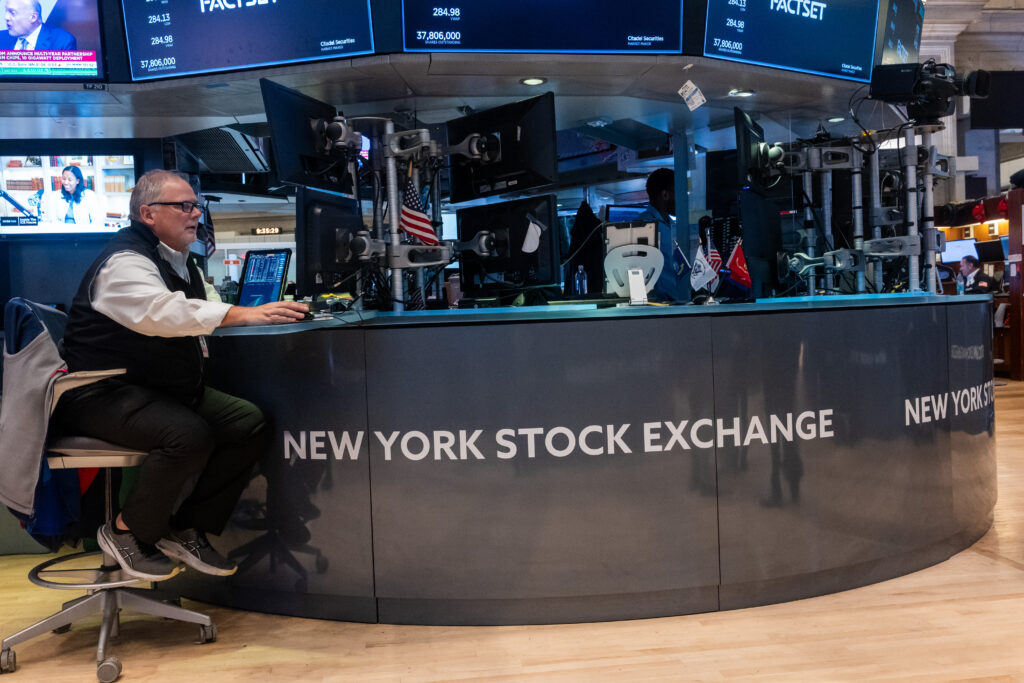
A stock market rebound  lost traction on Tuesday after data showed inflation gathering steam in the US, complicating the picture for interest rate cuts.Meanwhile oil prices retreated further after US President Donald Trump renewed his threat to raise tariffs on India over its purchases of Russian crude.Wall Street’s main stock indices had opened higher Tuesday before turning lower. European markets ended mixed, with Paris dipping into the red.Global stocks had jumped on Monday, recovering ground lost after data released on Friday showed weakness in the US jobs market, raising concerns that the world’s biggest economy is in worse shape than previously thought.The rebound was fuelled by healthy company earnings and by bets that a slowing US economy would prompt the Federal Reserve to cut interest rates in September.Lower interest rates are positive for stocks as companies can borrow at better rates, as can consumers.Despite pressure from Trump, the Fed has said it will rely on the latest data on the inflation outlook to make its decision.Data released Tuesday showed that modest growth in the US services sector pretty much evaporated in July, with companies reporting increases in prices due to tariffs that Trump has imposed on US trading partners.”The 50.1 headline reading was more than one whole point below 51.5 expected and suggests growth in the dominant services sector is stalling,” said City Index and FOREX.com analyst Fawad Razaqzada.A reading above 50 percent indicates growth.He pointed to “alarming” details in the report, such as an unexpected rise in prices paid by companies.This “points to inflationary pressures building into the dominant services sector of the economy, making it difficult for the Fed to justify cutting rates,” said Razaqzada.CME Group’s FedWatch tool still showed investors have largely priced in two interest rate cuts — in September and October — and see another one as possible in the third and final Fed meeting this year in December.Some analysts were sceptical of the chances of  rate cut, however.”I continue to believe the Fed will not reduce rates at all this year given rising inflation caused by tariffs and a relatively stable unemployment rate,” said Lazard chief market strategist Ronald Temple.Trump’s fresh tariffs on dozens of US trade partners are set to kick in on August 7, almost one week later than planned.Swiss leaders flew to Washington on Tuesday in a last-ditch effort to avoid a hefty 39-percent tariff.Meanwhile, the European Union on Tuesday announced the suspension of its retaliatory tariffs on US goods worth 93 billion euros ($107 billion) after Brussels struck a deal with Washington last month.Trump on Tuesday renewed his threat to impose tariffs on imported pharmaceuticals of up to 250 percent, although he said the tariff would initially start small to allow companies time to move production to the United States.Investors shrugged off the threat, with share prices of European pharmaceuticals, which have announced major investments to build manufacturing sites in the US, mostly higher.Trump also indicated that an announcement of tariffs on semiconductors — key to all electronics from smartphones to AI datacentres — could come as soon as next week.Shares in AI chipmaker NVIDIA were down 1.9 percent in midday trading.- Key figures at around 1530 GMT -New York – Dow: DOWN 0.3 percent at 44,034.25 pointsNew York – S&P 500: DOWN 0.5 percent at 6,298.16 New York – Nasdaq Composite: DOWN 0.5 percent at 20,941.95London – FTSE 100: UP 0.2 percent at 9,142.73 (close)Paris – CAC 40: DOWN 0.1 percent at 7,621.04 (close)Frankfurt – DAX: UP 0.4 percent at 23,846.07 (close)Tokyo – Nikkei 225: UP 0.6 percent at 40,549.54 (close)Hong Kong – Hang Seng Index: UP 0.7 percent at 24,902.53 (close)Shanghai – Composite: UP 1.0 percent at 3,617.60 (close)Euro/dollar: UP at $1.1581 from $1.1573 on MondayPound/dollar: UP at $1.3300 from $1.3285Dollar/yen: UP at 147.41 yen from 147.08 yenEuro/pound: DOWN at 87.05 pence from 87.11 penceWest Texas Intermediate: DOWN 1.4 percent at $65.34 per barrelBrent North Sea Crude: DOWN 1.4 percent at $67.83 per barrelburs-rl/gv

Swiss president rushes to US to avert steep tariffs

Switzerland’s president and economy minister flew to Washington on Tuesday in a last-minute push to stop steep new tariffs that have blindsided the Alpine country.Switzerland faces a 39-percent duty, one of the highest among the dozens of economies that will be hit by new tariffs expected to come into force from Thursday.President Karin Keller-Sutter and Economy Minister Guy Parmelin were heading to Washington “to facilitate meetings with the US authorities at short notice and hold talks with a view to improving the tariff situation for Switzerland”, the government said in a statement.”The aim is to present a more attractive offer to the United States in a bid to lower the level of reciprocal tariffs for Swiss exports, taking US concerns into account.”US President Donald Trump had originally threatened in April to slap a 31-percent tariff on Switzerland.But he surprised the export-driven country last week when he decided to hike the rate to 39 percent despite numerous discussions between Swiss and US officials aimed at reaching a deal.The Swiss government noted that the country will be hit by much higher tariffs than what other wealthy economies, such as Britain, Japan or the European Union, are facing.During an extraordinary meeting on Monday, the government “reaffirmed that it was keen to pursue talks with the United States on the tariff situation”, Tuesday’s statement said.”For this reason,” the president and the economy minister “are to travel to Washington on Tuesday”.US Trade Representative Jamieson Greer, however, told CBS television on Sunday that the tariffs on global trading partners, which are coming into force this week, “are pretty much set”.And as Keller-Sutter headed to Washington, Trump signalled that a separate “small” tariff on imports of pharmaceuticals from around the world — a key sector for Switzerland — could come “within the next week”.But the sector-specific tariff could rise to 150 percent in a year and eventually be as high as 250 percent, he added.Pharmaceuticals represented 60 percent of Swiss goods exports to the United States last year.- Swiss surplus -Keller-Sutter and Parmelin took off on Tuesday morning, a Swiss government official said.They were accompanied by a small delegation, including the heads of the economy and international finance departments, but the official declined to give details about the potential meetings.The government said it will “issue a statement as soon as there are any relevant developments for the public”.The United States is a key trading partner for Switzerland, taking 18.6 percent of its total exports last year, according to Swiss customs data.Keller-Sutter has said Trump believes that Switzerland “steals” from the United States by enjoying a trade surplus of 40 billion Swiss francs ($50 billion).Swiss companies have urged the government to negotiate a lower tariff.”I am convinced that Donald Trump wants to make a deal and show it to his US voters,” Nik Hayek, the head of watch firm Swatch, told Le Temps newspaper in an interview published late Monday.But, Hayek added, “President Karin Keller-Sutter has to react and find a solution in person there.”

Stocks higher on US Fed rate cuts bets

Global stock markets rose Tuesday as investors grew increasingly confident that the US Federal Reserve will cut interest rates next month.The gains, helped also by some strong earnings and generally easing concerns about tariffs, followed strong advances on Monday.The dollar jumped against the euro and yen.Oil prices retreated after US President Donald Trump renewed his threat to raise tariffs on India over its purchases of Russian crude.Wall Street was steady at the opening bell, with the Dow flat and the S&P 500 and Nasdaq Composite edging up. However they quickly pushed higher.”While sentiment towards equity markets continues to remain positive for the time being, that’s not to say things will remain rosy in the coming weeks,” said City Index and FOREX.com analyst Fawad Razaqzada, pointing to high stock valuations amid a weakening economy.Briefing.com analyst Patrick O’Hare said “expectations of lower interest rates in the months ahead” were providing support for equities.Data released on Friday showing weakness in the US jobs market caused stock markets to slump as they raised concerns that the world’s biggest economy is in worse shape than expected.Stocks rebounded on Monday, however, as those worries fanned bets that the Fed will cut interest rates in September.According to CME Group’s FedWatch tool, investors have priced in two interest rate cuts — in September and October — and see another one as possible in the third and final meeting in December.Some analysts remained sceptical, however.”I continue to believe the Fed will not reduce rates at all this year given rising inflation caused by tariffs and a relatively stable unemployment rate,” said Lazard chief market strategist Ronald Temple.European markets were solidly higher in afternoon trading.”European markets continue to wave off any concerns around the direction of travel for the US economy and Thursday’s looming tariff day,” noted Joshua Mahony, chief market analyst at Rostro trading group.Trump’s fresh tariffs on dozens of US trade partners are set to kick in on August 7, almost one week later than planned.The European Union on Tuesday announced the suspension of its retaliatory tariffs on US goods worth 93 billion euros ($107 billion) after Brussels struck a deal with Washington last month.”The commission has today adopted the necessary legal procedures to suspend the implementation of our EU countermeasures, which were due to kick in on August 7,” EU trade spokesman Olof Gill said.Trump on Tuesday renewed his threat to impose tariffs on imported pharmaceuticals of up to 250 percent, although he said the tariff amounts would start small.Investors shrugged off the threat, with share prices of European pharmaceutical firms, which have announced major investments to build manufacturing sites in the United States as Trump has demanded, mostly higher.Ahead of the new deadline, Mahony said traders were focused “on the continued strength seen in second-quarter earnings season and the new dovish outlook for the Federal Reserve”.On the corporate front, shares in BP climbed 2.5 percent in London midday deals after the British energy giant surprised with better-than-expected earnings in the second quarter.- Key figures at around 1330 GMT -New York – Dow: FLAT at 44,168.17 pointsNew York – S&P 500: UP less than 0.1 percent at 6,334.05 New York – Nasdaq Composite: UP 0.1 percent at 21,075.81London – FTSE 100: UP 0.4 percent at 9,168.87 Paris – CAC 40: UP 0.3 percent at 7,651.60 Frankfurt – DAX: UP 0.8 percent at 23,941.01Tokyo – Nikkei 225: UP 0.6 percent at 40,549.54 (close)Hong Kong – Hang Seng Index: UP 0.7 percent at 24,902.53 (close)Shanghai – Composite: UP 1.0 percent at 3,617.60 (close)Euro/dollar: DOWN at $1.1551 from $1.1573 on MondayPound/dollar: UP at $1.3293 from $1.3285Dollar/yen: UP at 147.53 yen from 147.08 yenEuro/pound: DOWN at 86.90 pence from 87.11 penceWest Texas Intermediate: DOWN 1.5 percent at $65.29 per barrelBrent North Sea Crude: DOWN 1.3 percent at $67.84 per barrelburs-rl/rlp

Stocks climb tracking tariffs, US Fed

European and Asian stock markets rose Tuesday as tariff threats eased and as investors grow increasingly confident that the US Federal Reserve will cut interest rates next month.The gains, helped also by some strong earnings, tracked Monday’s rally on Wall Street.The dollar jumped against the euro and yen.Oil prices retreated after US President Donald Trump’s threat to raise tariffs on India over its purchases of Russian crude.”European markets continue to wave off any concerns around the direction of travel for the US economy and Thursday’s looming tariff day,” noted Joshua Mahony, chief market analyst at Rostro trading group.Trump’s fresh tariffs on dozens of US trade partners are set to kick in on August 7, almost one week later than planned.The European Union on Tuesday announced the suspension of its retaliatory tariffs on US goods worth 93 billion euros ($107 billion) after Brussels struck a deal with Washington last month.”The commission has today adopted the necessary legal procedures to suspend the implementation of our EU countermeasures, which were due to kick in on August 7,” EU trade spokesman Olof Gill said.Ahead of the new deadline, Mahony said traders were focused “on the continued strength seen in second-quarter earnings season and the new dovish outlook for the Federal Reserve”.Weakness in the US jobs market has raised concerns that the world’s biggest economy is in worse shape than expected, fanning bets that the Fed will cut interest rates in September.Some analysts remained sceptical, however.”I continue to believe the Fed will not reduce rates at all this year given rising inflation caused by tariffs and a relatively stable unemployment rate,” said Lazard chief market strategist Ronald Temple.On the corporate front, shares in BP climbed 2.4 percent in London midday deal after the British energy giant surprised with better-than-expected earnings in the second quarter.- Key figures at around 1045 GMT -London – FTSE 100: UP 0.4 percent at 9,160.14 pointsParis – CAC 40: UP 0.2 percent at 7,646.95 Frankfurt – DAX: UP 0.8 percent at 23,938.65Tokyo – Nikkei 225: UP 0.6 percent at 40,549.54 (close)Hong Kong – Hang Seng Index: UP 0.7 percent at 24,902.53 (close)Shanghai – Composite: UP 1.0 percent at 3,617.60 (close)New York – Dow: UP 1.3 percent at 44,173.64 (close)Euro/dollar: DOWN at $1.1543 from $1.1573 on MondayPound/dollar: UP at $1.3290 from $1.3285Dollar/yen: UP at 147.59 yen from 147.08 yenEuro/pound: DOWN at 86.87 pence from 87.11 penceWest Texas Intermediate: DOWN 1.1 percent at $65.54 per barrelBrent North Sea Crude: DOWN 1.0 percent at $68.08 per barrel

Asian markets track Wall St rally on Fed rate cut bets

Stock markets rose Tuesday as investors grow increasingly confident the Federal Reserve will cut interest rates next month, despite concerns about the US economy and Donald Trump’s tariffs.The gains tracked a rally on Wall Street, where traders rediscovered their mojo following Friday’s sell-off that was fuelled by news that fewer-than-expected American jobs were created in July, while the previous two months’ figures were revised down sharply.The reading raised concerns the world’s biggest economy was in worse shape than expected, though it also fanned bets the Fed will slash in September, with markets pricing the chance of a 25-basis-point reduction at about 95 percent, according to Bloomberg. There is also talk that bank officials could go for twice as much as that.”The narrative flipped fast: soft jobs equals soft Fed, and soft Fed equals risk-on,” said Stephen Innes at SPI Asset Management.But he warned that “if cuts are coming because the labour market is slipping from ‘cooling’ to ‘cracking’, then we’re skating closer to the edge than we care to admit”.He added: “That dichotomy — between rate cuts as stimulus and rate cuts as warning flare — is now front and center.”If the Fed moves proactively to shield markets from the tariff storm and weak labour, the equity rally has legs. But if policymakers are reacting to a sharper downturn that is in full swing, the runway shortens quickly.”Tokyo, Hong Kong, Shanghai, Sydney, Seoul, Singapore, Taipei and Jakarta were all in the green, along with London, Paris and Frankfurt.However, while there is a broad expectation that the Fed will cut rates, some analysts remained sceptical.”I continue to believe the Fed will not reduce rates at all this year given rising inflation caused by tariffs and a relatively stable unemployment rate,” Lazard chief market strategist Ronald Temple wrote.”I would align with the majority of the FOMC members who believe it is more appropriate to hold policy constant until there is greater clarity in terms of the effects of tariffs and stricter immigration enforcement on inflation and employment.”And economists at Bank of America said: “Our base case since January has been that the Fed won’t cut rates this year. The… downward revisions to nonfarm payrolls in the July jobs report challenges our view.”It now appears that the labour market stalled in May and June. This increases the probability of what we view as the most likely alternate scenario: ‘bad cuts,’ due to deterioration in the labor market. But we are sticking with our Fed call for now.”Traders were keeping an eye on trade talks between Washington and dozens of its trade partners after Trump imposed tariffs of between 10 and 41 percent on them.Among those to strike a deal is India, which Trump on Monday threatened to hit with “substantially” higher rates over its purchases of Russian oil. Shares in Mumbai edged down.- Key figures at around 0810 GMT -Tokyo – Nikkei 225: UP 0.6 percent at 40,549.54 (close)Hong Kong – Hang Seng Index: UP 0.7 percent at 24,902.53 (close)Shanghai – Composite: UP 1.0 percent at 3,617.60 (close)London – FTSE 100: UP 0.3 percent at 9,152.80Dollar/yen: UP at 147.39 yen from 147.08 yen on MondayEuro/dollar: DOWN at $1.1543 from $1.1573Pound/dollar: DOWN at $1.3270 from $1.3285Euro/pound: DOWN at 86.98 pence from 87.11 penceWest Texas Intermediate: DOWN 0.2 percent at $66.18 per barrelBrent North Sea Crude: DOWN 0.1 percent at $68.69 per barrelNew York – Dow: UP 1.3 percent at 44,173.64 (close)

Malaysia tycoon pleads guilty in Singapore to abetting obstruction of justice

A Malaysian hotel tycoon who helped bring Formula One to Singapore pleaded guilty there Monday to abetting the obstruction of justice, in a case linked to one that saw a former minister jailed for accepting gifts as a public servant last year.Singapore-based billionaire Ong Beng Seng, 79, was charged in October last year with helping former transport minister S. Iswaran cover up evidence in a probe by the country’s anti-corruption bureau.Ong entered his guilty plea from a glass-encased dock at a district court in downtown Singapore on Monday.Prosecutors sought a two-month jail term after Ong agreed to plead guilty. He will be sentenced on August 15.But prosecutors also agreed with defence lawyers that the court could exercise “judicial mercy” in view of Ong’s poor health — which could further reduce any sentence.Defence lawyers pleaded for clemency, saying their septuagenarian client suffered from a litany of serious ailments, including an incurable form of cancer.They asked for a “stiff fine” instead of actual jail time. “The risks to Mr. Ong’s life increase dramatically in prison,” lawyer Cavinder Bull told the court, saying prison could not give his client sufficient care.”This man is living on the edge,” Bull added.The Attorney General’s Chambers said in a statement that after “considering the medical evidence before the Court”, the prosecutors did not object to imposing a fine instead of jail time.The trial of Malaysia-born Ong had attracted significant media attention due to his links with Iswaran and the affluent city-state’s reputation as one of the world’s least corrupt nations.Ong owns Singapore-based Hotel Properties Limited and is the rights holder to the Singapore Grand Prix Formula One race. He and Iswaran were instrumental in bringing the Formula One night race on a street circuit to Singapore in 2008.In July 2023, Ong was arrested as part of a graft probe involving Iswaran and was subsequently released on bail.In October last year, Iswaran was jailed for 12 months after he pleaded guilty to accepting illegal gifts worth more than Sg$400,000 ($310,000).He was also found guilty of obstructing justice, in the city-state’s first political graft trial in nearly half a century.Iswaran completed his sentence on June 6.

Stocks mostly rebound on US interest rate cut bets

Most stock markets bounced on Monday on hopes of US interest rate cuts after weak jobs figures raised concerns about the world’s top economy.The broad gains followed a Wall Street sell-off on Friday in reaction to the jobs data and news that dozens of countries would be hit with US tariffs ranging from 10 to 41 percent.Major US indices spent the entire day in positive territory, with the broad-based S&P 500 finishing up 1.5 percent.”Traders and investors have made a lot of money by deciding that tariffs won’t matter, and they’re not going to change that now,” said Steve Sosnick of Interactive Brokers.”I think the bias that most of them have now is ‘Let’s not think about tariffs as being a problem until they actually prove that they are.'”European indices mostly started the week on the front foot, with Paris and Frankfurt both ending the day up more than one percent.”Investors seem to be taking an optimistic view… betting on an increased likelihood of further monetary easing by the Fed after Friday’s employment figures,” said John Plassard, head of investment strategy at Cite Gestion Private Bank.CME’s FedWatch tool now has investors seeing a 94.1 percent chance of the Fed making a quarter-point cut in interest rates at the next meeting in September.Plassard noted, however, that “uncertainty reigns” as US President Donald Trump’s latest round of tariffs are set to take effect on Thursday.Switzerland’s stock market dropped around two percent at Monday’s open, its first session as it returned from a holiday after a tough 39-percent US tariff rate was announced.But the index later pared most of its losses on hopes the Swiss government, which announced it would make an improved offer to Washington, could negotiate a reduction in the levy, which is steeper than that imposed on the European Union and Britain.London advanced, lifted by banking stocks after the sector was granted a reprieve from the worst of feared compensation claims over controversial car loans dating back to 2007.Lloyds Banking Group jumped nine percent while Close Brothers, listed on the FTSE 250, soared more than 23 percent.Asian investors started the week mixed, with Hong Kong and Shanghai advancing while Tokyo fell.Stocks had struggled Friday as US jobs growth fell short of expectations in July, with revised data showing the weakest hiring since the Covid-19 pandemic — fueling concerns that Trump’s tariffs are starting to bite.Trump responded to the data by firing the commissioner of labor statistics, accusing her of manipulating employment data for political reasons.Markets reacted more favorably on Monday, as the hiring slowdown boosted hopes of Fed rate cuts to support the economy.Elsewhere, oil prices fell more than two percent after a sharp output increase by eight OPEC+ countries, with markets anticipating abundant supply.However, they later trimmed their losses after Trump threatened to hike tariffs on Indian goods further over its purchases of Russian oil.- Key figures at around 2050 GMT -New York – Dow: UP 1.3 percent at 44,173.64 (close)New York – S&P 500: UP 1.5 percent at 6,329.94 (close)New York – Nasdaq Composite: UP 2.0 percent at 21,053.58 (close)London – FTSE 100: UP 0.7 percent at 9,128.30 (close)Paris – CAC 40: UP 1.1 percent at 7,632.01 (close)Frankfurt – DAX: UP 1.4 percent at 23,757.69 (close)Tokyo – Nikkei 225: DOWN 1.3 percent at 40,290.70 (close)Hong Kong – Hang Seng Index: UP 0.9 percent at 24,733.45 (close)Shanghai – Composite: UP 0.9 percent at 3,583.31 (close)Dollar/yen: DOWN at 147.08 yen from 147.40 yen on FridayEuro/dollar: DOWN at $1.1573 from $1.1587Pound/dollar: UP at $1.3285 from $1.3279Euro/pound: DOWN at 87.11 pence from 87.25 penceWest Texas Intermediate: DOWN 1.6 percent at $66.29 per barrelBrent North Sea Crude: DOWN 1.3 percent at $68.76 per barrelburs-jmb/sst

Stocks rebound on US rate cut bets

Most stock markets bounced on Monday on hopes of US interest rate cuts after weak jobs figures raised concerns about the world’s top economy.The broad gains followed a Wall Street sell-off on Friday in reaction to the jobs data and news that dozens of countries would be hit with US tariffs ranging from 10 to 41 percent.The main New York indices were up more than one percent in midday trading.European indices mostly started the week on the front foot, with Paris and Frankfurt both ending the day up more than one percent.”Investors seem to be taking an optimistic view… betting on an increased likelihood of further monetary easing by the Fed after Friday’s employment figures,” said John Plassard, head of investment strategy at Cite Gestion Private Bank.CME’s FedWatch tool has investors seeing an 87.5 percent of the Fed making a quarter-point cut in interest rates.Plassard noted, however, that “uncertainty reigns” as US President Donald Trump’s tariffs are set to take effect on Thursday.Switzerland’s stock market dropped around two percent at Monday’s open, its first session as it returned from a holiday after a tough 39-percent US tariff rate was announced.The index pared most of its losses to end the day off just 0.15 percent, on hopes the Swiss government, which announced it would make an improved offer to Washington, could negotiate a reduction in the levy, which is steeper than that imposed on the European Union and Britain.London advanced, lifted by banking stocks after the sector was granted reprieve from the worst of feared compensation claims over controversial car loans dating back to 2007.Lloyds Banking Group jumped nine percent while Close Brothers, listed on the FTSE 250, soared more than 23 percent.Asian investors started the week mixed, with Hong Kong and Shanghai advancing while Tokyo fell.Stocks had struggled Friday as US jobs growth missed expectation in July, with revised data showing the weakest hiring since the Covid-19 pandemic — fuelling concerns that Trump’s tariffs are starting to bite.Trump responded to the data by firing the commissioner of labour statistics, accusing her of manipulating employment data for political reasons.Markets reacted more favourably on Monday, as the hiring slowdown boosted hopes of Fed rate cuts to support the economy.”Analysts are betting that rate-setters will prioritise recession avoidance over price controls,” said Derren Nathan, head of equity research at Hargreaves Lansdown.Observers also noted that news of Federal Reserve governor Adriana Kugler stepping down six months early, which gives Trump a chance to increase his influence on the Fed as he pushes for lower rates.Kathleen Brooks, research director at trading platform XTB, said it was expected that Trump’s choice to replace Kugler would be in line to later succeed Fed Chairman Jerome Powell when his term ends in May.”Whoever replaces Powell is likely to be a dove and is more likely to acquiesce to President Trump’s demands to cut rates,” she said.Elsewhere, oil prices fell more than two percent after a sharp output increase by eight OPEC+ countries, with markets anticipating abundant supply.However, they later cut their losses after Trump threatened to hike tariffs on Indian goods further over its purchases of Russian oil.- Key figures at around 1530 GMT -New York – Dow: UP 1.1 percent at 44,046.19 pointsNew York – S&P 500: UP 1.2 percent at 6,309.45New York – Nasdaq Composite: UP 1.5 percent at 20,962.21London – FTSE 100: UP 0.7 percent at 9,128.30 (close)Paris – CAC 40: UP 1.1 percent at 7,632.01 (close)Frankfurt – DAX: UP 1.4 percent at 23,757.69 (close)Tokyo – Nikkei 225: DOWN 1.3 percent at 40,290.70 (close)Hong Kong – Hang Seng Index: UP 0.9 percent at 24,733.45 (close)Shanghai – Composite: UP 0.9 percent at 3,583.31 (close)Dollar/yen: DOWN at 147.32 yen from 147.43 yen on FridayEuro/dollar: DOWN at $1.1565 from $1.1586Pound/dollar: UP at $1.3282 from $1.3276Euro/pound: DOWN at 87.06 pence from 87.25 penceWest Texas Intermediate: DOWN 1.0 percent at $66.67 per barrelBrent North Sea Crude: DOWN 0.8 percent at $69.10 per barrelburs-rl/js

China’s Baidu to deploy robotaxis on rideshare app Lyft

Chinese internet giant Baidu plans to launch its robotaxis on rideshare app Lyft in Germany and Britain in 2026, pending regulatory approval, the two companies said on Monday.  Last month, Baidu announced a similar agreement with Uber in Asia and the Middle East as it seeks to take pole position in the competitive autonomous driving field both at home and abroad.Lyft and Baidu said Monday that “in the following years” the fleet of Apollo Go driverless cars will be expanded to thousands of vehicles across Europe.They did not specify which other countries the cars would be deployed in, and it was not clear how long it might take to gain regulatory approval for the initial deployment.Driverless taxis are already on some roads with limited capacity in the United States and China, most notably in the central city of Wuhan, where a fleet of over 500 can be hailed by app in designated areas.Their reach is spreading, with Shanghai’s financial district Pudong recently announcing a batch of permits for multiple companies to operate robotaxis.China’s tech companies and automakers have poured billions of dollars into self-driving technology in recent years, with intelligent driving the new battleground in the country’s cutthroat domestic car market.Baidu is not alone among Chinese companies in searching to expand its foothold abroad. Its rival WeRide is also active in the Gulf region, and in January announced it had been picked to lead a small pilot project in Switzerland. Pony.AI, another Chinese company, said in May that it had signed a deal to launch its self-driving taxis on Uber in “a key market in the Middle East later this year”.San Francisco-based Lyft in April said it had agreed to buy German taxi app Freenow, planting a flag in the European market.The acquisition marked Lyft’s “most significant expansion outside North America”, the group said. 

Stocks mostly rise as traders boost US rate cut bets

Most stock markets bounced on Monday as hopes for US interest rate cuts rose following a sharp slowdown in jobs growth that raised concerns about the world’s top economy.The broad gains followed a sell-off on Wall Street Friday in reaction to the weak jobs data and news that dozens of countries would be hit with US tariffs ranging from 10 to 41 percent.European indices mostly started the week on the front foot, with Paris gaining 0.8 percent and Frankfurt rising over one percent.”Investors seem to be taking an optimistic view… betting on an increased likelihood of further monetary easing by the Fed after Friday’s employment figures,” said John Plassard, head of investment strategy at Cite Gestion Private Bank.He noted, however, that “uncertainty reigns” as US President Donald Trump’s tariffs are set to take effect on Thursday. Switzerland’s stock market dropped around two percent at Monday’s open, its first session as it returned from a holiday after a tough 39-percent US tariff rate was announced.The index pared some of its losses in early afternoon trading, with hopes the Swiss government can negotiate a reduction in the levy, which is steeper than that imposed on the European Union and Britain.London advanced, lifted by banking stocks after the sector was granted reprieve from the worst of feared compensation claims over controversial car loans dating back to 2007.Lloyds Banking Group rose nearly eight percent, while Close Brothers, listed on the FTSE 250, soared more than 20 percent.Asian investors started the week mixed, with Hong Kong and Shanghai advancing while Tokyo fell.Stocks had struggled Friday as US jobs growth missed expectation in July, with revised data showing the weakest hiring since the Covid-19 pandemic — fuelling concerns that Trump’s tariffs are starting to bite.The president responded to the data by firing the commissioner of labour statistics, accusing her of manipulating employment data for political reasons.Markets reacted more favourably on Monday, as the slowdown boosted hopes of Fed rate cuts to support the economy.”Analysts are betting that rate-setters will prioritise recession avoidance over price controls,” said Derren Nathan, head of equity research at Hargreaves Lansdown.”This is likely the main driver of a rebound in US stock futures in anticipation of a positive market open later today,” he added.Observers also noted that news of Federal Reserve governor Adriana Kugler stepping down six months early gives Trump a chance to increase his influence on the Fed as he pushes for lower rates.Oil prices fell after a sharp output increase by eight OPEC+ countries, with markets anticipating abundant supply.- Key figures at around 1100 GMT -London – FTSE 100: UP 0.3 percent at 9,093.20 pointsParis – CAC 40: UP 0.8 percent at 7,606.20 Frankfurt – DAX: UP 1.3 percent at 23,720.70Tokyo – Nikkei 225: DOWN 1.3 percent at 40,290.70 (close)Hong Kong – Hang Seng Index: UP 0.9 percent at 24,733.45 (close)Shanghai – Composite: UP 0.9 percent at 3,583.31 (close)New York – Dow: DOWN 1.2 percent at 43,588.58 (close)Dollar/yen: UP at 147.57 yen from 147.43 yen on FridayEuro/dollar: DOWN at $1.1574 from $1.1586Pound/dollar: UP at $1.3293 from $1.3276Euro/pound: DOWN at 87.10 pence from 87.25 penceWest Texas Intermediate: DOWN 1.6 percent at $66.25 per barrelBrent North Sea Crude: DOWN 1.5 percent at $68.64 per barrel