Afp Business Asia

Asian markets mixed as traders weigh Trump’s latest tariff salvo

Equities were mixed in Asia on Monday after Donald Trump ramped up his trade war by announcing huge tariffs on steel and aluminium imports and warned every country would face “reciprocal” levies.Another week got off to an uncertain start following losses on Wall Street that came in reaction to data showing US consumers increasingly worried about inflation and news that far fewer jobs than expected were created last month.The US president has resumed his hardball tactics on trade since returning to the White House by last week hitting China with a fresh batch of tariffs, having reached a deal to delay measures against Canada and Mexico.The moves have fanned concerns about the global economy and jolted a recent rally in markets.Trump said Sunday 25 percent duties would be imposed on “any steel coming into the United States”, adding this will also affect aluminium. He also said he would announce “reciprocal tariffs” to match his government’s levies to the rates charged by other countries on US products. “Every country will be reciprocal,” he warned, adding that he would provide details on Tuesday or Wednesday.The news weighed on commodity-linked currencies, with the Canadian dollar, Mexican peso and South Korean won all weaker.Canada is the largest source of steel and aluminium imports to the United States, according to US trade data. Brazil, Mexico and South Korea are also major steel providers to the country.At a meeting with Prime Minister Shigeru Ishiba in Washington on Friday, Trump threatened to target Japanese goods if the US trade deficit with the country is not equalised.Equity markets were mixed, with Tokyo, Sydney, Seoul, Jakarta, Wellington and Taipei all lower.- ‘It’s an escalation’ -“Trump’s latest move isn’t merely another trade skirmish; it’s an escalation of his ‘America First’ trade doctrine where ‘no country is off-limits’,” said Stephen Innes at SPI Asset Management.”This high-stakes gamble could disrupt global supply chains. Markets have witnessed this scenario before — last-minute exemptions and backroom deals (see: Mexico and Canada tariffs) — but if Trump maintains his hardline stance this time, Asian economies will be the first to feel the impact.”Still, Hong Kong and Shanghai extended last week’s gains, with Chinese tech firms boosted by the emergence of startup DeepSeek, which has shaken up the AI sector with a chatbot that it said rivalled those of US giants but at a fraction of the cost.There were also gains in Singapore and Manila.All three main indexes in New York fell as the University of Michigan’s consumer survey showed a drop in consumer sentiment in February to 67.8, down from 71.1 in January.In another concerning development, respondents said they expect inflation to hit 4.3 percent a year from now, up a full percentage point from a month earlier.Separate data showed the world’s top economy created 143,000 jobs last month, down from a revised 307,000 in December and below forecasts.The readings did little to alter traders’ view that the Federal Reserve will cut interest rates two times at best this year, after boss Jerome Powell said after its January meeting that officials were in no “hurry” to move again.Among companies, Nippon Steel fell more than two percent in Tokyo, following Trump’s Friday announcement that the Japanese giant would make a major investment in US Steel, but will no longer attempt to take it over.US Steel dived 5.8 percent in New York on Friday.- Key figures around 0230 GMT -Tokyo – Nikkei 225: DOWN 0.1 percent to 38,746.96 (break)Hong Kong – Hang Seng Index: UP 1.2 percent to 21,391.17Shanghai – Composite: UP 0.3 percent to 3,314.25Euro/dollar: DOWN at $1.0304 from $1.0328 on FridayPound/dollar: DOWN at $1.2386 from $1.2405Dollar/yen: UP at 152.00 yen from 151.43 yenEuro/pound: DOWN at 83.19 pence from 83.24 penceWest Texas Intermediate: UP 0.7 percent at $71.50 per barrelBrent North Sea Crude: UP 0.7 percent at $75.19 per barrelNew York – Dow: DOWN 1.0 percent at 44,303.40 points (close)London – FTSE 100: DOWN 0.3 percent at 8,700.53 (close)

China inflation picks up after Lunar New Year spending boost

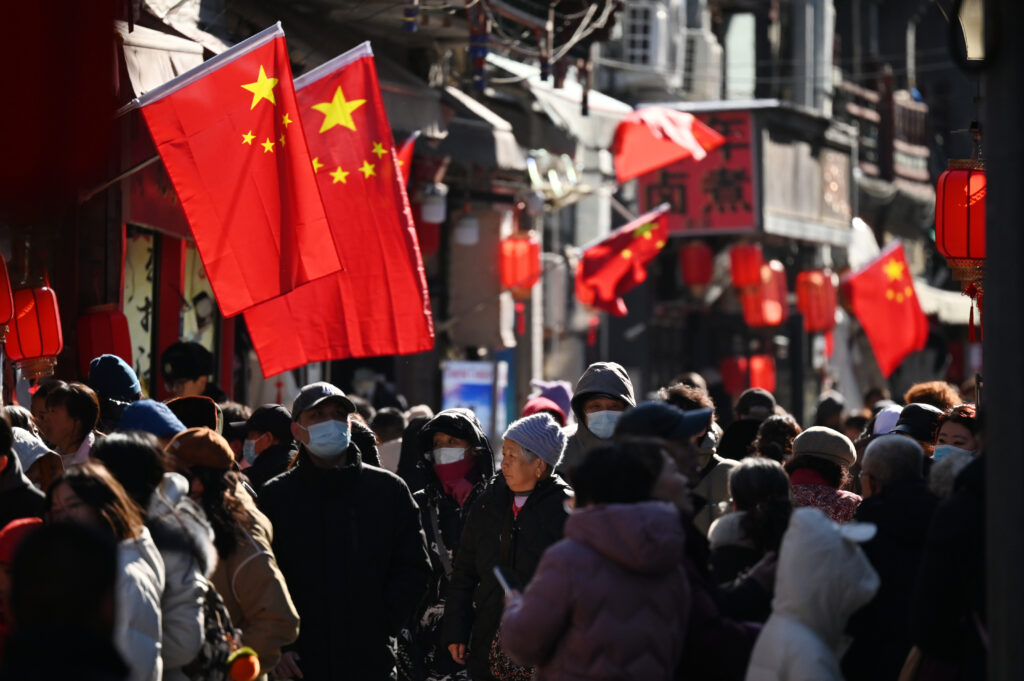
Inflation picked up in China last month, official figures showed Sunday, as the Lunar New Year holiday boosted January spending.China has struggled to raise consumption and stave off deflation for months as sluggish spending, a property slump and ballooning local government debt all weigh on growth.The consumer price index (CPI), a key measure of inflation, rose 0.5 percent last month, up from a 0.1 percent rise in November, according to the National Bureau of Statistics.The reading from January, which coincided with the start of the long Lunar New Year holiday this year, is the highest since August’s reading of 0.6 percent.Last month’s reading exceeded the 0.4 percent rise predicted by Bloomberg analysts.The NBS reported a rise in prices for goods associated with the holiday, where millions of people travel to their hometowns and celebrate with feasts and drinking.Fresh vegetable prices rose by 2.4 percent year-on-year and the price of pork rose by 13.8 percent.The boost in prices last month is “mainly due to higher food prices and tourism-related services prices on an earlier-than-usual Lunar New Year holiday,” Goldman Sachs analyst Xinquan Chen wrote in a note on Sunday.”But the boost is likely to become a drag in February as seasonal demand fades,” Chen said.China suffered its sharpest fall in prices for 14 years in January 2024, at the end of a four-month period of deflation.Inflation stayed below 0.5 percent for nine months of 2024.While deflation suggests the cost of goods is falling, it poses a threat to the broader economy as consumers tend to postpone purchases under such conditions, hoping for further reductions.A lack of demand can then force companies to cut production, freeze hiring or lay off workers, while potentially also having to discount existing stocks — dampening profitability even as costs remain the same.Beijing unveiled a slew of measures to boost the economy last year, including cutting interest rates and cancelling restrictions on homebuying.Last month, policymakers expanded a subsidy scheme for common household items, from water purifiers to laptops and electric vehicles.During the holiday period, sales of household appliances and communication equipment at “key monitored retail enterprises” were up more than 10 percent year-on-year, the Chinese commerce ministry said on Thursday.

PlayStation outages frustrate users around the world

From the United States to Thailand, users of the popular Sony PlayStation consoles might encounter “difficulties,” the Japanese group said Saturday, as game players around the world expressed their frustration.”You might have difficulty launching games, apps or network features,” Sony said on its status page. “We’re working to resolve the issue as soon as possible. Thank you for your patience.”PlayStation’s online services allow users of Sony consoles like the PS4 or the PS5 to play hugely popular multiplayer games like “Fortnite” and “Call of Duty.” The specialized site DownDetector.com reports that users’ difficulties peaked sharply around 7:00 pm Friday (00H00 GMT Saturday), before falling steadily but not quite returning to normal levels. Users took to social media to express their anger and frustration. One user said on X that it was “criminal” to have a PlayStation outage on a Friday evening, but another quipped more equably that it was time for him to reintroduce himself to the woman he married five years ago. 

Trump says Nippon Steel to ‘invest’ in US Steel, not buy it

US President Donald Trump said Friday that Japan’s Nippon Steel will make a major investment in US Steel, but will no longer attempt to take over the troubled company.Trump, referring to the Japanese car company Nissan but apparently meaning Nippon Steel, said “they’ll be looking at an investment rather than a purchase.”Spokespeople for Nippon Steel and US Steel did not respond to a request for comment. US Steel’s shares closed down 5.8 percent on the news.The announcement marks a shift in tone from Trump, who heavily criticized Nippon’s $14.9 billion takeover offer during the 2024 presidential election campaign. Former US president Joe Biden blocked the deal shortly before he left office last month on national security grounds, sparking a joint lawsuit from the two firms — and condemnation from Japanese Prime Minister Shigeru Ishiba.In the suit filed on January 6, Nippon Steel and US Steel said Biden had improperly used his influence and blocked the deal “for purely political reasons” to gain favor with workers’ unions.In response, the US authorities announced they had extended the deadline for the Japanese firm to abandon its acquisition of US Steel until June 18, extending an initial 30-day deadline.Trump’s remarks suggest his administration is open to Nippon Steel’s investment in the US steel giant so long as it does not assume overall control — a step that could in theory ensure it remains in American hands. “Our concerns regarding Nippon’s continued interest in US Steel remain unchanged,” United Steelworkers international president David McCall said in a statement. “Nippon has proven itself to be a serial trade cheater with a history of dumping its products into our markets,” he said, adding that the US steelworkers’ union had not been in contact with either company or the Trump administration about Nippon’s proposed investment.  “While we await the details of the proposed investment, we encourage President Trump to continue safeguarding the long-term future of the domestic steel industry by instead seeking American alternatives,” he added.

US stocks slide on tariff fears, inflation expectations

US and European shares fell Friday, with a cooler US jobs report and higher inflation expectations capping the end of a volatile week marked by concerns over a trade war.Official data showed the United States added fewer jobs than expected in January while unemployment ticked down.The jobs data missed expectations, but Wall Street’s three main indexes initially rose. They quickly fell into the red, however, after separate data showed US consumers now expect inflation to jump.Employment and inflation are what the US Federal Reserve takes into account when setting interest rates.President Donald Trump’s remarks on unspecified “reciprocal tariffs” also appeared to reignite concerns.Trump said at a press conference with Japanese Prime Minister Shigeru Ishiba that he was “probably meeting on that Monday or Tuesday,” saying that this would be “opposed to a flat-fee tariff” approach.”Today’s (jobs) data does not show a large enough divergence from expectations to shift what is expected to be the Fed’s next rate move,” said Jochen Stanzl, chief market analyst at CMC Markets.”Still the Fed is expected to cut the Fed Funds rate twice this year and today’s data does not really give a hint into when the first cut will be,” Stanzl said.The Fed kept its rate unchanged last week, with chair Jerome Powell saying the central bank was in no “hurry” to adjust borrowing costs again.Total US employment rose by 143,000 jobs last month, said the Labor Department, significantly lower than the revised 307,000 figure in December.The January figure was also below an analyst consensus estimate of 155,000 according to Briefing.com.”We do not think that the labour market data shifts the dial for the Fed,” said Kathleen Brooks, research director at XTB trading platform.But data released afterward subsequently showed US consumer sentiment fell to its lowest level in July, with survey respondents reporting feeling less confident and more concerned about inflation.Year-ahead inflation expectations rose to 4.3 percent, up a full percentage point from a month earlier.”Such a substantial one-month rise of one percentage point or more has occurred only five times in the past 14 years,” noted Axel Rudolph, Senior Technical Analyst at online trading platform IG.The jump in inflation expectations follows a turbulent week for stock markets and currencies after Trump imposed tariffs on China.The US leader also warned that the European Union would face tariffs “pretty soon” while he delayed duties on Canada and Mexico at the 11th hour.- Gold and results -Investors were also tracking corporate results.In Frankfurt, Porsche shares slumped after the luxury carmaker’s forecasts for the year ahead disappointed expectations.Gold was another shining performer this week, reaching a new all-time peak as the precious metal profits from its status as a haven investment.Hong Kong and Shanghai stock markets closed solidly higher thanks to gains across technology firms. Chinese startup DeepSeek has shaken up the race for AI supremacy, spooking US tech companies. Tokyo stocks were weighed by a stronger yen, which picked up this week after Bank of Japan board member Naoki Tamura said he wanted borrowing costs to increase.- Key figures around 2145 GMT -New York – Dow: DOWN 1.0 percent at 44,303.40 points (close)New York – S&P 500: DOWN 1.0 percent at 6,025.99 (close)New York – Nasdaq Composite: DOWN 1.4 percent at 19,523.40 (close)London – FTSE 100: DOWN 0.3 percent at 8,700.53 (close)Paris – CAC 40: DOWN 0.4 percent at 7,973.03 (close)Frankfurt – DAX: DOWN 0.5 percent at 21,787.00 (close)Tokyo – Nikkei 225: DOWN 0.7 percent to 38,787.02 (close)Hong Kong – Hang Seng Index: UP 1.2 percent to 21,133.54 (close)Shanghai – Composite: UP 1.0 percent to 3,303.67 (close)Euro/dollar: DOWN at $1.0328 from $1.0387 on ThursdayPound/dollar: DOWN at $1.2405 from $1.2436Dollar/yen: DOWN at 151.43 yen from 151.47 yenEuro/pound: DOWN at 83.24 pence from 83.50 penceBrent North Sea Crude: UP 0.5 percent at $74.66 per barrelWest Texas Intermediate: UP 0.6 percent at $71.00 per barrelburs-rl/dw

US Postal Service halts China suspension after stoking trade fear

The US Postal Service (USPS) said Wednesday it would continue accepting packages from China and Hong Kong, hours after an order to suspend shipments over President Donald Trump’s new tariffs sparked fears of major trade disruptions.Tensions between the US and China have soared in recent days as the world’s two largest economies slapped a volley of tariffs on each others’ imports, hitting hundreds of billions of dollars in trade.As part of Trump’s tariffs — which he enacted citing drug trafficking concerns — the United States on Tuesday scrapped a duty-free exemption for low-value packages.The “de minimis” exemption allows goods valued at $800 or below to enter the United States without paying duties or certain taxes, but it has faced scrutiny due to a surge in shipments in recent years.The US Customs and Border Protection agency said last month that exemption shipments rose to over 1.36 billion in fiscal year 2024, creating challenges for its enforcement of trade laws, health and safety requirements, intellectual property rights, and consumer protection rules.US officials have pointed to the growth of Chinese-founded online retailers Shein and Temu as a key factor behind the increase — and Tuesday’s halt threatened major delays to parcels from both companies from entering the country.The developments at the USPS came as the latest data showed the US trade deficit swelled last year to its second-largest on record, a metric that Trump has used in the past to justify trade battles with China and others.In an apparent climbdown, the USPS on Wednesday morning said it would “continue accepting all international inbound mail and packages from China and Hong Kong Posts.””The USPS and Customs and Border Protection are working closely together to implement an efficient collection mechanism for the new China tariffs to ensure the least disruption to package delivery,” it added, without further details.Beijing had responded with fury to the move, accusing the United States of “politicizing trade and economic issues and using them as tools.”Vowing to “take necessary measures to resolutely safeguard the legitimate rights and interests of Chinese companies,” foreign ministry spokesman Lin Jian accused Washington of “unreasonable suppression.”AFP has reached out to Shein and Temu for comment.Other retailers such as Amazon might also be impacted by the “de minimis” removal.The low-cost retailers took another hit Wednesday as the European Commission announced it would seek to impose new fees on e-commerce imports — the bulk of which come from China.The measures are part of efforts to tackle a surge of “harmful” products into the bloc.- Tariff standoff -Tuesday saw Beijing say it would impose levies on imports of US energy, vehicles and equipment in a return salvo minutes after Trump’s threatened tariffs on Chinese goods came into effect.A day earlier, Trump suspended duties on Mexico and Canada for a month after both countries vowed to step up measures to counter flows of the drug fentanyl and the crossing of undocumented migrants into the United States.Beijing’s moves hit roughly $20 billion worth of US goods per year — roughly 12 percent of total American imports into China, according to calculations by Capital Economics.But their impact is a far cry from US tariffs announced over the weekend, which will affect some $450 billion worth of goods.Although earlier it appeared that US parcels could still be sent from Macau, by Wednesday evening the semi-autonomous Chinese city’s post office announced that its service was also suspended.Trump had signalled earlier that the talks with Xi could take place early this week, but addressing reporters at the White House Tuesday afternoon, he said he was in “no rush.”

US stocks slide as inflation expectations jump

US and European shares fell Friday, with a cooler US jobs report and higher inflation expectations capping the end of a volatile week marked by concerns over a trade war.Official data showed the United States added fewer jobs than expected in January while unemployment ticked down.The jobs data missed expectations, but Wall Street’s three main indexes initially rose, but they quickly fell into the red after separate data showed US consumers now expect inflation to jump.Employment, along with inflation, are what the US Federal Reserve takes into account when setting interest rates.”Today’s NFP data does not show a large enough divergence from expectations to shift what is expected to be the Fed’s next rate move,” said Jochen Stanzl, chief market analyst at CMC Markets.”Still the Fed is expected to cut the Fed Funds rate twice this year and today’s data does not really give a hint into when the first cut will be,” Stanzl said.The Fed kept its rate unchanged last week, with chair Jerome Powell saying the central bank was in no “hurry” to adjust borrowing costs again.Total US employment rose by 143,000 jobs last month, said the Labor Department, significantly lower than the revised 307,000 figure in December.The January figure was also below an analyst consensus estimate of 155,000 according to Briefing.com.”We do not think that the labour market data shifts the dial for the Fed,” said Kathleen Brooks, research director at XTB trading platform.But data released afterwards subsequently showed US consumer sentiment fell last month to its lowest level in July, with survey respondents reporting feeling less confident and more concerned about inflation.Year-ahead inflation expectations rose to 4.3 percent, up a full percentage point from a month earlier.”Such a substantial one-month rise of one percentage point or more has occurred only five times in the past 14 years,” noted Axel Rudolph, Senior Technical Analyst at online trading platform IG.The jump in inflation expectations follows a turbulent week for stock markets and currencies after US President Donald Trump imposed tariffs on China.The US leader also warned that the European Union would face tariffs “pretty soon” while he delayed duties on Canada and Mexico at the 11th hour.- Gold and results -Investors were also tracking corporate results.In Frankfurt, Porsche shares slumped after the luxury carmaker’s forecasts for the year ahead disappointed expectations.Gold was another shining performer this week, reaching a new all-time peak as the precious metal profits from its status as a haven investment. Hong Kong and Shanghai stock markets closed solidly higher thanks to gains across technology firms. Chinese startup DeepSeek has shaken up the race for AI supremacy, spooking US tech companies. Tokyo stocks were weighed by a stronger yen, which picked up this week after Bank of Japan board member Naoki Tamura said he wanted borrowing costs to increase.- Key figures around 1630 GMT -New York – Dow: DOWN 0.6 percent at 44,484.08 pointsNew York – S&P 500: DOWN 0.6 percent at 6,044.37New York – Nasdaq Composite: DOWN 1.0 percent at 19,586.56London – FTSE 100: DOWN 0.3 percent at 8,700.53 (close)Paris – CAC 40: DOWN 0.4 percent at 7,973.03 (close)Frankfurt – DAX: DOWN 0.5 percent at 21,787.00 (close)Tokyo – Nikkei 225: DOWN 0.7 percent to 38,787.02 (close)Hong Kong – Hang Seng Index: UP 1.2 percent to 21,133.54 (close)Shanghai – Composite: UP 1.0 percent to 3,303.67 (close)Euro/dollar: DOWN at $1.0339 from $1.0387 on ThursdayPound/dollar: DOWN at $1.2405 from $1.2436Dollar/yen: DOWN at 151.18 yen from 151.47 yenEuro/pound: DOWN at 83.35 pence from 83.50 pence Brent North Sea Crude: UP 0.3 percent at $74.52 per barrelWest Texas Intermediate: UP 0.5 percent at $70.93 per barrelburs-rl/cw

US stocks rise as investors digest US jobs report

US stock markets rose but European shares fell Friday as investors digested a cooler US jobs report at the end of a volatile week marked by concerns over a trade war.Official data showed the United States added fewer jobs than expected in January while unemployment ticked down.Wall Street’s three main indexes were up in early deals as the non-farm payrolls data could have an influence on the US Federal Reserve’s future decisions on interest rates.Europe’s leading stock markets were in the red in afternoon deals.”Today’s NFP data does not show a large enough divergence from expectations to shift what is expected to be the Fed’s next rate move,” said Jochen Stanzl, chief market analyst at CMC Markets.”Still the Fed is expected to cut the Fed Funds rate twice this year and today’s data does not really give a hint into when the first cut will be,” Stanzl said.The Fed kept its rate unchanged last week, with chair Jerome Powell saying the central bank was in no “hurry” to adjust borrowing costs again.Total US employment rose by 143,000 jobs last month, said the Labor Department, significantly lower than the revised 307,000 figure in December.The January figure was also below an analyst consensus estimate of 155,000 according to Briefing.com.”We do not think that the labour market data shifts the dial for the Fed,” said Kathleen Brooks, research director at XTB trading platform.The jobs data caps a turbulent week for stock markets and currencies after US President Donald Trump imposed tariffs on China.The US leader also warned that the European Union would face tariffs “pretty soon” while he delayed duties on Canada and Mexico at the 11th hour.- Gold and results -Investors were also tracking corporate results.In Frankfurt, Porsche shares slumped after the luxury carmaker’s forecasts for the year ahead disappointed expectations.Gold was another shining performer this week, reaching a new all-time peak as the precious metal profits from its status as a haven investment. Hong Kong and Shanghai stock markets closed solidly higher thanks to gains across technology firms. Chinese startup Deepseek has shaken up the race for AI supremacy, spooking US tech companies. Tokyo stocks were weighed by a stronger yen, which picked up this week after Bank of Japan board member Naoki Tamura said he wanted borrowing costs to increase.- Key figures around 1445 GMT -New York – Dow: UP 0.1 percent at 44,792.86 pointsNew York – S&P 500: UP 0.2 percent at 6,094.27New York – Nasdaq Composite: UP 0.2 percent at 19,834.63London – FTSE 100: DOWN 0.3 percent at 8,702.35Paris – CAC 40: DOWN 0.2 percent at 7,988.34Frankfurt – DAX: UP 0.1 percent at 21,886.41Tokyo – Nikkei 225: DOWN 0.7 percent to 38,787.02 (close)Hong Kong – Hang Seng Index: UP 1.2 percent to 21,133.54 (close)Shanghai – Composite: UP 1.0 percent to 3,303.67 (close)Euro/dollar: DOWN at $1.0381 from $1.0387 on ThursdayPound/dollar: UP at $1.2457 from $1.2436Dollar/yen: UP at 151.66 yen from 151.47 yenEuro/pound: DOWN at 83.36 pence from 83.50 pence Brent North Sea Crude: UP 0.9 percent at $74.96 per barrelWest Texas Intermediate: UP 1.1 percent at $71.36 per barrelburs-ajb-lth/cw

Stock markets, dollar mixed before key US jobs data

Global stock markets and the dollar diverged Friday as investors awaited US jobs data for signs of possible cuts to interest rates in the world’s biggest economy.It comes at the end of a volatile week for assets caused by US President Donald Trump’s move to impose tariffs on key trading partners China, Canada and Mexico.“All eyes will be on US jobs figures later today,” said Russ Mould, investment director at AJ Bell. “The market is expecting a big drop in non-farm payrolls in January… likely impacted by the LA fires and cold weather,” he added.A below forecast reading could rekindle hopes of further US interest rate cuts, analysts said, after the Federal Reserve kept borrowing costs steady last week.The latest figures will be looked at particularly closely as they contain annual revisions for “the previous five years of payrolls”, noted Jim Reid, managing director at Deutsche Bank. Wall Street provided a broadly positive lead Thursday, despite a disappointing earnings release from Amazon — a day after a similar result from Google-Parent Alphabet.On Friday, European stock markets performed steadily having recovered from heavy losses at the start of the week.London’s benchmark FTSE 100 index hit a fresh record high Thursday, as listed multinationals earning in dollars benefited from a slump in the pound.Sterling had retreated sharply after the Bank of England halved its forecast for UK economic growth this year, citing the possibility of Trump imposing tariffs on British imports. The BoE also cut its main interest rate amid deteriorating business confidence in the UK — and forecast that the country would experience higher-than-expected inflation in the coming months owing to elevated energy bills.The FTSE 100 fell overall Friday in morning deals but there were some bright spots.Insurer Legal & General saw its share price jump five percent after the group announced the sale of its US insurance arm for $2.3 billion. In Frankfurt, which has also hit new heights this week, Porsche slid more five percent after the luxury carmaker’s forecasts for the year ahead disappointed expectations.Gold was another shining performer this week, reaching a new all-time peak as the precious metal profits from its status as a haven investment. Hong Kong and Shanghai stock markets closed solidly higher Friday thanks to gains across technology firms. Chinese startup Deepseek has shaken up the race for AI supremacy, spooking US tech companies. Tokyo stocks were weighed by a stronger yen, which picked up this week after Bank of Japan board member, Naoki Tamura, said he wanted borrowing costs to increase.- Key figures around 1100 GMT -London – FTSE 100: DOWN 0.3 percent at 8,701.83Paris – CAC 40: DOWN 0.1 percent at 7,998.01Frankfurt – DAX: UP 0.1 percent at 21,922.26Tokyo – Nikkei 225: DOWN 0.7 percent to 38,787.02 (close)Hong Kong – Hang Seng Index: UP 1.2 percent to 21,133.54 (close)Shanghai – Composite: UP 1.0 percent to 3,303.67 (close)New York – Dow: DOWN 0.3 percent at 44,747.63 (close) Euro/dollar: DOWN at $1.0379 from $1.0387 on ThursdayPound/dollar: UP at $1.2451 from $1.2436Dollar/yen: UP at 152.16 yen from 151.47 yenEuro/pound: DOWN at 83.36 pence from 83.50 pence Brent North Sea Crude: UP 0.7 percent at $74.84 per barrelWest Texas Intermediate: UP 0.7 percent at $71.12 per barrelburs-ajb/bcp/cw

Hong Kong to file complaint with WTO over US tariffs

Hong Kong will file a complaint with the World Trade Organization in response to heightened US tariffs on its goods, a government spokesperson said Friday, days after Beijing announced a similar move.US President Donald Trump over the weekend launched the opening salvo in an escalating trade war with China, imposing a 10 percent tariff hike on goods coming from mainland Chinese and Hong Kong.A spokesperson for the financial hub said Friday the Hong Kong government “will formally launch procedures in accordance with the WTO Dispute Settlement Mechanism against the US’ unreasonable measures to defend our legitimate rights”.The US tariffs are “grossly inconsistent with the relevant WTO rules and ignore our status as a separate customs territory”, the spokesperson said, adding that the government “strongly opposes” the measures.Mainland China also filed a complaint with the WTO to defend its “legitimate rights and interests”, its commerce ministry said.After reverting to Chinese rule in 1997, Hong Kong has been run as a special administrative region and is classed as a separate customs territory.It has been a WTO member for three decades.Hong Kong’s secretary for commerce and economic development Algernon Yau said Thursday that the tariffs “are not expected to have a large impact”.Goods exported from Hong Kong to the United States in 2023 were valued at around HK$6.1 billion ($780 million) and made up only 0.1 percent of the city’s total exports, Yau added.City officials have for years tread a fine line by insisting Hong Kong is a separate entity in international trade, but politically an “inalienable part” of China.The United States removed Hong Kong’s special trading privileges in 2020 after Beijing imposed a sweeping national security law on the former British colony to curb dissent.Trump at the time said in an executive order that Hong Kong was “no longer sufficiently autonomous to justify differential treatment in relation to (China)”.