AFP Asia

Return of millions of Afghans fuels terror potential

A massive spike in millions of migrants forced back into impoverished Afghanistan by Pakistan and Iran could fuel Islamic State militancy, diplomatic and security sources fear. Around 2.6 million Afghans have returned since January, including many who have spent decades abroad or who are setting foot in Afghanistan for the first time.”The risk that Islamic State Khorasan sees these newly arrived Afghans as a potential recruitment pool is high,” Hans-Jakob Schindler, a former coordinator of the UN committee monitoring militant groups, told AFP. Security in Afghanistan has vastly improved since the Taliban won their insurgency against the Nato-backed government and returned to power in 2021. However, the local branch of Islamic State — a rival jihadist group with a foothold in eastern Afghanistan — carries out periodic attacks and remains a threat to Taliban rule and the wider region. “Since August 2021, the group has continued to recruit disgruntled Taliban as well as Afghans that are not part of the new regime,” Schindler said. The UN warned in July of a “permissive environment for a range of terrorist groups… posing a serious threat to the security of Central Asian and other countries”.It said the most serious threat is from the Islamic State, with 2,000 fighters, who have carried out deadly attacks in Russia, Iran and Pakistan in the past few years.While the Pakistani Taliban, a separate but closely linked group to the Afghan Taliban, has triple the fighters, it is focused on a campaign against the Pakistan government’s security forces. Islamabad has consistently accused Afghanistan’s rulers of giving safe haven to militant groups.The Taliban government has repeatedly claimed that there are “no longer any terrorist organisations” operating in Afghanistan.- ‘Foreigners’ in their own country -The UN High Commissioner for Refugees (UNHCR) has predicted that up to four million Afghans could return to the country by the end of the year. Upon arrival, “they face enormous challenges, without jobs, housing, or access to basic services,” notes Indrika Ratwatte, the UN’s humanitarian coordinator in the country. “They may become vulnerable to negative coping mechanisms, including exploitation by armed groups.”According to the World Bank, nearly half of Afghanistan’s 48 million people live below the poverty line, and nearly a quarter of 15-29 year-olds are unemployed. “We already know that some Afghans join terrorist groups not out of conviction, but out of ‘economic necessity,'” a European diplomatic source told AFP. Afghans who have spent decades abroad are considered outsiders when they arrive in Afghanistan, said Amina Khan of the Institute for Strategic Studies (ISSI) in Islamabad.Some will hold resentment towards Pakistan, which took away their businesses and properties. “They’re the perfect fodder for these transnational terrorist groups that are operating within the region,” she said. – ‘Ticking time bomb’ -According to Moscow, Afghanistan is home to approximately 23,000 fighters from 20 different organisations. “The greatest concern is the activity of the Afghan branch of (Islamic State)… which has training camps, mainly in the east, north, and northeast of the country,” noted Russian Security Council Secretary Sergei Shoigu at the end of August. In July, a year after the Islamic State killed 149 people in a mass shooting at a Moscow music venue, Russia became the first — and only — country to recognise the Taliban government.It said the decision would boost regional security and the “fight against the threats of terrorism”.”Many foiled attacks in Europe between 2023 and 2025 have been linked back to the (Islamic State),” Schindler said.For many European countries, the “risk of a kind of ticking time bomb for Europe is real” the European diplomatic source added.The only way to stop these recruitments is to “build a dignified future” for migrants, thanks to foreign aid, argues Ratwatte. But the humanitarian sector has been lacerated by funding cuts since US President Donald Trump took power in January. 

India see off Bangladesh to book Asia Cup final spot

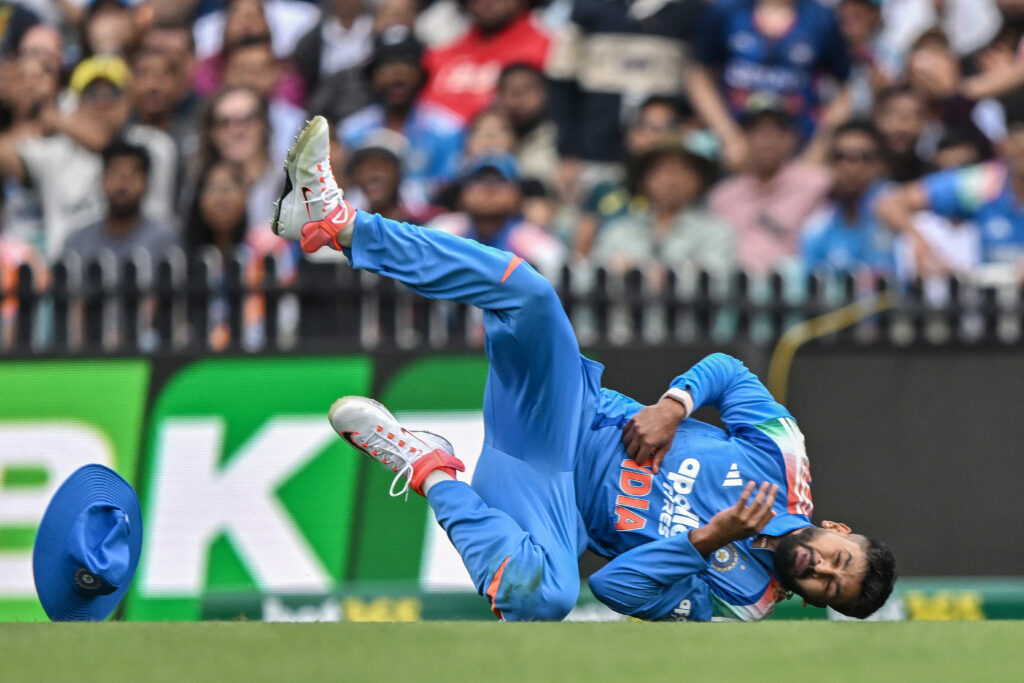
India secured their place in the Asia Cup final on Wednesday as Abhishek Sharma starred with 75 in a comfortable 41-run win over Bangladesh in Dubai.The holders posted 168-6 batting first after stumbling following a quick start, but their spinners helped stifle Bangladesh to 127 all out.The result means Sri Lanka are out of the tournament, with Thursday’s Super Four match between Pakistan and Bangladesh to decide who faces India in Sunday’s final.Abhishek has enjoyed a remarkable start to his T20 international career with 783 runs from 22 matches at a strike-rate of 197.72.The opener set up victory with another brilliant innings, striking six sixes and five fours in his 37-ball blitz, which ended with a run-out caused by a mix-up with captain Suryakumar Yadav.”I was just doing my job,” Abhishek said.”I have told before as well that I do not think much (while going in to bat) and go with the flow. If it is in my range, even if it is the first ball, I go for it.”Both Abhishek and fellow opener Shubman Gill, who made 29, started cautiously before the two took on left-arm spinner Nasum Ahmed, smashing 21 runs off the fourth over.Abhishek reached his fifty off just 25 balls after Gill fell to leg-spinner Rishad Hossain.Rishad quickly struck again with the wicket of the promoted Shivam Dube, before the dismissals of Abhishek and Suryakumar, for five off 11 balls, left India on 114-4.Hardik Pandya ensured India reached a competitive total with a 29-ball 38 with four fours and one six.Jasprit Bumrah struck first to send back opener Tanzid Hasan for one in the second over of Bangladesh’s chase, before Saif Hassan and Parvez Hossain Emon, who made 21, put on 42 runs to steady the innings.But Kuldeep Yadav dismissed Parvez and Bangladesh soon lost their way as the Indian spinners took charge.Saif, who survived four dropped catches, played a lone hand to raise Bangladesh hopes.Kuldeep struck twice with successive balls before Nasum played out the hat-trick ball.Saif finally fell in the 18th over for 69 to Bumrah and Bangladesh were bowled out in 19.3 overs.Kuldeep stood out with figures of 3-18 as the left-arm wrist spinner took his tournament tally to 12 wickets in five matches.Bangladesh were without skipper Litton Das, who was injured, and Jaker Ali stood in as captain.”We can take lots of things from this game,” said Jaker. “Let’s see what kind of combination we are going to go (in Thursday’s match) but we will give our best.”

No pause for food delivery riders during Pakistan’s monsoon

Abdullah Abbas waded through Lahore’s flooded streets, struggling to push his motorcycle and deliver a food order on time. The water had risen to his torso, his jeans soaked and rolled up over sandals, leaving him vulnerable to electrocution and infectious diseases.Even as monsoon rains deluge Pakistan’s cities, food and grocery orders on the Singapore-based delivery platform Foodpanda pour in.”If I don’t deliver the orders, my Foodpanda account will get blocked, which would leave me without money,” Abbas told AFP in the old quarter of Lahore, known for its narrow, congested streets.”I need this money to pay my high school fees,” added the 19-year-old, who is completing his last year of secondary school. Since June, monsoon rains in Pakistan have killed more than 1,000 people, swelling major rivers and devastating rural communities along their banks.Urban centres such as Lahore, a city of more than 14 million people, and Karachi, the country’s largest city with more than 25 million people, have also suffered urban flooding in part because of poorly planned development.Abbas earns around $7 a day, above the average salary, but only when the sun is shining.To meet the average monthly pay of around $140, he was to work seven days a week for over 10 hours fitted around his studies. “Customers behave rudely and you have to handle all the stress,” added Muhammad Khan, a 23-year-old Foodpanda rider, as he carefully navigated his motorbike through Karachi’s muddy, pothole ridden roads.Pakistan, where 45 percent of people live under the poverty line, is among the countries most vulnerable to climate change, with limited resources dedicated to adaptation.- ‘Stressful’ – By the middle of August, Pakistan had already received 50 percent more monsoon rainfall than last year, according to disaster authorities, while in neighbouring India, the annual rains kill hundreds every year.While South Asia’s seasonal monsoon brings rainfall that farmers depend on, climate change is making the phenomenon more erratic.A report by the Human Rights Commission of Pakistan said brown water inundating city streets is not only the result of climate change but “clogged drains, inadequate solid waste disposal, poor infrastructure, encroachments, elitist housing societies.”Doctors warn that working repeatedly in damp conditions can cause fungal infections and flu, while exposure to dirty water can spread eye and skin infections.  Gig economy workers attached to delivery apps such as Foodpanda and ride hailing apps Bykea and InDrive, made up nearly two percent of Pakistan’s labour force or half a million people in 2023, according to Fairwork, a project by the University of Oxford.Fairwork rated six digital labour platforms in the country and all of them have the “minimum standards of fair work conditions”.International Labour Organization meanwhile says gig workers lack government protection and face systemic violations of international labour standards.Motorbike rider Muneer Ahmed, 38, said he quit being a chef and joined Bykea to become “his own boss”.”When it rains, customers try to take rickshaws or buses, which leaves me with no work,” said Ahmed, waiting anyway on the side of the flooded street.”Rain is a curse for the poor,” he said, watching the screen of his phone for a new customer. Daily wage labourers, often working in construction, also see their work dry up. It hs been nearly four days since labourer Zahid Masih, 44, was hired, he told AFP while taking refuge under a bridge with other masons in Karachi.”Jobs do come up, but only after the rain stops. There is no work as long as it is raining,” says the father of three.”Sitting idle at home is not an option, as our stoves won’t be lit.”

Singapore firm rejects paying $1bn Sri Lankan pollution damages

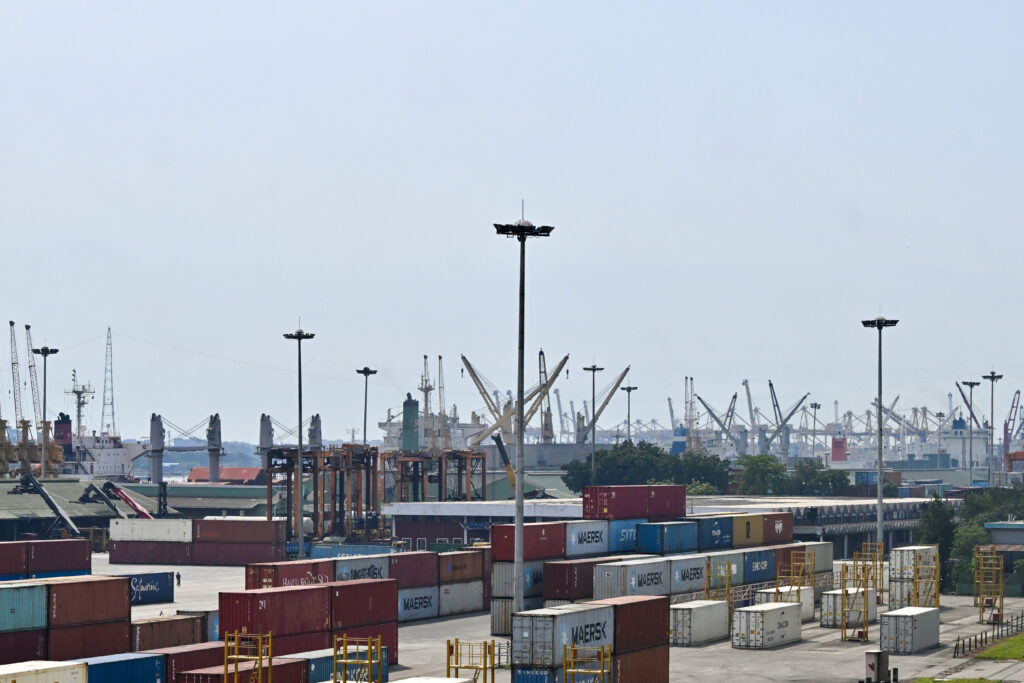
A Singapore shipping company told AFP on Tuesday it will refuse to pay Sri Lankan court-ordered damages of US$1 billion for causing that country’s worst case of environmental pollution.In an exclusive interview, X-Press Feeders chief executive Shmuel Yoskovitz said he believed paying would have wide-ranging implications on global shipping and “set a dangerous precedent”.The company operated the MV X-Press Pearl that sank off Colombo Port in June 2021 after a fire — believed caused by a nitric acid leak — that raged for nearly two weeks.Its cargo included 81 containers of hazardous goods, including acids and lead ingots, and hundreds of tonnes of plastic pellets.The ship was refused permission by ports in Qatar and India to offload the leaking nitric acid before it arrived in Sri Lankan waters. Tonnes of microplastic granules from the ship inundated an 80-kilometre (50-mile) stretch of beach along Sri Lanka’s western coast. Fishing was prohibited for months.Sri Lanka’s Supreme Court in July ordered the company to pay Colombo an “initial” US$1 billion in damages within a year, with the first tranche of US$250 million to be paid by Tuesday.It also ordered the company “to make such other and further payments” in the future as the court may direct.- ‘Hanging guillotine’ -Yoskovitz rejected the open-ended nature of the penalty. “We are not paying because the whole base of maritime trade is based on the limitation of liability. This judgment undermines this limitation of liability,” he told AFP.”Any payment towards the judgment could set a dangerous precedent for how maritime incidents will be resolved in the future,” he said.Sri Lanka’s government said it would ask its chief prosecutor what action it could take.”We will be guided by the advice of the attorney general on what further steps to take,” government spokesman and media minister Nalinda Jayatissa told reporters in Colombo.The United Nations office in Colombo noted that the “polluter pays” principle was enshrined in global agreements, including the UN Convention on the Law of the Sea.”The Supreme Court’s ruling is a vital step toward justice and accountability,” the UN in Sri Lanka said on X.Yoskovitz said the absence of limitations could lead to higher insurance premiums, which would be ultimately passed on to consumers.The chief executive again apologised for the incident, saying the company recognised the disaster and was trying to make amends. He said X-Press Feeders had already spent $170 million to remove the wreck, clean up the seabed and beaches, and compensate affected fishermen.”We are not trying to hide… We are willing to pay more, but it has to be under certain marine conventions and an amount that is full and final and then it can be settled, and we can move on,” he said.”But to live under this hanging guillotine — it is simply impossible to operate like this.”- Long-term effects -In Colombo, Sri Lanka’s Supreme Court has scheduled a hearing on Thursday about the implementation of its decision.One of the petitioners who sought compensation for the pollution has called for further research to determine the full extent of the damage to the island’s marine ecosystems.”If you visit the coastlines today, there is nothing visible in terms of plastic pollution. A major clean-up took place soon after the X-Press Pearl incident, but the effects of the pollution will be felt for a long time,” said Hemantha Withanage from the Centre for Environmental Justice.It remains unclear how Sri Lanka’s Supreme Court could enforce its decision. However, in its 361-page decision in July, the court ordered the police and the state prosecutor to initiate criminal proceedings for non-compliance if the parties were present in Sri Lanka.Yoskovitz expressed concern over the ship’s Russian captain, Vitaly Tyutkalo, who has been banned from leaving Sri Lanka for more than four years, as well as the company’s third-party agents there. The firm had offered to pay a fine for the skipper’s release, but this was refused, according to Yoskovitz. X-Press Feeders obtained an order from London’s Admiralty Court in July 2023, limiting its liability to a maximum of 19 million pounds (US$25 million), but Sri Lanka has challenged that.The Sri Lankan government also filed a lawsuit against the ship’s owners in the Singapore International Commercial Court. But that has been stayed pending the result of the case in London, with a pre-trial hearing expected in May 2026. 

India bids tearful farewell to maverick musician

Tens of thousands of mourners thronged the streets of India’s northeastern Assam state on Tuesday to bid farewell to a flamboyant artiste, celebrated as much for his music as for his irreverent persona. Zubeen Garg, 52, died by drowning in Singapore last week, triggering a massive outpouring of grief among his millions of fans in Assam, where he enjoyed a cult-like status.”He will be remembered for his rich contribution to music,” Prime Minister Narendra Modi said in a condolence message.  “His renditions were very popular among people across all walks of life.” Assam’s Chief Minister Himanta Biswa Sarma said the state had “lost one of its favourite sons”.  “Zubeen’s voice had an unmatched ability to energise people and his music spoke directly to our minds and souls,” he said in a statement. “He has left a void that will never be filled.” As news of his death broke, hundreds of thousands of people poured onto the streets across the state, breaking into his popular numbers.Legions of people also turned up to pay their respects at a stadium complex in Assam’s biggest city Guwahati where his embalmed body was kept for two days.Garg was cremated on Tuesday, with full state honours and accorded a 21-gun salute. India’s parliamentary affairs minister Kiren Rijiju was also in attendance, as a representative of Modi. Assam has declared four days of state mourning, with Sarma flying to New Delhi to receive the singer’s body.His death brought the state of over 30 million people to a standstill, with businesses shuttering and the government suspending all non-emergency services. Garg, who rarely ever shied away from speaking his mind, largely eschewed the popular world of Bollywood and chose to sing primarily in Assamese and other local dialects. He was also a gifted actor, having won several accolades for his performances in Assamese cinema.He identified himself as an atheist and was a vocal critic of Hinduism’s deeply entrenched caste system.”I don’t have any caste, religion or God,” he once said, one of his many proclamations rejecting tradition.Garg is survived by his wife Garima Saikia Garg.

Hopes of Western refuge sink for Afghans in Pakistan

In their Pakistan safehouse, Shayma and her family try to keep their voices low so their neighbours don’t overhear their Afghan mother tongue.But she can belt out Bob Dylan’s “The Times They Are a-Changin'” any time she likes, and no-one would guess it comes from a 15-year-old refugee in hiding.”In the kitchen, the sound is very good,” she told AFP alongside her sister and fellow young bandmates.By now, Shayma should have been testing the acoustics of her new home in New York.But before her family’s scheduled February flight, US President Donald Trump indefinitely suspended refugee admissions, stranding around 15,000 Afghans already prepared to fly out from Islamabad.Thousands more are waiting in the city for relocation to other Western nations, but shifting global sentiment towards refugees has diminished their chances and put them at risk of a renewed deportation drive by Pakistan, where they have long exhausted their welcome.For girls and women, the prospect is particularly devastating: a return to the only country in the world that has banned them from most education and jobs.”We will do whatever it takes to hide ourselves,” said Shayma’s 19-year-old bandmate, Zahra.”For girls like us, there is no future in Afghanistan.”-‘Not a transit camp’ -After the Taliban’s return to power in 2021, tens of thousands of Afghans travelled to neighbouring Pakistan to register refugee and asylum applications with Western embassies, often on the advice of officials.Many had worked for the US-led NATO forces or Western NGOs, while others were activists, musicians or journalists. Four years on, thousands are still waiting, mostly in the capital Islamabad or its outskirts, desperately hoping that one of the embassies will budge and offer them safe haven.Hundreds have been arrested and deported in recent weeks, and AFP gave interviewees pseudonyms for their protection.”This is not an indefinite transit camp,” a Pakistan government official told AFP on condition of anonymity. He said Pakistan would allow Afghans with pending cases to stay if Western nations assured the government that they would resettle them.”Multiple deadlines were agreed but they were not honoured,” he added. – Miraculous music -The teenaged musicians learned to play guitar back in Kabul at a nonprofit music school for girls, who are now dispersed across Afghanistan, Pakistan and the United States.”We want to use our music for those who don’t have a voice, especially for the girls and women of Afghanistan,” said Zahra, one of the four in Pakistan.The school opened under Kabul’s previous US-backed government, when foreign-funded initiatives proliferated alongside NATO troops.Overcoming social taboos, Shayma and her sister Laylama attended the after-school lessons run by an American former arena rocker, who helped kids get off the streets and into guitar practice.One of 10 siblings, Laylama sold sunflower seeds to help support the family. She had cherished a stringless plastic guitar, until she encountered the real thing.”Music really changed our life,” she said.But fearing retribution from the Taliban government, which considers Western music anti-Islamic, Laylama’s father burned her guitar.”I cried all night,” the 16-year-old told AFP.- ‘Drastic measures’ -Since they were smuggled into Pakistan in April 2022 to apply for refugee status with the United States, Shayma and her bandmates have had to move four times, driven deeper into hiding.At the start of Pakistan’s crackdown in 2023, the US embassy provided the government with a list of Afghans in its pipeline that should be spared, according to a former staffer with the State Department’s Coordinator for Afghan Relocation Efforts. That office, and the protections it offered, have been dismantled by the Trump administration.”Leaving these refugees in limbo is not just arbitrary, it’s cruel,” said Jessica Bradley Rushing of the advocacy coalition #AfghanEvac.As Pakistan expands its “Illegal Foreigners Repatriation Plan” to include refugees, it may be seeking leverage over foreign partners in its counter-terrorism campaign, said International Crisis Group analyst Ibraheem Bahiss.”These are really drastic measures not only to put pressure on the Taliban government but also to show the international community they are very serious,” he told AFP. For the girls, every day brings the fear that a knock on the door will send them back.Outside, mosque loudspeakers in Afghan neighbourhoods order migrants to leave, while refugees are picked up from their homes or workplaces, or off the street.To stem their anxiety, the girls maintain rigorous daily routines, starting with the dawn call to prayer.They rehearse a Farsi version of Coldplay’s “Arabesque” and a riff on Imagine Dragons’ “Believer”.They also practice English through YouTube videos and reading “Frankenstein”.”It’s not normal to always stay in the house, especially for children. They should be in nature,” Zahra said.”But going back to Afghanistan? It’s a horrible idea.”

Singapore firm rejects $1bn Sri Lankan pollution damages

A Singapore shipping company told AFP on Tuesday it will refuse to pay Sri Lankan court-ordered damages of US$1 billion for causing that country’s worst case of environmental pollution.In an exclusive interview, X-Press Feeders chief executive Shmuel Yoskovitz said he believed paying would have wide-ranging implications on global shipping and “set a dangerous precedent”.The company operated the MV X-Press Pearl that sank off Colombo Port in June 2021 after a fire — believed caused by a nitric acid leak — that raged for nearly two weeks.Its cargo included 81 containers of hazardous goods, including acids and lead ingots, and hundreds of tonnes of plastic pellets.The ship was refused permission by ports in Qatar and India to offload the leaking nitric acid before it arrived in Sri Lankan waters. Tonnes of microplastic granules from the ship inundated an 80-kilometre (50-mile) stretch of beach along Sri Lanka’s western coast. Fishing was prohibited for months.Sri Lanka’s Supreme Court in July ordered the company to pay Colombo an “initial” US$1 billion in damages within a year, with the first tranche of US$250 million to be paid by Tuesday.It also ordered the company “to make such other and further payments” in the future as the court may direct.- ‘Hanging guillotine’ -Yoskovitz rejected the open-ended nature of the penalty. “We are not paying because the whole base of maritime trade is based on the limitation of liability. This judgment undermines this limitation of liability,” he told AFP.”Any payment towards the judgment could set a dangerous precedent for how maritime incidents will be resolved in the future,” he said.Yoskovitz said the absence of limitations could lead to higher insurance premiums, which would be ultimately passed on to consumers.The chief executive again apologised for the incident, saying the company recognised the disaster and was trying to make amends. He said X-Press Feeders had already spent $170 million to remove the wreck, clean up the seabed and beaches, and compensate affected fishermen.”We are not trying to hide… We are willing to pay more, but it has to be under certain marine conventions and an amount that is full and final and then it can be settled, and we can move on,” he said.”But to live under this hanging guillotine — it is simply impossible to operate like this.”- Long-term effects -In Colombo, Sri Lanka’s Supreme Court has scheduled a hearing on Thursday about the implementation of its decision.One of the petitioners who sought compensation for the pollution has called for further research to determine the full extent of the damage to the island’s marine ecosystems.”If you visit the coastlines today, there is nothing visible in terms of plastic pollution. A major clean-up took place soon after the X-Press Pearl incident, but the effects of the pollution will be felt for a long time,” said Hemantha Withanage from the Centre for Environmental Justice.It remains unclear how Sri Lanka’s Supreme Court could enforce its decision. However, in its 361-page decision in July, the court ordered the police and the state prosecutor to initiate criminal proceedings for non-compliance if the parties were present in Sri Lanka.Yoskovitz expressed concern over the ship’s Russian captain, Vitaly Tyutkalo, who has been banned from leaving Sri Lanka for more than four years, as well as the company’s third-party agents there. The firm had offered to pay a fine for the skipper’s release, but this was refused, according to Yoskovitz. X-Press Feeders obtained an order from London’s Admiralty Court in July 2023, limiting its liability to a maximum of 19 million pounds (US$25 million), but Sri Lanka has challenged that.The Sri Lankan government also filed a lawsuit against the ship’s owners in the Singapore International Commercial Court. But that has been stayed pending the result of the case in London, with a pre-trial hearing expected in May 2026. 

Just not cricket: how India-Pakistan tensions spill onto the pitch

India and Pakistan’s refusal to shake hands during their Asia Cup cricket matches bent the code of the so-called “gentleman’s game”, as sport once again served as a proxy battlefield.The tournament marks the first meeting between the nuclear-armed neighbours since their armies clashed in May — a four-day exchange of artillery, drones and missiles that killed more than 70 people.The sporting rivals do not play bilateral matches, meeting only at neutral venues during international tournaments.The handshake snub is the latest example of how cricket mirrors politics between the two countries.- Eyes down -The cricket-mad neighbours have already met twice in the Asia Cup T20 tournament this month, played in the United Arab Emirates as a neutral venue.On September 14, India captain Suryakumar Yadav said his refusal to shake hands with his Pakistani counterpart was “aligned with the government” — a move Pakistan said had “disappointed” them.When they met again on September 21, neither side offered the traditional handshake. Both skippers kept their eyes and hands down after the toss.The hostility did not stop there. Pakistan’s Fakhar Zaman celebrated his half-century by using his bat like a gun, while his teammate Haris Rauf taunted the crowd by seemingly mimicking a plane crashing, an apparent reference to the Indian fighter jets that Pakistan said they shot down in May.India won both games.If both sides progress, they may meet in the September 28 final — and again in October when India co-hosts the Women’s World Cup, with that game played in Sri Lanka.- ‘Cricket for peace’ -A love of cricket is one thing the two sides can agree on.In 1987, Pakistan’s then military ruler Ziaul Haq stunned India with a surprise visit to a Test match in Jaipur.The hastily arranged trip, dubbed “cricket for peace”, helped defuse a tense border standoff and saw Zia charm both fans and Indian prime minister Rajiv Gandhi.In 2005, a match in New Delhi brought Pakistan’s then president Pervez Musharraf face-to-face with Indian leader Manmohan Singh.- Pitch gardening -In 1991, spade-wielding activists from India’s Hindu right-wing Shiv Sena party dug up the pitch at Mumbai’s Wankhede Stadium to prevent Pakistan’s cricket tour.The scheduled one-day series was cancelled.Security fears forced Pakistan to call off two more tours in 1993 and 1994 before returning for the 1996 World Cup.In 1999, Shiv Sena struck again, damaging the pitch at New Delhi’s Feroz Shah Kotla stadium ahead of a Test match, but authorities repaired it in time.- Fans evicted -A 1999 Test in Kolkata’s  Eden Gardens descended into chaos after India’s Sachin Tendulkar was controversially run out following a collision with Pakistan’s Shoaib Akhtar.Crowds erupted, chanting “cheat, cheat” and hurled water bottles at Akhtar, forcing officials to halt play.Tendulkar’s pleas failed to calm the stands, thousands of fans were evicted, and Pakistan sealed victory in front of empty stands.- Pakistan ban -Pakistani stars were a major draw in the Indian Premier League’s 2008 debut season, with Sohail Tanvir topping the wicket charts.But after the Mumbai terror attacks that same year, carried out by Pakistan-based militants, Indian authorities barred players from across the border.The ban remains in place, depriving Pakistan cricketers of the chance to play in the world’s most lucrative T20 league.

Not a rivalry anymore, Suryakumar says after beating Pakistan

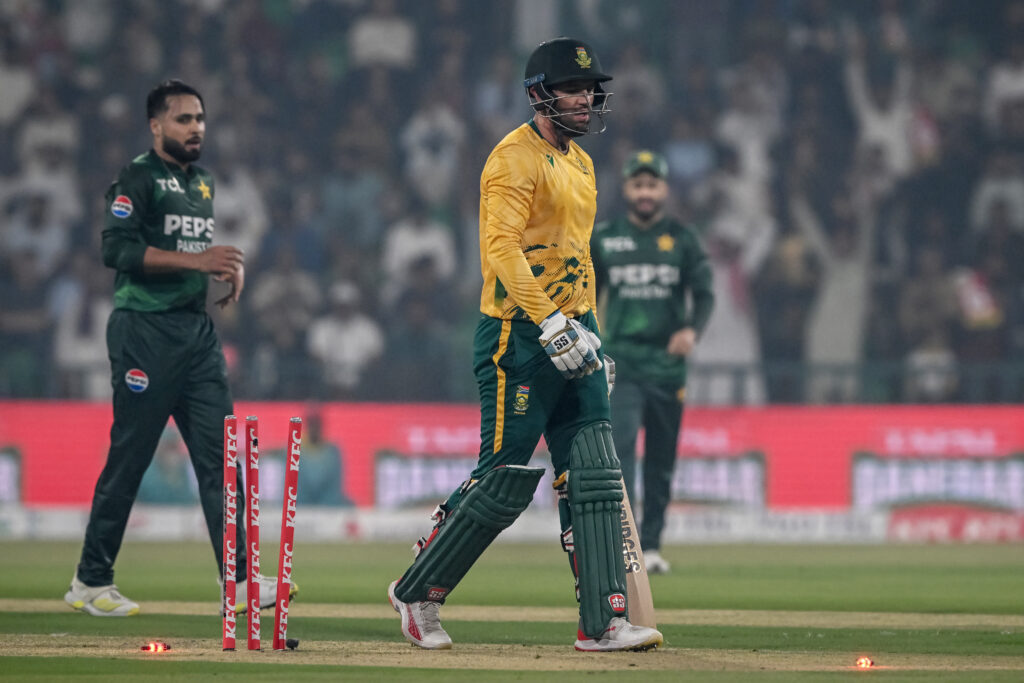
India captain Suryakumar Yadav played down the hype around the cricket rivalry with Pakistan after beating their bitter rivals by six wickets in the Asia Cup in Dubai on Sunday.India rode on a blazing 74 from opener Abhishek Sharma as they chased down a target of 172 in 18.5 overs in the Super Four clash, where they again refused to shake hands with their opponents.It was India’s second win in the Twenty20 tournament over Pakistan in a week after their group stage clash.It was also their 12th in 15 T20 internationals.Asked if this dominance showed that the rivalry was waning, Suryakumar replied: “You guys should stop asking questions about the rivalry between India-Pakistan. “According to me, if two teams play 15-20 matches, and if it is even, then it is a rivalry. 13-0, 10-1, I don’t know what the stat is, but this is not a rivalry anymore.” Pakistan’s last of three T20 wins over India came in the Asia Cup in Dubai in 2022. India and Pakistan only play in multinational tournaments as their bilateral ties have been stalled since 2012 over political tension.Pakistan rode on a brilliant 45-ball 58 from opener Sahibzada Farhan but managed 171-5 after romping to 93-1 in 9.3 overs.Suryakumar said that India played better cricket as Abishek and Shubman Gill put on a rapid 105 for the opening stand in 9.5 overs.”I think we were better than them (Pakistan), and also from a bowling point of view,” said Suryakumar. “The catch drop percentage at this venue is so high and that is part and parcel of the game.”Suryakumar praised Sharma’s talent.”He knows what is required of him, what bowlers are going to bowl, that’s a plus point for him. He is learning with every game,” said Suryakumar of the 25-year-old left-hander.Pakistan captain Salman Agha said that his team had come up 15-20 runs short.”We have yet to play a perfect game in this event,” said Agha, whose team next faces Sri Lanka in Abu Dhabi on Tuesday.”After being 91 in 10 overs we lost way but still feel 171 was a challenging total.”Agha acknowledged that his bowlers could not control the Indian openers.”We need to play a perfect game, do well in all three departments,” said Agha. “We look forward to playing Sri Lanka in the next game.”Bangladesh beat Sri Lanka by four wickets in their Super Four match in Dubai on Saturday.The top two teams from Super Four will play the final in Dubai on September 28.

Abhishek fires India to win over Pakistan but no handshakes again

Opener Abhishek Sharma hit a blazing 74 as India beat Pakistan by six wickets and again refused to shake hands with their opponents in the Super Four clash of the Asia Cup on Sunday.Chasing 172 for victory, India rode on a 105-run opening stand between the left-handed Abhishek and Shubman Gill, who made 47, to achieve their target with seven balls to spare in Dubai.The rivals came into the contest of the regional tournament with tensions high after India angered Pakistan by also refusing to shake hands when the pair met in the group stage.Tempers flared on the field when Gill and Shaheen Afridi exchanged simmering glances after the batter hit the pace bowler for a boundary.Both Abhishek and Gill came out roaring with a flurry of boundaries to unsettle the Pakistan attack as they raced to 101-0 in 9 overs. Abhishek and Haris Rauf kept up the spice with a fiery exchange.”Today was pretty simple, the way they were coming out to us without any reason, I did not like it at all,” Abhishek said after being named player of the match.”That’s why I went after them. I wanted to deliver for the team.”Medium-pace bowler Faheen Ashraf bowled Gill, and Rauf in the next over took down skipper Suryakumar Yadav for a duck to check India’s surge.Abhishek fell to Abrar Ahmed’s leg spin after his 35-ball blitz laced with six fours and five sixes.Rauf took one more wicket but Tilak Varma, with his unbeaten 30 off 19 balls, steered the team home off a six and a four.The Indian batters quickly left the field while Pakistan players shook hands amongst themselves.”We are yet to play a perfect game, but we are getting there,” said Pakistan captain Salman Agha. “A great game but in the powerplay (first six overs) they took the game away from us.”- Gun celebration -India won the toss and fielded first, but Pakistan came out attacking as Sahibzada Farhan, who hit 58, and Saim Ayub, who made 21, put on 72 runs for the second wicket, to help their team reach 171-5.Fakhar Zaman opened with Farhan and started aggressively in his nine-ball 15 before being caught behind.Farhan kept up the charge as he hit five fours and three sixes in his 45-ball knock as he reached his fifty with a six and celebrated by using his bat to mimmick a gun.India hit back with three wickets, including Farhan who was dismissed by medium-pace bowler Shivam Dube, as Pakistan slipped to 115-4.Mohammad Nawaz made 21 before he was run out.Agha, on 17, and Faheem Ashraf, with 20 off eight balls, struck 22 between them to boost the total.Dube stood out with figures of 2-33, but Indian fielders had a day to forget as they dropped four catches. India beat Pakistan in their group match, which was the first cricketing clash between the rival nations since a four-day cross-border conflict in May left more than 70 people dead.Andy Pycroft turned out as match referee for the Super Four match in spite of Pakistan lodging a protest with the International Cricket Council, alleging that the Zimbabwean had told Agha not to approach Suryakumar for a handshake.The Pakistan Cricket Board demanded that Pycroft be removed from their matches and threatened to withdraw from the eight-team T20 competition.Because of fraught political ties, nuclear-armed neighbours India and Pakistan only meet at neutral venues during multi-team tournaments.Sri Lanka and Bangladesh are the other teams in the Super Four. The top two will move into the final on September 28.