AFP Asia

Afghan women cricketers reunite in first game after fleeing Taliban

Afghanistan’s women cricketers on Thursday played their first game since fleeing the Taliban three years ago, a charity match in Australia that captain Nahida Sapan said she hoped would spark “a movement for change”.Hundreds of women athletes fled Afghanistan as the Taliban took over in August 2021, escaping a hardline stance that essentially banned women’s sport and education. Most of the national women’s cricket side settled as refugees in Australia, where they reunited for the first time on Thursday to play a charity match in Melbourne.”Together, we’re building not just a team, we’re building a movement for change and promise,” captain Sapan said in the run-up to the game. “We have big hopes for this match because this match can open doors for Afghan women, for education, sport and in the future.” The Afghanistan Cricket Board made a significant stride in November 2020 when it handed 25 promising women cricketers professional contracts. But before this fledgling squad had a chance to play together, the Taliban captured capital Kabul and declared an end to women’s cricket. “We have never played before together as a team,” said cricketer Firooza Amiri.”We are going to represent millions of Afghan women that are in Afghanistan and denied their rights.”It’s very special for all of us to get back together after three years, (after) leaving everything and losing everything back home in Afghanistan.”- ‘Profound sadness’ -Of the 25 women once contracted by the Afghanistan Cricket Board, 22 are now settled in the Australian cities of Melbourne and Canberra.Some of these players have lobbied the governing International Cricket Council in the hopes of forming a refugee team with some kind of official status. “A profound sadness remains that we, as women, cannot represent our country like the male cricketers,” some players wrote in a joint letter last year. “The creation of this team will allow all Afghan women who want to represent their country to come together under one banner.” The council has so far ignored these calls.Thursday’s game was played at Melbourne’s Junction Oval, a storied ground where a young Shane Warne once plied his trade.The Afghan side played an invitational outfit representing Cricket Without Borders, a charity which aims to draw young women into the game.Governing body Cricket Australia threw its weight behind the match, pledging to “advocate” for the Afghan women’s side at the highest levels.”I’m just so proud of everyone across Australian cricket who’s worked to support the players since they’ve been in Australia,” chief executive Nick Hockley said earlier this week.Citing human rights concerns, Australia has in recent years boycotted a series of non-tournament fixtures against the Afghanistan men’s side. 

At least 30 dead in India stampede at Hindu mega-festival

A pre-dawn stampede at the world’s largest religious gathering killed at least 30 people in India on Wednesday, with many more injured after a surging crowd spilled out of a police cordon and trampled bystanders.Deadly crowd incidents are a frequent occurrence at Indian religious festivals, including the Kumbh Mela, which attracts tens of millions of devotees every 12 years to the northern city of Prayagraj.As pilgrims rushed to participate in a sacred day of ritual bathing, people sleeping and sitting on the ground near the rivers told AFP they were trampled by huge swells of devotees coming towards them in the darkness.”The entire crowd fell on top of me, trampling me as it moved forward,” pilgrim Renu Devi, 48, told AFP. “When the crowd surged, elderly people and women were crushed, and no one came forward to help.”Rescue teams carrying victims from the accident site weaved through piles of clothes, shoes and other discarded belongings. Police were seen carrying stretchers bearing the bodies of victims draped with thick blankets.”Thirty devotees have unfortunately died,” senior police officer Vaibhav Krishna told reporters during an evening news conference at the festival. “Ninety injured were taken to the hospital.”Krishna’s briefing came nearly 18 hours after the stampede and was the first official death toll given by authorities. Festivities had otherwise been allowed to continue almost as normal during the day, with millions still trekking to the riverbanks to immerse themselves in the water.Prime Minister Narendra Modi called the stampede “extremely sad” and offered his “deepest condolences” to relatives of those killed. “I wish for the speedy recovery of all injured,” he added. Dozens of relatives were anxiously waiting for news outside a large tent serving as a purpose-built hospital for the festival near the disaster site.- ‘Please cooperate’ -The six-week Kumbh Mela is the single biggest milestone on the Hindu religious calendar.Wednesday marks one of the holiest days in the festival, when saffron-clad holy men lead millions in a sin-cleansing ritual of bathing at the confluence of the Ganges and Yamuna rivers in tandem with a planetary alignment in the Solar System. Officials had attempted to divert crowds away from the disaster site, instructing them to bathe at other locations.”We humbly request all devotees do not come to the main bathing spot,” said one festival staffer, his voice crackling through his megaphone. “Please cooperate with security personnel.”But even as news of the stampede spread, crowds pushed through cordons to move towards the river, shrugging off aggressive orders from police to turn back.Officials from the Uttar Pradesh state government, responsible for staging the festival, said millions had participated in the ritual bathing through the day.Indian opposition leader Rahul Gandhi blamed the disaster on poor crowd control that prioritised the comfort of distinguished visitors.”Mismanagement and the administration’s special focus on VIP movement instead of common devotees are responsible for this tragic incident,” he wrote on social media. – ‘My family got scared’ -Railway police superintendent Ashtabhuja Singh told AFP that special train services taking pilgrims to Prayagraj were still running, after earlier reports that they had been halted due to crowding in the city. “My family got scared, so we’re leaving,” attendee Sanjay Nishad told AFP.The Kumbh Mela is rooted in a mythological Hindu battle between deities and demons for control of a pitcher containing the nectar of immortality. Organisers have likened the scale of this year’s festival to a temporary country, forecasting up to 400 million pilgrims would visit before the final day on February 26. Police this year installed hundreds of cameras at the festival site and on roads leading to the sprawling encampment, mounted on poles and a fleet of overhead drones. The surveillance network feeds into a sophisticated command and control centre meant to alert staff if sections of the crowd get so concentrated that they pose a safety threat. “If you see advertisements it seems like the government is providing world class facilities,” university student Ruchi Bharti told AFP not far from the riverbank.”But this stampede proved that was all a lie.”More than 400 people died after they were trampled or drowned at the Kumbh Mela on a single day of the festival in 1954, one of the largest tolls in a crowd-related disaster globally.Another 36 people were crushed to death in 2013, the last time the festival was staged in Prayagraj. 

Lion cub gifted to Pakistani YouTube star causes wedding chaos

A Pakistani YouTube star who was gifted a lion cub on his wedding day has avoided jail after promising a judge to upload animal rights videos for a year.Rajab Butt has one of the largest online followings in the South Asian country and his week-long nuptials in late December were plastered over celebrity gossip websites. When a sleepy lion cub, resembling young Simba from the 2019 “Lion King” film, was presented to him in a gold-chained cage in front of thousands of guests who partied late into the night in the eastern megacity of Lahore, pictures spread rapidly online.Butt captioned a video of the event “it’s raining gifts”, racking up nearly 10 million views.The morning after, police raided his house, confiscated the cub and kept the newly-wed in custody overnight.”We found out about the lion cub through social media,” said Faisal Mushtaq, an inspector from the Punjab provincial wildlife department.Police officers went to Butt’s house and found the lion cub roaming around the garage, he said.”It was in a poor condition, as it was very cold,” said Mushtaq. Last week, Butt pleaded guilty to owning an undocumented wild animal but the judge waived a possible fine and prison sentence of up to two years for a more tailored punishment.Every month for one year, he must post a five-minute video dedicated to animal rights, said the order by judge Hamid Ul Rahman Nasir. The social media influencer agreed to the conditions, after admitting in a court statement that he “set a poor example” by accepting the gift and going on to “glorify it”.Butt is one of the country’s highest-paid YouTube stars, according to the platform, and usually posts videos about his family’s daily life, from arguments to new car purchases.Tanvir Janjua, a veteran wildlife official in Punjab, said the cub was likely bought for between 700,000 and 800,000 Pakistani rupees ($2,500-$2,900).”It is so wrong, morally and legally, to take away such a small cub from its mother,” which was likely still feeding it, he told AFP.- New regulations -A week after the YouTuber was arrested, an adult lion escaped from his cage, running through the narrow streets of a Lahore neighbourhood as residents clambered to their rooftops. The full-grown adult male was eventually shot dead by a security guard, prompting heated outrage on social media about the dangers of keeping a big cat in a residential area. Big cats are imported and bred across Pakistan, seen as symbols of wealth and power to the elite that own them.Last year, Pakistan Muslim League-Nawaz, which rules the government, banned supporters from bringing lions — the symbol of the party — to political rallies.However, stringent new regulations banning private ownership of big cats in residential areas are currently making their way through Punjab’s provincial government. Breeders would have to buy a licence and have at least 10 acres (four hectares) of land on a site approved by wildlife officials. – ‘Never be your pet’ -The gifted lion cub, which hasn’t been named, is now enjoying the winter sun in an open pen at Lahore’s sprawling Safari Zoo on the edge of the city, under the watchful eye of a handler.Janjua, also the zoo’s deputy director, has conducted hundreds of raids against owners, breeders and poachers over the past 33 years to confiscate wild animals, including lions which often had their teeth and claws removed.”Look at these YouTubers who use these animals to get clicks. What kind of a message are they spreading by being cruel to these animals?” he said, scornful of those who parade them in their cars and at political rallies. “They can never be your pet. For two or three months it won’t say anything but after that, it will turn aggressive.”As he nears retirement, Janjua says attitudes towards animals have worsened throughout his career. Laws, however, have improved, he says. “Now wildlife officials have dedicated uniforms, weapons and we will get our own courts,” he told AFP. “The courts that already exist are now strict about animal cruelty.”

At least 15 dead in India stampede at Hindu mega-festival

A pre-dawn stampede at the world’s largest religious gathering killed at least 15 people in India Wednesday, with many more injured after a surging crowd spilled out of a police cordon and trampled bystanders. Deadly crowd incidents are a frequent occurrence at Indian religious festivals, including the Kumbh Mela, which attracts tens of millions of devotees every 12 years to the northern city of Prayagraj.As pilgrims rushed to participate in a sacred day of ritual bathing, people sleeping and sitting on the ground near the rivers told AFP they were trampled by huge swells of devotees coming towards them in the darkness.”The entire crowd fell on top of me, trampling me as it moved forward,” pilgrim Renu Devi, 48, told AFP. “When the crowd surged, elderly people and women were crushed, and no one came forward to help.”Rescue teams carrying victims from the accident site weaved through piles of clothes, shoes and other discarded belongings. Police were seen carrying stretchers bearing the bodies of victims draped with thick blankets.”At least 15 people” were killed with dozens more injured, a doctor at a hospital tending to survivors told AFP, speaking on condition of anonymity as they were not authorised to talk to media. Hours after the stampede, which took place around 1:00 am (1930 GMT Tuesday), authorities had not announced any official death toll. Prime Minister Narendra Modi confirmed people had died in the incident, calling it “extremely sad” and offering his “deepest condolences” to relatives of those killed. “I wish for the speedy recovery of all injured,” he added. Dozens of relatives were anxiously waiting for news outside a large tent serving as a purpose-built hospital for the festival near the disaster site.- ‘Please cooperate’ -The six-week Kumbh Mela is the single biggest milestone on the Hindu religious calendar.Wednesday marks one of the holiest days in the festival, when saffron-clad holy men typically lead millions in a sin-cleansing ritual of bathing at the confluence of the Ganges and Yamuna rivers.Instead, officials were strolling the festival with loudhailers pleading with pilgrims to keep away from the disaster site and bathe at other locations.”We humbly request all devotees do not come to the main bathing spot,” said one festival staffer, his voice crackling through his megaphone. “Please cooperate with security personnel.”But even as news of the stampede spread, crowds pushed through cordons to move towards the riverbed, shrugging off aggressive orders from police to turn back.Officials from the Uttar Pradesh state government, responsible for staging the festival, said millions continued to bathe in the hours after the stampede.Chief Minister Yogi Adityanath told reporters that medical workers were treating those seriously injured in the crush, adding that the situation was “under control”.Indian opposition leader Rahul Gandhi blamed the disaster on poor crowd control that prioritised the comfort of distinguished visitors.”Mismanagement and the administration’s special focus on VIP movement instead of common devotees are responsible for this tragic incident,” he wrote on social media. – ‘My family got scared’ -Railway police superintendent Ashtabhuja Singh told AFP that special train services taking pilgrims to Prayagraj were still running, after earlier reports that they had been halted due to crowding in the city. “My family got scared, so we’re leaving,” attendee Sanjay Nishad told AFP.The Kumbh Mela is rooted in a mythological Hindu battle between deities and demons for control of a pitcher containing the nectar of immortality. Organisers have likened the scale of this year’s festival to a temporary country, forecasting up to 400 million pilgrims would visit before the final day on February 26. Police this year installed hundreds of cameras at the festival site and on roads leading to the sprawling encampment, mounted on poles and a fleet of overhead drones. The surveillance network feeds into a sophisticated command and control centre meant to alert staff if sections of the crowd get so concentrated that they pose a safety threat. “If you see advertisements it seems like the government is providing world class facilities,” university student Ruchi Bharti told AFP not far from the riverbank.”But this stampede proved that was all a lie.”More than 400 people died after they were trampled or drowned at the Kumbh Mela on a single day of the festival in 1954, one of the largest tolls in a crowd-related disaster globally.Another 36 people were crushed to death in 2013, the last time the festival was staged in Prayagraj. 

Crowd chaos and confusion at site of India festival stampede

Journeying across India for the pinnacle celebration of the Hindu calendar, Laxmi and her family were sleeping by the roadside Wednesday as they waited to cleanse themselves in the sacred Ganges river.All of a sudden they were violently roused in the middle of the night by police officers, who smacked them with wooden sticks and ordered them to clear a path for other pilgrims.The officers were frantically trying to make way for a surging throng of devotees that would imminently spill over crowd control barriers and crush the dozing masses on the other side.”A large crowd surged forward, pushing and trampling us,” Laxmi, shell-shocked and huddled under a thick woollen shawl in the morning cold, told AFP.”In that chaos, my sister-in-law lost her life.”Laxmi is among millions of people who flocked to the northern city of Prayagraj for the Kumbh Mela, a six-week festival of worship and ritual bathing meant to cleanse the faithful of sin.Wednesday marks one of the holiest days in the festival, coinciding with an alignment of planets in the solar system, when saffron-clad holy men lead crowds into the water at the confluence of the Ganges and Yamuna rivers.But the Kumbh Mela has a woeful safety record and celebrations have once again been overshadowed by a stampede, this time fatally crushing at least 15 pilgrims.Even before the latest incident, the festival’s attendees fumed over what they said was poor crowd management.”If we talk about the worst organized Kumbh Mela in history it will be 2025,” Mata Prasad Pandey, a 65-year-old retired teacher, told AFP.Pandey complained that he had been forced to walk more than 25 kilometres (15 miles) to and from the festival site because of onerous restrictions on vehicle traffic by organisers. “Elderly people and women are forced to walk for ages,” he added. Reserved pathways and cordoned-off areas reserved for eminent attendees have been a source of vehement complaint at the festival for reducing the amount of space for common pilgrims.Several videos shared widely on social media before the stampede showed crowds shouting at police officers for preventing them from moving about the festival grounds on foot, while they gave priority travel to distinguished guests in cars.Indian opposition leader Rahul Gandhi condemned organisers for “mismanagement” and a “focus on VIP movement” which he blamed for the deaths.Others, including Prayagraj local Rekha Verma, pointed the finger at heavy-handed tactics by “rude and abusive” police officers to keep immense throngs of devotees in line.”Police are using force to control the crowd and that’s why this happened,” she said. – ‘They have failed’ – But on the ground it was unclear how much power police had to keep order, with the Uttar Pradesh state government estimating tens of millions of people scattered around the festival site.Even after news of the stampede spread, a mass of people slid under gates and jumped fences to move towards the riverbed, shrugging off aggressive orders from officers to turn back.Others felt uncomfortable staying at the festival, despite the long and arduous journey.”We walked all over the night to reach out the bathing spot, but now I don’t think it’s safe to go there,” pilgrim Nirmala Devi told AFP. “We have children and elderly people with us,” she said. “We are headed back home, safety is important.”Organisers have been eager to tout the technological advancements introduced for this year’s edition of the Kumbh Mela.That includes an extensive artificial intelligence-assisted surveillance system meant to give advance warning of dangerous crowd crushes. “The government said again and again on TV that the arrangements it had made were sufficient but we now see that they have failed,” university student Ruchi Bharti told AFP. “If you see advertisements it seems like the government is providing world-class facilities,” he said. “But this stampede proved that was all a lie.”

15 dead in India stampede at Hindu mega-festival

A pre-dawn stampede at the world’s largest religious gathering killed at least 15 people in India Wednesday, with many more injured after a surging crowd spilled out of a police cordon and trampled bystanders. Deadly crowd incidents are frequent occurrence at Indian religious festivals, including the Kumbh Mela, which attracts tens of millions of devotees every 12 years to the northern city of Prayagraj.As pilgrims rushed to participate in a sacred day of ritual bathing, people sleeping and sitting on the ground near the rivers told AFP they were trampled by huge swells of devotees coming towards them in the darkness.”I was sitting near a barricade, and during the pushing and shoving, the entire crowd fell on top of me, trampling me as it moved forward,” Pilgrim Renu Devi, 48, told AFP. “When the crowd surged, elderly people and women were crushed, and no one came forward to help.”Rescue teams carrying victims from the accident site weaved through piles of clothes, shoes and other discarded belongings. Police were seen carrying stretchers bearing the bodies of victims draped with thick blankets.”At least 15 people” were killed with dozens more injured, a doctor at a hospital tending to survivors told AFP, speaking on condition of anonymity as they were not authorised to talk to media. Authorities have yet to officially confirm the number of dead in the stampede, which took place around 1:00 am (1930 GMT Tuesday).Prime Minister Narendra Modi said the accident was “extremely sad” and offered his “deepest condolences” to relatives of those killed. “I wish for the speedy recovery of all injured,” he added. Dozens of relatives were anxiously waiting for news outside a large tent serving as a purpose-built hospital for the festival around one kilometre (0.6 miles) from the disaster site.- ‘Please cooperate’ -The six-week Kumbh Mela is the single biggest milestone on the Hindu religious calendar.Wednesday marks one of the holiest days in the festival, when saffron-clad holy men lead millions in a sin-cleansing ritual of bathing at the confluence of the Ganges and Yamuna rivers.Instead, officials were strolling the festival with loudhailers pleading with pilgrims to keep away from the disaster site and bathe at other locations.”We humbly request all devotees do not come to the main bathing spot,” said one festival staffer, his voice crackling through his megaphone. “Please cooperate with security personnel.”The Uttar Pradesh state government, responsible for staging the festival, said millions had already bathed in the waterways between midnight and the early morning. Chief Minister Yogi Adityanath told reporters that medical workers were treating those seriously injured in the crush, adding that the situation was “under control”.Indian opposition leader Rahul Gandhi blamed the disaster on poor crowd management that prioritised the comfort of prominent pilgrims.”Mismanagement and the administration’s special focus on VIP movement instead of common devotees are responsible for this tragic incident,” he wrote on social media. – ‘My family got scared’ -Railway official Manish Kumar said numerous special train services scheduled to transport pilgrims had been halted due to massive crowding at Prayagraj. Some devotees decided to make an early exit from the city.”I heard the news and saw the bathing site,” attendee Sanjay Nishad told AFP.”My family got scared, so we’re leaving.” The Kumbh Mela is rooted in Hindu mythology, a battle between deities and demons for control of a pitcher containing the nectar of immortality.Organisers have likened the scale of this year’s festival to that of a temporary country, forecasting up to 400 million pilgrims would visit before the final day on February 26. Mindful of the risk of deadly crowd accidents, police this year installed hundreds of cameras at the festival site and on roads leading to the sprawling encampment, mounted on poles and a fleet of overhead drones. The surveillance network is fed into a sophisticated command and control centre that is meant to alert staff if sections of the crowd get so concentrated that they pose a safety threat. More than 400 people died after they were trampled or drowned at the Kumbh Mela on a single day of the festival in 1954, one of the largest tolls in a crowd-related disaster globally.Another 36 people were crushed to death in 2013, the last time the festival was staged in the northern city of Prayagraj. 

India’s Kumbh Mela, world’s largest religious gathering

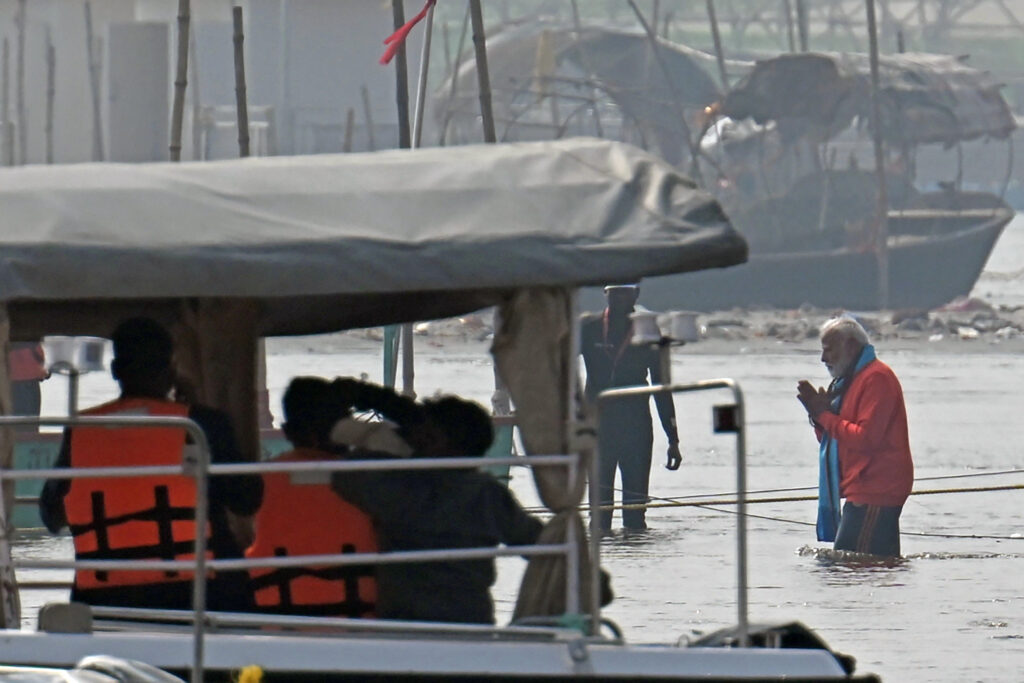
A deadly stampede on Wednesday hit India’s Kumbh Mela, a vast Hindu festival held by the banks of the Ganges river that 400 million pilgrims are expected to visit over its six-week duration.Devotees have travelled from across India and beyond to take part in elaborate rituals, prayers and religious processions with elephants, as well as horse-back parades and chariots.The mass Hindu mela, or fair, opened on January 13 and runs until February 26 on the river banks of Prayagraj in the northern state of Uttar Pradesh. Organisers say the scale of preparations for the Kumbh Mela is akin to setting up a country from scratch. – History of deadly stampedes -At least 15 people were killed in Wednesday’s stampede, a doctor told AFP, despite organisers installing hundreds of cameras and using drones to track crowds.A system using AI was designed to track people flow and sound the alarm if crowd density posed a safety threat. The plans were intended to avoid a repeat of 2013, the last time the festival was staged in the northern city of Prayagraj, when 36 people were crushed to death.In one of the worst crowd-related disasters globally, more than 400 people were trampled to death or drowned at the Kumbh Mela on a single day in 1954.- Mind-boggling numbers -Around 150,000 toilets have been built along with community kitchens that can each feed up to 50,000 people at a time.The last celebration at the site, the “ardh” or half Kumbh Mela in 2019, attracted 240 million pilgrims, according to the government.This year, authorities are preparing for up to 400 million people — more than the combined population of the United States and Canada.Mela authorities and police have set up a network of “Lost and Found” centres as well as a special Kumbh phone app to help lost pilgrims reunite with their families.- Sacred bathing -The Kumbh Mela, the “festival of the sacred pitcher”, is held at the confluence of the Ganges, Yamuna and mythical Sarasvati rivers.A central part of the rituals is bathing in the holy rivers, with the dawn charge often led by naked, ash-smeared monks.Hindus believe that those who immerse themselves in the waters cleanse themselves of sin, breaking free from the cycle of rebirth and ultimately attaining salvation.Many pilgrims embrace a life of simplicity during the festival — vowing non-violence, celibacy and the offering of alms — and focusing on prayer and meditation.- Cosmic battle – The festival is rooted in Hindu mythology, a battle between deities and demons for control of a pitcher, or kumbh, containing the nectar of immortality.During the battle, a cosmic fight called “Samudra Manthan”, or the “churning of the ocean”, four drops of nectar were spilt.One landed at Prayagraj, where the Kumbh is held every 12 years.The other drops fell in Nashik, Ujjain and Haridwar, cities where smaller Kumbh festivals are held in intervening years.The mythological battle is mentioned in the Rig Veda, an ancient sacred canonical Hindu text.One of the earliest historical mentions of the festival comes from Chinese Buddhist monk and scholar Hiuen Tsang, who attended in the seventh century.- Key dates -Bathing takes place every day, but on the most auspicious dates, it is known as Shahi Snan, or “royal bath”.Ceremonies include the visually spectacular “aarti”, when vast numbers of priests perform rituals holding flickering lamps.Devotees also float a sea of twinkling “diya” prayer lamps, crafted from baked flour, that glow from burning mustard oil or clarified butter.Millions of people had been expecting to participate in ritual bathing Wednesday for Mauni Amavasya, considered to be the most auspicious day of the festival, when celestial alignments are said to be ideal for purifying waters.The festival began on January 13, coinciding with the full moon, with celebrations culminating on February 26, the final holy bathing day. abh-burs-rsc/gle

15 dead in India after stampede at Hindu mega-festival

A stampede at the world’s largest religious gathering in India killed at least 15 people with many more injured, a doctor at the Kumbh Mela festival in Prayagraj told AFP Wednesday.Deadly crowd crushes are a notorious feature of Indian religious festivals and the Kumbh Mela, with its unfathomable throngs of devotees, already had a grim track record of deadly crowd crushes before the latest incident overnight.The six-week festival is the single biggest milestone on the Hindu religious calendar, and millions of people were expected to be present on Wednesday for a sacred day of ritual bathing at the confluence of the Ganges and Yamuna rivers.”At least 15 people have died for now. Others are being treated,” said the doctor in Prayagraj city, speaking on condition of anonymity as they were not authorised to talk to media.Rescue teams were seen working with pilgrims to carry victims away from the site of the accident.Local government official Akanksha Rana told the Press Trust of India (PTI) news agency that the stampede began after crowd control barriers “broke”. Pilgrim Malti Pandey, 42, told AFP that he was on his way to bathe in the river along a barricaded walking route when the stampede began.”Suddenly a crowed started pushing and many people were crushed,” he said. The Kumbh Mela is rooted in Hindu mythology, a battle between deities and demons for control of a pitcher containing the nectar of immortality.Organisers have likened the scale of this year’s festival to that of a temporary country, forecasting up to 400 million pilgrims to visit before the final day on February 26. Mindful of the risk of deadly crowd accidents, police this year installed hundreds of cameras at the festival site and on roads leading to the sprawling encampment, mounted on poles and a fleet of overhead drones. The surveillance network is fed into a sophisticated command and control centre that is meant to alert staff if sections of the crowd get so concentrated that they pose a safety threat. More than 400 people died after being trampled or drowned at the Kumbh Mela on a single day of the festival in 1954, one of the largest tolls in a crowd-related disaster globally.Another 36 people were crushed to death in 2013, the last time the festival was staged in the northern city of Prayagraj. 

England down India to keep T20 series alive

Disciplined bowling and a quickfire 51 by Ben Duckett helped England bounce back to win the third T20 international against India on Tuesday and keep the series alive.Duckett’s 28-ball knock set up England to make 171-9 despite a collapse triggered by Indian spinner Varun Chakravarthy, who returned figures of 5-24 in Rajkot.England’s bowlers then combined to limit India to 145-9, sealing a 26-run win in a five-match series now only led 2-1 by India.Leg-spinner Adil Rashid impressed with figures of 1-15 from an excellent four-over spell, while England’s fast bowlers struck regularly.Jamie Overton took three wickets while Jofra Archer and Brydon Carse claimed two each.Hardik Pandya stuttered to 40 off 35 deliveries before being dismissed by Overton when the required run-rate climbed to more than 20 an over.Archer struck first with the wicket of Sanju Samson, who was caught at mid-on by Rashid.Carse dismissed Abhishek Sharma, for 24, with Archer taking a spectacular catch while running backwards from mid-off.Mark Wood sent back skipper Suryakumar Yadav, with the batter top-edging a quick, rising delivery into the gloves of wicketkeeper Phil Salt.Wickets kept tumbling as Rashid bowled Tilak Varma and Overton sent back Washington Sundar to reduce India to 85-5 and Pandya never seriously threatened to take India over the line.Earlier, Duckett’s blazing start and then a 24-ball 43 by Liam Livingstone boosted the total and the lower-order chipped in after England slipped to 127-8 in 16 overs.Duckett put on 76 runs with skipper Jos Buttler, who hit 24, after losing his opening partner Salt.Chakravarthy broke the stand with Buttler’s wicket, a caught-behind dismissal given on review.Duckett, who struck two sixes and seven fours, reached his 50 in 26 balls but was out in the same over off Axar Patel’s left-arm spin.England soon lost their way against India’s spinners as Ravi Bishnoi bowled Harry Brook for eight and Chakravarthy struck twice to send back Jamie Smith and Jamie Overton in the next over.Chakravarthy returned in his last over to take two more and register his second five-wicket haul in T20 internationals.Livingstone stood defiant and smashed Bishnoi for three sixes in the space of four balls before he holed out off Pandya, but his knock proved key.Fast bowler Mohammed Shami, who returned to international action for the first time since the 2023 ODI World Cup final, bowled three wicketless overs for 25 runs.The fourth match is on Friday in Pune.

India’s Bumrah named cricketer of the year after stellar 2024

India pace bowler Jasprit Bumrah has been named men’s cricketer of the year for 2024, the International Cricket Council announced Tuesday, a day after he won the Test award.Bumrah, 31, ended last year as the top wicket-taker in Tests with 71 wickets and inspired India to the T20 World Cup title in June.”The year 2024 was incredibly special — winning the men’s T20 World Cup 2024 in Barbados and also contributing as much as I could across all three formats of the game,” said Bumrah.”I dedicate this award to everyone who has believed in me, the power of hard work and dreams, and to bowlers worldwide who continue to inspire and strive for excellence.”Bumrah beat England batters Harry Brook and Joe Root as well as Australia’s Travis Head to the award — the Sir Garfield Sobers Trophy, given by the sport’s governing body.He is fifth Indian to receive the award after Rahul Dravid (2004), Sachin Tendulkar (2010), Ravichandran Ashwin (2016) and Virat Kohli (2017, 2018).Bumrah has claimed 443 wickets in 204 international matches since his debut for India in 2016.New Zealand all-rounder Amelia Kerr was voted women’s cricketer of the year to win the Rachael Heyhoe Flint Trophy, after she won the T20 cricketer of the year on Saturday.Kerr becomes the first New Zealander to win the trophy after she inspired the White Ferns to their women’s T20 World Cup victory in October last year.The 24-year-old overcame South Africa skipper Laura Wolvaardt, Sri Lanka’s Chamari Athapaththu and Australia’s Annabel Sutherland to win the award.