AFP Asia

India asks IMF to reconsider Pakistan programme over ‘terror funding’

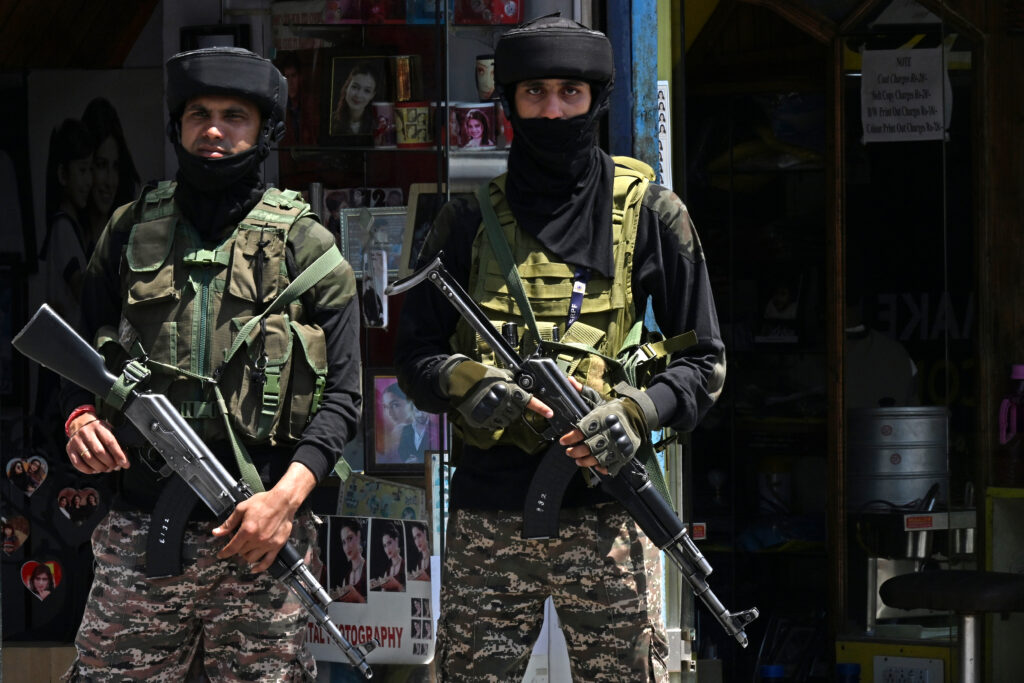
Indian Defence Minister Rajnath Singh said Friday the International Monetary Fund (IMF) should reconsider a one billion dollar loan to Pakistan alleging it was “funding terror”, a move denounced by Islamabad as proof of New Delhi’s desperation.India and Pakistan last week clashed in the worst military violence in decades, killing around 70 people before agreeing a ceasefire that began Saturday.The confrontations were sparked by an attack on tourists by gunmen in Indian-administered Kashmir last month that New Delhi accused Islamabad of backing — a charge it denies.”I believe a big portion of the $1 billion coming from IMF will be used for funding terror infrastructure,” Singh told troops at an air force base in western India.”I believe any economic assistance to Pakistan is nothing less than funding terror.”Despite India’s objections, the IMF last week approved a loan programme review for Pakistan, unlocking a $1 billion payment which the state bank said has already been received.A fresh $1.4 billion loan was also approved under the IMF’s climate resilience fund.India — which also represents Bhutan, Sri Lanka, and Bangladesh on the IMF board — abstained from the review vote with a statement from its finance ministry stating, “concerns over the efficacy of IMF programmes in case of Pakistan given its poor track record”.”India was the lone country which tried to stop it and it failed. It again reflects Indian frustration. Trying to criticise an institution like IMF speaks about this desperation,” Pakistan’s foreign ministry spokesman Shafqat Ali Khan told reporters.Pakistan came to the brink of default in 2023, as a political crisis compounded an economic downturn and drove the nation’s debt burden to terminal levels before being saved by a $7 billion bailout from the IMF which sparked further crucial loans from friendly nations.- Removed from watchlist -Pakistan, which has long battled militancy within its borders, has faced scrutiny over its ability to combat illicit financing, including to militant organisations and in 2022 was put on an international money-laundering watchlist.However, the Financial Action Task Force removed Pakistan from it so-called grey-list in 2022 after “significant progress” which included charges being filed against suspected militants accused of being involved in the 2008 attacks in India’s Mumbai.Singh claimed it was “clear that in Pakistan, terrorism and their government are hand in glove with each other. “In this situation there is a possibility that their nuclear weapons could get their way into the hands of terrorists. This is a danger not just for Pakistan but the entire world,” he said.Singh on Thursday called for Pakistan’s nuclear arsenal to be put under the surveillance of the UN’s atomic energy agency, with Islamabad firing back that the international community should investigate a nuclear “black market” in India.Britain’s Foreign Secretary David Lammy met with his Pakistani counterpart Ishaq Dar in Islamabad on Friday, where the two discussed the ceasefire, according to a statement from Pakistan’s foreign ministry.Lammy also contacted his Indian counterpart on Thursday, the UK foreign office said, adding he “will look to travel to New Delhi soon.”Prime Minister Shehbaz Sharif, who has warned that Pakistan’s armed forces are ready to counter any Indian aggression, called Friday evening for diplomatic solutions. “We have to sit down at the table like peaceful neighbours and settle our outstanding issues, including Jammu and Kashmir,” Sharif said. The disputed Muslim-majority region of Kashmir has been at the heart of several wars between the two neighbours, who administer separate portions of the divided territory.Militants stepped up operations on the Indian side of Kashmir from 2019, when Prime Minister Narendra Modi’s Hindu nationalist government revoked the region’s limited autonomy and imposed direct rule from New Delhi.
‘Serious problem’: Afghan capital losing race against water shortages

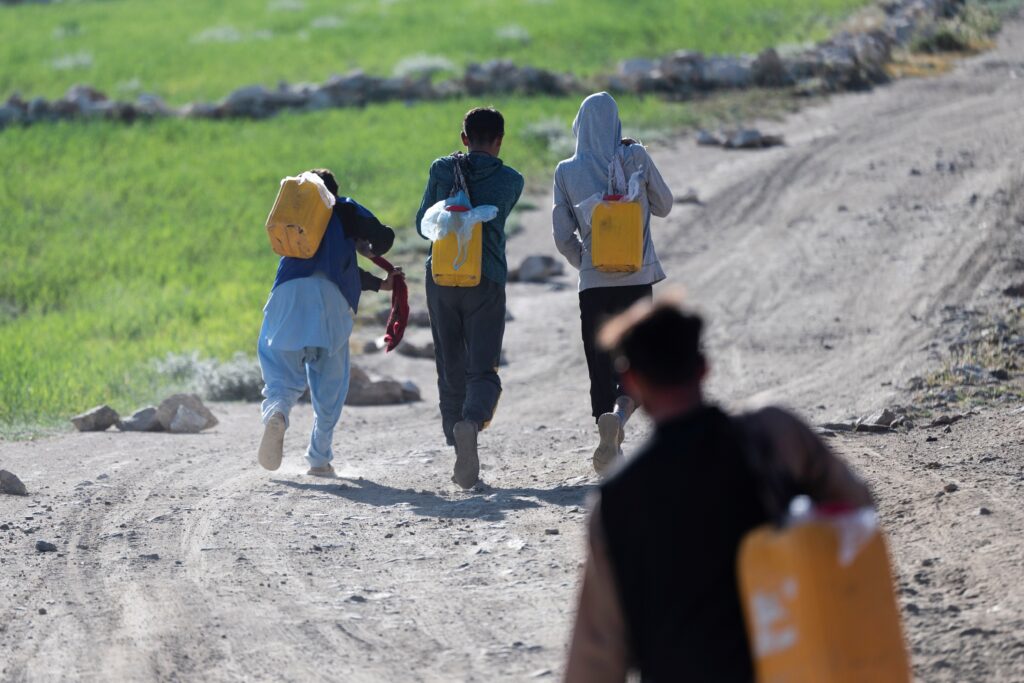
Every week, Bibi Jan scrapes together some of her husband’s meagre daily wage to buy precious water from rickshaw-drawn tankers that supply residents of Afghanistan’s increasingly parched capital.Kabul faces a looming water crisis, driven by unruly and rapid urbanisation, mismanagement over years of conflict, and climate change, meaning people like Bibi Jan are sometimes forced to choose between food and water.”When my children have only tea for a few days, they say, ‘You bought water and nothing for us’,” the 45-year-old housewife told AFP, describing reusing her supplies for bathing, dishes and laundry.Experts have long sounded the alarm over Kabul’s water problems, which are worsening even as many international players have backed off big infrastructure projects and slashed funding to Afghanistan since the Taliban government took power in 2021. “There could be no ground water in Kabul by 2030” without urgent action, the UN children’s agency UNICEF warned last year.  Other experts are more cautious, citing limited consistent and reliable data, but say the situation is clearly deteriorating. A 2030 cliff is a “worst-case scenario”, said water resources management expert Assem Mayar. But even if slated development projects are completed in a few years, it “doesn’t mean the situation would become better than now”, Mayar said.”As time goes on, the problems are only increasing,” he added, as population growth outstrips urban planning and climate change drives below-average precipitation.   – ‘Decreasing day by day’ -The Taliban authorities have launched projects ranging from recycling water to building hundreds of small dams across the country, but larger interventions remain hampered by financing and technical capacity. They remain unrecognised by any country since they ousted the Western-backed government and imposed their severe interpretation of Islamic law, with restrictions on women a major sticking point. They have repeatedly called for non-governmental groups to reboot stalled projects on water and climate change, as Afghanistan faces “some of the harshest effects” in the region, according to the United Nations. The water and energy ministry wants to divert water from the Panjshir river to the capital, but needs $300 million to $400 million. A dam project near Kabul would ease pressures but was delayed after the Taliban takeover.For now, Kabul’s primary drinking water source is groundwater, as much as 80 percent of which is contaminated, according to a May report by Mercy Corps.It is tapped by more than 100,000 unregulated wells across the city that are regularly deepened or run dry, the NGO said. Groundwater can be recharged, but more is drawn each year than is replenished in Kabul, with an estimated annual 76-million-cubic-metre (20-billion-gallon) deficit, experts say.”It’s a very serious problem… Water is decreasing day by day in the city,” said Shafiullah Zahidi, who heads central Kabul operations for the state-owned water company UWASS. Water systems designed decades ago serve just 20 percent of the city’s population, which has exploded to around six million over the past 20 years, said Zahidi. – ‘Use less water’ -At one of Kabul’s 15 pumping stations, maintenance manager Mohammad Ehsan said the seven-year-old well is already producing less water. Two others nearby sit dry. “The places with shallower water levels are dried out now,” said 53-year-old Ehsan, who has worked in water management for two decades, as he stood over an old well.It once produced water from a depth of 70 metres (230 feet), but a newer well had to be bored more than twice as deep to reach groundwater.    At one of the two large stations in the city, the International Committee of the Red Cross (ICRC) recently procured four new pumps where only one had been functioning. “If that pump collapsed for any reason, that means stopping the service for 25,000 beneficiary households,” which now have uninterrupted water, said Baraa Afeh, ICRC’s deputy water and habitat coordinator. Everyone in Kabul “should have 24-hour service”, said Zahidi, from the state water company.But in reality, Bibi Jan and many other Kabulis are forced to lug water in heavy jugs from wells or buy it from tankers.These suppliers charge at least twice as much as the state-owned utility, with potable water even more pricy in a country where 85 percent of the population lives on less than a dollar a day.Bibi Jan said she has to police her family’s water use carefully. “I tell them, ‘I’m not a miser but use less water.’ Because if the water runs out then what would we do?”

India and Pakistan trade accusations of nuclear arsenal mismanagement

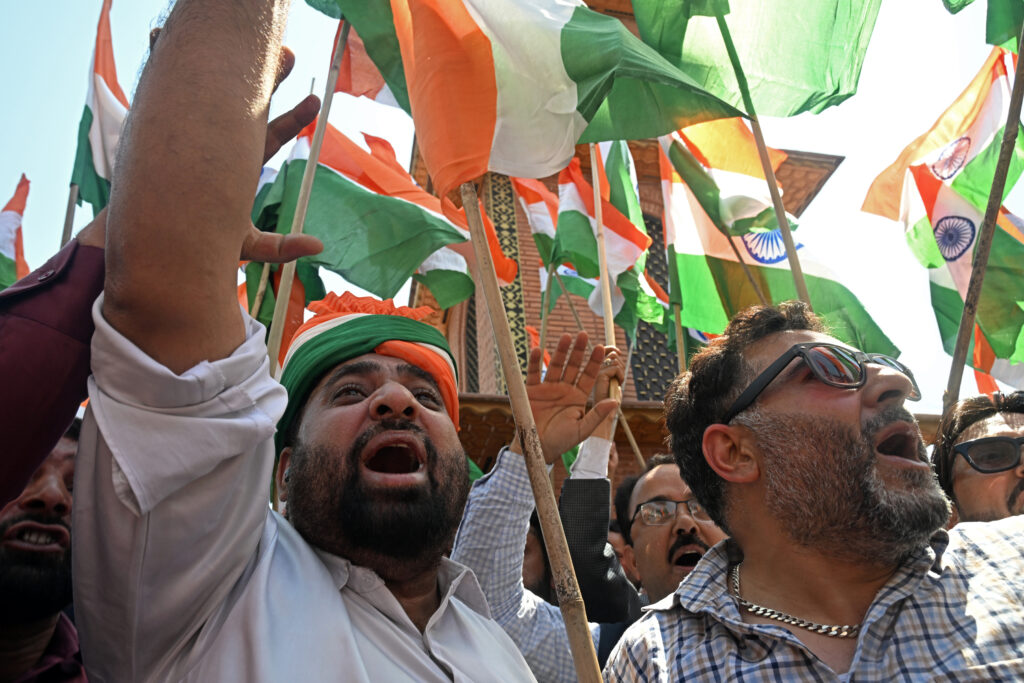
India and Pakistan accused each other Thursday of failing to control their nuclear weapons, calling on the world to monitor their neighbour’s arsenal just days after their most serious military confrontation in two decades.Indian Defence Minister Rajnath Singh said Pakistan’s nuclear arsenal should be under the surveillance of the UN’s atomic energy agency, while Islamabad said the international community should investigate a “black market” in India. The latest conflict between India and Pakistan had sparked global concerns that it could spiral into a full-blown war before a ceasefire was brokered on Saturday.”I wanted to raise this question for the world: are nuclear weapons safe in the hands of a rogue and irresponsible nation?” Singh told troops at a base in Indian-administered Kashmir.”I believe that Pakistan’s atomic weapons should be brought under the surveillance of the IAEA (International Atomic Energy Agency),” Singh added.Hours later, Pakistan’s Foreign Ministry said the IAEA should instead probe “the repeated theft and illicit trafficking incidents involving nuclear and radioactive material in India”.”These incidents also suggest the existence of a black market for sensitive, dual-use materials inside India,” its statement added.But on Thursday, Foreign Minister Ishaq Dar announced there had been “military to military communications” and both sides had agreed to extend a ceasefire until Sunday, May 18. – Ceasefire -Fighting began when India launched strikes on May 7 against what it called “terrorist camps” in Pakistan following an April attack in Indian-administered Kashmir which killed 26 people.New Delhi blamed Islamabad for backing the militants it claimed were behind the attack — the deadliest on civilians in Kashmir in decades. Pakistan denies the charge.Four days of intense drone, missile and artillery exchanges ensued, leaving nearly 70 people, including dozens of civilians, dead on both sides.Both India and Pakistan are nuclear powers and members of the IAEA, which regulates the use of nuclear weapons.Pakistani ministers have repeatedly said the nuclear option was not on the table and that the country’s nuclear governmental body was not summoned at any point during the recent conflict.Pakistani military spokesperson Ahmed Sharif Chaudhry told reporters on Sunday that escalating conflict between the nuclear rivals was “inconceivable and sheer stupidity”.”That conflict can lead to the peril of 1.6 billion people, so in reality there is no space for war between India and Pakistan,” Chaudhry said.- Restraint calls -Fearing further escalation, global leaders had urged restraint from the arch-enemies with US President Donald Trump announcing the surprise truce.The ceasefire has held since the weekend, following initial claims of violations from both sides.But Pakistan’s Prime Minister Shehbaz Sharif, in a call with UN chief Antonio Guterres on Wednesday, expressed “concerns over the continued provocative and inflammatory remarks by Indian leadership, as a threat to the fragile regional peace”.India’s Foreign Minister Subrahmanyam Jaishankar said on Thursday that a key water treaty, which governs river water critical to parched Pakistan for consumption and agriculture, would remain suspended until “cross-border terrorism by Pakistan is credibly and irrevocably stopped”.His counterpart in Pakistan, Ishaq Dar, responded calling the treaty “a no-go area”.”The treaty can’t be amended, nor can it be terminated by any party unless both agree,” he told parliament.Militants have stepped up operations on the Indian side of Kashmir since 2019, when Prime Minister Narendra Modi’s Hindu nationalist government revoked the region’s limited autonomy and imposed direct rule from New Delhi.Police in Indian-administered Kashmir meanwhile said they killed three suspected militants on Thursday in the town of Tral, in Pulwama district south of Srinagar, the region’s main city. Police also said three other suspected militants died in a gun battle with soldiers on Tuesday in the southern Kashmir valley.Muslim-majority Kashmir is claimed in full by both India and Pakistan, which have fought several wars over the territory since their 1947 independence from British rule.burs-ecl/tc/dhw/bys

‘Miracle’: family reunites in Kashmir after fleeing conflict

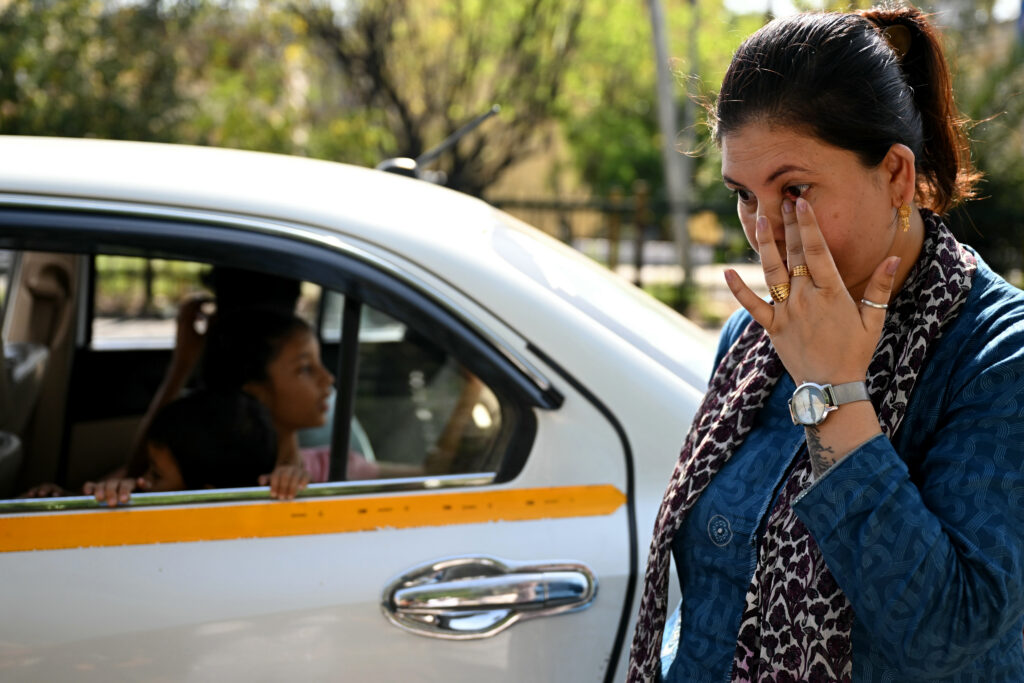
Shruti Sharma tearfully hugged her family goodbye and fled her home near the contested border in Kashmir with her three children on the first night of India and Pakistan’s worst conflict in decades.She returned home on Wednesday to a rapturous welcome from her mother-in-law and husband after fearing they would be killed by Pakistani strikes and that her house would be destroyed.”I never thought I would return to a home that was still intact,” the 37-year-old school teacher from Poonch said.The house is a patchwork of brightly painted rooms, built gradually as the family expanded. A second floor is underway but far from complete.Tens of thousands of people living near India’s contested frontier with Pakistan were forced to flee as both countries launched deadly attacks and counter-attacks over four days, starting May 7. But many are returning after the nuclear-armed neighbours agreed to a ceasefire on Saturday.Poonch, a frontier town in Indian-administered Kashmir that was one of the worst-hit in the attacks.Sharma’s home, in a narrow lane hemmed by tightly packed houses, survived the deadly strikes, but several of her neighbours were not so lucky.Her mother-in-law, Champa Devi, who refused to leave, said it was a “miracle” their house was intact and that she and her son survived. “I had resigned to the possibility of not seeing my grandchildren ever again,” she said, as her youngest grandson, two-year-old Daksh, zoomed past in a toy car.- ‘Night of terror’ -“It was a night of terror,” Sharma said, recalling the first night of fighting before she fled in a taxi to her sister’s house, nearly 300 kilometres (190 miles) away.She said her decision to leave was “for the sake of my children”. Sharma’s mother, who lives alone a few blocks away, joined them.The 12-hour journey down the mountains saw them being bombarded with phone calls and text messages bringing a spate of bad news. “I got a call from a relative saying that an explosion in a petrol station had killed my nephew,” she recalled. “Our cab had stopped there for refuelling barely 10 minutes earlier.”At least 15 Indian civilians died in the fighting — the deadliest between the two South Asian rivals since 1999.It followed an April 22 attack on tourists in Indian-controlled Kashmir that killed 26 civilians.India accused Pakistan of backing the “terrorists” it said were responsible for the Pahalgam attack — a charge Islamabad denied — and last week launched missiles at sites in Pakistan it said were hosting the militants.- ‘The trauma followed us’ -Sharma said she was constantly fretting about her husband and in-laws’ safety during the week she was away.”We may have been physically far, but the trauma followed us,” she said. “I would often wake up in the middle of the night with a feeling of dread.”An AFP team joined them for their return journey, a far more relaxed and happy affair.After an early start, the family stopped for breakfast at a small eatery on the highway, where they chatted with other families returning home.  The conversations were grim, with many of the exchanges discussing dead relatives or friends.”They have changed Poonch forever,” said Sharma’s mother Purnima. “You will never know what we have gone through.”A packed lunch, chicken curry and rice, was eaten on paper plates in the car.  As the sun dipped, the scenery changed from semi-urban plains to more rural and picturesque, pine-dotted valleys, signalling that home was near. “It feels good to be back but there is this lingering apprehension that something will go wrong again,” said Sharma. In some areas along the contested frontier that fear pervades, with reports of fresh drone sightings and renewed shelling, forcing some families to flee again.That fear pervades in some parts of the contested frontier where there have been reports of fresh drone sightings and renewed shelling, forcing some people to flee again. The sun was setting when the taxi finally reached Sharma’s neighbourhood. Her husband Sanjeev stood outside the narrow lane leading to their home to greet them. His son Daksh immediately jumped into his father’s arms.Sharma lugged her suitcase up the alleys, arriving home just in time for evening tea — their first together in over a week.”I feel alive again,” her mother-in-law Champa Devi said. “What is a home anyway without the kids?”

Pakistan returns Indian border guard captured after Kashmir attack

Pakistan returned a captured border guard to India on Wednesday, in a fresh sign of detente after a ceasefire ended four days of conflict between the nuclear-armed South Asian rivals.The guard was captured a day after an April attack in Indian-administered Kashmir that killed 26 people and sparked tit-for-tat missile, drone and fighter jet attacks.No group claimed responsibility for the April 22 attack but India blamed Pakistan for backing it. Islamabad rejects the accusations and has called for an independent probe.”Purnam Kumar Shaw, who had been in the custody of Pakistan Rangers since 23 April 2025, was handed over to India,” India’s Border Security Force said in a statement.The handover was “conducted peacefully and in accordance with established protocols,” it added.”I am very happy today,” Shaw’s wife Rajani, who is pregnant, told reporters following the announcement. She had earlier told the Indian Express newspaper that before the ceasefire she had “lost all hope”.- Ceasefire holding -Pakistan’s army announced on Wednesday a new death toll from the fighting, saying India’s “unprovoked and reprehensible dastardly attacks” killed 40 civilians, half of them women and children.It also said 13 military service members had been killed during operations.India has said that 15 civilians and five soldiers died on its side.Addressing troops on Wednesday, Pakistan Prime Minister Shehbaz Sharif said Islamabad had taken revenge for its last war with India, which led to the creation of Bangladesh from Pakistan’s then eastern wing.”In this war, you have taken revenge for the 1971 war with India,” he told his troops.Despite mutual claims of initial violations, the ceasefire still appeared to be holding on Wednesday.The flare-up in violence was the worst since the rivals’ last open conflict in 1999 and sparked global shudders that it could spiral into a full-blown war.The Pakistani military has said it downed five Indian jets without any losses of its own.India has not disclosed losing any aircraft, although a security source told AFP at least three fighter jets had crashed on Indian territory.Indian Prime Minister Narendra Modi said in a televised address to the nation Monday that Pakistan had chosen to attack rather than help it fight “terrorism”.”If another terrorist attack against India is carried out, a strong response will be given,” he said.Modi wrote on X Tuesday that he had met with service members involved in the conflict.”India is eternally grateful to our armed forces for everything they do for our nation,” he said.Sharif held a call with UN chief Antonio Guterres on Wednesday in which “he expressed concerns over the continued provocative and inflammatory remarks by Indian leadership, as a threat to the fragile regional peace”, his office said in a statement. Pakistan’s foreign ministry said that it rejected Modi’s “provocative and inflammatory assertions” and his “propensity to fabricate misleading narratives to justify aggression”.”Make no mistake, we will closely monitor India’s actions and behaviour in this regard in the coming days. We also urge the international community to do the same,” it added in a statement.Sharif also warned India about suspending a key water supply treaty, calling it his country’s “red line”.”Don’t even think of touching the water treaty,” Sharif said after India suspended it in the wake of the attack in Indian-administered Kashmir that sparked the latest conflict.- ‘Terror activities’ -Militants have stepped up operations on the Indian side of Kashmir since 2019, when Modi’s Hindu nationalist government revoked the region’s limited autonomy and imposed direct rule from New Delhi.A gun battle at a forest around 65 kilometres (40 miles) from Pahalgam, the site of the April 22 attack on tourists, killed three men alleged to be members of Lashkar-e-Taiba, a Pakistan-based armed group, the Indian army said Wednesday.”The three were actively involved in recent terror activities in the region,” it said in a post on X.”Recoveries from the operation include AK series rifles, large quantity of ammunition, grenades and other” military materials, it said.Muslim-majority Kashmir is claimed in full by both countries, which have fought two full-scale wars over the territory since their 1947 independence from British rule.