AFP Asia Business

Israeli cabinet to vote on ceasefire, as US ‘confident’ deal will go ahead

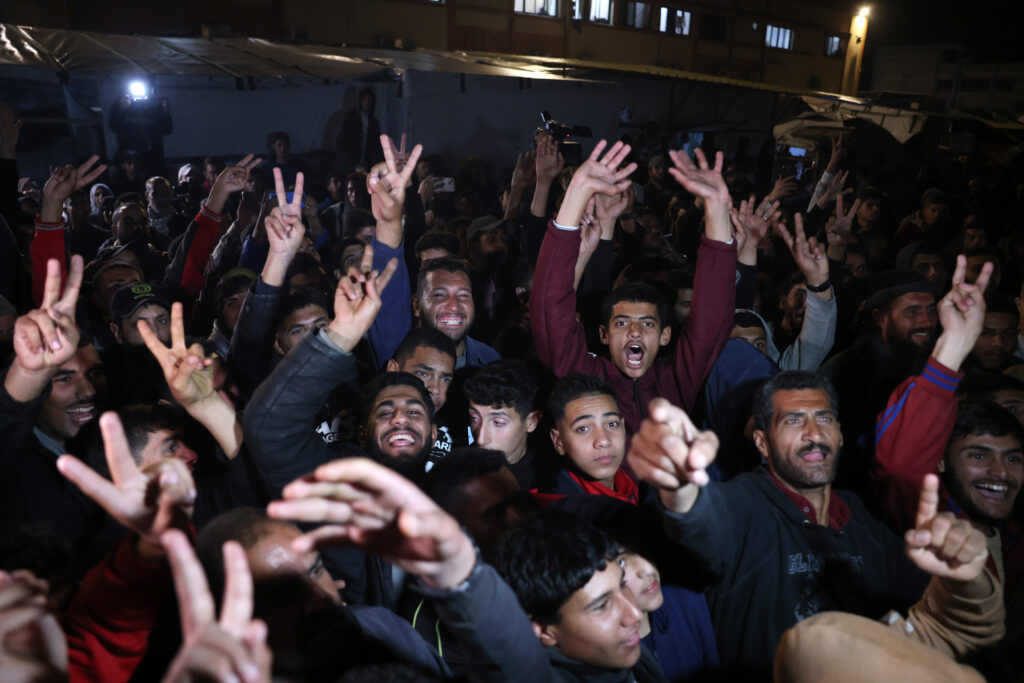
Israel’s cabinet was set to vote Friday on a Gaza ceasefire and hostage release deal, an official said, with mediator the United States “confident” the accord would take effect as planned.As ministers weighed whether to approve the fragile agreement, new Israeli strikes killed dozens of people, Gaza rescuers said Thursday, and Israel’s military reported hitting about 50 targets across the territory over the past day.At least two cabinet members have voiced opposition to the ceasefire, with far-right National Security Minister Itamar Ben Gvir saying Thursday that he and his party colleagues would quit the government — but not the ruling coalition — if it approved the “irresponsible” deal.The truce, announced by mediators Qatar and the United States on Wednesday, would begin on Sunday and involve the exchange of Israeli hostages for Palestinian prisoners, after which the terms of a permanent end to the war would be finalised.Prime Minister Benjamin Netanyahu’s office accused Hamas on Thursday of reneging “on parts of the agreement… to extort last-minute concessions”, and vowed to postpone the cabinet vote until the issues were addressed.But an Israeli official later told AFP the cabinet would meet Friday to decide on the deal.Hamas political bureau member Sami Abu Zuhri said there was “no basis” for Israel’s accusations.US Secretary of State Antony Blinken, who has been involved in months of mediation efforts, said he believed the ceasefire would go ahead on schedule.”I am confident, and I fully expect that implementation will begin, as we said, on Sunday,” he said.The foreign ministry of fellow mediator Egypt said in a statement the ceasefire must “start without delay”.Gaza’s civil defence agency said Israel pounded several areas of the territory after the deal was announced, killing at least 80 people and wounding hundreds.Hamas’s armed wing, the Ezzedine al-Qassam Brigades, warned that Israeli strikes were risking the lives of hostages due to be freed under the deal, and could turn their “freedom… into a tragedy”.The war was triggered by the October 7, 2023 Hamas attack on Israel, which resulted in the deaths of 1,210 people, mostly civilians, according to an AFP tally of official Israeli figures.During the attack, the deadliest in Israeli history, Palestinian militants also took 251 people hostage, 94 of whom are still being held in Gaza, including 34 the Israeli military says are dead.Israel’s ensuing campaign has destroyed much of Gaza, killing 46,788 people, most of them civilians, according to figures from the Hamas-run territory’s health ministry that the UN considers reliable.- Mixed feelings -The ceasefire agreement followed intensified efforts from mediators Qatar, Egypt and the United States, after months of fruitless negotiations to end the deadliest war in Gaza’s history.If finalised, it would pause hostilities one day before the inauguration of US President-elect Donald Trump.Envoys from both the Trump team and the outgoing administration of President Joe Biden were present at the latest negotiations, with a senior Biden official saying the unlikely pairing had been a decisive factor in reaching the deal.In Israel and Gaza, there were celebrations welcoming the truce deal, but also anguish.Saeed Alloush, who lives in north Gaza, said he and his loved ones were “waiting for the truce and were happy”, until overnight strikes killed many of his relatives.”It was the happiest night since October 7″ until “we received the news of the martyrdom of 40 people from the Alloush family”, he said.In Tel Aviv, pensioner Simon Patya said he felt “great joy” that some hostages would return alive, but also “great sorrow for those who are returning in bags, and that will be a very strong blow, morally”.In addition to Ben Gvir, far-right Finance Minister Bezalel Smotrich has also opposed the truce, calling it a “dangerous deal”.Qatari Prime Minister Sheikh Mohammed bin Abdulrahman bin Jassim Al-Thani, announcing the agreement on Wednesday, said an initial 42-day ceasefire would see 33 hostages released, including women, “children, elderly people, as well as civilian ill people and wounded”.Also in the first phase, Israeli forces would withdraw from Gaza’s densely populated areas and allow displaced Palestinians to return “to their residences”, he said.- Aid needed -Announcing the deal from the White House, Biden said the second phase of the agreement could bring a “permanent end to the war”.He added the deal would “surge much needed humanitarian assistance to Palestinian civilians, and reunite the hostages with their families”.Egyptian President Abdel Fattah al-Sisi also underscored the “importance of accelerating the entry of urgent humanitarian aid” into Gaza.Cairo said it was ready to host an international conference on reconstruction in Gaza, where the United Nations has said it would take more than a decade to rebuild civilian infrastructure.The World Health Organization’s representative in the Palestinian territories, Rik Peeperkorn, said Thursday that at least $10 billion would probably be needed over the next five to seven years to rebuild Gaza’s devastated health system alone.The UN Palestinian refugee agency UNRWA, facing an Israeli ban on its activities set to start later this month, welcomed the ceasefire deal.”What’s needed is rapid, unhindered and uninterrupted humanitarian access and supplies to respond to the tremendous suffering caused by this war,” UNRWA head Philippe Lazzarini wrote on X.burs-ser/ami/smw/srm


Fate of two child hostages grips Israel after Gaza deal

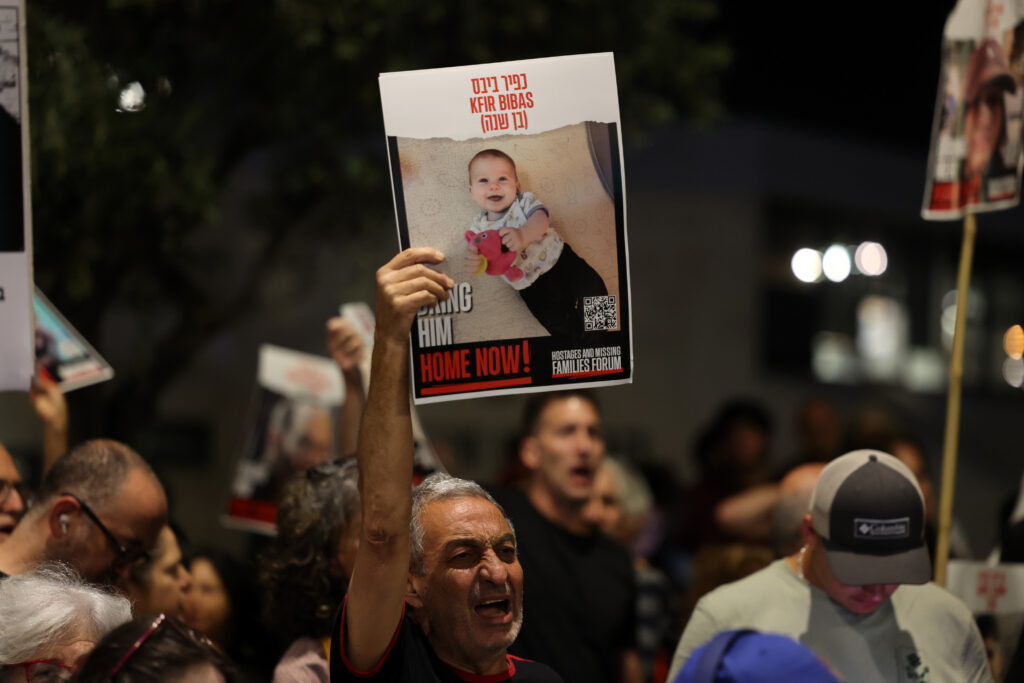
The fates of a baby and his four-year-old brother, taken hostage by Hamas on October 7, 2023, have been on everyone’s mind in Israel since the announcement of a Gaza ceasefire.Kfir Bibas, whose second birthday falls on Saturday, is the youngest of the 251 people seized by militants during Hamas’s unprecedented attack on southern Israel more than 15 months ago.Hamas said in November 2023 that Kfir, his brother Ariel and their mother Shiri were killed in an Israeli strike, but with the Israeli military yet to confirm their deaths, many are clinging to the hope they are still alive.”To imagine them coming back alive brings me immense joy,” Hila Shlomo, a musician, told AFP at “Hostages Square”, a central plaza in Israel’s main commercial city Tel Aviv that has become the focus of protests and campaigns on the captives’ behalf.”What happened to these children is a symbol, a symbol of man-made evil, but also of the victory of life if we manage to free them, whatever the cost,” said the 23-year-old, visibly moved.The boys and their mother are on the list of 33 hostages to be released during the first stage of the ceasefire deal, as is the boys’ father, Yarden Bibas, though that does not guarantee they are among the living.Hostages released during an earlier, short-lived truce said Yarden Bibas was kept separately from his family, and Hamas has not said he is dead. For several days now, countless messages of support accompanied by photos of Kfir Bibas have been circulating on social media, a sign that many are still holding out hope.Footage published by Hamas of Shiri Bibas tightly holding her two red-headed boys, taken from their house in kibbutz Nir Oz, became one of the lasting images of the tragedy that struck Israel that day.- ‘Heart-wrenching’ -Further along the square, two retirees, Osnat Nyska and Yafa Wolfensohn, also became emotional at the mention of the Bibas boys.The two friends were attending a weekly gathering calling for the liberation of the hostages.”I think of them, these two little redheads, and I get shivers,” said 70-year-old Nyska, whose grandchildren attended nursery school with the Bibas brothers.”They really are a symbol… the two youngest children kidnapped, and if they’re not alive anymore it will be heart-wrenching,” added Wolfensohn.At a football game in the southern Israeli city of Beersheba on Wednesday evening, players from Hapoel Beersheba held orange balls, a colour that has come to be associated with the redheaded Bibas children.During Saturday night’s regular protest, Eli Bibas, grandfather to Kfir and Ariel, was among the speakers addressing the crowd.”Next Saturday, our Kfir will live his second birthday in captivity. How is it possible that my grandson, who was kidnapped when he was eight-and-a-half months old, is going through his second birthday in hell?” he asked.”How is it that he still hasn’t celebrated a birthday with his father, his family, in his home in his country?”Relatives of the Bibas family declined to speak about the ceasefire deal when contacted by AFP, but did issue a statement Wednesday saying they were “aware of information suggesting that our family will be part of the first phase of the deal, and that Shiri and the children will be freed”.But, they added, we “won’t take anything for granted as long as our loved ones haven’t crossed the border”.Thirty-three Israeli hostages — among them women and children — will be released in the initial 42-day phase of the agreement, which could become a permanent ceasefire, according to Qatari Prime Minister Sheikh Mohammed bin Abdulrahman Al-Thani, whose country acted as a mediator during the months-long negotiations.”All the hostages are in our hearts,” said Nelly Ben Israel, a librarian at Jerusalem’s Hebrew University. “But I think I’m not mistaken when I say we think first and foremost about the young Bibases.”

US ‘confident’ Gaza truce will go ahead as Israel launches new strikes

The United States said Thursday it was “confident” that a fragile Gaza ceasefire and hostage release deal would take effect on time, even as Israel carried out new air strikes ahead of a cabinet vote on the accord.The truce, announced by mediators Qatar and the United States on Wednesday, would begin on Sunday and involve the exchange of Israeli hostages for Palestinian prisoners, after which the terms of a permanent end to the war would be finalised.However, the office of Prime Minister Benjamin Netanyahu said Thursday that Hamas had “reneged on parts of the agreement… in an effort to extort last-minute concessions”.It also said Israel’s cabinet, which has yet to approve the agreement, “will not convene until the mediators notify Israel that Hamas has accepted all elements of the agreement”.An Israeli official later told AFP the cabinet was scheduled to meet Friday to decide on the deal.Hamas political bureau member Sami Abu Zuhri, meanwhile, said there was “no basis” for Israel’s accusations.US Secretary of State Antony Blinken, who has been involved in months of mediation efforts, said he believed the ceasefire would go ahead on schedule.”I am confident, and I fully expect that implementation will begin, as we said, on Sunday,” he said.The foreign ministry of fellow mediator Egypt said in a statement the ceasefire must “start without delay”.Gaza’s civil defence agency said Israel pounded several areas of the territory after the deal was announced, killing at least 80 people and wounding hundreds.The Israeli military said it had hit about 50 targets across Gaza since late Wednesday, targeting Palestinian militants.Hamas’s armed wing, the Ezzedine al-Qassam Brigades, warned that Israeli strikes were risking the lives of hostages due to be freed under the deal, and could turn their “freedom… into a tragedy”.The war was triggered by the October 7, 2023 Hamas attack on Israel, which resulted in the deaths of 1,210 people, mostly civilians, according to an AFP tally of official Israeli figures.During the attack, the deadliest in Israeli history, Palestinian militants also took 251 people hostage, 94 of whom are still being held in Gaza, including 34 the Israeli military says are dead.Israel’s ensuing campaign has destroyed much of Gaza, killing 46,788 people, most of them civilians, according to figures from the Hamas-run territory’s health ministry that the UN considers reliable.- Mixed feelings -The ceasefire agreement followed intensified efforts from mediators Qatar, Egypt and the United States, after months of fruitless negotiations to end the deadliest war in Gaza’s history.If finalised, it would pause hostilities one day before the inauguration of US President-elect Donald Trump.Envoys from both the Trump team and the outgoing administration of President Joe Biden were present at the latest negotiations, with a senior Biden official saying the unlikely pairing had been a decisive factor in reaching the deal.In Israel and Gaza, there were celebrations welcoming the truce deal, but also anguish.Saeed Alloush, who lives in north Gaza, said he and his loved ones were “waiting for the truce and were happy”, until overnight strikes killed many of his relatives.”It was the happiest night since October 7″ until “we received the news of the martyrdom of 40 people from the Alloush family”, he said.In Tel Aviv, pensioner Simon Patya said he felt “great joy” that some hostages would return alive, but also “great sorrow for those who are returning in bags, and that will be a very strong blow, morally”.Two far-right party leaders in Netanyahu’s cabinet have publicly opposed the agreement.Finance Minister Bezalel Smotrich said it was a “dangerous deal”, while National Security Minister Itamar Ben Gvir called it “disastrous”.Israeli media said the government’s ratification of the agreement may be delayed, in part, by disagreements within the ruling coalition.Qatari Prime Minister Sheikh Mohammed bin Abdulrahman bin Jassim Al-Thani, announcing the agreement on Wednesday, said an initial 42-day ceasefire would see 33 hostages released, including women, “children, elderly people, as well as civilian ill people and wounded”.Also in the first phase, Israeli forces would withdraw from Gaza’s densely populated areas and allow displaced Palestinians to return “to their residences”, he said.- Aid needed -Announcing the deal from the White House, Biden said he was “deeply satisfied this day has come”.He added that the second phase of the agreement could bring a “permanent end to the war”.Biden said the deal would “surge much needed humanitarian assistance to Palestinian civilians, and reunite the hostages with their families”.Egyptian President Abdel Fattah al-Sisi also underscored the “importance of accelerating the entry of urgent humanitarian aid” into Gaza.Cairo said it was ready to host an international conference on reconstruction of the Gaza Strip, where the United Nations has said it would take more than a decade to rebuild civilian infrastructure.The World Health Organization’s representative in the Palestinian territories, Rik Peeperkorn, said Thursday that at least $10 billion would probably be needed over the next five to seven years to rebuild Gaza’s devastated health system alone.The UN Palestinian refugee agency UNRWA, facing an Israeli ban on its activities set to start later this month, welcomed the ceasefire deal.”What’s needed is rapid, unhindered and uninterrupted humanitarian access and supplies to respond to the tremendous suffering caused by this war,” UNRWA head Philippe Lazzarini wrote on X.burs-ser/ami/smw/srm

‘Heinous crimes’ in Gaza conflict must be punished, regardless of truce: HRW

Human Rights Watch on Thursday called for punishment for the “heinous crimes” committed “on and since October 7, 2023,” in Israel and Gaza, after the announcement of a fragile ceasefire deal in the conflict.”While yesterday Israeli officials and Hamas agreed to a multi-phase ceasefire, the heinous crimes committed on and since October 7, 2023, should not go unpunished,” said HRW chief Tirana Hassan.Hassan was speaking at a press conference to launch the organization’s annual report, in which it called out Israel for committing “crimes against humanity” and possibly “genocide” during the Gaza war.Qatar and the United States on Wednesday announced the ceasefire deal had been reached between Israel and Hamas in their bloody 15-month conflict.But Israeli air strikes have continued as it accuses the Palestinian armed group of reneging on parts of the agreement.”Whilst the ceasefire will bring some relief for the millions of displaced inside Gaza, it won’t be a solution in and of itself,” said Hassan.At least 1.9 million people — or 90 percent of Gaza’s population — have been displaced by Israel’s offensive in the territory, according to UN estimates.An estimated 345,000 people in Gaza face “catastrophic levels” of food insecurity, the UN says.”What will be required moving forward is humanitarian access, and that by that, we’re talking about the Israeli authorities, allowing materials in to rebuild the infrastructure, including the water infrastructure and the health system, which has been decimated during this conflict, as well as humanitarian relief,” Hassan said. Much of Gaza has been levelled by Israel’s punishing assault on the Palestinian territory, which has killed 46,788 people, most of them civilians, according to figures from the Hamas-run territory’s health ministry that the UN considers reliable.The war was triggered by the October 7, 2023, Hamas attack on Israel, which resulted in the deaths of 1,210 people, mostly civilians, according to an AFP tally of official Israeli figures.During the attack, Palestinian militants also took 251 people hostage, 94 of whom are still being held in Gaza, including 34 the Israeli military says are dead.Israel’s cabinet has yet to approve the ceasefire agreement, which was due to be implemented from Sunday.

Gaza’s destruction in numbers

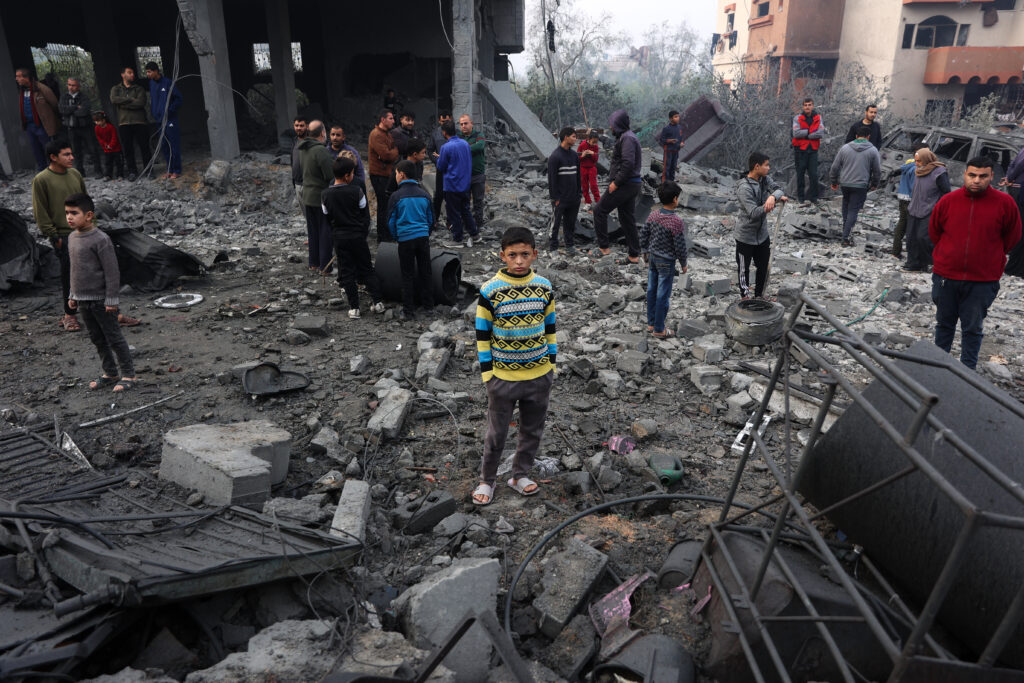
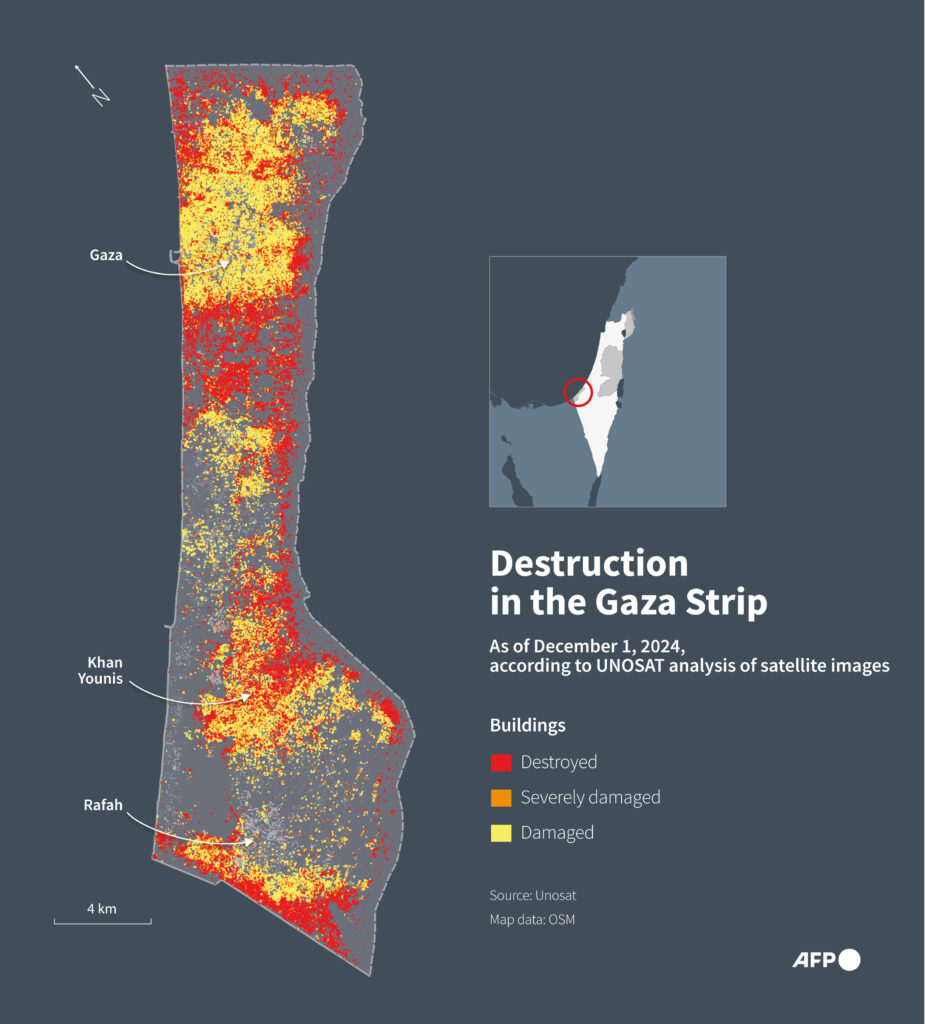
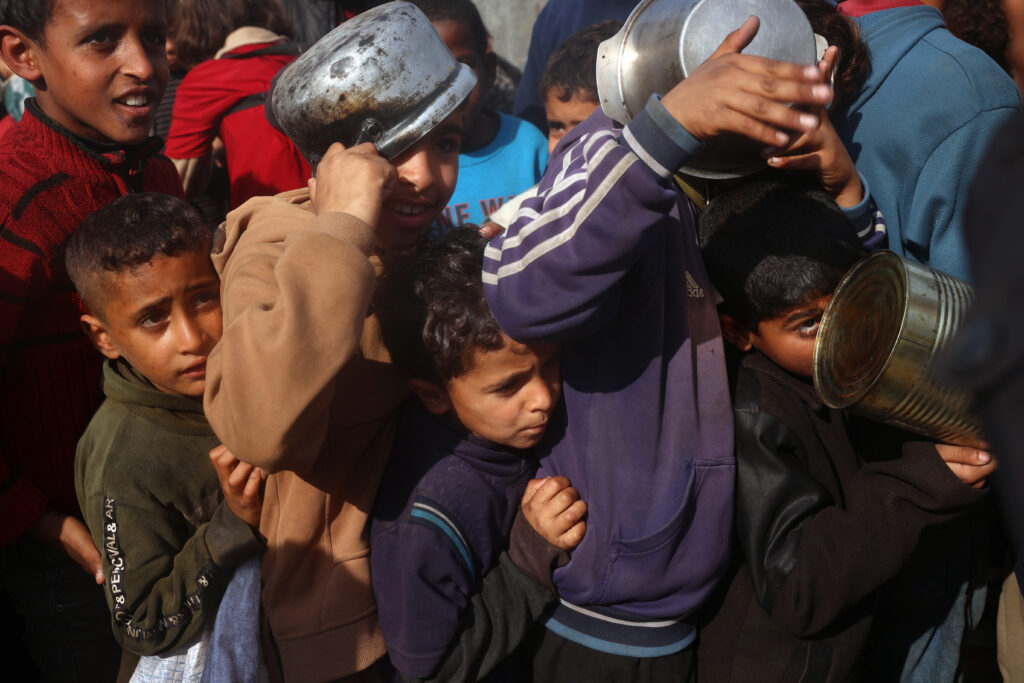
The war in the Gaza Strip between Israel and Hamas, which on Wednesday agreed a ceasefire, has killed tens of thousands of people and created a humanitarian disaster.The fragile ceasefire deal is due to start on Sunday, but still has to be approved by Israel’s cabinet.The sheer scale of bombardment and violence of the fighting have disfigured the densely populated Palestinian territory’s urban landscape.AFP looks at the material impact of the war.- 170,000 buildings damaged or destroyed -Gaza is one of the most densely populated places on the planet. Before the war 2.4 million people lived on a 365-square-kilometre (140-square-mile) strip of land.By December 1, 2024, nearly 69 percent of the buildings in Gaza had been destroyed or damaged, according to satellite imagery analysed by the UN’s Satellite Centre (UNOSAT). That amounts to 170,812 buildings.US researchers Corey Scher and Jamon Van Den Hoek, who use satellite imagery with different methodology, counted 172,015 damaged or destroyed buildings in Gaza on January 11, 2025.Hamas’s unprecedented October 7, 2023, attack on Israel resulted in the death of more than 1,200 people on the Israeli side, most of them civilians, according to an AFP tally of Israeli official figures.That figure includes hostages killed while in captivity in the Gaza Strip.Since October 7, 2023, at least 46,788 Palestinians, most of them civilians, have been killed in Israel’s military campaign in Gaza, according to data provided by the health ministry in the Hamas-run territory.Those figures are acknowledged as reliable by the UN.- Rafah city half destroyed -Before the war, Gaza City in the territory’s north was home to some 600,000 people. Almost three-quarters of its buildings (74.2 percent) have been damaged or destroyed. In Rafah, Gaza’s southernmost city along the border with Egypt, the Israeli army launched a ground offensive in early May.By the end of that month, nearly 48.7 percent of the buildings in Rafah had been hit, against 33.9 percent the previous month.Although relatively spared compared with Gaza City, gutted facades and buildings stand testament to the scars of war.Rights group Amnesty International said that more than 90 percent of the buildings along 58 square kilometres of Gaza’s border territory with Israel appear to have been “destroyed or severely damaged” between October 2023 and May 2024.The United Nations has estimated that reconstruction in the territory would take up to 15 years and cost as much as $50 billion.- Half of hospitals not functioning -During the war, Gaza’s hospitals have been repeatedly attacked by Israel, which accused Hamas of using them for military purposes, a charge the militant group denies.Kamal Adwan hospital, one of the few medical facilities still operational in northern Gaza, is now empty and out of service since a major Israeli strike in late December, according to the World Health Organization.By December 31, just 18 of Gaza’s 36 hospitals, or half, were partially functioning, according to the WHO, with a total capacity of 1,800 beds.Data from UNOSAT and geographic database OpenStreetMap also indicates that more than 83 percent of Gaza’s mosques have been damaged or destroyed.- Nearly 90 percent of schools damaged -The territory’s largely UN-run schools, where many civilians have sought refuge from the fighting, have also paid a heavy price, with the Israeli military accusing Hamas of using them to conceal fighters.As of December 1, 2024, UNICEF counted 496 schools damaged — nearly 88 percent of its count of 564 facilities. There have been direct hits on 396 schools.- 68 percent of farmland -According to UN satellite imagery from August 26, 68 percent of Gaza’s farmland (103 square kilometres) has been damaged. That includes 79 percent of agricultural land in north Gaza and 57 percent of such land in Rafah.The destruction of irrigation systems, orchards, machinery and barns is even greater, with between 80 percent and 96 percent “decimated” since the beginning of 2024, according to a report from the UN Conference on Trade and Development (UNCTAD) in September.In addition, 68 percent of Gaza’s road network has been damaged.About 1,190 kilometres (740 miles) of roads have been destroyed, 415 kilometres badly damaged and 1,440 kilometres moderately damaged, according to a preliminary analysis by UNOSAT, taking into account data up to August 18.

Wall Street stocks rally loses steam

Strong bank earnings failed to sustain a rally on Wall Street, but stocks in Europe and Asia pushed higher.More US banks reported robust earnings Thursday, but US retail sales data disappointed. “There is a good bit of news to digest this morning, including another batch of better-than-expected earnings results from the likes of Bank of America, …

Wall Street stocks rally loses steam Read More »

Gaza war leaves Hamas battered but undefeated

Palestinian militant group Hamas has been significantly battered by 15 months of war in Gaza but has not suffered the eradication that Israeli Prime Minister Benjamin Netanyahu intended, experts say.After sparking the deadliest war in the Palestinian territory’s history, Hamas now faces questions over its legitimacy and whether to stick to its policy of armed resistance.”Hamas has been extraordinarily weakened, its military capacity and its leadership very damaged,” said Sanam Vakil, director of Chatham House’s Middle East programme.However, “those challenges are also opportunities for Hamas”, she told AFP.Hamas political leader Ismail Haniyeh was killed by Israel in a Tehran bombing last July, and Israeli soldiers killed his successor and Gaza chief Yahya Sinwar some weeks later.The group’s armed wing, the Ezzedine al-Qassam Brigades, has continued fighting in Gaza but has suffered heavy losses.”Hamas is under pressure,” said Hugh Lovatt, a researcher at the European Council on Foreign Relations.He pointed to the suffering of the population, as well as the decision by Hamas’s Lebanese ally Hezbollah to sign its own ceasefire deal with Israel in November despite the Gaza war continuing.However, a senior Hamas leader said the organisation “represents an idea aimed at liberating Palestine, not just a group of people that the enemy can eliminate”.”The resistance will continue for so long as the occupation exists”, he told AFP.- Support grown -Despite the devastation of both Hamas and the Gaza Strip since October 2023, the group has achieved some successes, experts said.With Netanyahu having declared the annihilation of the group to be a war aim, Hamas sees “its survival as a victory in itself”, said Jamal al-Fadi, a Palestinian political scientist.Lovatt said that support for Hamas had grown and that in the occupied West Bank “clearly, many people feel aligned with their ideas”.In the most recent study by the Palestinian Center for Policy and Survey Research, published in September, Hamas had the highest support of any party at 36 percent, although that represented a four-point fall from July.Yasser Abu Hein, another Palestinian political scientist, said that the October 7 attack had “elevated Hamas to global relevance” and gained the sympathy of people worldwide, “even Americans”.That said, experts pointed out that Hamas’s support among Palestinians exists in the unique context of Gaza and the West Bank, where there have been no elections for nearly two decades and political outlets are extremely limited.The majority of Palestinians do not support any political group, said Lovatt, be it Hamas, its main rival and dominant force in the Palestinian Authority Fatah, or any others.Joost Hilterman of the International Crisis Group said popular support for Hamas “as a group pursuing armed struggle against the military occupation” by Israel, stemmed from a lack of political alternatives.He said the war had also allowed Hamas to find new recruits, “as so many young Palestinians in Gaza have been orphaned”.That was a sentiment backed up by top US diplomat Antony Blinken, who said this week that during the war, “Hamas has recruited almost as many new militants as it has lost”.He called this “a recipe for enduring insurgency and perpetual war”.- ‘Hamas 2.0’ -While Hamas may have survived Israel’s military onslaught and gained some support in doing so, Vakil said it actually found itself in a crisis of legitimacy.Many “Palestinians see Hamas as part of the problem”, she said.The group “can only be seen to be legitimate if it manages to restore governance and accountability and to become… a representative voice for Palestinians”.Many experts have said that during the ceasefire negotiations, Hamas made compromises but was unwilling to bend on the return of displaced Gazans and an increase in humanitarian aid to the besieged territory.”Their desire to put an end to the war led them to show some flexibility but they remain steadfast in their principal objectives,” above all the fight against Israel, Lovatt said, adding that the group could regenerate its military capabilities.Vakil said it would “be important to assess how Palestinians themselves will assess the landscape for Hamas”, pointing out that Hamas shared responsibility for the destruction wrought by the war.The greatest unknowns remain how Hamas will choose to operate in any post-war period and how it will try to portray the October 7 attack and its consequences.While it could make compromises to remain relevant, Vakil said it was possible to “imagine a Hamas 2.0 emerging, more radicalised and perhaps motivated by the events since October 7”.