AFP Asia Business

Israel blocks aid to devastated Gaza as truce’s first phase ends

Israel on Sunday blocked aid flowing into Gaza, where a six-week truce enabled the entry of vital food, shelter and medical assistance, prompting the UN to call for an immediate restoration of humanitarian assistance.The Israeli decision came as talks on a truce extension appeared to hit an impasse, after the ceasefire’s 42-day first phase drew to a close.Truce mediators Egypt and Qatar accused Israel of blatantly violating the ceasefire deal by halting the aid, a move which according to AFP images left trucks loaded with goods lined up on the Egyptian side of the Rafah crossing to Gaza.Early on Sunday Israel had announced a truce extension until mid-April that it said United States Middle East envoy Steve Witkoff had proposed.But Hamas has repeatedly rejected an extension, instead favouring a transition to the truce deal’s second phase that could bring a permanent end to the war.With uncertainty looming over the truce, both Israel and Palestinian sources reported Israeli military strikes in the Hamas-run Gaza Strip, whose health ministry reported at least four people killed.Hamas, whose October 7, 2023 attack on Israel triggered the fighting, said the “decision to suspend humanitarian aid is cheap blackmail, a war crime and a blatant coup against the (ceasefire) agreement”.The Egyptian foreign ministry accused Israel of using starvation as “a weapon against the Palestinian people”, comments echoed by Qatar which said it “strongly condemns” Israel’s decision.Saudi Arabia, which has rejected any talk of normalising its ties with Israel without a Palestinian state, condemned the aid block as “a tool of blackmail and collective punishment”.Jordan said Israel’s action “threatens to reignite” fighting in Gaza.UN chief Antonio Guterres called for “humanitarian aid to flow back into Gaza immediately”.The European Union condemned what it called Hamas’s refusal to accept the extension of the first phase, and added that Israel’s subsequent aid block “risked humanitarian consequences”.Brussels called for “a rapid resumption of negotiations on the second phase of the ceasefire”.- Panic -Gazans expressed concern over prices they said immediately surged.”Prices are rising and people are panicking about food supplies,” Belal al-Helou, 56, said in Gaza City.More than 15 months of war in Gaza destroyed or damaged most buildings, displaced almost the entire population and triggered widespread hunger, according to the UN.Israeli Foreign Minister Gideon Saar, asked by reporters about the risk of starvation, dismissed such warnings as “a lie”.Israeli Prime Minister Benjamin Netanyahu’s office said he had “decided that, from this morning, all entry of goods and supplies into the Gaza Strip will be suspended”.It said there would be “consequences” for Hamas if it did not accept the temporary truce extension.But on a sandy street in Gaza City, Mays Abu Amer, 21, expressed hope the ceasefire can continue “forever”.According to Israel, the truce extension would see half of the hostages still in Gaza freed on the day the deal came into effect, with the rest to be released at the end if an agreement was reached on a permanent ceasefire.Of the 251 captives taken during Hamas’s October 2023 attack, 58 remain in Gaza including 34 the Israeli military has confirmed are dead.- ‘Return all of them’ -In Israel, mourners who turned out to farewell Shlomo Mansour, 85, whose body militants had held in Gaza and returned to Israel on Thursday, said more should be done to get the remaining captives home.”Return all of them immediately,” said Vardit Roiter.Later in Jerusalem, AFP images showed protesters outside Netanyahu’s residence making a similar plea. “Still Alive. Still waiting,” said one sign with pictures of hostage brothers Ariel and David Cunio.Under the first phase of the truce, Gaza militants handed over 25 living hostages and eight bodies, including Mansour’s, in exchange for about 1,800 Palestinian prisoners held in Israel.Israelis in Jerusalem welcomed the decision to block aid, describing it as a way to pressure Hamas.Neria, a 27-year-old teacher who only gave his first name, aid the “smart move” could “push forward new things, the release of more hostages and the end of the war”.In southern Gaza on Sunday, the civil defence agency reported shelling and gunfire “from Israeli tanks”, which the army said it was “unaware of”.The Palestine Red Crescent said Israeli drone strikes killed one person in the same area and another in a nearby town.The military said it conducted an air strike in northern Gaza targeting suspects it said had “planted an explosive device” near its troops.Including the deaths on Sunday, Gaza’s health ministry has recorded 116 people killed by Israel’s military since the ceasefire began on January 19, substantially reducing violence.The 2023 attack that sparked the war resulted in the deaths of more than 1,200 people in Israel, mostly civilians, while Israel’s retaliation in Gaza has killed more than 48,300 people, also mostly civilians, data from both sides show.
UN urges Israel to restore Gaza aid as Hamas sees ‘coup’ against truce

The United Nations on Sunday called on Israel to immediately allow aid into Gaza, hours after it suspended humanitarian deliveries into the war-battered territory as talks on a truce extension appeared to hit an impasse.With uncertainty looming over the truce, both Israel and Palestinian sources reported Israeli military strikes in the Gaza Strip which the health ministry in the Hamas-run territory said killed at least four people.The 42-day first phase of the ceasefire drew to a close, and early on Sunday Israel announced a truce extension until mid-April that it said US Middle East envoy Steve Witkoff had proposed.Hamas has repeatedly rejected an extension, instead favouring a transition to the truce deal’s second phase that could bring a permanent end to the war.The Palestinian group, whose October 7, 2023 attack on Israel triggered the fighting, said the “decision to suspend humanitarian aid is cheap blackmail, a war crime and a blatant coup against the (ceasefire) agreement”.In a statement posted online, UN chief Antonio Guterres called for “humanitarian aid to flow back into Gaza immediately”, urging “all parties to make every effort to prevent a return to hostilities” and militants to release “all hostages”.The head of the United Nations humanitarian agency OCHA, Thomas Fletcher, said in a post on X that “Israel’s decision to halt aid into Gaza is alarming” and may be in violation of international law.Following the announcement of the aid suspension, AFP images showed trucks loaded with goods lined up on the Egyptian side of the Rafah crossing.”Since the morning we haven’t seen any trucks entering,” said Umm Mohammad Abu Laia, a resident of Rafah on Gaza’s southern border.She warned of a “crisis” as the prices of basic commodities surged “as soon as the merchants heard about the closing of the crossing”.The first phase of the truce, which took effect on January 19, saw an increase of aid into Gaza, where the war destroyed or damaged most buildings, displaced almost the entire population and triggered widespread hunger, according to the UN.Israeli Foreign Minister Gideon Saar, asked by reporters about the risk of starvation, dismissed such warnings as “a lie”.- A ‘forever’ truce -Israeli Prime Minister Benjamin Netanyahu’s office said he had “decided that, from this morning, all entry of goods and supplies into the Gaza Strip will be suspended”.It said there would be “consequences” for Hamas if it did not accept the temporary truce extension, which would cover the Muslim holy month of Ramadan and the Jewish holiday of Passover.On a sandy street in Gaza City, Mays Abu Amer, 21, expressed hope the ceasefire can continue “forever”.”We have so much destruction, we need a lot of time for reconstruction,” she said.Mediator Egypt and the International Committee of the Red Cross have appealed for the truce to be maintained.Militant group Islamic Jihad, a Hamas ally, accused Israel of “sabotaging” the ceasefire.According to Israel, the truce extension would see half of the hostages still in Gaza freed on the day the deal came into effect, with the rest to be released at the end if an agreement was reached on a permanent ceasefire.Of the 251 captives taken during Hamas’s October 2023 attack, 58 remain in Gaza including 34 the Israeli military has confirmed are dead.- ‘Return all of them’ -In Israel, mourners who turned out to farewell Shlomo Mansour, 85, whose body militants had held in Gaza and returned to Israel on Thursday, said more should be done to get the remaining captives home.”Return all of them immediately,” said Vardit Roiter.Under the first phase of the truce, Gaza militants handed over 25 living hostages and eight bodies, including Mansour’s, in exchange for the release of about 1,800 Palestinian prisoners.Israelis in Jerusalem welcomed the decision to block aid, describing it as a way to pressure Hamas into making concessions.Neria, a 27-year-old teacher who only gave his first name, told AFP it was a “smart move” that could “push forward new things, the release of more hostages and the end of the war”.In southern Gaza on Sunday, the civil defence agency reported shelling and gunfire “from Israeli tanks”, which the army said it was “unaware of”.The Palestine Red Crescent said Israeli drone strikes killed one person in the same area and another in a nearby town.The military said it had conducted an air strike in northern Gaza targeting suspects it said had “planted an explosive device” near its troops.Including the deaths on Sunday, Gaza’s health ministry has recorded 116 people killed by Israel’s military since the ceasefire took effect on January 19, substantially reducing violence.The 2023 attack that sparked the war resulted in the deaths of more than 1,200 people in Israel, mostly civilians, while Israel’s retaliation in Gaza has killed more than 48,300 people, also mostly civilians, data from both sides show.

Iran lawmakers sack minister over economic woes

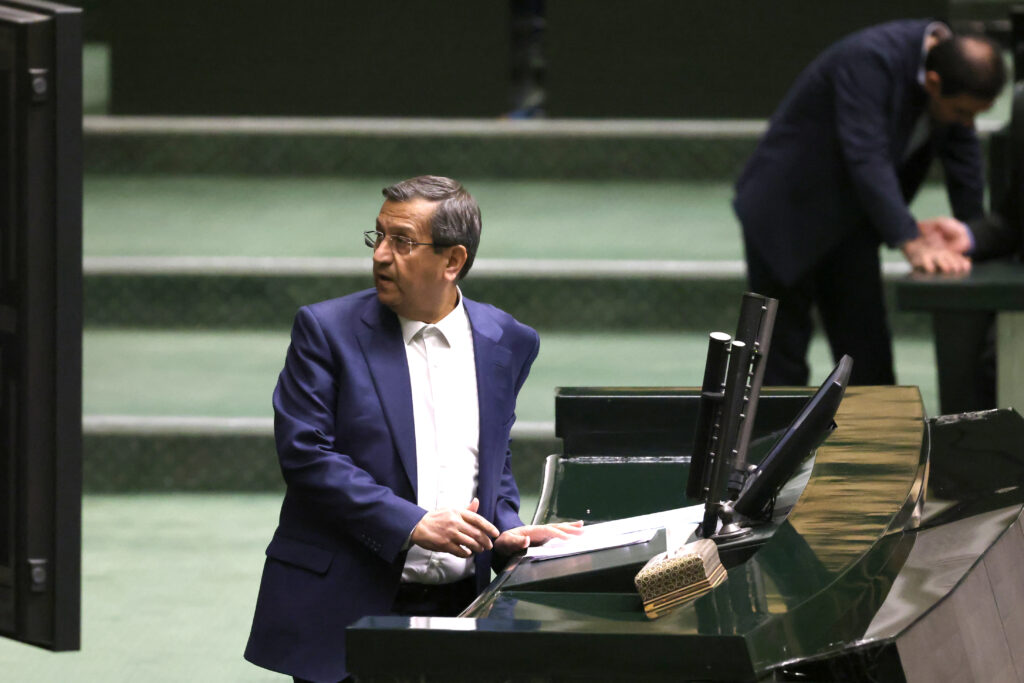
Iran’s parliament sacked the country’s finance minister on Sunday after impeaching him over soaring inflation and a plunging currency, state television reported.Economy and finance minister Abdolnaser Hemmati lost a vote of confidence, with 182 of 273 parliamentarians present backing his removal.On the black market on Sunday, the Iranian rial was trading at more than 920,000 to the US dollar, compared with less than 600,000 in mid-2024.Earlier, President Masoud Pezeshkian defended Hemmati, a former central bank governor, telling lawmakers: “We are in a full-scale (economic) war with the enemy… we must take a war formation”.”The economic problems of today’s society are not related to one person and we cannot blame it all on one person.”Lawmakers took turns angrily censuring Hemmati, blaming him for Iran’s economic woes.”People cannot tolerate the new wave of inflation; the rise in the price of foreign currency and other goods must be controlled,” said one parliamentarian, Ruhollah Motefakker-Azad.”People cannot afford to buy medicine and medical equipment,” said another, Fatemeh Mohammadbeigi.Pezeshkian took office in July with the ambition of reviving the economy and ending some Western-imposed sanctions.But the depreciation of the rial has only intensified, especially since the fall in December of Iran ally Bashar al-Assad of Syria.The day before his government was toppled in Damascus, the US dollar was trading for around 717,000 rials on Iran’s black market.”The rate of the foreign exchange is not real; the price is due to inflationary expectations,” Hemmati said in his defence.- ‘Chronic inflation’ -“The most important problem of the country’s economy is inflation, and that is chronic inflation, which has plagued our economy for years,” the minister added before he was ousted.Hemmati was replaced in the interim by Rahmatollah Akrami, a deputy economy minister, Iran’s ISNA news agency reported.Decades of US-led sanctions have battered Iran’s economy, with double-digit inflation causing an increase in consumer prices since Washington pulled out of a landmark 2015 nuclear deal in 2018.The deal, formally called the Joint Comprehensive Plan of Action, provided for an easing of sanctions and the return of Western investment to Iran in return for increased limits on the country’s nuclear activities.US President Donald Trump, who returned to the White House in January, has revived his policy of “maximum pressure” on Iran, further tightening restrictions on the Islamic republic but at the same time calling for talks.Nevertheless, Iran’s supreme leader Ayatollah Ali Khamenei, later rejected the idea of negotiations with the US altogether.”I personally believe in dialogue, and I will continue to do so,” said Pezeshkian during the impeachment session.”However, we will stand by the position the supreme leader has taken regarding America until the end, and we will not do anything else.”The Iranian economy has since 2018 been under pressure from high inflation, serious unemployment and the depreciation of its currency, which weighs heavily on everyday Iranians.In that year, then economy minister Masoud Karbasian lost a vote of confidence during an impeachment session over the dire economic conditions.Since 2019, inflation in Iran has been above 30 percent annually, according to figures from the World Bank.In 2023, it reached a whopping 44 percent, according to the Washington-based institution’s last report.According to the Iranian constitution, a dismissal of the minister would be effective immediately, with a caretaker appointed until the government chooses a replacement.In April 2023, lawmakers voted to dismiss then-minister of industry Reza Fatemi Amin due to a surge in prices linked to international sanctions.

Israel suspends aid, strikes Gaza as Hamas sees ‘coup’ against truce

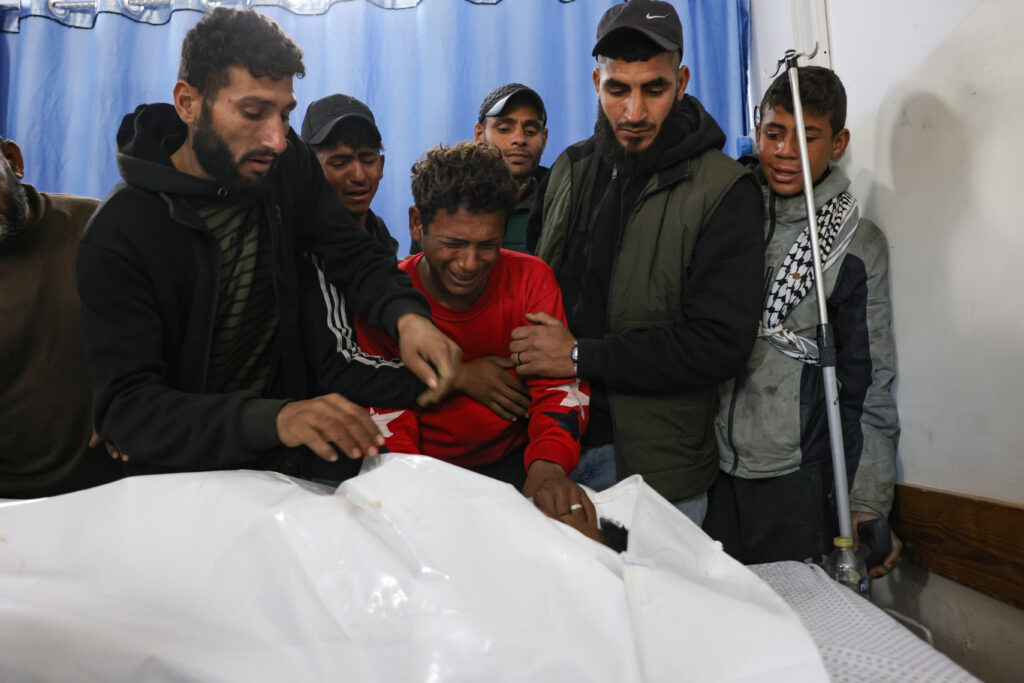
Israel said Sunday it was suspending the entry of aid into Gaza, where both Israel and Palestinian sources reported Israeli military strikes as Hamas alleged a “coup” against a six-week old truce.The health ministry in Hamas-run Gaza reported at least four killed and six wounded in Israeli attacks. As the 42-day first phase of the ceasefire drew to a close with negotiations inconclusive, Israel early Sunday approved a truce extension it said US Middle East envoy Steve Witkoff proposed.The extension would cover the Muslim holy month of Ramadan and the Jewish holiday of Passover.Hamas has repeatedly rejected an extension, instead favouring a transition to the truce deal’s second phase.As outlined by former US president Joe Biden, the second phase would bring a permanent end to the war that began on October 7, 2023 when Hamas attacked Israel.The truce’s first phase saw an increase of aid into the territory, where the war destroyed or damaged most of Gaza’s buildings, displaced almost the entire population, and triggered widespread hunger, according to the United Nations.Israeli Prime Minister Benjamin Netanyahu’s office said he had “decided that, from this morning, all entry of goods and supplies into the Gaza Strip will be suspended”.It said there would be “consequences” for Hamas if it did not accept the temporary truce extension.- A ‘forever’ truce -On a sandy street in Gaza City, Mays Abu Amer, 21, expressed hope the ceasefire can continue “for a longer period of time and forever as well. Because we have so much destruction, we need a lot of time for reconstruction.”Hamas said the “decision to suspend humanitarian aid is cheap blackmail, a war crime and a blatant coup against the (ceasefire) agreement”.Gaza’s civil defence agency reported “artillery shelling and gunfire from Israeli tanks” east of Khan Yunis city in southern Gaza. The Israeli army said it was “unaware of any artillery shelling in this area”.The Palestine Red Crescent, however, reported one person killed in an Israeli drone strike in the area, and one more killed in another town nearby.The military said it had conducted an air strike in northern Gaza targeting suspects it said had “planted an explosive device” near its troops.Including the deaths on Sunday, Gaza’s health ministry has recorded 116 people killed by Israel’s military since the ceasefire took effect on January 19, substantially reducing violence.Mediator Egypt, the Red Cross and the UN have all appealed for the truce to be maintained. “There is no alternative to the faithful and full implementation by all parties of what was signed last January,” Egypt’s Foreign Minister Badr Abdelatty said. He called for the European Union to exert pressure on the parties “especially the Israeli” side.Following the announcement of the aid suspension, AFP images showed trucks loaded with goods lined up on the Egyptian side of the Rafah crossing to Gaza.Far-right Israeli Finance Minister Bezalel Smotrich, whose party is crucial to keeping Netanyahu’s government in power, welcomed the decision to suspend aid.According to Israel, the truce extension would see half of the hostages still in Gaza freed on the day the deal came into effect, with the rest to be released at the end if an agreement was reached on a permanent ceasefire.Hamas spokesman Hazem Qassem later said Israel “bears responsibility for the consequences of its decision on the people of the Strip and the fate of its prisoners”.Its allied militant group, Islamic Jihad, accused Israel of “sabotaging” the ceasefire.Of the 251 captives taken by Hamas during its October 7, 2023 attack on Israel, 58 remain in Gaza, including 34 the Israeli military has confirmed are dead.- ‘Return all of them’ -On Sunday, Israeli mourners who turned out to farewell Shlomo Mansour, 85, whose body had been held in Gaza, said more should be done to get the remaining captives home.”Return all of them immediately and then think about what to do,” said Vardit Roiter. Mansour’s was among four bodies that militants handed over on Thursday under the truce’s first phase.They were among a total of eight bodies and 25 living hostages Hamas handed over under the initial phase, in exchange for the release of about 1,800 Palestinian prisoners.The aid suspension comes as Palestinians in Gaza, alongside much of the Muslim world, mark the second day of the holy month of Ramadan, during which the faithful observe a dawn-to-dusk fast.In November, a UN-backed assessment found “a strong likelihood that famine is imminent” within northern Gaza.Israeli Foreign Minister Gideon Saar on Sunday called such warnings “a lie during all this war.”Hamas’s October 7, 2023 attack resulted in the deaths of more than 1,200 people in Israel, mostly civilians, while Israel’s retaliation in Gaza killed more than 48,300 people, also mostly civilians, data from both sides show.US Secretary of State Marco Rubio, whose country is Israel’s top military supplier, on Saturday said he signed a declaration “to expedite” delivery of about $4 billion in military assistance to Israel.Abu Mohammed al-Basyuni, 56, had a message for America: “Enough bias towards one party,” he said among debris in Gaza City.”As a people, we have the right to life and the right to coexist. Animals have rights. What about humans?”

Israel suspends aid to Gaza as first phase of truce ends

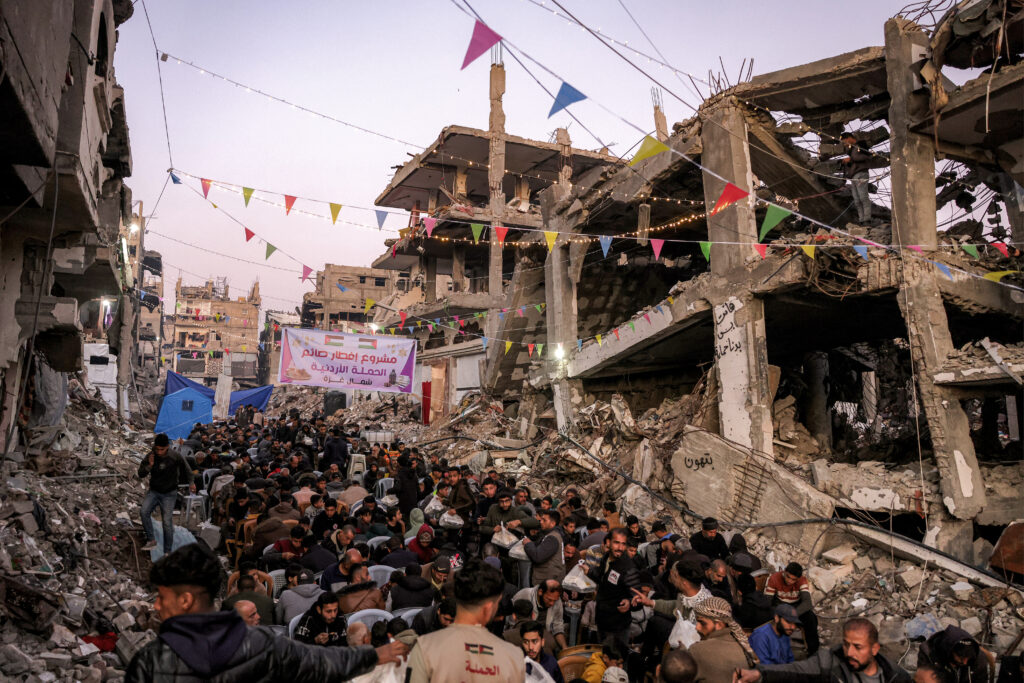
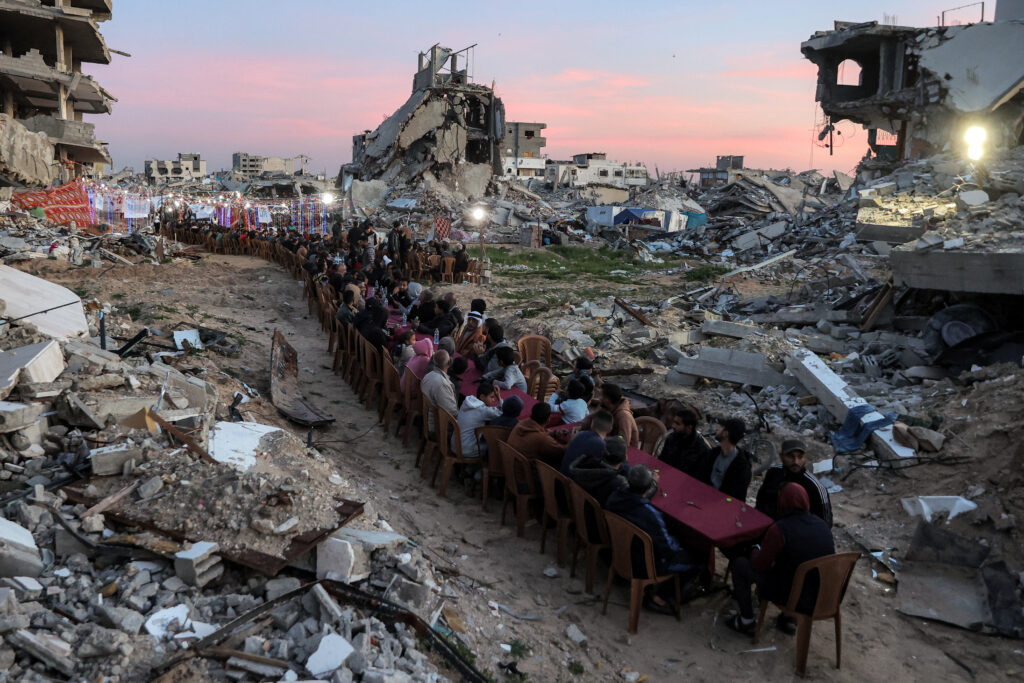
Israel said Sunday that it was suspending the entry of supplies into Gaza, with deadly attacks reported in the territory after it and Hamas hit an impasse over how to proceed with their fragile ceasefire.As the 42-day first phase of the ceasefire drew to a close, Israel gave its backing to an extension it said was put forward by US Middle East envoy Steve Witkoff, which would cover the Muslim holy month of Ramadan and the Jewish holiday of Passover.Hamas has repeatedly rejected an extension, instead favouring a transition to the truce deal’s second phase, which would see the release of all remaining hostages and a more permanent end to the fighting in the war-ravaged Gaza Strip.”Prime Minister Benjamin Netanyahu decided that, from this morning, all entry of goods and supplies into the Gaza Strip will be suspended,” his office said in a statement.”If Hamas persists with its refusal, there will be other consequences,” it added.Hamas slammed the move, saying in a statement that the “decision to suspend humanitarian aid is cheap blackmail, a war crime and a blatant coup against the (ceasefire) agreement”.Gaza’s civil defence agency, meanwhile, reported “artillery shelling and gunfire from Israeli tanks” east of Khan Yunis city, in the southern Gaza Strip.Approached for comment, the Israeli army said it was “unaware of any artillery shelling in this area”.The Palestine Red Crescent, however, reported one person killed in an Israeli drone strike in the area, and one more killed in another town nearby.The army also said it had conducted an air strike in northern Gaza targeting suspects it said had “planted an explosive device” near its troops.Gaza’s health ministry later reported at least four killed and six wounded in Israeli attacks on Sunday.- ‘Punitive measures’ -Following the announcement of the aid suspension, Netanyahu spokesman Omer Dostri wrote on X: “No trucks entered Gaza this morning, nor will they at this stage.”Far-right Israeli Finance Minister Bezalel Smotrich, whose party is crucial to keeping Netanyahu’s government in power, welcomed the decision to suspend aid as “an important step in the right direction”, calling for a renewed fight “until total victory” against Hamas.”We have remained in government to ensure this,” he added.According to Israel, the truce extension would see half of the hostages still in Gaza freed on the day the deal came into effect, with the rest to be released at the end if an agreement was reached on a permanent ceasefire.Hamas called on “mediators and the international community to pressure” Israel to “put an end to these punitive, immoral measures against more than two million people in the Gaza Strip”.Its spokesman Hazem Qassem later said Israel “bears responsibility for the consequences of its decision on the people of the Strip and the fate of its prisoners”.A senior Hamas official had earlier told AFP the Palestinian militant group was prepared to release all remaining hostages in a single swap during the second phase.At a demonstration in Tel Aviv on Saturday evening, supporters and family members of the hostages demanded the government secure their freedom.”The current crisis in the negotiations is a deliberate crisis, orchestrated and manipulated by Netanyahu,” said Einav Zangauker, whose son Matan is still in Gaza.- ‘Iftar on our land’ -Under the first phase, Hamas returned 25 living hostages and the bodies of eight others, in exchange for the release of about 1,800 Palestinian prisoners.Of the 251 captives taken by Hamas during its October 7, 2023 attack on Israel, 58 remain in Gaza, including 34 the Israeli military has confirmed are dead.More than 15 months of war created a humanitarian crisis in Gaza, with the UN repeatedly warning the territory was on the brink of famine before the ceasefire allowed a surge of aid to enter.But Israeli Foreign Minister Gideon Saar on Sunday dismissed warnings of famine in Gaza.”With regards to this starvation [claim], that was a lie during all this war,” Saar told a press conference.The suspension of aid comes as Palestinians in Gaza, alongside much of the Muslim world, mark the second day of the holy month of Ramadan, during which the faithful observe a dawn-to-dusk fast.On Saturday evening, Gazans gathered amid destroyed buildings for a fast-breaking iftar meal as they entered their second Ramadan under the shadow of war.”We are here in the midst of destruction and rubble, and we are steadfast despite the pain and our wounds,” said Beit Lahia resident Mohammed Abu Al-Jidyan.”Here we are eating iftar on our land and we will not leave this place.”The war has left much of Gaza in ruins, displaced the vast majority of its residents and killed more than 48,388 people, mostly civilians, according to the territory’s health ministry, figures the UN has deemed reliable.It began with Hamas’s October 7 attack on Israel, which resulted in the deaths of 1,218 people, mostly civilians, according to an AFP tally of official figures.Washington has announced it is boosting its military aid to Israel.Secretary of State Marco Rubio said late Saturday he was using “emergency authorities to expedite the delivery of approximately $4 billion in military assistance”.