AFP Asia Business

Israeli team heads to Qatar for Gaza truce talks

Israel’s negotiating team left for Qatar Monday for talks aimed at extending the fragile Gaza ceasefire after the authorities cut the Palestinian territory’s electricity supply to ramp up pressure on Hamas.Ahead of the negotiations, Israel disconnected the only power line to a water desalination plant in Gaza, a move Hamas denounced as “cheap and unacceptable blackmail”.The first phase of the truce deal expired on March 1 with no agreement on subsequent stages that should secure a lasting end to the war that erupted with Hamas’s October 7, 2023 attack on Israel.There are differences over how to proceed — Hamas wants immediate negotiations on the next phase, but Israel prefers extending phase one.Hamas accused Israel of reneging on the ceasefire deal, saying in a statement on Monday that Israel “refuses to commence the second phase, exposing its intentions of evasion and stalling”.An Israeli official familiar with the negotiations told AFP the country’s team had left for Doha. Media reports said the delegation was led by a top official from the domestic security agency Shin Bet.Israel has halted aid deliveries to Gaza amid the deadlock and said on Sunday it was cutting the electricity supply.”We will use all the tools at our disposal to bring back the hostages and ensure that Hamas is no longer in Gaza the day after” the war, Energy Minister Eli Cohen said.- Loss of drinking water -The move echoed the early days of the war when Israel announced a “complete siege” on the Palestinian territory, severing the electricity supply, which only began flowing again in late 2024.Hamas spokesman Abdul Latif al-Qanoua said Israel’s move would impact its hostages still held in Gaza.”The decision to cut electricity is a failed option and poses a threat to its prisoners, who will only be freed through negotiations,” Qanoua said in a statement on Monday.The United Nations expressed concerns over Israel’s latest decision.”This latest decision will substantially reduce the availability of drinking water in the Gaza Strip, starting today,” said Stephane Dujarric, spokesman for UN Secretary General Antonio Guterres.”Restoring this connection is vital for tens of thousands of families and children.”Germany’s foreign ministry spokeswoman Kathrin Deschauer said that cutting off electricity was “unacceptable and not compatible with (Israel’s) obligations under international law”.But Israel’s key military ally, the United States, appeared to back the decision.”The Israelis are going to do what they believe is in their interest to force Hamas to make a decision,” Secretary of State Marco Rubio told journalists.The sole power line between Israel and Gaza supplies electricity to the territory’s main desalination plant, and Gazans now mainly rely on solar panels and fuel-powered generators to produce electricity.- ‘Long-term truce’ -Gaza residents told AFP the electricity cut would only worsen their situation.”The decision to cut off electricity is proof of a war of extermination,” Dina al-Sayigh said from Gaza City.”The occupation never stops killing Palestinian civilians, whether by bombing, missiles or by starvation.”Hamas has repeatedly demanded that the second phase of the truce — brokered by Qatar, Egypt and the United States — include a comprehensive hostage-prisoner exchange, a complete Israeli withdrawal from Gaza, a permanent ceasefire and the reopening of border crossings to end the blockade.Spokesman Hazem Qassem told AFP that Hamas wanted the mediators to ensure Israel “complies with the agreement… and proceeds with the second phase according to the agreed-upon terms”.Former US president Joe Biden had outlined a second phase involving hostage releases and the withdrawal of all Israeli forces from Gaza.US envoy Adam Boehler, who has held unprecedented direct talks with Hamas, told CNN on Sunday a deal could be reached “within weeks” to secure the release of all remaining hostages.Of the 251 hostages taken during the October 7 attack, 58 are still held in Gaza, including 34 the Israeli military has confirmed dead.Boehler told CNN a “long-term truce” was “real close”.- ‘Nothing available’ -Hamas meanwhile accused Israel of violating the ceasefire by keeping its troops at the Philadelphi Corridor, a strip of land on the Palestinian side of the Egypt-Gaza border.Hamas said that, according to the ceasefire deal, Israel was to remove troops from the corridor by Sunday. Israel seized the area last year and insists that controlling it is vital to stop smuggling of weapons into Gaza.The initial 42-day phase of the truce, which began on January 19, reduced hostilities after more than 15 months of relentless fighting that displaced nearly all of Gaza’s 2.4 million people.But in recent days, Israel has carried out daily strikes targeting militants in Gaza, including on Monday when it struck three people it said were trying to plant explosives.During the ceasefire’s first phase, 25 living Israeli hostages and eight bodies were exchanged for about 1,800 Palestinians in Israeli custody.Hamas’s October 7, 2023, attack resulted in the deaths of 1,218 people on the Israeli side, most of them civilians, while Israel’s retaliatory campaign has killed at least 48,467 people in Gaza, also mostly civilians, according to data from both sides.


A close-up of a stack of newspapers resting on a desk, symbolizing information and media.

Fear among Syrian Christians after deadly attacks

Members of Syria’s small Christian community on the coast are living in fear after attacks killed more than 1,000 mostly Alawite civilians, with Christians reportedly caught up in the violence.”The current conflict in Syria does not concern me, but we are its victims,” said Ruwayda, a 36-year-old Christian from the port city of Latakia.”There’s a feeling that no one is protecting us,” she told AFP.”I feel a mix of both fear and anticipation for what lies ahead in Syria, but I feel certain that migration is the only option,” she added.The wave of violence — the worst since former president Bashar al-Assad was toppled in December — erupted in Syria’s Alawite heartland on the coast on Thursday.It began with clashes between gunmen loyal to Assad and the country’s new security forces.What later transpired has been described as a “massacre” in which members of Assad’s Alawite minority were targeted.War monitor the Syrian Observatory for Human Rights reported at least 1,068 civilians — the vast majority Alawites — killed by security forces and allied groups.There were reports of Christians being caught in the crosshairs.In a Damascus sermon on Sunday, the Greek Orthodox Patriarch of Antioch John X said “many innocent Christians were also killed” alongside Alawites.Obituaries have been shared on social media for several members of the small Christian community on the coast.AFP was able to confirm at least seven of these, including for a man and his son an acquaintance said were shot on their way to Latakia.Another four members of one family were killed in their home in an Alawite-majority neighbourhood of the city, and the father of a priest was killed in Baniyas further south, relatives and their churches said.- ‘Doors locked’ -Social media videos have also spread panic, with one showing a fighter speaking in a non-Syrian Arabic dialect threatening Christians as well as Alawites.One Christian resident of Latakia, speaking on condition of anonymity for fear of reprisals, said he and his neighbours “have been staying at home since the start of the escalation with the doors locked for fear that foreign fighters might enter”.All the Christians who spoke to AFP refused to give their full or real names for safety reasons.Many of the fighters who have staged the attacks since Thursday were not from Syria, according to various accounts.Analyst Fabrice Balanche said that before the war began in 2011, Syria had about one million Christians, or about five percent of the population.He said that number shrank to about 300,000 after the majority fled during the civil war.Despite efforts by the interim president and government to assuage fears, Syria’s various minorities, including Christians, have been gripped by dread since the Sunni authorities seized power in December.Interim President Ahmed al-Sharaa led the Hayat Tahrir al-Sham group that spearheaded the offensive that toppled Assad.HTS was an offshoot of Al-Qaeda in Syria, and remains proscribed as a terrorist organisation by Western governments including the United States.- ‘Pale with fear’ -By Monday, a sense of relative normalcy had returned to Latakia, as security forces erected checkpoints outside Alawite-majority neighbourhoods, an AFP correspondent said.In Sunni and Christian districts, there was near-normal activity, although they lacked their habitual hustle and bustle.”We are very anxious. People’s faces are pale with fear,” said Heba, a Christian teacher who used a pseudonym to protect her identity.”We don’t know what the future will bring,” the 40-year-old said.She noted that while Christians had not been targeted directly as Alawites were, people were killed after being caught in crossfire.In a joint statement on Saturday, the pastors of churches in Latakia urged residents “not to be carried away by rumours”.The statement sought to send a “message of reassurance” after the pastors met “a delegation from the leadership of the security department”.Sharaa on Sunday vowed to “hold accountable, firmly and without leniency, anyone who was involved in the bloodshed of civilians… or who overstepped the powers of the state”.But residents such as Gabriel, 37, said this failed to allay deep fears.”I’m not reassured about my future and I don’t dare get married and have children in this place,” he said.”A decade ago I had the chance to migrate to Canada, but I gambled that the situation would improve.”Today I regret not making use of that opportunity.”

Israel seeking ‘substitutes’ for UNRWA in Gaza: ambassador

Israel said Monday that it was “encouraging” other UN agencies and NGOs to take over the assistance provided in war-ravaged Gaza by UNRWA, after Israel cut ties with the aid agency.”We, the state of Israel, are working to find substitutes to the work of UNRWA inside Gaza,” Daniel Meron, Israel’s ambassador to the UN in Geneva, told reporters.Israel, he said, was actively “encouraging UN agencies and NGOs to take over”. For more than seven decades, the United Nations Relief and Works Agency for Palestine Refugees has provided essential aid and assistance to Palestinian refugees.But after Israel accused UNRWA of providing cover for Hamas militants and charged that some staff members took part in the October 7, 2023 attacks, legislation severing ties with the agency came into force at the end of January.UNRWA has been banned from operating on Israeli soil, and contact between it and Israeli officials is forbidden.The move sparked fears that it would hamper vital services delivered by the lead agency in coordinating aid to Gaza, ravaged by 17 months of war.But so far, UNRWA has continued to provide aid, saying Sunday that since late January it had “delivered food assistance to the entire population of the Gaza Strip”.During the period it also provided “over 412,000 health consultations and reached more than half a million people with shelter and non-food items”.UN agencies and other aid organisations have repeatedly said that there was no replacement in Gaza for UNRWA, which is also the main provider of basic public services in the strip, including education and social services for registered Palestinian refugees.But Meron said Israel was urging other organisations to step in, “each one in its own field that they specialise in”.For instance, he said, the UN’s World Food Programme could deal with food, while “others deal with other issues”.”There has been serious work… with the different agencies and making sure that the people of Gaza will not suffer because of the this… switch from UNRWA to other agencies,” he said.He did not provide further details about other agencies contacted or how they had responded to the Israeli request.

Adopted orphan brings couple ‘paradise’ in war-ravaged Gaza

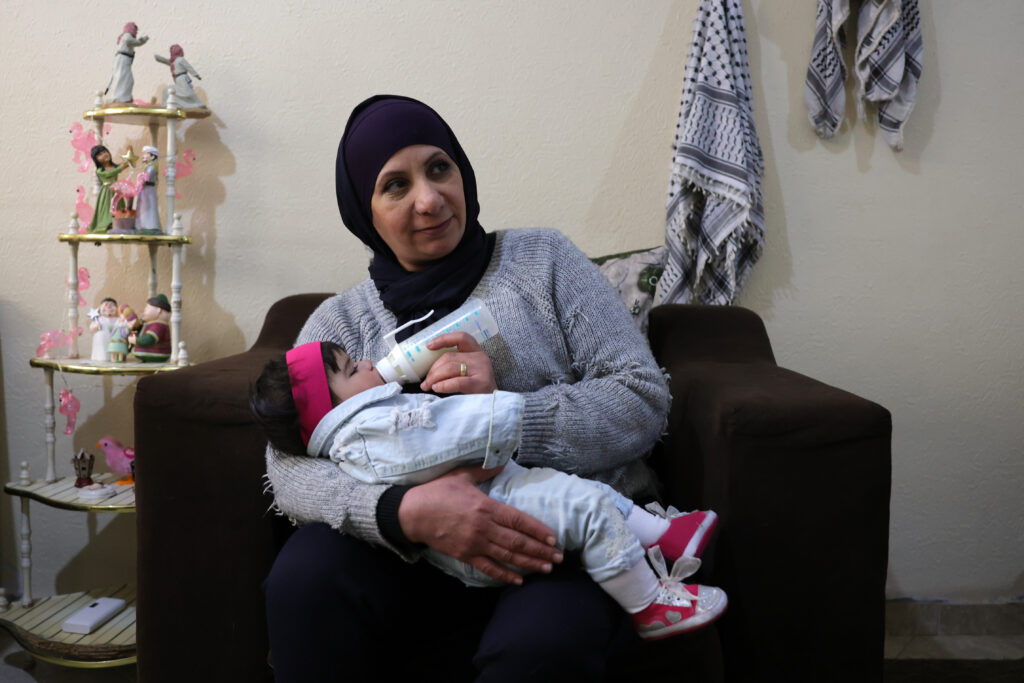
In their home in war-devastated Gaza City, Iman Farhat and her husband cherish the “paradise” brought by their newly-adopted baby, one of many orphans in the Palestinian territory after more than 15 months of fighting between Israel and Hamas.Wrapping five-month-old Jannah in a brightly coloured blanket, Farhat gently sang as she rocked her to sleep.”I chose Jannah just as she was,” the new mother said smiling, explaining the couple simply wanted to adopt a young child without preference for gender or physical appearance.”Her name was Massa, and I officially changed her name from Massa to Jannah,” which means “paradise” in Arabic, she added.Farhat, 45, and her husband Rami al-Arouqi, 47, adopted the well-behaved and chubby baby in January.”At first, we had mixed feelings of both joy and fear, because it is a huge responsibility and we had never had a child”, said Arouqi, a Palestinian Authority employee.The couple already owned a cat.”The idea of adopting a child had crossed our minds, but it was cemented during the war” which “wiped out entire families and left only orphans”, he added.In September, the United Nations children’s fund, UNICEF, estimated there were 19,000 children who were unaccompanied or separated from their parents in Gaza, Jonathan Crickx, UNICEF’s spokesman for the Palestinian territories, told AFP.Data for the number of adoptions in Gaza was not immediately available.The war sparked by Palestinian militant group Hamas’s October 7, 2023 attack on Israel left more than 69 percent of Gaza’s buildings damaged or destroyed, displaced almost the entire population and triggered widespread hunger, according to the United Nations.- Life ‘turned upside down’ -Hamas’s attack resulted in the deaths of 1,218 people on the Israeli side, most of them civilians, according to official figures.Israel’s retaliatory military offensive has killed at least 48,446 people in Gaza, the majority of them civilians, according to the Hamas-run territory’s health ministry. The UN considers these figures reliable.Farhat and her husband said that before Jannah’s adoption, she was taken care of by the SOS Children’s Villages — an international NGO which looks after children in need.After the NGO’s premises in the southern Gaza city of Rafah were destroyed in the war, the organisation had to move to nearby Khan Yunis where “they could not house all the children in buildings, so they set up tents for them,” Farhat said.Her husband Arouqi told AFP that another motive for adopting a child came from the idea that “Palestinians should stand by each other’s side”.”The whole world has abandoned and let us down, so we shouldn’t let each other down,” he added.Once the pair took Jannah home, “our life was turned upside down in a beautiful and pleasant way,” he said.”Her name is Jannah and our world has truly become a paradise.”A fragile truce took effect on January 19, largely halting the devastating fighting between Israel and Hamas Palestinian militants. The ceasefire’s first phase ended last weekend.While Israel has said it wants to extend the first phase until mid-April, Hamas has insisted on a transition to the deal’s second phase, which should lead to a permanent end to the war.

Israeli team due in Qatar for Gaza truce talks

Israel is due to send a delegation to Qatar on Monday for a fresh round of talks on extending a fragile ceasefire in Gaza, after cutting off the electricity supply to ramp up pressure on Hamas.The first phase of the deal expired at the beginning of March with no agreement on subsequent stages that should secure a lasting end to the war that erupted with Hamas’s October 7, 2023 attack on Israel.There are differences over how to proceed — Hamas wants immediate negotiations on the next phase, but Israel prefers extending phase one.Hamas accused Israel of reneging on the ceasefire deal, saying in a statement Monday Israel “refuses to commence the second phase, exposing its intentions of evasion and stalling”.Media reports said a top official from the domestic security agency Shin Bet will lead Israel’s delegation.Israel has halted aid deliveries to Gaza amid the deadlock, and on Sunday announced it was cutting off the territory’s electricity supply.”We will use all the tools at our disposal to bring back the hostages and ensure that Hamas is no longer in Gaza the day after” the war, Energy Minister Eli Cohen said as he ordered the power cut.The move echoed the early days of the war when Israel announced a “complete siege” on the Palestinian territory, severing the electricity supply which was only restored in mid-2024.Hamas spokesman Abdul Latif al-Qanoua said Israel’s move will impact its hostages still held in Gaza.”The decision to cut electricity is a failed option and poses a threat to its (Israeli) prisoners, who will only be freed through negotiations,” Qanoua said in a statement on Monday.Germany criticised Israel Monday for its latest decisions.Foreign ministry spokeswoman Kathrin Deschauer said Gaza was “again threatened with a food shortage” and that cutting off electricity was “unacceptable and not compatible with (Israel’s) obligations under international law”.The sole power line between Israel and Gaza supplies its main desalination plant, and Gazans now mainly rely on solar panels and fuel-powered generators to produce electricity.Hundreds of thousands of Palestinians now live in tents across Gaza, where temperatures reach a night-time low of about 12 degrees Celsius (54 Fahrenheit).Top Hamas official Izzat al-Rishq called Israel’s decision “to cut off electricity to Gaza, after depriving it of food, medicine, and water” a “desperate attempt to pressure our people and their resistance”.- ‘Long-term truce’ -Hamas has repeatedly demanded that the second phase of the truce — brokered by Qatar, Egypt and the United States — include a comprehensive hostage-prisoner exchange, a complete Israeli withdrawal from Gaza, a permanent ceasefire and the reopening of border crossings to end the blockade.Spokesman Hazem Qassem told AFP that Hamas wanted the mediators to ensure Israel “complies with the agreement… and proceeds with the second phase according to the agreed-upon terms”.Former US president Joe Biden had outlined a second phase involving hostage releases and the withdrawal of all Israeli forces from Gaza.US envoy Adam Boehler, who has held unprecedented direct talks with Hamas, told CNN Sunday a deal could be reached “within weeks” to secure the release of all remaining hostages, not just the five dual Israeli-US nationals, most of whom have been confirmed dead.Of the 251 hostages taken during the October 7 attack, 58 are still held in Gaza, including 34 the Israeli military has confirmed dead.Boehler told CNN a “long-term truce” was “real close”, but later Sunday he told Israel’s Channel 12 that Washington would back any Israeli decision, including a return to war.- ‘Nothing available’ -In late February, US President Donald Trump issued what he called a “last warning” to Hamas, threatening further destruction if it does not release all remaining hostages.Trump had earlier proposed expelling Palestinians from Gaza, prompting Arab leaders to offer an alternative reconstruction plan for the territory that does not involve displacement.The initial 42-day phase of the truce, which began on January 19, reduced hostilities after more than 15 months of relentless fighting that displaced nearly all of Gaza’s 2.4 million people.During phase one, 25 living Israeli hostages and eight bodies were exchanged for about 1,800 Palestinians in Israeli custody.The truce also allowed in much-needed food, shelter and medical assistance.After Israel cut the aid flow on March 2, UN rights experts accused it of “weaponising starvation”.At a UN distribution of flour in Jabalia, northern Gaza, Abu Mahmoud Salman, 56, said that with fresh supplies now closed off, “there is nothing available”.”The markets are empty… prices are high, and there is no income. The situation in Gaza is difficult,” he told AFP.Hamas’s October 7, 2023 attack resulted in the deaths of 1,218 people on the Israeli side, most of them civilians, while Israel’s retaliatory campaign has killed at least 48,467 people in Gaza, also mostly civilians, according to data from both sides.
Israeli negotiators head to Qatar for Gaza truce talks

Israel is due to send a delegation to Qatar on Monday for a fresh round of talks on extending a fragile ceasefire in Gaza, after cutting off the electricity supply to ramp up pressure on Hamas.The first phase of the deal expired at the beginning of March with no agreement on subsequent stages that should secure a lasting end to the war that erupted with Hamas’s October 7, 2023 attack on Israel.There are still differences over how to proceed, with Hamas calling for immediate negotiations on the next phase, while Israel prefers an extension of phase one.Israeli media said the Israeli delegation will be led by a top official from the domestic security agency Shin Bet.Israel has halted aid deliveries to Gaza amid the deadlock, and on Sunday announced it was cutting off the electricity supply to the territory.”We will use all the tools at our disposal to bring back the hostages and ensure that Hamas is no longer in Gaza the day after” the war, Energy Minister Eli Cohen said as he ordered the power cut.The move echoed the early days of the war when Israel announced a “complete siege” on Gaza, severing the electricity supply which was only restored in mid-2024.Hamas spokesman Abdul Latif al-Qanoua said cutting off electricity will impact Israeli hostages still held in Gaza.”The decision to cut electricity is a failed option and poses a threat to its (Israeli) prisoners, who will only be freed through negotiations,” Qanoua said in a statement on Monday.The sole power line between Israel and Gaza supplies the Palestinian territory’s main desalination plant, and Gazans now mainly rely on solar panels and fuel-powered generators to produce electricity.Hundreds of thousands of Palestinians are now living in tents across Gaza, where temperatures reach a low of about 12 degrees Celsius (54 Fahrenheit) at night.Top Hamas official Izzat al-Rishq said the Israeli decision “to cut off electricity to Gaza, after depriving it of food, medicine, and water” was a “desperate attempt to pressure our people and their resistance”.- ‘Long-term truce’ -Hamas has repeatedly demanded that the second phase of the truce — brokered by Qatar, Egypt and the United States — include a comprehensive hostage-prisoner exchange, a complete Israeli withdrawal from Gaza, a permanent ceasefire and the reopening of border crossings to end the blockade.Spokesman Hazem Qassem told AFP that Hamas wanted the mediators to ensure Israel “complies with the agreement… and proceeds with the second phase according to the agreed-upon terms”.Former US president Joe Biden had outlined a second phase involving hostage release and the withdrawal of all Israeli forces left in Gaza.US envoy Adam Boehler, who held unprecedented direct talks with Hamas officials in recent days, told CNN on Sunday that a deal could be reached “within weeks” to secure the release of all remaining hostages, not just the five dual Israeli-US nationals, most of who have been confirmed dead. Of the 251 hostages taken during the October 7 attack, 58 are still held in Gaza, including 34 the Israeli military has confirmed dead.The US envoy told CNN a “long-term truce” was “real close”, but in an interview with Israel’s Channel 12 that aired later on Sunday, he said Washington would back any Israeli decision, including a return to war.- ‘Nothing available’ -In late February, US President Donald Trump had issued what he called a “last warning” to Hamas, threatening further destruction if the group does not release all remaining hostages.An earlier proposal from Trump to expel Palestinians from Gaza prompted Arab leaders to offer an alternative reconstruction plan without displacement.The initial 42-day phase of the truce, which began on January 19, reduced hostilities after more than 15 months of relentless fighting that displaced nearly all of Gaza’s 2.4 million people.During this period, 25 living Israeli hostages and eight bodies were exchanged for the release of about 1,800 Palestinians in Israeli custody.The truce also allowed in much-needed food, shelter and medical assistance.After Israel cut off the aid flow on March 2, UN rights experts accused the government of “weaponising starvation”.At a UN distribution of flour in Jabalia, northern Gaza, Abu Mahmoud Salman, 56, said that with the territory now closed off from fresh supplies, “there is nothing available”.”The markets are empty… prices are high, and there is no income. The situation in Gaza is difficult,” he told AFP.Hamas’s 2023 attack resulted in the deaths of 1,218 people on the Israeli side, most of them civilians, while Israel’s retaliatory campaign has killed at least 48,467 people in Gaza, also mostly civilians, according to data from both sides.