AFP Asia Business

Fresh Yemen war chat revelations heap pressure on White House

A US magazine published Wednesday the transcript of accidentally leaked messages laying out plans for an attack on Yemen, heaping pressure on Donald Trump’s White House and boosting calls for top officials to resign.The White House insisted that Trump still had confidence in his national security team, despite revelations in The Atlantic that Defense Secretary Pete Hegseth had revealed details including the times of strikes in advance.The Atlantic’s editor in chief Jeffrey Goldberg reported earlier this week that he had been mistakenly added to the chat on the commercially available Signal app in a stunning security breach.The magazine initially withheld the details of the attack plans, but finally published them on Thursday after White House had insisted that no classified details were involved and attacked Goldbeg as a liar.The Trump administration doubled down on its attacks on Wednesday.Peppered with questions at a daily press briefing, Press Secretary Karoline Leavitt described Goldberg as an “anti-Trump hater” who “loves manufacturing and pushing hoaxes.” Leavitt would not respond directly when asked if she could definitively say that no officials would lose their jobs as Democrats called for heads to roll over the so-called “Signalgate” scandal.”What I can say definitively is what I just spoke to the president about, and he continues to have confidence in his national security team,” Leavitt told reporters.Elon Musk, the billionaire running a huge government cost-cutting drive for Trump, had “offered to put his technical experts on this” to establish how Goldberg was added to the chat, she added.- ‘Big mistake’ -Democrats in particular turned their fire on Hegseth, the former Fox News contributor and veteran who has never run a huge organization like the Pentagon before.They have also called for National Security Advisor Mike Waltz, who has taken responsibility for accidentally adding the journalist to the chat, to go.Hegseth claimed the exchange about the attacks on Huthi rebels on March 15 had “No names. No targets” and said they were not “war plans.””My job… is to provide updates in real time, general updates in real time, keep everybody informed, that’s what I did,” he told reporters on a visit to Hawaii on Wednesday.Secretary of State Marco Rubio, who was also included in the chat, admitted Wednesday that including the journalist was a “big mistake.”But calls mounted for Trump to sack officials over the breach. “The secretary of defense should be fired immediately if he’s not man enough to own up to his mistakes and resign in disgrace,” House Democrat leader Hakeem Jeffries told MSNBC.Democratic Senator Tammy Duckworth said Trump should fire all the officials in the chat and called Hegseth a “liar” who “could’ve gotten our pilots killed.”The US House of Representatives discussed the scandal in a hearing Wednesday.- ‘First bombs’ -The Atlantic said the texting was done barely half an hour before the first US warplanes took off to hit the Huthis — and two hours before the first target was expected to be bombed.”1215et: F-18s LAUNCH (1st strike package)”, Hegseth writes, referring to F-18 US Navy jets, before adding that “Target Terrorist is @ his Known Location so SHOULD BE ON TIME.””1415: Strike Drones on Target (THIS IS WHEN THE FIRST BOMBS WILL DEFINITELY DROP, pending earlier ‘Trigger Based’ targets).”Hegseth also writes about the use of US drones and Tomahawk cruise missiles. A short time later, Waltz sent real-time intelligence on the aftermath of an attack, writing that US forces had identified the target “walking into his girlfriend’s building and it’s now collapsed.”The story also threatens to cause further ructions between Washington and its allies, after Goldberg revealed disparaging comments by Vance and Hegseth about “pathetic” European nations during their chat.The Trump administration has stepped up attacks on the Huthi rebels in response to constant attempts to sink and disrupt shipping through the strategic Red Sea.The Huthi rebels, who have controlled much of Yemen for more than a decade, are part of the “axis of resistance” of pro-Iran groups staunchly opposed to Israel and the US. 

After a week on the streets, Turkey protesters remain defiant

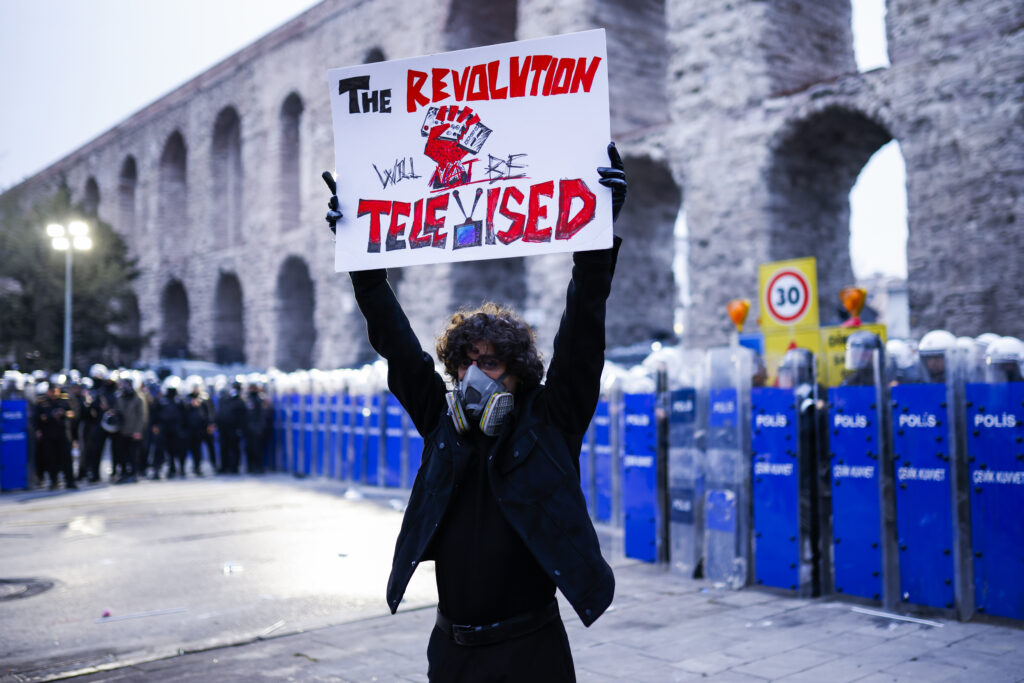
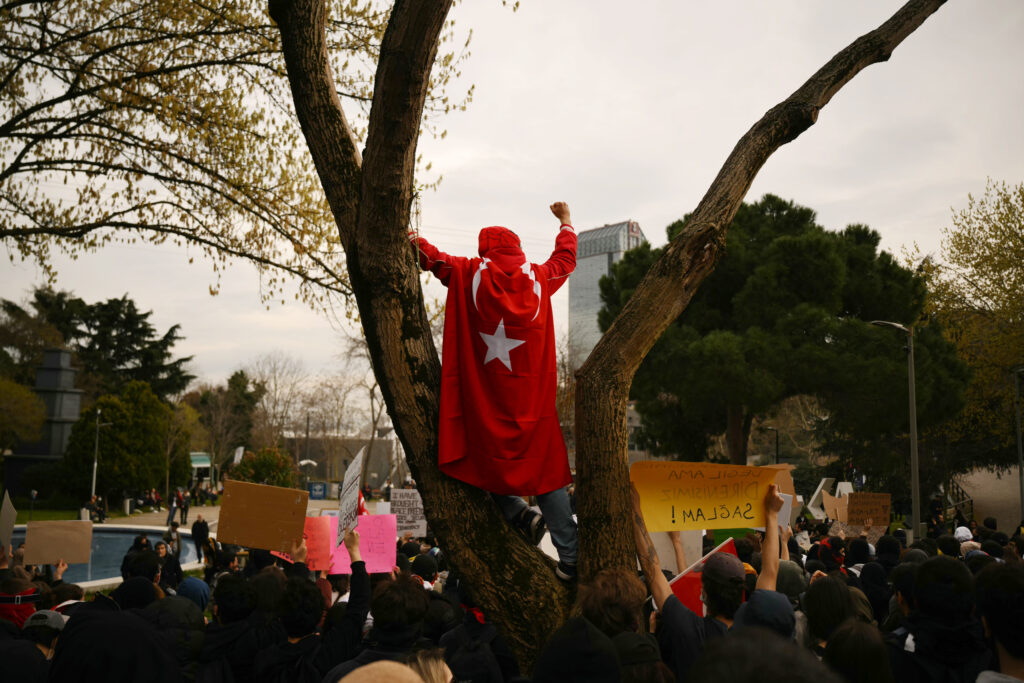
Student protesters were back on the streets on Wednesday as they marked a week since the start of Turkey’s biggest demonstrations against the rule of President Recep Tayyip Erdogan since 2013.The protests erupted after the March 19 arrest of Istanbul opposition mayor Ekrem Imamoglu as part of a graft and “terror” probe, which the main opposition CHP party slammed as a “coup”.Vast crowds have hit the streets daily, defying a protest ban in Istanbul and other big cities, with the biggest crowds gathering after dark, sparking running battles with riot police. Ahead of a major rally on Saturday, the CHP appeared to change strategy on Wednesday, urging people to applaud, honk their horns or wave flags from their windows at 1730 GMT. In Istanbul, crowds of students — many of them masked — marched through the Levent business district after a day in which many thousands had flooded the streets chanting: “Government, resign!”And in the capital, students rallied at Ankara University campus alongside medical students from Haceteppe University and a handful of lecturers from the prestigious Middle East Technical University. “The pressures exerted on members of the opposition have reached an alarming level,” said one robed lecturer who did not give his name. “In the same way, government pressure on universities, which has been going on for years, has become even worse with recent developments.”- ‘Absolutely scandalous’ -By Tuesday afternoon, police had arrested 1,418 people, the interior ministry said. Among them was AFP photographer Yasin Akgul, who was arrested in a pre-dawn raid on Monday and remanded in custody a day later alongside six other journalists.The move was sharply denounced by the Paris-based news agency, which said that Akgul had been covering the protests, denouncing his jailing as “unacceptable” and demanding his immediate release.Reporters Without Borders chief Thibaut Bruttin described the arrests as “absolutely scandalous”, urging Turkey to free the journalists, including Akgul.”These journalists were only doing their job. They have no business being brought before a court. They absolutely must be released,” he told AFP. And a French foreign ministry source said Paris was “deeply concerned by reports of repression against protesters and journalists” in Turkey, noting that Akgul “was covering the protests professionally”.The UN also voiced concern on Wednesday over the court’s U-turn on the journalists’ fate. “It is a matter of concern that reportedly the initial decisions of a court in Istanbul to free the journalists were immediately reversed on the prosecutor’s intervention,” UN Human Rights Office spokeswoman Liz Throssell told AFP.- ‘No room left in the prisons’ -Erdogan, who has repeatedly denounced the protests as “street terror”, stepped up his attacks on the opposition with a bitter tirade against the CHP and its leader Ozgur Ozel.Most nights, the protests have turned into running battles with riot police, whose crackdown has alarmed rights groups. But there were no such clashes on Tuesday, AFP correspondents said. Addressing the vast crowds at Istanbul City Hall on Tuesday, Ozel warned Erdogan that the crackdown would only strengthen the protest movement.”Our numbers won’t decrease with the detentions and arrests, we will grow and grow and grow!” he vowed, saying the extent of the crackdown meant there was “no room left in Istanbul’s prisons”.Although the crackdown has not reduced the numbers, most students who joined a huge street rally on Tuesday had their faces covered, an AFP correspondent said. “We want the government to resign, we want our democratic rights, we are fighting for a freer Turkey right now,” a 20-year-old student who gave his name as Mali told AFP. “We are not terrorists, we are students and the reason we are here is to exercise our democratic rights and to defend democracy,” he said.Ozel has called the next major rally for Saturday in the Istanbul district of Maltepe on the Asian side of the city.

Anti-Hamas chants at new protests in Gaza: witnesses

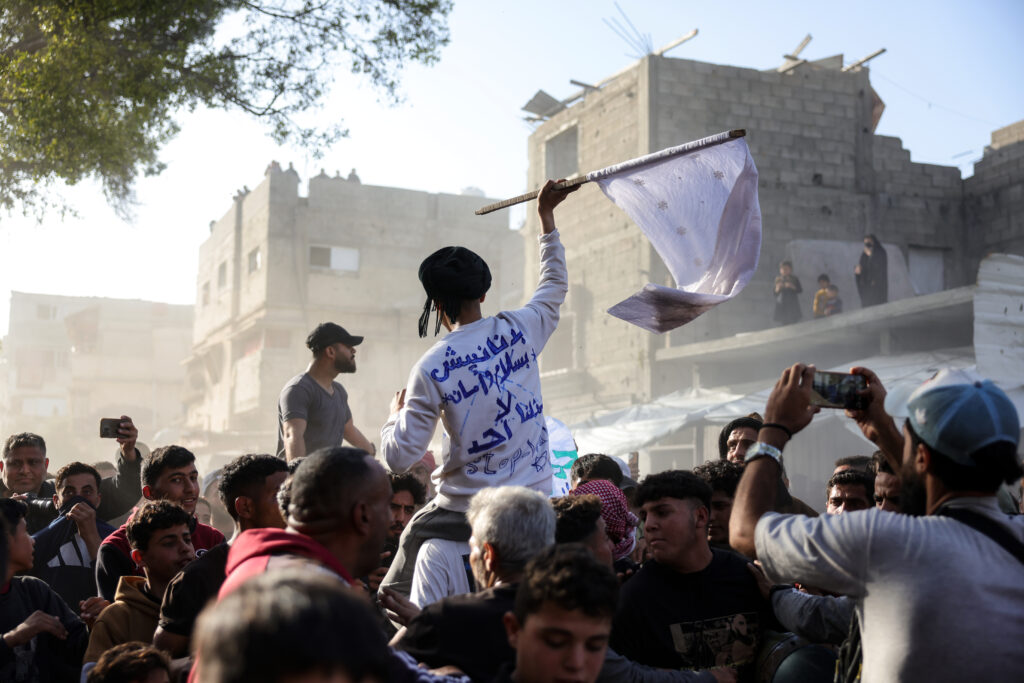
Palestinians on Wednesday staged protests in the Gaza Strip against the territory’s Hamas rulers for the second consecutive day, calling for an end to the war with Israel, witnesses said.Demonstrators carrying banners reading “Hamas does not represent us” were seen marching in Gaza City and the town of Beit Lahia to the north, just over a week after Israel resumed its bombing campaign following nearly two months of a truce.”We do not want Hamas! We are tired,” said protester Muayed Zahir, who took part in the rally in Gaza City.After more than 17 months of devastating war, “there is no education, no food, no clothing — and all this is because of Hamas,” Zahir added.”We appeal to (Israeli Prime Minister Benjamin) Netanyahu: Stop firing missiles at the sad, poor people.”Protesters also chanted “Out, out, Hamas out!” witnesses said.One demonstrator who declined to be named said that nearly “two years of destruction and extreme hardship are enough”.”Enough, Hamas, with the suffering inflicted on the people of Gaza… These are the demands of the people,” added the man, stressing that “we speak in the name of the people, we are not being controlled by anyone.”On Tuesday, hundreds of Palestinians participated in a protest in Beit Lahia, the biggest rally in Gaza against Hamas since the start of the war.Hamas has been in power in Gaza since 2007.Levels of discontent towards Hamas are difficult to gauge, in part because of its intolerance for public expressions of dissent.A public opinion poll conducted in September by the Palestinian Center for Policy and Survey Research, based outside of Gaza in the occupied West Bank, estimated that 35 percent of Gazans supported Hamas.According to the survey, support for Hamas in Gaza was slightly higher than for its main political rival, the Fatah movement of Ramallah-based Palestinian president Mahmud Abbas, estimated at 26 percent.In Israel’s parliament on Wednesday, Netanyahu said: “More and more Gazans understand that Hamas brings them destruction and ruin… all of this proves that our policy is working.”Fatah’s spokesman in Gaza, Monther al-Hayek, on Saturday called on Hamas to “step aside from governing” the territory to safeguard the “existence” of Palestinians there.Before Israel resumed its military operations in Gaza, it had blocked in early March the entry of aid into the war-ravaged territory, worsening an already dire humanitarian situation.Israeli officials said the move to block aid was aimed at forcing the militants to release Israeli hostages held in Gaza since Hamas’s October 7, 2023 attack that sparked the war.That attack resulted in the deaths of 1,218 people on Israeli side, mostly civilians, according to an AFP tally based on official figures.Since Israel resumed its military operations on March 18, at least 830 Palestinians have been killed in Gaza, according to the health ministry in the Hamas-run territory.Israel’s military offensive since October 2023 has killed at least 50,183 people in Gaza, the majority of them civilians, according to the health ministry.

Magazine publishes full US attack plan shared in Signal chat

US magazine the Atlantic on Wednesday published the full exchange of leaked messages between officials laying out plans for an attack on Yemen, as the White House fought fiercely to defend itself over the slip-up.Details including the times of strikes and types of planes used were shown in screenshots of the chat between President Donald Trump’s top officials on the commercial Signal messaging app.The story broke earlier this week after an Atlantic journalist was accidentally added to the chat, and the magazine said it was revealing full details of the attack plans now because Trump’s team insisted that no classified details were involved.The White House reacted defiantly, launching a coordinated attack in which it slammed the magazine’s journalists as “scumbags” and dismissed the story as a “hoax.””There weren’t details, and there was nothing in there that compromised, and it had no impact on the attack, which was very successful,” Trump told podcaster Vince Coglianese when asked about the latest revelations.Vice President JD Vance, who was on the Signal conversation, said The Atlantic had “oversold” the story. National Security Advisor Mike Waltz, who has taken responsibility for accidentally adding Atlantic journalist Jeffrey Goldberg to the chat, likewise insisted that the Signal chain revealed “no locations” and “NO WAR PLANS.”Goldberg revealed Monday that Defense Secretary Pete Hegseth sent information in the Signal chat about imminent strikes against the Huthi rebels on March 15. The magazine — which initially said it published only the broad outlines about the attacks to protect US troops — said it had published the full details after the Trump repeatedly denied that any classified details had been included.The texting was done barely half an hour before the first US warplanes took off — and two hours before the first target was expected to be bombed.- ‘Bombs will definitely drop’ – “1215et: F-18s LAUNCH (1st strike package)”, Hegseth writes, referring to F-18 US Navy jets, before adding that “Target Terrorist is @ his Known Location so SHOULD BE ON TIME.””1415: Strike Drones on Target (THIS IS WHEN THE FIRST BOMBS WILL DEFINITELY DROP, pending earlier ‘Trigger Based’ targets).”Hegseth also writes about the use of US drones and Tomahawk cruise missiles missiles. A short time later, Waltz sent real-time intelligence on the aftermath of an attack, writing that US forces had identified the target “walking into his girlfriend’s building and it’s now collapsed.”The full version of the chat group also revealed the informal side of the high-stakes chat, including when Waltz wrote a garbled message and Vance replied “What?” Waltz explained he was “typing too fast.”The chat included emojis of a fist, an American flag, a muscled arm and a flame.The Atlantic said its full publication Wednesday included everything in the Signal chain other than one CIA name that the agency had asked not to be revealed.It added that it had asked the government whether there would be any problem in publishing the rest of the material, given the official insistence that no secrets were shared.White House Press Secretary Karoline Leavitt had replied insisting there was no classified material involved but adding that “we object to the release,” the magazine said.The depth of detail has fueled a furious outcry from Democrats in Congress who are accusing the Trump officials of incompetence and putting US military operations in peril. The House of Representatives discussed the scandal in a hearing Wednesday.The story also threatens to cause further ructions between Washington and its allies, after Goldberg revealed disparaging comments by Vance and Hegseth about “pathetic” European nations during their chat.The Trump administration has stepped up attacks on the Huthi rebels in response to constant attempts to sink and disrupt shipping through the strategic Red Sea.The Huthi rebels, who have controlled much of Yemen for more than a decade, are part of the “axis of resistance” of pro-Iran groups staunchly opposed to Israel and the US. 

Erdogan takes Turkey to new crossroads with mayor’s arrest: analysts

President Recep Tayyip Erdogan has taken Turkey closer to autocracy with the arrest of the elected mayor of Istanbul, but the scale of the ensuing protests could yet shake his grip, analysts say.Long accused by opponents of presiding over a drift into authoritarianism, analysts say Erdogan crossed a new line with the arrest last week of the elected mayor of Istanbul, Ekrem Imamoglu, a popular and charismatic figure who made no secret of his desire to challenge the Turkish strongman.Turkey’s political life remains based on a cycle of municipal, presidential and legislative elections and it does not yet resemble Russia — where presidential elections turned into a rubber stamp of Vladimir Putin’s authority — or Iran where the supreme leader is chosen for life by a clerical body.But the apparent bid to eliminate Imamoglu as a political force represents a major turning point in modern Turkish history which is not without risks for Erdogan, analysts say, with tens of thousands pouring into the streets every night to protest.”It may not yet be a dictatorship, but it is well on the way to becoming one,” Didier Billion, deputy director of France’s Institute for International and Strategic Relations (IRIS), told AFP.”It’s clear that there’s been a kind of acceleration, a deepening of the government’s repressive course,” he added.According to the Turkish interior ministry, over 1,400 people have been arrested after taking part in the demonstrations. Among them is AFP photographer Yasin Akgul, whose detention for covering the protest as a journalist the agency condemned as “unacceptable”.Billion said while the arrest of Imamoglu was the “spark that set off the fire” the protests were going further than demanding his release and “are the expression of a growing exasperation among a large part of the population, although not the whole population.” – ‘Make or break’ -Already looming large in Turkey is the shadow of the next presidential election, due by 2028, for which Imamoglu had been about to announce his candidacy just before his arrest.In theory, Erdogan, 71, is barred by the constitution from standing again but speculation is rife he will circumvent this with an amendment or by calling snap polls before his full mandate expires.He has dominated Turkey for almost a quarter of a century, with his Islamic-rooted Justice and Development Party (AKP) first winning power in 2002, Erdogan himself becoming premier in 2003 and then president from 2014. Since 2018, he has ruled in a presidential system with the office of premier abolished.While international observers complain that Turkish elections are marked by an uneven playing field with opposition voices squeezed on state TV, there remains confidence in the voting process.The arrest of Imamoglu is a move by Erdogan “to stay in power by eliminating his most popular rival,” said Yusuf Can, coordinator for the Wilson Center’s Middle East Program.But he said Turkish people, especially the young, were braving a “lot of the police brutality and arrests” in a mass movement unseen in Turkey since the 2013 Gezi uprising over the redevelopment of an Istanbul park.”Younger people in Turkey have lost faith in the future under Erdogan and essentially do not see a future under Erdogan. This is a make-or-break point for younger people especially,” he said.Mainstream television and newspapers have been brought under Erdogan’s control in recent years with mainly Internet-based channels and publications offering an alternative viewpoint.- ‘Repression will increase’ -As well as political risk, Erdogan is also flirting with financial peril.The Turkish central bank has stepped in with mass interventions to prop up the lira, with economists saying it has spent more than $20 billion trying to prop up its value.Asli Aydintasbas, visiting fellow at the Brookings Institution, said while it was possible the street demonstrations will “taper off over the next weeks” amid the crackdown, Erdogan “cannot control how people vote” even after consolidating all branches of power in the last years.”It is closer to the Iranian or Russian system — but still not there,” she said. “The opposition can still have a good game if they play their cards right and maintain the coalition they have built in previous elections.”The situation poses a challenge as well as an opportunity for Imamoglu’s opposition Republican People’s Party (CHP), whose leader Ozgur Ozel, a former pharmacist and a much lower-profile figure than the Istanbul mayor, must decide how far to ride the protest wave.Marc Pierini, senior fellow at Carnegie Europe, said a “degree of panic” had set in among Erdogan supporters after recent polls highlighted Imamoglu’s popularity.”The protest will likely continue and may have already escaped from CHP control. Repression will increase inevitably. The impact on the economy will be very damaging. All this will sharply erode Erdogan’s image.”But he added: “I am not sure at all it will erode his grip on power.”