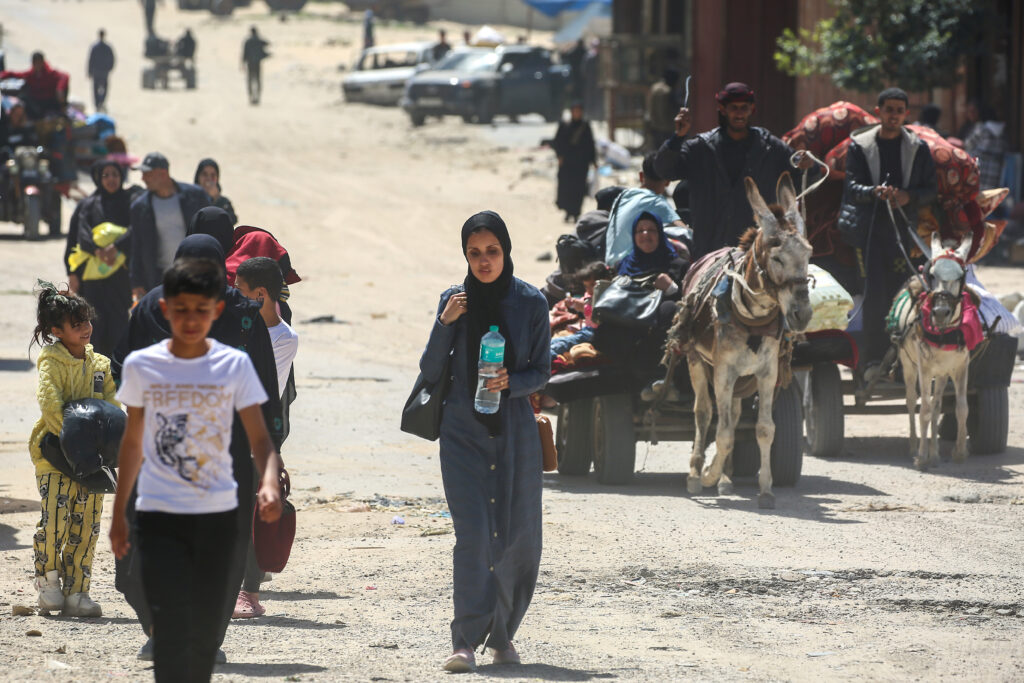
A senior Hamas official urged supporters worldwide on Monday to take up weapons and fight plans to displace Gaza’s people, as Israel issued a sweeping evacuation order in the territory’s south, stepping up its renewed offensive.The idea of forcing Gazans to leave the devastated territory for neighbouring countries such as Egypt and Jordan was first floated by US President Donald Trump, and has since been seized on by right-wing Israeli politicians, including Prime Minister Benjamin Netanyahu, who vowed on Sunday to implement it.”In the face of this sinister plan — one that combines massacres with starvation — anyone who can bear arms, anywhere in the world, must take action,” Sami Abu Zuhri said in a statement Monday.”Do not withhold an explosive, a bullet, a knife, or a stone. Let everyone break their silence.”AFPTV images showed residents of southern Gaza leaving the area on Monday following the Israeli military’s evacuation order warning of renewed operations.Some rode in cars piled high with belongings, while others pushed heavy carts and others carried nothing at all.The order, posted to X by army spokesman Avichay Adraee, included a map showing a swath of southern Gaza in red, including the city of Rafah.It said the military was “returning to fight with great force to eliminate the capabilities of terrorist organisations in these areas”, urging residents to head to the Al Mawasi area, northwest of Rafah.”I am currently on foot, there is no transportation, and I do not have the fare for a car ride. As you can see, we have no luggage with us — we left all our belongings behind,” said Ali Mansour, a resident of the city. Fellow Rafah resident Najah Dhahir, fleeing with her nine-month-old baby, said “they told us we had two hours to evacuate” before the Israeli army arrived.The head of the UN agency for Palestinian refugees (UNRWA) said “people are treated like pinballs with constant military orders playing with their fate & lives”.”As if death, diseases, destruction and hunger were not enough for the Palestinians in Gaza,” Philippe Lazzarini wrote on X.- Trump plan -Hamas’s call to arms came a day after Netanyahu offered to let the group’s leaders leave Gaza while demanding it disarm.The group has previously expressed a willingness to relinquish administration of Gaza, but has warned its weapons are a “red line”.Netanyahu said Sunday that after the war, Israel would ensure overall security in Gaza and “enable the implementation of the Trump plan” — which had initially called for the mass displacement of all 2.4 million people living in the Palestinian territory — calling it a “voluntary migration plan”.UK-based Alan Mendoza, founder of the Henry Jackson Society think tank, said it appeared that Israeli authorities were taking Trump’s plan seriously.”This alarms Hamas because their very existence depends on controlling Gaza,” Mendoza told AFP.Hamas had also been “shocked” by last week’s protests in Gaza against the group.”It is a two-pronged pressure (that Hamas is facing), both externally and internally,” Mendoza said.”Internally, Hamas led their own people to disaster and so if they make (the external pressure) a national cause then they can get people to rally around the flag.”Days after taking office in January, Trump floated a proposal to move Gaza’s population out of the war-battered territory, suggesting that Egypt or Jordan could take them in.Both countries, along with other Arab allies, governments around the world and the Palestinians themselves, have flatly rejected the notion.Trump later appeared to backtrack on the proposal, saying he was “not forcing” his widely condemned plan.- ‘Forced displacement’ -Arab nations have since come up with an alternative plan for rebuilding the Gaza Strip without relocating its people, which would take place under the future administration of the Ramallah-based Palestinian Authority.Israeli Defence Minister Israel Katz said in February that a special agency would be established for the “voluntary departure” of Gazans.Israel resumed intense bombing of Gaza on March 18 and then launched a new ground offensive, ending a nearly two-month ceasefire in the war with Hamas after negotiations to extend it hit an impasse.Since the fighting restarted, the health ministry in Hamas-run Gaza says that at least 1,001 people have been killed.Decrying attacks “against unarmed civilians” living in tents, Hamas in a statement Monday condemned a “policy of extermination and forced displacement”.The war was sparked by Hamas’s October 7, 2023, attack on Israel, which resulted in the deaths of 1,218 people, according to an AFP tally based on official Israeli figures.Israel’s retaliatory military campaign has killed at least 50,357 people in Gaza, the majority of them civilians, according to the territory’s health ministry.