AFP Asia Business
EU to review cooperation deal with Israel over Gaza
The EU on Tuesday ordered a review of its cooperation deal with Israel and Britain halted trade talks with it as European nations took a tougher line over the Gaza war.France renewed its commitment to recognise a Palestinian state, a day after Israel’s Prime Minister Benjamin Netanyahu angrily hit back at Britain, France and Canada for threatening action over his country’s military offensive and blockade of Gaza.EU foreign affairs chief Kaja Kallas said “a strong majority” of the 27 member states at a foreign ministers’ meeting backed the move in a bid to pressure Israel.”Countries see that the situation in Gaza is untenable, and what we want is to really help the people, and… to unblock the humanitarian aid so that it will reach the people,” Kallas told journalists.Momentum to re-examine the EU-Israel Association Agreement, which forms the basis for trade ties, has grown since Israel resumed a military offensive in Gaza after a ceasefire expired.Diplomats said 17 EU states pressed for the review under an article of the agreement that calls for a respect for human rights, with the Netherlands spearheading the latest push.- Divided EU acts -The EU has long been divided between countries backing Israel and those considered more pro-Palestinian. In a sign of the splits, in a separate move, Hungary blocked imposing more sanctions on Israeli settlers in the occupied West Bank.Belgium’s foreign minister Maxime Prevot said he had “no doubt” about the violation of rights in Gaza, and the review could lead to the suspension of the entire deal.Britain meanwhile suspended free-trade negotiations and summoned Israel’s ambassador. Foreign Secretary David Lammy accused Netanyahu’s government of “egregious actions and rhetoric” over its expansion of military operations in the Palestinian territory.Lammy told the British parliament that the government was imposing new sanctions on individuals and organisations involved in West Bank settlements.”The world is judging, history will judge them. Blocking aid, expanding the war, dismissing the concerns of your friends and partners. This is indefensible and it must stop,” he said.He said Britain would be “reviewing cooperation” with Israel under a so-called 2030 roadmap for UK-Israel relations. The “Netanyahu government’s actions have made this necessary,” Lammy said.Israel responded by saying “external pressure” would not stop the country “defending its existence and security against enemies who seek its destruction”.”If, due to anti-Israel obsession and domestic political considerations, the British government is willing to harm the British economy — that is its own prerogative,” Israeli foreign ministry spokesman Oren Marmorstein said in a statement.France also renewed its diplomatic criticism of Israel, with Foreign Minister Jean-Noel Barrot reaffirming a commitment to recognise a Palestinian state.”We cannot leave the children of Gaza a legacy of violence and hatred. So all this must stop, and that’s why we are determined to recognise a Palestinian state,” Barrot told France Inter radio.French President Emmanuel Macron joined British Prime Minister Keir Starmer and Canadian Prime Minister Mark Carney in a rare joint statement on Gaza on Monday that angered Israel.The three threatened “concrete actions” if Israel continued to block aid. Netanyahu said the statement was a “huge prize” for Hamas, which set off the Gaza war with its October 7, 2023 attacks on Israel.
Rubio says Syria could be weeks away from ‘full-scale civil war’
US Secretary of State Marco Rubio warned Tuesday that Syria could be weeks away from a fresh civil war of “epic proportions,” as he called for support to the transitional leadership.The top American diplomat blamed a resurgence of the Islamic State extremist group in areas outside of the transitional government’s control, as well as Iran.He told a US Senate hearing that the government, “given the challenges they’re facing, are maybe weeks — not many months — away from potential collapse and a full-scale civil war of epic proportions, basically the country splitting up.”Rubio spoke after a series of bloody attacks on the Alawite and Druze minorities in Syria, where Islamist-led fighters in December toppled then-president Bashar al-Assad, capping a brutal civil war that began in 2011.US President Donald Trump last week on a visit to Saudi Arabia announced a lifting of Assad-era sanctions and met with the guerrilla leader who is now Syria’s transitional president, Ahmed al-Sharaa.Sharaa, clad in a suit and complimented by Trump as a “young, attractive guy,” was until recently on a US wanted list over jihadist connections. Rubio quipped: “The transitional authority figures, they didn’t pass their background check with the FBI.”But he added: “If we engage them, it may work out, it may not work out. If we did not engage them, it was guaranteed to not work out.”Rubio, who also met with Syria’s foreign minister in Turkey on Thursday, said Iran was looking to work with remnants of the fallen ally Assad, a largely secular leader who hailed from the Alawite sect.Rubio acknowledged concerns about Syria’s direction in Israel, which has kept pounding military sites in the neighboring country.But Rubio, who has spoken twice in recent days to Israeli Prime Minister Benjamin Netanyahu, said a more stable Syria that did not serve as a “launchpad for attacks” would be an “extraordinary achievement for Israel’s security.”- EU ends sanctions -European Union countries, which had already suspended economic sanctions on Syria, gave the green light on Tuesday to lift all restrictions.”We want to help the Syrian people rebuild a new, inclusive and peaceful Syria,” top EU diplomat Kaja Kallas wrote on X after the bloc’s foreign ministers met in Brussels.EU diplomats said that move would unfreeze central bank assets and help reintegrate Syrian banks to the global system, although sanctions would remain on individuals over stirring ethnic tensions.Syria’s foreign ministry hailed the EU decision, saying it marked “the beginning of a new chapter in Syrian-European relations built on shared prosperity and mutual respect.”Syrian Foreign Minister Asaad al-Shaibani, welcoming his Jordanian counterpart to Damascus, said at a joint news conference that “the doors are open” for investment in Syria with the lifting of sanctions.The United States had previously insisted on key steps from Syria’s transitional authorities, including protection of minorities.Trump’s move on Syria was encouraged by Turkey — the main patron of the Islamist fighters who had battled Assad, an ally of Iran and Russia — and Sunni regional power Saudi Arabia.”The nations in the region want to get aid in, want to start helping them, and they can’t because they’re afraid of our sanctions,” Rubio said.Rubio has said Trump plans to waive the Caesar Act, which imposed sanctions for investment on Syria in an effort to ensure accountability regarding abuses under Assad.But such waivers would be temporary, and Syria remains classified by the US as a state sponsor of terrorism, a major impediment to business dealings.Rubio, asked if the administration sought to delist Syria from its terrorism blacklist, replied: “Yes, if they meet the standard.”
European nations increase pressure on Israel to stop broad Gaza offensive
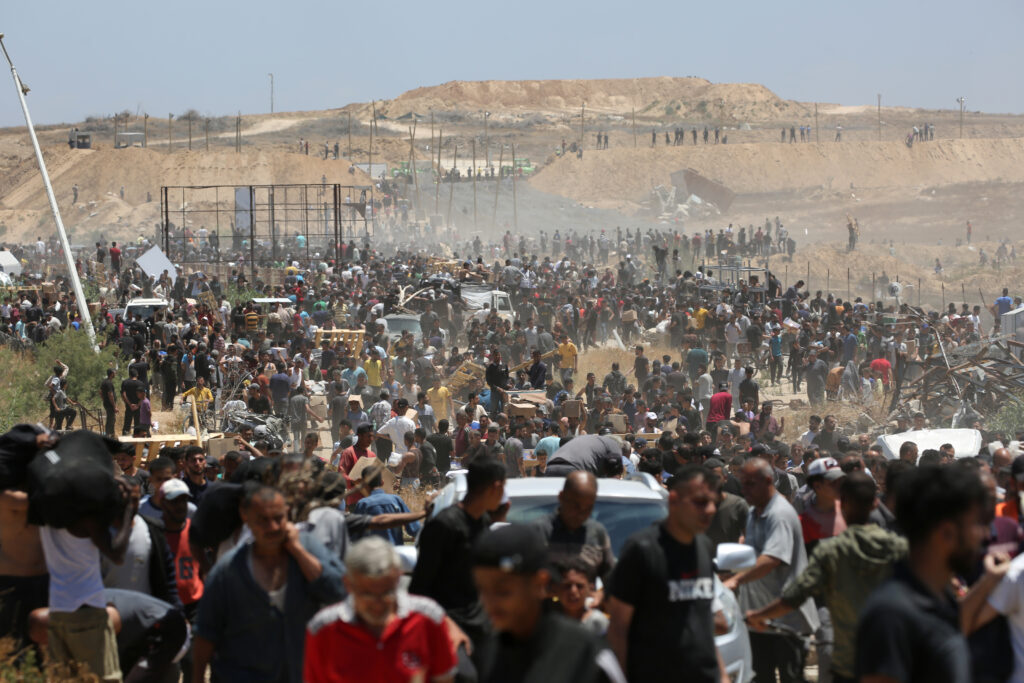
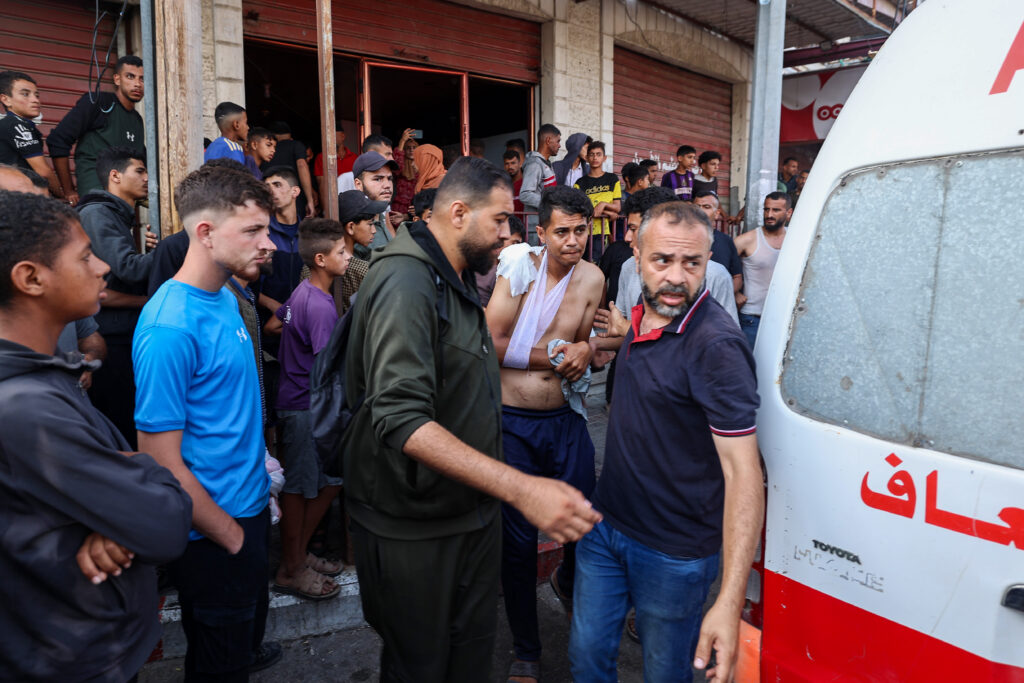
European countries ramped up pressure on Israel to abandon its intensified campaign in Gaza and let more aid into the war-ravaged territory, where rescuers said fresh attacks killed dozens of people on Tuesday.An AFP journalist saw some trucks entering the Kerem Shalom crossing into Gaza from the Israeli side on Tuesday, a day after the UN said it had been cleared to send aid for the first time since Israel imposed a total blockade on March 2, sparking severe shortages of food and medicine.The dire humanitarian situation in the Strip has prompted an international outcry, with the European Union saying it would review its trade cooperation deal with Israel over alleged human rights abuses following a foreign ministers’ meeting on Tuesday. The bloc’s top diplomat Kaja Kallas said “a strong majority” of its 27 member states backed the move, adding “the countries see that the situation in Gaza is untenable… and what we want is to unblock the humanitarian aid”.Sweden said it would press the EU to level sanctions against Israeli ministers.”Since we do not see a clear improvement for the civilians in Gaza, we need to raise the tone further,” said Foreign Minister Maria Malmer Stenergard.And Britain suspended free-trade negotiations with Israel, summoned the Israeli ambassador and said it was imposing sanctions on settlers in the occupied West Bank in its toughest actions so far against Israel’s conduct of the war.”Blocking aid, expanding the war, dismissing the concerns of your friends and partners. This is indefensible and it must stop,” Foreign Secretary David Lammy said in an impassioned speech to parliament.Responding to Britain’s moves, Israeli foreign ministry spokesman Oren Marmorstein said “external pressure will not divert Israel from its path in defending its existence and security”.- Flour, baby food, medicine -COGAT, the Israeli defence ministry body that oversees civil affairs in the Palestinian territories, said “93 UN trucks carrying humanitarian aid, including flour for bakeries, food for babies, medical equipment, and pharmaceutical drugs were transferred” to Gaza on Tuesday.The spokesman for UN chief Antonio Guterres confirmed dozens of trucks were allowed in, but spoke of difficulties receiving the deliveries.”Today, one of our teams waited several hours for the Israeli green light to… collect the nutrition supplies. Unfortunately, they were not able to bring those supplies into our warehouse,” Stephane Dujarric said.UN humanitarian chief Tom Fletcher said that the nine trucks cleared to enter on Monday were “a drop in the ocean of what is urgently needed”.He told the BBC on Tuesday that 14,000 babies could die in the next 48 hours if aid did not reach them in time.US Secretary of State Marco Rubio, replying to a Democrat’s comment during a Senate Foreign Relations Committee meeting, said he understood “that it’s not in sufficient amounts, but we were pleased to see that decision was made” to restart aid shipments.The Israeli army stepped up its offensive at the weekend, vowing to defeat Gaza’s rulers Hamas, whose October 7, 2023 attack on Israel triggered the war.Strikes overnight and early Tuesday left “44 dead, mostly children and women, as well as dozens of wounded”, civil defence spokesman Mahmud Bassal told AFP.Bassal said 15 people were killed when a petrol station was hit near the Nuseirat refugee camp, and eight others were killed in a strike on a school sheltering displaced Palestinians in Gaza City to the north.The Israeli military told AFP it had “struck a Hamas terrorist who was operating from within a command and control centre” inside the school compound. There was no comment on the other incidents.At the bombarded petrol station, Nuseirat resident Mahmoud al-Louh carried a cloth bag of body parts to a vehicle.”They are civilians, children who were sleeping. What was their fault?” he told AFP.In a statement on Tuesday, the military said it had carried out strikes on more than “100 terror targets” in Gaza over the past day.- ‘Irresponsible’ behaviour -On Monday, Prime Minister Benjamin Netanyahu said Israel would “take control of all the territory of the Strip” with its new campaign.Israel resumed operations across Gaza on March 18, bringing an end to a two-month ceasefire amid deadlock over how to proceed.Negotiators from Israel and Hamas began a new round of indirect talks in Doha over the weekend, just as the intensified campaign was getting underway.Qatar, which has been involved in mediation efforts throughout the war, said Tuesday that Israel’s “irresponsible, aggressive behaviour” had undermined the chances of a ceasefire.Hours later, Netanyahu’s office accused Hamas of refusing to accept a deal, saying Israel was recalling its senior negotiators but leaving the “working levels” of its team in Doha.A source close to Hamas alleged that Israel’s delegation “has not held any real negotiations since last Sunday”, blaming “Netanyahu’s systematic policy of obstruction”.The Hamas attack in October 2023 resulted in the deaths of 1,218 people on the Israeli side, mostly civilians, according to an AFP tally based on official figures.Militants also took 251 hostages, 57 of whom remain in Gaza including 34 the military says are dead.Gaza’s health ministry said Tuesday at least 3,427 people have been killed since Israel resumed strikes on March 18, taking the war’s overall toll to 53,573.
Back at Cannes, Iran filmmaker Panahi defies repression
Back in Cannes for the first time in 15 years, dissident Iranian filmmaker Jafar Panahi spoke to AFP about how he feels “alive” thanks to filmmaking and the danger of continuing to work in the Islamic republic.Imprisoned twice and until recently subjected to a travel ban, Panahi also said he was not afraid of the consequences of showing “It Was Just an Accident” in Cannes. The answers have been translated by AFP from the original Persian and edited for clarity:Q: Your new film “It Was Just an Accident” explores the moral dilemma faced by Iranians tempted to take revenge on their torturers. What does this say about the issues facing Iranian society?”We chose a range of characters, from violent to non-violent, from a simple man to someone completely detached from such concerns. “Through their actions and reactions, we reach — or perhaps fail to reach — a conclusion about what the right path might be.”We let the viewer decide for themselves, asking what would they do in that situation? For me, the real question is: what would I do if this actually happened? And honestly, I don’t know.”And in the end, perhaps the film suggests that the real issue lies within a flawed structure — and that the problem lies with the government, not the people trapped inside it.”Q: In what way does your film denounce a system of government?”It’s about how we can shape the future of this country. Where is it headed? Will this cycle continue, or will we reach a place where no one dictates how we dress, what we create, or what we eat? No one has the right to control that.”We are looking forward, thinking a few steps ahead. When will this become a reality? I don’t know. But I hope it will, and I believe that it will.”Q: You were sentenced in 2010 and imprisoned twice in Iran. Are you afraid for your safety when you return home after Cannes?”What matters most is that the film gets made… I haven’t made space in my thoughts for whatever else might happen. I’m alive as long as I’m making films. If I’m not making films, then what happens to me no longer matters.”Q: How do you feel about being back at the Cannes Festival?”The truth is I missed watching films with an audience because I couldn’t put my films on in cinemas, I couldn’t sit and watch them or see people’s reactions. That’s the biggest thing, to experience a film with an audience. When you watch a film with others, you feel alive. “Cannes is a bigger stage and has its own qualities, but what I truly want is to sit in a cinema with ordinary people in Iran and watch this film. That’s the most important thing.”Q: Do you fear being prevented from making films due to restrictions in Iran?”They (the Iranian government) have always stopped us from making films, but we find a way. It’s typical of regimes like this: they don’t let artists work, they don’t let anyone do what they love. “What matters is that you find a way, just as I and other friends have done. The important thing is not to give up trying, and not to expect a regime like this to suddenly say: ‘Go ahead, make your film.'”When they gave me a 15- or 20-year work ban, I could have easily gone home and told myself: ‘That’s it, it’s over. I can’t do anything, it’s not my fault,’ and then let myself sink into despair. “But I thought: ‘No — what should I do instead?’ The important thing is to keep working.”
Dissident director Panahi takes on Iran’s jailors in Cannes comeback
Dissident Iranian director Jafar Panahi vowed Tuesday to keep defying his country’s rulers after showcasing a hard-hitting film in Cannes about political prisoners and their torturers. After a travel ban was lifted, the 64-year-old flew to the Cannes Festival for the first time in 15 years for the premiere of “It Was Just An Accident”.It was applauded for more than eight minutes on its debut and is a likely strong contender for the festival’s top prize which will be awarded on Saturday.The story, written by Panahi, who spent nearly seven months in prison in 2022-2023, follows a group of ordinary Iranians confronted with a man they believe tortured them behind bars.”Many Iranian filmmakers are under pressure and banned from working, especially the female artists who were with the people in the Mahsa movement,” he said at the premiere, referring to the 2022 Iranian anti-government protest movement. “I would like to dedicate this screening to them and to the artists who have been involuntarily exiled from Iran.”Panahi told AFP that he intended to return home after the festival despite the dangers for him.”They (the Iranian government) have always stopped us from making films, but we found a way,” he said.”It’s typical of regimes like this — they don’t let artists work, they don’t let anyone do what they love. “The important thing is not to give up trying, and not to expect a regime like this to suddenly say, ‘Go ahead, make your film’,” he told AFP. Panahi shoots in secret and often smuggles his films out of Iran, once sending a documentary called “This is Not a Film” to the Cannes festival on a flash drive stashed in a cake.He was banned from making films for 20 years in 2010 and has been imprisoned twice over his gritty dramas that, like “It Was Just An Accident”, are often laced with humour.- Assange appears -A second Iranian film is competing in the top Cannes competition — “Mother and Child” by Saeed Roustaee.Roustaee was sentenced to six months jail for the screening of his film “Leila’s Brothers” at Cannes in 2022 but his latest production has drawn criticism from some exiled directors.The Iranian Independent Filmmakers Association (IIFMA) has called it a “propaganda film”, though it is unclear if they have seen it in full. Fellow Iranian Cannes favourite Mohammad Rasoulof, who fled the country last year, defended Roustaee.He told film magazine Variety that there was a “clear distinction between the propaganda films of the Islamic republic and the films that are made under the constraints of censorship”.Elsewhere in Cannes, Wikileaks founder Julian Assange promoted a documentary about him, “The Six Billion Dollar Man”, following his release from a British prison last year. Its director, Eugene Jarecki, was awarded the first ever Golden Globe for documentary at Cannes on Monday for his previous work, including his 2018 film about Elvis, “The King”. Ecuador’s left-wing former president Rafael Correa, who famously offered Assange asylum in the Ecuadorian embassy in London, was to attend the film’s red-carpet premiere on Wednesday. – Scarlett -Panahi and Assange’s presence comes at one of the most political Cannes for many years, dominated by protest over the war in Gaza, sexual politics and US President Donald Trump’s threat to impose tariffs on movies from “foreign lands”.Actors directing first films is also a trend this year, with “Twilight” star Kristen Stewart and “Babygirl” British actor Harris Dickinson both showcasing debut features.Scarlett Johansson faced tough initial reviews for her film “Eleanor the Great” after it premiered on Tuesday. Variety called it “an unconvincing crowd-pleaser”, while The Hollywood Reporter said it was “wobbly” and “a sentimental Holocaust weeper”.Denzel Washington went viral on Tuesday after a tense red carpet exchange with a photographer.The 70-year-old was presented with a surprise lifetime award on Monday at the premiere of his latest film with New York director Spike Lee, “Highest 2 Lowest”.The photographer had appeared to grab the actor by the arm as he posed in front of cameras. Washington shook him off and then pointed his finger at him and appeared to say “Stop it” a number of times, videos showed.
EU plans two-euro flat fee on small parcels from outside bloc
The EU said Tuesday that it was preparing to impose a two-euro ($2.25) flat fee on the billions of low-value packages that flood into the bloc each year, the great majority from China.Trade chief Maros Sefcovic told the European Parliament that e-commerce platforms would be expected to pay the levy per parcel, which aims to …
EU plans two-euro flat fee on small parcels from outside bloc Read More »