AFP Asia Business
Rocking ‘King Lear’ to draw young audience in Iran
An Iranian director is breathing new life into William Shakespeare’s “King Lear” with a bold staging in Tehran infused with rock music and a dazzling light show to attract younger audiences.In Iran, artists, writers, filmmakers, musicians and playwrights must walk a tightrope to avoid censorship of content the authorities deem inappropriate.But despite political tensions between Tehran and the West, many international works still make it to the Iranian stage.Now well-known actress Elika Abdolrazzaghi has taken on the challenge of reimagining “King Lear” for a contemporary audience.”If I had staged the original version, it would have been too heavy for people — they would have been bored,” the 45-year-old told AFP.To inject energy into the performance, Abdolrazzaghi has incorporated music from British rock band Muse and German industrial metal group Rammstein.Vivid costumes and sparkling lights lend the production a festive atmosphere, despite the play’s dark core.First published in the early 17th century, “King Lear” tells the story of a crumbling monarchy and a family torn apart by betrayal, power struggles and hunger for the throne.An ageing and weary Lear decides to divide his kingdom between his three daughters, based on how well they flatter him in public.- ‘No restrictions’ -Naive and prideful, Lear disowns Cordelia, his youngest daughter, who refuses to join the charade.”I transformed many word-heavy sections of the play into movement, imagery, music and dance,” Abdolrazzaghi said.The actors wear richly detailed costumes in bold reds, greens and yellows, inspired by classic fashions from the 17th century.Reza Yazdani, a household name in Iran’s rock scene, performs the Persian-language songs live on stage.The production has struck a chord with theatregoers.”We didn’t think we could sit through a two-hour play,” Amin, a 32-year-old engineer, told AFP.”But it was really good — from the actors’ performances to the music and set design,” he said after going to the play with his wife, Elham.With a company of around 100 people, including several dozen actors, Abdolrazzaghi and her team spent several months preparing the show.”In Iran there are many women directing theatre, but few are well known,” she said.Abdolrazzaghi, who has performed in works by Bertolt Brecht, Friedrich Durrenmatt from Switzerland and France’s Yasmina Reza, says the Iranian authorities impose “no restrictions” on staging foreign plays.- ‘A more just world’ -“Theatre is essentially a Western phenomenon and remains a young art form in Iran,” said Abdolrazzaghi.Ahmad Saatchian, the lead actor and a stage veteran with two decades of experience, calls Lear “the greatest role” of his career.”Portraying one of the most important characters in literary history is a rare opportunity for an actor,” he said.Tragedies such as “King Lear” are “universal and resonate with people around the world — that’s why Shakespeare remains timeless,” he added.In recent years, many of Shakespeare’s works have been performed in Iran.”Countries that have experienced similar political dynamics — like Iran or those in Eastern Europe — tend to connect deeply with Shakespeare’s work,” said Saatchian.In the final act, Lear, broken by betrayal, regains clarity before his death.”In one scene, Lear calls on those in power to expose themselves to the suffering of the poor in order to build a more just world,” Saatchian said.”That’s a message that resonates everywhere.”
Pineapple is the new potato: imported fruits back in Syria
After decades of poverty and isolation under the Assad dynasty, imported fruits like pineapples, kiwis and mangoes are available again in Syria’s bustling markets, making mouths water and eyes twinkle.Fruits that were once designated luxury items, meaning they were accessible only to Syria’s wealthiest, are now as common as potatoes or onions, cooking staples for many of the country’s population.”We used to smuggle them in,” said 46-year-old fruit vendor Marwan Abu Hayla with a big smile as he displayed his produce at Damascus’s Shaalan market.Grocers used to face fines and even imprisonment for importing exotic fruits.But now “we do not hide pineapples any more — we can put them on display”, Abu Hayla told AFP, adding: “The era of pineapple-phobia is over.”One kilogram of pineapple used to cost around 300,000 Syrian pounds (around $23) before an Islamist-led offensive ousted leader Bashar al-Assad in December after nearly 14 years of civil war.That has now plummeted to a much sweeter price of around 40,000 pounds, about $4.”We used to smuggle (the fruit) with the help of taxi drivers — just like petrol and diesel,” Abu Hayla said of other commodities which Syrians used to bring in illicitly from neighbouring Lebanon when supplies were scarce under Assad.Now “pineapples are like potatoes and onions”, he added, as potential customers eyed the ripe fruit.- Bananas -Buyers and sellers linked the fruits’ newfound presence to developments including the free availability of the US dollar since Assad’s ousting. Trading in the currency was previously punishable by law.Other signs of change include new cars on the streets and more abundant fuel supplies.The late Syrian president Hafez al-Assad imposed heavy state control over the economic system, which isolated the country from global trade.His son and successor Bashar kept up the system to maintain the clan’s iron-fisted rule until he was overthrown in December.Fruit seller Ahmed al-Hareth, 45, said tropical fruit — even bananas — used to cost the equivalent of a public employee’s monthly salary.Customs authorities and security forces would raid stores, further fuelling a limited black-market fruit trade.Medical student Nour Abed al-Jabbar, 24, said she “used to see tropical fruit on screens more often than in markets”.One problem with that: some Syrians who have never had a pineapple before just don’t know how to cut it. “Pineapple is for everyone — even if some people don’t know how to peel it,” Jabbar said.However, many people still struggle to buy the fruit in a country whose economy has been ravaged by years of conflict and sanctions, and where 90 percent of the people live in poverty.Housewife Ilham Amin, 50, said she had noticed grocery stores becoming more colourful, which “tempts customers to buy”.But she steers her children away from the tantalising new fruit as she cannot afford it.”Living conditions are tough, and pineapple is a luxury for a family like ours,” she said.
Iraq’s Jewish community saves a long-forgotten shrine
In a vibrant Baghdad district, labourers are working tirelessly to repair the centuries-old shrine of a revered rabbi in an effort to revive the long-faded heritage of Iraq’s Jewish community.A few months ago, the tomb of Rabbi Isaac Gaon was filled with rubbish. Its door was rusted, the windows shattered and the walls stained black from decades of neglect.Today, marble tiling covers the once-small grave, and at its centre stands a large tombstone inscribed with a verse, the rabbi’s name and the year he died: 688. A silver menorah hangs on the wall behind it.”It was a garbage dump and we were not allowed to restore it,” said the head of Iraq’s Jewish community, Khalida Elyahu, 62.The Jewish community in Iraq was once one of the largest in the Middle East, but now it has dwindled to just dozens.Baghdad today has one synagogue left, but it has no rabbis. And many houses that once belonged to Jews are abandoned and dilapidated.The Jewish community itself is funding the shrine’s restoration, at an estimated cost of $150,000. The project will bring “a revival for our community, both within and outside Iraq”, Elyahu said.With the backing of Iraqi officials, she said she hopes to restore more neglected sites.- Who was he? -Little information is available about Rabbi Isaac. But when Iraq’s National Security Adviser Qassem al-Araji visited the tomb earlier this year, he said the rabbi had been a finance official.Rabbi Isaac Gaon was prominent during the Gaonic period, also known as the era of Babylonian academies for rabbis.The term “Gaon” is likely to refer to his position as the head of one such academy.His name was mentioned in the 10th century by another rabbi, who told a tale that never appeared elsewhere, according to Professor Simcha Gross from the University of Pennsylvania.”There is only one single story,” said Gross.It goes that Rabbi Isaac led 90,000 Jews to meet Ali Ibn Abi Talib, the fourth Islamic caliph and a relation of the Prophet Mohammed, who is also revered by Shiites as the first Imam, during one of his conquests in central Iraq.”We have no other evidence for this event, and there are reasons to be sceptical,” Gross said.Nothing else is known about Rabbi Isaac, not even his religious opinions.But the tale has origins that are not without context, said Gross.In the 10th century, minorities — Christians, Jews, and Zoroastrians — began to tell stories of how they greeted “Muslim conquerors” because “their privileges including taxes were dependent on whether or not they were believed to have welcomed the Muslims”, he said.At that same time, Jewish shrines started to appear, even though Jewish roots in Iraq date back some 2,600 years.According to biblical tradition, Jews arrived in Iraq in 586 BC as prisoners of Babylonian king Nebuchadnezzar II after he destroyed Solomon’s Temple in Jerusalem.In Iraq, they wrote the Babylonian Talmud.Thousands of years later, in Ottoman-ruled Baghdad, Jews made up 40 percent of the population. A turning point was the 1941 pogrom in Baghdad when more than 100 Jews were killed. Like other Jewish communities in the Arab region, their history has changed since the Palestinian Nakba — “catastrophe” in Arabic — and Israel’s creation in 1948. Soon afterwards, almost all of Iraq’s 135,000 Jews went into exile. – Blessings -Decades of conflict and instability — Saddam Hussein’s dictatorship, the 2003 US-led invasion and the ensuing violence — completed the community’s erosion.Some who stayed on converted to other religions, or do not reveal their faith.Today, 50 synagogues and Jewish sites remain, Elyahu said. Most are crumbling, and some have become warehouses.Rabbi Isaac’s shrine once included a synagogue and a school, but has been reduced to the small room housing the grave, the restoration’s supervisor said.”It took us two months to clean it of garbage,” said the supervisor, who asked to remain anonymous.Now “we are receiving requests from outside Iraq to visit it”.Decades ago people would come to pray and light candles, believing in the rabbi’s “healing powers”.Mussa Hayawi, 64, lives nearby. He recounted stories from his childhood in a quarter which was, until the 1940s, one of several Jewish districts in Baghdad.He said women used to soak themselves in water from the shrine’s well, hoping to conceive.Rabbi Isaac “was a revered man”. People came “to pray for their sick, to ask for a baby, or the release of a prisoner”, Hayawi said.
China not trying to ‘replace’ US in Colombia: ambassador
China is not seeking to “replace” the United States as the top trading partner of Colombia, Beijing’s ambassador to Bogota, whose president has announced a pivot to China, told AFP on Tuesday.Until recently Colombia was one of the United States’ closest trade and security partners in Latin America. But the country’s first leftist president Gustavo Petro, …
China not trying to ‘replace’ US in Colombia: ambassador Read More »
Stocks climb as US-EU trade tensions ease
Wall Street shares bounced on Tuesday while Europe maintained a rally after US President Donald Trump delayed huge tariffs on imports from the EU over the long holiday weekend.New York’s main stock markets all rebounded vigorously as trading resumed after the Memorial Day weekend, with the broad-based S&P 500 finishing more than two percent higher …
Thousands rush into new aid distribution centre in south Gaza
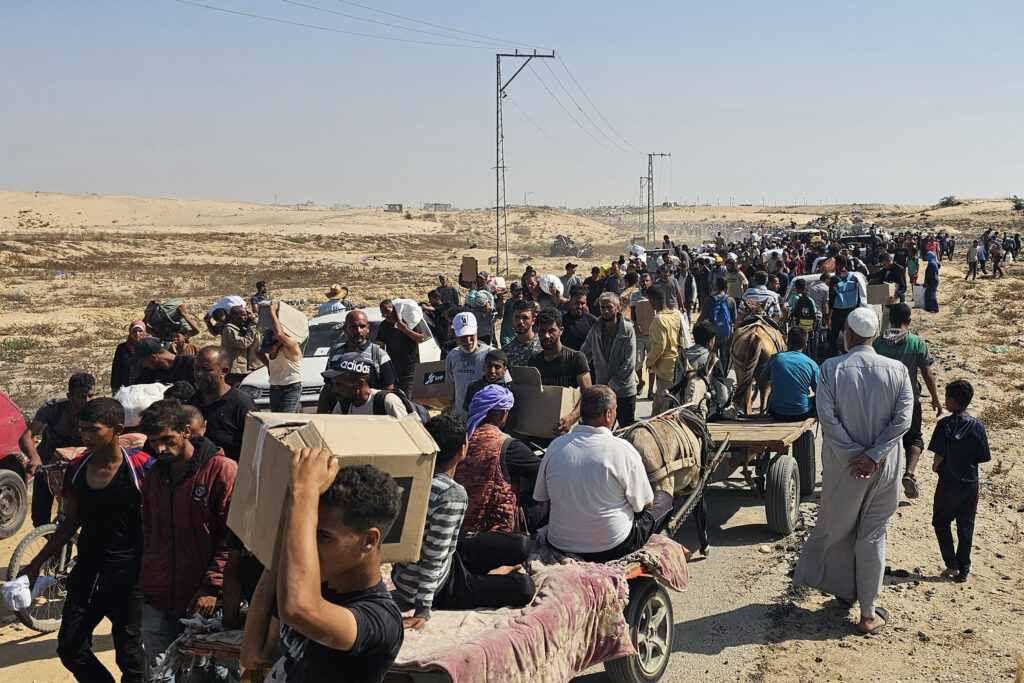
Thousands of Palestinians rushed into a new aid distribution centre run by a US-backed group in southern Gaza on Tuesday, AFP journalists reported, leading to chaotic scenes as Israel implemented a new distribution system.The incident in Rafah came days after the partial easing of a total aid blockade on the territory that Israel imposed on March 2, leading to severe shortages of food and medicine.Israeli Prime Minister Benjamin Netanyahu later acknowledged a “loss of control momentarily” at the centre, but a senior military official said the distribution was nonetheless “a success”.According to the US-backed Gaza Humanitarian Foundation (GHF), normal operations resumed following the incident.Ayman Abu Zaid, a displaced Gazan, told AFP he was standing in line at the centre when “suddenly a large number of people started pushing and entering randomly”. “It was because of the lack of aid and the delay in distribution, so they tried to get in to take whatever they could,” he said.At one point, “the Israeli forces started shooting, and the sound was very frightening, and people began to scatter, but some still kept trying to take the aid despite the danger”, he added.The Israeli military later said its “troops fired warning shots in the area outside the compound”, and that it had re-established “control over the situation”.GHF said in a statement that there was a point at which the “volume of people at the SDS (distribution centre) was such that the GHF team fell back to allow a small number of Gazans to take aid safely and dissipate”.”Normal operations have resumed,” it added.AFP footage showed crowds of people streaming out of the area on Tuesday carrying supplies, including in boxes marked “GHF”.- ‘462,000 meals’ -GHF blamed “blockades imposed by Hamas” for creating delays of several hours at one of its centres.In a statement of its own, Hamas’s government media office said Israel’s new efforts to distribute aid in Gaza had “failed miserably”.”This failure occurred after thousands of hungry people, who have been besieged by the occupation and deprived of food and medicine for about 90 days, rushed toward these areas in a tragic and painful scene,” the statement said. In its statement on Tuesday, the GHF said around “8,000 food boxes have been distributed so far… totalling 462,000 meals”. It previously said it had commenced operations the day before.A senior Israeli military official told AFP that “today’s distribution of aid by American providers was a success”, saying Hamas had sought to frighten civilians into staying away, but Gazans turned out to collect thousands of aid packages nonetheless. Israel has facilitated GHF’s efforts to distribute aid in Gaza, saying it aims to keep supplies out of Hamas’s hands.”We worked out a plan with our American friends to have controlled distribution sites where an American company would distribute the food to Palestinian families,” Netanyahu said on Tuesday. “There was some loss of control momentarily. Happily, we brought it back under control.”- ‘Heartbreaking’ scenes -GHF has faced accusations of helping Israel fulfil its military objectives while excluding Palestinians, bypassing the UN system, and failing to adhere to humanitarian principles.A spokesman for UN chief Antonio Guterres called Tuesday’s scenes “heartbreaking”, adding that “we and our partners have a detailed, principled, operationally sound plan supported by Member States to get aid to a desperate population”.Registered in Geneva in February, GHF has no known offices or representatives in the unofficial capital of the humanitarian world.Its former executive director, Jake Wood, announced his resignation on Sunday, saying it was impossible to do his job in line with humanitarian principles.Some humanitarian workers have argued that the designation of secure distribution sites contravenes the principle of humanity because it would force already displaced people to move again in order to stay alive.Critics have also questioned who determined the location of the distribution points — especially in light of Israel’s plans for the “conquest” of Gaza.In an article published on May 24, The New York Times, citing unnamed Israeli officials, reported that a new US-backed aid plan for Gaza had been “conceived and largely developed by Israelis as a way to undermine Hamas”.The United Nations has ruled out involvement in GHF’s plan, with a spokesman saying that it “does not accord with our basic principles, including those of impartiality, neutrality, independence”.COGAT, the Israeli defence ministry body that oversees civilian affairs in the Palestinian territories, said “95 trucks belonging to the UN and the international community carrying humanitarian aid” were allowed into Gaza on Tuesday.Separately, it alleged that hundreds of trucks were piling up just inside the Gaza Strip waiting to be picked up by the UN.”Don’t fall for misinformation,” it said on X. “The UN still refuses to do its job.”
Sudan’s RSF attacks army amid cholera outbreak
A paramilitary drone strike hit a fuel depot and a military base in war-torn Sudan’s south Tuesday, a military source said, as the capital Khartoum battles a deadly cholera outbreak.The paramilitary Rapid Support Forces (RSF), targeted the city of Kosti in White Nile State, after weeks of a long-range drone campaign that has hit vital infrastructure across the country.The RSF and regular army have been locked in a devastating war since April 2023.”The drone strike caused the depot to catch fire,” the military source told AFP, speaking on condition of anonymity because they were not authorised to brief the media.Eyewitnesses in Kosti, some 320 kilometres (200 miles) south of Khartoum, reported hearing explosions and seeing columns of thick smoke over the city.The RSF drone offensive began after the army wrested back control of the capital in March.Last week, army forces pushed the paramilitaries out of their last holdouts in the greater Khartoum area.This month, the RSF has launched strikes across Khartoum, including on three power stations, triggering a massive blackout that disrupted electricity and water services and unleashed a cholera outbreak.In a statement on Tuesday, the army-aligned health ministry reported more than 2,700 cholera infections and 172 deaths in just seven days across six states, with 90 percent of cases concentrated in Khartoum state.Cholera is endemic to Sudan, but outbreaks have become worse and more frequent since the war broke out, wrecking already fragile water, sanitation and health infrastructure.Last Tuesday, the ministry said 51 people had died of cholera out of more than 2,300 reported cases over the past three weeks, 90 percent of them in Khartoum state.Sudan’s doctors’ union sounded the alarm on Tuesday, saying actual figures were far higher than those reported by the ministry, with hundreds dead in the capital alone.In a statement, it warned there was a “severe shortage of intravenous solutions, a lack of clean water sources and a near-total absence of sterilisation equipment and disinfectants” in the city’s hospitals.- Lying on hospital floors -With electricity supply and subsequently the local water network out of service, the people of Khartoum have been forced to turn to unsafe water sources, according to Doctors Without Borders (MSF).”Water treatment stations no longer have electricity and cannot provide clean water from the Nile,” Slaymen Ammar, MSF’s medical coordinator in Khartoum, said in a statement.People in Omdurman, part of greater Khartoum, say they have had no electricity for nearly two weeks.”We now fetch water directly from the Nile, buying it from donkey carts that bring it in barrels,” resident Bashir Mohamed said.According to a doctor at Omdurman’s Al-Nao hospital, the capital’s main functioning health facility, residents have resorted to “drinking untreated Nile water, after the shutdown of water pumping stations”.He said this “is the main reason for the rapid spread” of cholera.Medics in the already overwhelmed hospital are struggling to keep pace with the outbreak, and the local emergency response room (ERR) has issued a call for more volunteers.”The number of patients exceeds the hospital’s capacity,” a member of the ERR told AFP, requesting anonymity for safety reasons.”There is not enough medical staff. Some patients are lying on the floors in hospital corridors,” he said.Cholera, an acute diarrhoeal illness caused by ingesting contaminated water or food, can kill within hours if untreated.It is easily preventable and treatable when clean water, sanitation and timely medical care are available.Sudan’s already fragile healthcare system has been pushed to “breaking point” by the war, according to the World Health Organization.Up to 90 percent of the country’s hospitals have at some point been forced to close because of the fighting, according to the doctors’ union, with health facilities regularly stormed, bombed and looted.The war, now in its third year, has killed tens of thousands of people, displaced 13 million and created the world’s largest displacement and hunger crisis.