AFP Asia Business

Gaza rescuers say Israeli fire kills 36, six near aid centre

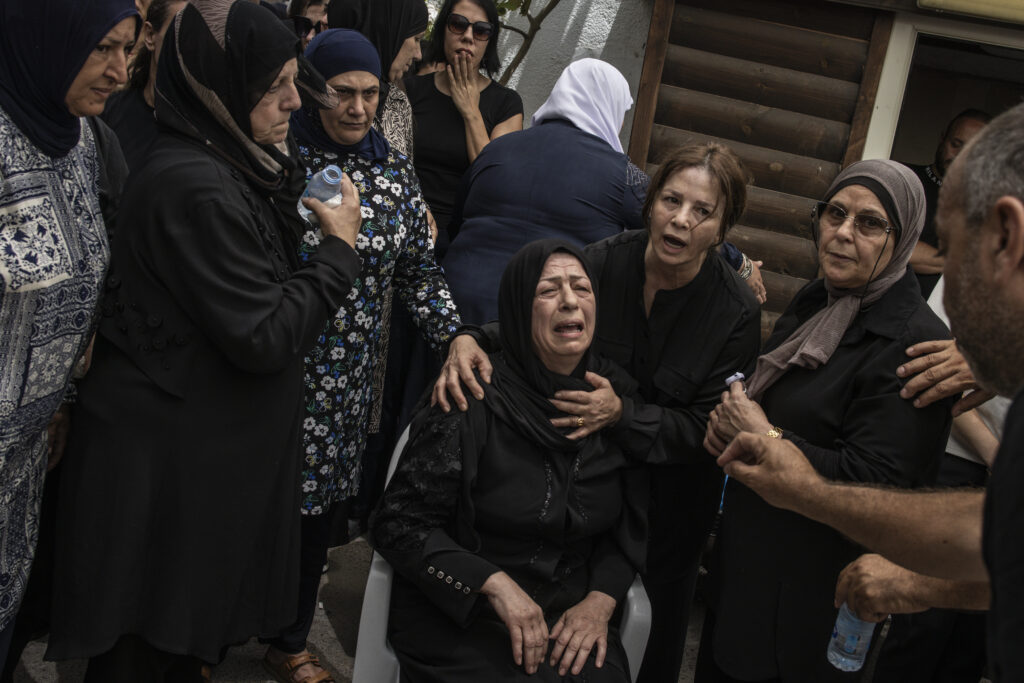
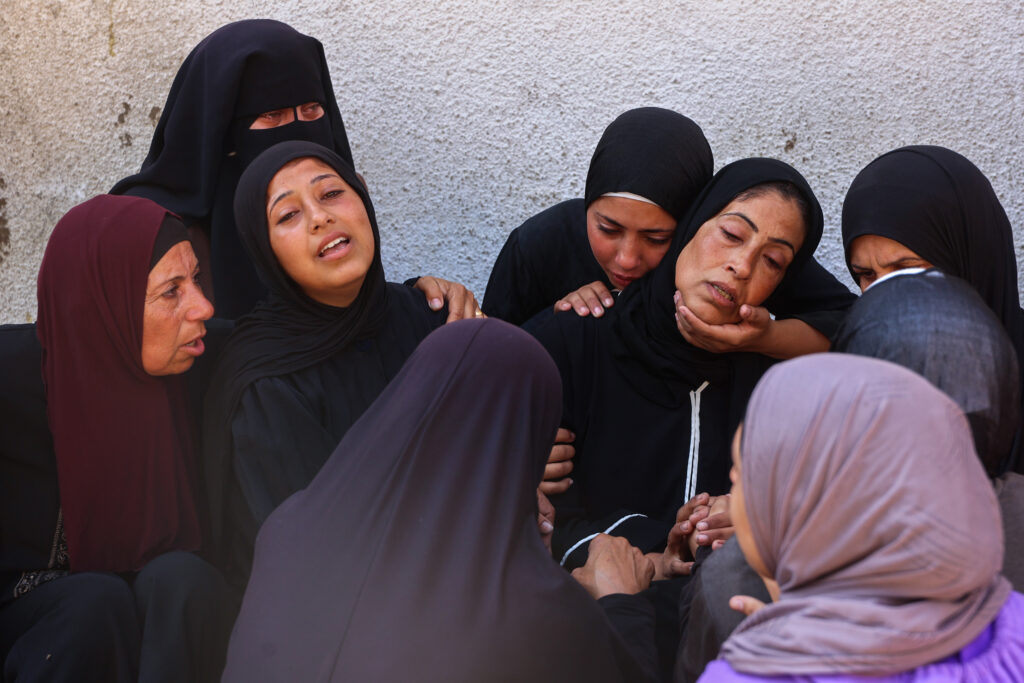
Gaza’s civil defence agency said Saturday that Israeli forces had killed at least 36 Palestinians, six of them in a shooting near a US-backed aid distribution centre.The Israeli military told AFP that troops had fired “warning shots” at individuals it said were “advancing in a way that endangered the troops”.The shooting deaths were the latest reported near the aid centre run by the Gaza Humanitarian Fund (GHF) in the southern district of Rafah, and came after it resumed distributions following a brief suspension in the wake of similar deaths earlier this week. Meanwhile, an aid boat with 12 activists on board, including Swedish climate campaigner Greta Thunberg, was nearing Gaza in a bid to highlight the plight of Palestinians in the face of an Israeli blockade that has only been partially eased.Civil defence spokesman Mahmud Bassal told AFP that at around 7:00 am (0400 GMT), “six people were killed and several others wounded by the forces of the Israeli occupation near the Al-Alam roundabout”, where they had gathered to seek humanitarian aid from the distribution centre around a kilometre away.AFP is unable to independently verify the tolls compiled by the civil defence agency or the circumstances of the deaths it reports.Samir Abu Hadid, who was there early Saturday, told AFP that thousands of people had gathered near the roundabout.”As soon as some people tried to advance towards the aid centre, the Israeli occupation forces opened fire from armoured vehicles stationed near the centre, firing into the air and then at civilians,” Abu Hadid said.The GHF said in a statement it had not distributed aid on Saturday because of “direct threats” from Hamas.Later Saturday, the Israeli army said an operation in Gaza City resulted in the killing of Asaad Abu Sharia, reportedly head of the Mujahideen Brigades.The armed group is close to Hamas ally Islamic Jihad that Israel has also accused over deaths of hostages seized from Kibbutz Nir Oz near the border.The army said he had taken part in the bloody attack on Nir Oz when Hamas launched its October 7, 2023 attack on Israel. It said he was “directly implicated” in the killings of Shiri, Ariel and Kfir Bibas, a family who became a symbol of seized hostages for many in Israel. – Activist boat nears Gaza -The GHF, officially a private effort with opaque funding, began operations in late May as Israel partially eased a more than two-month-long aid blockade.UN agencies and major aid groups have declined to work with it, citing concerns it serves Israeli military goals.On Saturday, the health ministry in Hamas-run Gaza said that the overall toll for the Gaza war had reached 54,772, the majority civilians. The UN considers these figures reliable.The war was sparked by Hamas’s October 2023 attack on Israel, which resulted in the deaths of 1,218 people on the Israeli side, mostly civilians, according to an AFP tally of official figures. Israel has come under increasing international criticism over the dire humanitarian situation in Gaza, where the UN warned in May that the entire population was at risk of famine.The aid boat Madleen, organised by an international activist coalition, was sailing towards Gaza on Saturday, aiming to breach Israel’s naval blockade and deliver aid to the territory, organisers said.”We are now sailing off the Egyptian coast,” German human rights activist Yasemin Acar told AFP, saying they expected to reach Gaza by Monday.The Palestinian territory was under Israeli naval blockade even before Hamas’s October 2023 attack and the Israeli military has made clear it intends to enforce it.A 2010 commando raid on the Turkish ship Mavi Marmara, which was part of a similar attempt to breach Israel’s naval blockade, left 10 civilians dead.- Evacuation order -The Israeli military has stepped up its operations in Gaza in recent weeks in what it says is a renewed push to defeat Hamas, whose October 2023 attack sparked the war.On Saturday, the military issued evacuation orders for neighbourhoods in northern Gaza, saying they had been used for rocket attacks.Also on Saturday, Hamas released a photograph of one of the remaining hostages, Matan Zangauker, appearing to be in poor health, with a warning that he would not survive.His mother, Einav Zangauker, speaking at a protest in Tel Aviv, said “I can no longer bear this nightmare. The angel of death, Netanyahu, continues to sacrifice the hostages”.During the October 2023 attack, militants abducted 251 hostages, 55 of whom remain in Gaza, including 31 the Israeli military says are dead.

Gaza rescuers say Israel fire kills 36, six of them near aid centre

Gaza’s civil defence agency said Israeli forces killed at least 36 Palestinians on Saturday, six of them in a shooting near a US-backed aid distribution centre.The Israeli military told AFP that troops had fired “warning shots” at individuals that it said were “advancing in a way that endangered the troops”.The shooting deaths were the latest reported near the aid centre run by the Gaza Humanitarian Fund (GHF) in the southern district of Rafah and came after it resumed distributions following a brief suspension in the wake of similar deaths earlier this week. Meanwhile, an aid boat with 12 activists on board, including Swedish climate campaigner Greta Thunberg, was nearing Gaza in a bid to highlight the plight of Palestinians in the face of an Israeli blockade that has only been partially eased.Civil defence spokesman Mahmud Bassal told AFP that at around 7:00 am (0400 GMT), “six people were killed and several others wounded by the forces of the Israeli occupation near the Al-Alam roundabout”, where they had gathered to seek humanitarian aid from the distribution centre around a kilometre (a little over half a mile) away.AFP is unable to independently verify the tolls compiled by the civil defence agency or the circumstances of the deaths it reports.Samir Abu Hadid, who was there early Saturday, told AFP that thousands of people had gathered near the roundabout.”As soon as some people tried to advance towards the aid centre, the Israeli occupation forces opened fire from armoured vehicles stationed near the centre, firing into the air and then at civilians,” Abu Hadid said.The GHF said in a statement it had not distributed aid on Saturday because of “direct threats” from Hamas.It said it was adapting its operations to “overcome these threats” and planned to “resume distributions without delay”.- Activist boat nears Gaza -The GHF, officially a private effort with opaque funding, began operations in late May as Israel partially eased a more than two-month-long aid blockade.UN agencies and major aid groups have declined to work with it, citing concerns it serves Israeli military goals.On Saturday, the health ministry in Hamas-run Gaza said that the overall toll for the Gaza war had reached 54,772, the majority civilians. The UN considers these figures reliable.The war was sparked by Hamas’s October 2023 attack on Israel, which resulted in the deaths of 1,218 people on the Israeli side, mostly civilians, according to an AFP tally of official figures. Israel has come under increasing international criticism over the dire humanitarian situation in Gaza, where the UN warned in May that the entire population was at risk of famine.The aid boat Madleen, organised by an international activist coalition, was sailing towards Gaza on Saturday, aiming to breach Israel’s naval blockade and deliver aid to the territory, organisers said.”We are now sailing off the Egyptian coast,” German human rights activist Yasemin Acar told AFP. She said they expected to reach Gaza by Monday morning.The Palestinian territory was under Israeli naval blockade even before Hamas’s October 2023 attack and the Israeli military has made clear it intends to enforce it.”For this case as well, we are prepared,” army spokesman Brigadier General Effie Defrin said on Tuesday. “We have gained experience in recent years, and we will act accordingly.”A 2010 commando raid on the Turkish ship Mavi Marmara, which was part of a similar attempt to breach Israel’s naval blockade, left 10 civilians dead.- Body of Thai hostage recovered -The Israeli military has stepped up its operations in Gaza in recent weeks in what it says is a renewed push to defeat Hamas, whose October 2023 attack sparked the war.On Saturday, the military issued evacuation orders for neighbourhoods in northern Gaza, saying they had been used for rocket attacks.Meanwhile the World Health Organisation said in a statement there were no functioning hospitals left in northern Gaza and said the healthcare system in the territory was collapsing.It also warned that the last two functioning hospitals in Khan Yunis in southern Gaza were at risk and called for them to be protected. Separately, in a special operation in the Rafah area on Friday, Israeli forces retrieved the body of Thai hostage Nattapong Pinta, Defence Minister Israel Katz said.Thai Foreign Ministry spokesman Nikorndej Balankura said the country was “deeply saddened” by his death.Also on Saturday, Hamas released a photograph of one of the remaining hostages, Matan Zangauker, appearing to be in poor health, with a warning that he would not survive.His mother, Einav Zangauker, speaking at a protest in Tel Aviv, said “I can no longer bear this nightmare. The angel of death, Netanyahu, continues to sacrifice the hostages”.During the October 2023 attack, militants abducted 251 hostages, 55 of whom remain in Gaza, including 31 the Israeli military says are dead.

Cristiano Ronaldo rules himself out of Club World Cup

Cristiano Ronaldo confirmed he would not play in the upcoming Club World Cup on Saturday, dismissing rumours he was set to transfer to one of the participating clubs. Speaking ahead of Sunday’s Nations League final against Spain in Munich, the Portugal captain said suggestions he was set to take part in the newly expanded competition were wide of the mark.”I will not be at the Club World Cup,” the Portugal veteran said, but added he had “been contacted” by several participating teams. Ronaldo came into Nations League in Germany amid swirling doubts about his future at club level, with the veteran’s contract at Saudi side Al-Nassr set to expire at the end of June.In May, the Portuguese posted on social media “the chapter is over” as reports emerged he could switch to another club, potentially Saudi side Al Hilal, one of the teams who will be at the tournament in the United States in June.Ronaldo said he was not interested in making a short-term decision which would allow him to play in the competition.”Some teams reached out to me. Some made sense and others did not, but you can’t try and do everything, you can’t catch every ball.”The forward said the decision on his future was “almost final”.

In Tunisia’s arid south, camel milk offers hope for economic gain

Deep in Tunisia’s desert south, camels stride toward humming milking machines. Their milk is at the heart of a women-led project promising an economic lifeline for disadvantaged communities.Spearheading this effort is 32-year-old Latifa Frifita, who launched Tunisia’s first, and so far only, camel milk pasteurisation unit two years ago in Medenine.The unit is based on research by Amel Sboui, 45, a senior biochemist at the Institute of Arid Regions, who succeeded in patenting a pasteurisation method that preserves camel milk’s “nutritional and therapeutic qualities” while extending its shelf life to two weeks.Containing up to five times more iron than cow’s milk, camel milk is non-allergenic and some studies have suggested that it has immune-boosting and anti-inflammatory properties.Pasteurisation of camel milk is essential to bringing it to wider markets because the milk is highly perishable.Sboui and her lab of ten researchers — eight of them women — also conducted clinical trials at the regional hospital which showed that consuming the milk could help diabetic patients reduce their medication doses by up to half in some cases.- Growing demand -Jobs and investment in southern Tunisia are scarce, yet entrepreneur Frifita has pinned her hopes on a product long undervalued by local herders and is working to change their minds.At first, she said she faced many challenges when trying to convince the herders to sell milk instead of meat — a far more common commodity.”They didn’t see the point,” she said while testing a fresh sample of the milk, wearing a hairnet. “They usually keep it for themselves or give it away for free.”But, having built “a relationship of trust” and with demand for the product growing, Frifita said she planned to reach further agreements with breeders.Frifita, who holds a master’s degree in food technologies, began sketching out her idea in 2016, but it was not until 2023 that she launched ChameLait with the support of the Institute, which provided her startup with premises to operate.Today, she is happy to “promote a local product that defines southern Tunisia”, where dromedaries are a fixture of the landscape, she said.A mother of a two-year-old girl, she said she chose to “stay and invest in her region” rather than following her sports coach husband to the Middle East.The station in Chenchou, about 100 kilometres (60 miles) south of Medenine, also serves as a training site for herders to learn mechanised milking, which yields up to seven litres a day compared to just two litres with traditional hand milking.Frifita now runs the business alongside two other women — one of them her older sister, Besma — producing about 500 litres of pasteurised milk per week with the aim of doubling their output within two years.ChameLait sells its products on demand and through a dozen retail shops, starting at 12 Tunisian dinars (about $4) per litre — double the price Frifita pays breeders.And the demand has been growing.Amel Sboui, a 45-year-old senior researcher at the Institute, said this was largely due to word of mouth because of “people realising the milk’s health benefits”.- ‘A future in Tunisia’ -Beyond ChameLait and with more research needed, Sboui said he saw additional potential in freeze-dried camel milk, which could one day be sold “as a medicine, a functional food or food supplement”.The Institute views Frifita’s business as a model enterprise.Established under a programme by Tunisia’s first president, Habib Bourguiba, the organisation aims to use scientific research to benefit the country’s harshest and most neglected areas.Medenine, with a population of a little over half a million, suffers from high levels of poverty and unemployment — 22 and 19 percent respectively, compared to national averages of 15 and 16 percent.These conditions have driven thousands of young people to leave, either for coastal cities or to seek opportunities abroad.”Our primary goal, even as a research centre, is to create added value and jobs,” said Moez Louhichi, head of innovation at the Institute.By supporting “farmers and young entrepreneurs in promoting the region’s resources, we encourage them to build their future here in Tunisia”.Since 2010, the Institute has helped launch 80 businesses, creating between 600 and 1,000 jobs, according to Louhichi.A major camel milk collection centre is expected to open by the end of 2025 to expand mechanised milking in the region.Louhichi said this would help the sector grow, turning the once-overlooked commodity into southern Tunisia’s “white gold”.

Inside Saudi’s hajj-only barbershop, shaving thousands of heads in a day

Near the holy city of Mecca, men in white robes stand quietly in a long queue, waiting for the next important act of their hajj pilgrimage: a haircut.Shaving or cutting the hair comes near the end of the hajj, and marks the moment when pilgrims can change out of the Ihram clothing that signifies purity and devotion.The barbershop, strategically positioned by the Jamarat complex in Mina, where the “stoning of the devil” ritual took place on Friday, opens exclusively for the annual hajj and does a roaring trade.On the pilgrimage’s third day, which coincides with the major festival of Eid al-Adha, its barbers typically handle 6,000 customers, said manager Imad Fawzi, an official employed by the hajj organisation.Inside, men in plastic aprons wield electric clippers and cut-throat razors, shearing scalps on an industrial scale for 60 riyals ($13) per head.Despite the rush — there are so many customers that an usher is required — Ahmed, a 28-year-old barber from Egypt, is happy in his work.”This is a very simple thing to do, but it brings us so much joy,” he says.”We’re happy to serve the pilgrims… and to be able to work in a holy place,” he said.Fawzi, who grew up in Mecca, called himself a “child of the hajj”.”I’ve been working in hajj since I was seven,” he says.- ‘This outfit is exhausting’ -The once-a-year hairdresser is not the only place for a cut: parts of Mecca and the plain of Mina, on its outskirts, turn into an open-air barbershop at this stage of the hajj.Leaving the Jamarat, a southeast Asian man took out a razor and started scraping the back of his head as he walked. Further down the street, a group of African men were shaving each other with clippers.In Mecca, entire streets are lined with barbershops doing brisk business. While men shave their hair, women trim theirs by a fingertip-length.About 1.6 million pilgrims have gathered in and around Mecca, Islam’s holiest city, for this year’s hajj, which all Muslims with the means must complete at least once.Outside the Jamarat barbershop, Hani Abdel Samih is looking forward to changing out of the wrap-around skirt and shawl he has been wearing for the past three days.”The stoning of the devil at Jamarat requires great effort and we’ve been wearing these clothes all day,” he said.”We wanted to wear our everyday clothes and be comfortable, so we went to the nearest barbershop we could find after the Jamarat,” said the Egyptian.Yet his face was beaming with joy. He said he did not mind the wait for a haircut that bears a special place in his spiritual journey.”I’m excited, of course! Because this is Sunnah from the Prophet, peace be upon him,” he said, referring to the teachings of the Prophet Mohammed.”We like (this ritual) and we cannot break it,” he said.The hajj retraces the Prophet’s last pilgrimage, with rites at Mecca’s Grand Mosque and Mount Arafat before “stoning the devil” — throwing pebbles at three giant walls at Jamarat.

Stocks climb on reassuring jobs data, US-China trade optimism

Major stock indexes pushed higher Friday as data showed the US labor market is resilient despite uncertainty over President Donald Trump’s tariffs, while upcoming US-China talks added to hopes of easing trade tensions.Tesla stocks regained some ground after plunging Thursday following a stunning public row between the company’s billionaire boss Elon Musk and Trump.A below-par reading …

Stocks climb on reassuring jobs data, US-China trade optimism Read More »