AFP Asia Business

US military aircraft no longer visible at base in Qatar: satellite images

Dozens of US military aircraft are no longer on the tarmac at a major US base in Qatar, satellite images show — a possible move to shield them from eventual Iranian air strikes, as Washington weighs whether to intervene in Tehran’s conflict with Israel.Nearly 40 military aircraft — including transport planes like the Hercules C-130 and reconnaissance aircraft — were parked on the tarmac at the Al Udeid base on June 5, according to images published by Planet Labs PBC and analyzed by AFP.In an image taken on June 19, only three aircraft are visible.The US embassy in Qatar announced Thursday that access to the base would be limited “out of an abundance of caution and in light of ongoing regional hostilities,” and urged personnel to “exercise increased vigilance.”The White House says US President Donald Trump will decide sometime in the next two weeks whether to join ally Israel’s strikes on Iran. The Islamic republic could then respond by striking US bases in the region.Mark Schwartz, a former lieutenant general in the US Army and a defense researcher at the Rand Corporation, said the personnel, aircraft and installations at Al Udeid would be “extremely vulnerable” given its “close proximity” to Iran.Schwartz, who served in the Middle East, told AFP that even shrapnel could render the aircraft “non-mission capable.””You want to reduce risk to US forces, both personnel and equipment,” he said.The planes that have left the tarmac since early June could have been moved to hangars or to other bases in the region. A US defense official would not discuss the specific positioning of assets but told AFP: “We remain committed to maintaining operational security while executing our mission with the highest level of readiness, lethality and professionalism.”US forces in the Middle East have been mobilized since Israel’s first strikes on Iran nearly a week ago, with an additional aircraft carrier en route and significant aircraft movement.An AFP analysis of open source data tracking aircraft positioning showed that at least 27 military refueling planes — KC-46A Pegasus and KC-135 Stratotanker planes — traveled from the United States to Europe from June 15-18.Twenty-five of them were still in Europe as of late Wednesday, with only two returning to American soil, the data showed.

Trump to make Iran war decision in ‘next two weeks’

US President Donald Trump said Thursday he will decide whether to join Israel’s strikes on Iran within the next two weeks as there is still a “substantial” chance of talks to end the conflict.Trump’s move to hit the pause button could open up space for diplomacy, after days of fevered questions about whether or not he would order US military action against Tehran.White House Press Secretary Karoline Leavitt read out a message from Trump after what she called “a lot of speculation” about whether the United States would be “directly involved” in the conflict.”Based on the fact that there’s a substantial chance of negotiations that may or may not take place with Iran in the near future, I will make my decision whether or not to go within the next two weeks,” Trump said in the statement.Trump has set two-week deadlines that subsequently shifted on a series of other tough topics in the past, including the Russia-Ukraine war — but Leavitt denied he was putting off a decision.”If there’s a chance for diplomacy the president’s always going to grab it, but he’s not afraid to use strength as well,” Leavitt said. At the same time Leavitt reinforced the sense of urgency, telling reporters that Iran could produce a nuclear weapon in the space of a “couple of weeks.””Iran has all that it needs to achieve a nuclear weapon. All they need is a decision from the supreme leader to do that, and it would take a couple of weeks to complete the production of that weapon,” she said.Iran denies seeking a nuclear weapon, saying that its program is for peaceful purposes.- ‘Trust in President Trump’ -Trump said on Wednesday that Iran had asked to send officials to the White House to negotiate a deal on its nuclear program and end the conflict with Israel — although Iran denied making any such request.Washington and Tehran had continued “correspondence” since Israel first struck Iran last week, Leavitt said.She said however that there were currently no plans for Trump’s special envoy Steve Witkoff to join European diplomats meeting Iran’s foreign minister in Geneva on Friday.Trump met his top national security team in the White House Situation Room for the third day in a row on Thursday. He will have similar meetings daily until he leaves for a NATO summit in the Netherlands on Monday, the White House said.His two-week deadline comes after a tense few days in which Trump publicly mulled joining Israel’s strikes on Iran and said that Iran’s supreme leader Ayatollah Ali Khamenei was an “easy target.”Trump had spent weeks pursuing a diplomatic path towards a deal to replace the nuclear deal with Iran that he tore up in his first term in 2018.But he has since backed Israel’s attacks on Iran’s nuclear facilities and military top brass, while mulling whether to join in.A key issue is that the United States is the only country with the huge “bunker buster” bombs that could destroy Iran’s crucial Fordo Iranian nuclear enrichment plant.”We have capabilities that no other country on this planet possesses,” said Leavitt.The White House meanwhile urged Trump supporters to “trust” the president as he decides whether to act.A number of key figures in his “Make America Great Again” movement, including commentator Tucker Carlson and former aide Steve Bannon, have vocally opposed US strikes on Iran.Trump’s promise to extract the United States from its “forever wars” in the Middle East played a role in his 2016 and 2024 election wins.”Trust in President Trump. President Trump has incredible instincts,” Leavitt said.

Iran-Israel war: latest developments

Israel and Iran exchanged fire again on Thursday, the seventh day of the war between the longtime enemies.Here are the latest developments:- Trump waiting to decide -US President Donald Trump said Thursday he will decide whether to join Israel’s strikes on Iran within the next two weeks as there is still a “substantial” chance of negotiations to end the conflict.”Based on the fact that there’s a substantial chance of negotiations that may or may not take place with Iran in the near future, I will make my decision whether or not to go within the next two weeks,” Trump said in the statement.Iran and European diplomats said nuclear talks will be held in Geneva on Friday, bringing together top diplomats from Britain, France, Germany and the European Union as well as Tehran’s Abbas Araghchi.The Wall Street Journal reported Trump has told aides he has approved attack plans but is holding off to see if Iran will give up its nuclear programme.Tehran ally Moscow said any US military action “would be an extremely dangerous step”, while pro-Iran groups in Iraq threatened retaliatory attacks.- Hospital strike -A hospital in southern Israel was hit as Iran fired “dozens” of missiles at the country, officials said.The Soroka Hospital in Beersheba was left in flames, and its director Shlomi Codish said 40 people had sustained injuries.Iran said the main target of its missile attack was not the hospital but a nearby military and intelligence base.The International Committee of the Red Cross said “hospitals must be respected and protected”, citing international law.UN rights chief Volker Turk urged restraint from both Iran and Israel, saying it is “appalling to see how civilians are treated as collateral damage in the conduct of hostilities”.Meanwhile, Israeli Prime Minister Benjamin Netanyahu said Tehran would pay a “heavy price”.- Nuclear sites, missile launchers -The Israeli military said it struck an “inactive nuclear reactor” in Arak in overnight raids on Iran that also saw the uranium enrichment facility in Natanz targeted again.It said the strike on the Arak site was carried out “to prevent the reactor from being restored”.Iranian atomic energy chief Mohammed Eslami condemned the “barbaric and unlawful attack” on Arak, asking the UN nuclear watchdog to intervene.Netanyahu told Israeli public broadcaster Kan that Israel had destroyed “more than half” of Iran’s missile launchers since Friday.Iran’s Revolutionary Guards said more than 100 “combat and suicide” drones were launched at Israel on Thursday, while Iranian media reported blasts in Tehran.- Death toll -The body of a Ukrainian woman was recovered on Thursday from a building struck by an Iranian missile four days earlier, Israeli officials said.Maria Peshkarova, 31, is the ninth victim of the Sunday hit in the city of Bat Yam, taking the overall death toll in Israel to 25 since the war began, according to authorities.Iran said Sunday that Israeli strikes had killed at least 224 people, including military commanders, nuclear scientists and civilians. Authorities have not issued an updated toll since.- Arrests -Iranian police announced the arrest on Thursday of 24 people accused of spying for Israel and “trying to disturb public opinion and to tarnish and destroy the image of the sacred system of the Islamic Republic of Iran”, according to a statement carried by Tasnim news agency.Authorities in both Israel and Iran have announced arrests for espionage and other charges since the war began on Friday.Norway-based NGO Iran Human Rights said at least 223 people have been arrested nationwide on charges related to collaboration with Israel, cautioning that the actual figure was likely higher.

Govts scramble to evacuate citizens from Israel and Iran

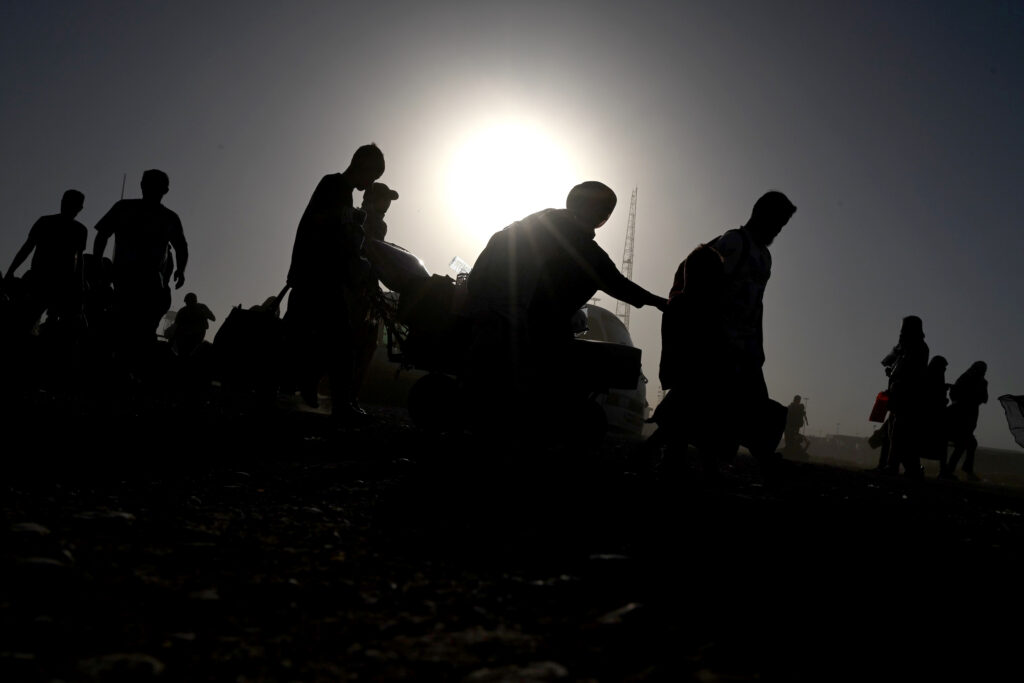
Governments around the world are evacuating thousands of their nationals caught up in the rapidly spiralling Israel-Iran conflict, organising buses and planes and in some cases assisting people crossing borders on foot.Foreigners have rushed to leave both countries after Israel launched an unprecedented bombing campaign on Friday targeting Iran’s nuclear and military facilities, sparking retaliation from Tehran.With Israel’s air space closed and the two countries exchanging heavy missile fire, many people are being evacuated via neighbouring countries.- Europe -European countries have already repatriated hundreds of their citizens from Israel.The Czech Republic and Slovakia repatriated 181 people, who were bussed to a neighbouring country and crossed the border on foot, the Czech defence ministry said.Germany scheduled flights for Wednesday and Thursday via Jordan, while Poland said the first of its citizens would also arrive back on Wednesday.Italian nationals were being offered a charter flight on Sunday from Israel to Egypt and then Italy, with non-refundable reservations set at 500 euros ($575) per adult.Greece said it had repatriated 105 citizens plus a number of foreign nationals via Egypt, while a private plane with 148 people landed in the Bulgarian capital Sofia on Tuesday.Hungary evacuated 21 citizens from Iran via Azerbaijan, mainly diplomats and their families, officials said.Bulgaria repatriated 17, and Slovenia two diplomats and their families.- United States -The US ambassador to Israel announced plans on Wednesday for evacuating Americans by air and sea.The embassy was working on evacuation flights and cruise ship departures for “American citizens wanting to leave Israel,” Ambassador Mike Huckabee posted on social media.- China -China has evacuated more than 1,600 citizens from Iran and several hundred more from Israel. Its foreign ministry said on Thursday those efforts would continue.- Australia -Australia has started evacuating around 1,500 citizens from Iran and more than 1,200 from Israel, although missile barrages have made it too risky for civilian aircraft, its foreign minister said.”We have taken the opportunity to get a small group of Australians out of Israel through a land border crossing,” said Foreign Minister Penny Wong.- Mexico -Mexico said it had evacuated 18 people from Iran to Azerbaijan, both Mexican nationals and family members.- Pakistan -Pakistan has shut its border crossings with neighbouring Iran, except to Pakistanis wanting to return home.Around 3,000 Pakistanis have crossed the border from Iran since the conflict started, foreign ministry spokesman Shafqat Ali Khan said on Thursday.The families of diplomats and some non-essential staff from Iran have also been evacuated.- India -Around 110 students who fled Iran over the land border with Armenia have landed in New Delhi, an Indian foreign ministry spokesperson said Thursday. There are around 10,000 Indian citizens in Iran.New Delhi also said it planned to evacuate all Indian nationals in Israel who wish to leave. There are around 30,000.- Japan -Japan has ordered military planes to be on standby for around 1,000 Japanese nationals believed to live in Israel, and around 280 in Iran, according to government ministers.- Indonesia -Indonesia is preparing to evacuate around 380 of its citizens currently in Iran by land, Jakarta’s foreign minister said Thursday.At least 11 Indonesians in Israel have also asked to leave.- Vietnam -Vietnam, which has more than 700 citizens in Israel and dozens in Iran, said it was working to ensure their safety.The foreign ministry said on Thursday that 18 Vietnamese from Iran were evacuated, 16 of whom returned to Vietnam. It did not provide further information on evacuations from Israel.- Philippines -The Philippines is preparing to repatriate 28 Israel-based Filipino workers out of 178 who asked for help, the Department of Migrant Workers said on Thursday.At least 21 Philippine government officials have also crossed into Jordan by land from Israel, the foreign ministry said.