AFP Asia Business

If Iran’s Khamenei falls, what would replace him?

Israel increasingly appears eager to oust the clerical leadership that has ruled Iran since the 1979 Islamic revolution but is taking a gamble given the Iranian opposition is divided and there is no guarantee new rulers would be any less hardline, analysts say.By striking targets other than nuclear or ballistic facilities, such as Iran’s IRIB broadcaster, expectations have grown that Israel has goals beyond degrading Iranian atomic and missile capabilities and eyes removing supreme leader Ayatollah Ali Khamenei.But while President Donald Trump has warned “we know” where Khamenei “is hiding”, what would follow his removal after over three-and-a-half decades in power is shrouded in uncertainty and risk.European leaders are haunted by the aftermath of the US-led invasion of Iraq in 2003 and the NATO-led intervention in Libya in 2011.They resulted in the removal of dictators Saddam Hussein and Moamer Kadhafi but also in years of bloody mayhem in both countries.”The biggest mistake today is to seek regime change in Iran through military means because that would lead to chaos,” French President Emmanuel Macron said at the end of the G7 summit in Canada.”Does anyone think that what was done in Iraq in 2003… or what was done in Libya the previous decade was a good idea? No!” Macron said.Analysts say ousting Khamenei and his fellow clerical leaders risks creating a vacuum that could be filled by hardline elements in the Revolutionary Guards (IRGC) ideological force or the Iranian military.”Israel’s strikes seem more focused on regime change than non-proliferation,” said Nicole Grajewski, fellow at the Carnegie Endowment.”Of course Israel is targeting ballistic missile and military related facilities but they are also targeting leadership and symbols of the regime like the IRIB,” she told AFP.”If the regime were to fall, the hope would be for a liberal and democratic government.”However, there is a strong likelihood that other powerful entities like the IRGC could emerge as the replacement,” she said.- ‘No organised alternative’ -Among the highest-profile opposition figures is the US-based Reza Pahlavi, the son of ousted shah Mohammad Reza Pahlavi.He has declared that the Islamic republic is “on the verge of collapse”, accusing Khamenei of “hiding underground” like a “frightened rat”.Pahlavi has long called for the restoration of the warm relationship that existed between his late father and Israel, to reverse the Islamic republic’s refusal to recognise the existence of Israel. Monarchists would like such a rapprochement to be termed the “Cyrus Accords” after the ancient Persian king credited with freeing the Jews from Babylon.But Pahlavi is far from enjoying universal support inside Iran or among exiles.The nationalism of supporters and his ties with Israel are divisive, especially after he refused to condemn the Israeli air strikes on Iran. Another major organised group is the People’s Mujahedin (MEK), whose leader Maryam Rajavi told the European Parliament on Wednesday: “The people of Iran want the overthrow of this regime.”But the MEK is despised by other opposition factions and regarded with suspicion by some Iranians for its support of Saddam Hussein in the Iran-Iraq war.”Part of the challenge in thinking about alternatives to the Islamic Republic in case it collapses is that there is no organised, democratic alternative,” said Thomas Juneau, professor at the University of Ottawa.He said that while Reza Pahlavi is the opposition leader “who has by far the most name recognition both in and out of Iran”, his supporters “tend to exaggerate his support inside the country”.”The only alternative — and this is among the worrying scenarios — is a coup d’etat by the Revolutionary Guards or changing from a theocracy to a military dictatorship.”- ‘Unpredictable scenario’ -Analysts also warn that a potential — and often overlooked — factor for future instability could be Iran’s complex ethnic make-up.Large Kurdish, Arab, Baluch and Turkic minorities co-exist alongside the Persian population.”There will also be an effort to capitalise on ethnic divisions by hostile countries,” said Grajewski.Analysts at the US-based think tank Soufan Center said that with the survival of the Iranian regime now viewed as a “strategic failure”, the prospect of an “Iraq 2.0″ is looming.”The post-regime-change scenario remains unpredictable and could trigger regional destabilisation on a scale greater than Iraq, with global ramifications,” they said.

Iraq’s top Shiite cleric warns against targeting Iran’s leadership

Iraq’s top Shiite Muslim cleric Grand Ayatollah Ali Sistani warned against targeting Iran’s leadership and said that the Iran-Israel war could plunge the whole region into chaos.Sistani said in a statement Thursday that any targeting of Iran’s “supreme religious and political leadership” would have “dire consequences on the region”.He warned that such action against the Shiite-led Islamic republic could spark “widespread chaos that would exacerbate the suffering of its (the region’s) people and severely harm everyone’s interests”.Sistani urged the international community to “make every effort to end this unjust war and find a peaceful solution” to concerns about Iran’s nuclear programme.Sistani, an Iranian, is the highest religious authority for millions of Shiite Muslims in Iraq and around the world, with the power to mobilise a huge following in Iraq.Despite his Iranian roots, Sistani is seen as a key figure in Iraq’s recent history and has been known for pushing back against Tehran’s growing clout in the country.Israel’s Defence Minister Israel Katz said Thursday that Iran’s supreme leader Ayatollah Ali Khamenei “can no longer be allowed to exist” after an Israeli hospital was hit during an Iranian missile attack.Earlier this week, Israeli Prime Minister Benjamin Netanyahu did not rule out plans to assassinate Khamenei.US President Donald Trump had earlier said his country would not kill Khamenei “for now”, but demanded Tehran’s “unconditional surrender” and warned he was weighing military action in the conflict.Israel launched a surprise attack Friday targeting Iran’s military and nuclear sites and killing top commanders and scientists, saying it is acting to prevent Iran from obtaining a nuclear weapon, an ambition Tehran denies.The assault has prompted Iran to retaliate with barrages of missiles on Israel, with residential areas in both countries suffering too.Iraq’s National Security Adviser Qassem al-Araji urged the European Union on Thursday to exert pressure on Israel to stop the war, ahead of a meeting between Iran and European powers.With warnings of all-out regional war intensifying, fears are growing over an intervention by Iran-backed Iraqi factions, mostly against American interests in the region.- ‘Destruction’ -Akram al-Kaabi, the leader of the pro-Iran group, Al-Nujaba, warned the United States against going after Khamenei.”If you harm a hair” of Khamenei’s head “you and your allies will be under our fire,” Kaabi said in a statement.”No soldier or diplomat will be spared,” Kaabi said. “Every person holding your nationality in our region, as well as all your direct or indirect interest will be a legitimate target,” he added.The powerful faction Kataeb Hezbollah said that Trump “made a mistake” when he spoke of Khamenei and warned the US president of “unprecedented calamities and destruction” if he goes into war in support of Israel.In Lebanon, Iran-backed militant group Hezbollah warned against threatening Khamenei, describing it as “an act of recklessness and foolishness” that would have “grave consequences”.It “constitutes an offence to hundreds of millions of believers”, added the group, which suffered heavy blows in its latest confrontation with Israel last year.

‘Like the sky was torn open’: At Turkey border, Iranians recall terror in Tehran

“The first two days were okay, people said it would just end. But then it started escalating and people really started panicking,” said Mehran Ataei of the Israeli bombardment of Tehran. Speaking to AFP at the Kapikoy crossing on the Turkish border, the 58-year-old Franco-Iranian, who lives in Paris, fled Tehran on the fifth day of an escalating war with Israel.As well as the ongoing bombardments, those fleeing the capital spoke of very limited internet access, problems withdrawing money after two major banks were hacked and food shortages. Standing with her was her 27-year-old daughter Lida Pourmomen. “It was really stressful because we didn’t leave together and Tuesday night was the worst night Tehran had experienced so far,” explained Pourmomen, taking up the story. “After my mum left, it felt like the sky was being torn open. I thought I might never see her again,” she said, describing chaotic scenes of explosions, smoke and the terror of not knowing if the ear-splitting sounds were air defence systems or incoming missiles.The pair had been due to fly back to Paris on Saturday but with all flights cancelled, they were stranded, repeatedly calling the French embassy for help. They eventually got through on Monday but were advised “to stay in Tehran” — advice which they ignored, although an official email advising French citizens to leave was eventually sent out Tuesday. “But there’s barely any internet access — there’s a window of two or three hours when you have access, so it’s likely most people didn’t receive the email telling them to leave,” Pourmomen said. “If we hadn’t decided on our own to leave Tehran, I don’t know what would have happened,” said her mother as they braced for the next leg of their journey — a 25-hour bus trip to Istanbul then a flight home. – ‘It became very bad’ -At the crossing, an AFP correspondent counted several dozen people arriving on Thursday morning, with a Turkish defence ministry saying there was “no increase” in numbers despite the escalating violence.”In the early days, it was just a few bombs but later it became very bad,” said a 50-year-old Iranian pharmacist living in Melbourne who did not want to give her name.She arrived in Tehran on the day the bombing started to visit her mother in intensive care, eventually fleeing the city for the Turkish border five days later. “People are really panicking. Yesterday the internet stopped and two major banks were hacked so people couldn’t access their money. And there’s not even enough food,” she told AFP. People were moving to the north where it was “a little bit better but it’s not safe really,” she said.”We had war before, but this one is terrible because you can’t predict it and it’s very brutal.”Although observers believe only the Iranian people can bring about change, the pharmacist admitted she was not optimistic. “They expect people to change the regime, but they can’t. They are very panicked and scared and the regime is very brutal,” she told AFP. And it seemed unlikely that the US would step in, despite the belligerent rhetoric from President Donald Trump. “We know (Iran’s supreme leader Ayatollah Ali) Khamenei is the source of the problem but Trump says ‘I don’t want to kill him’. If you really wanted to end the war, why say that?” she said.”Trump just pretends he wants to stop the war. This dictatorship regime is supported by the USA.”Another Iranian called Ismail Rabie, a retired 69-year-old who was trying to get back to his home in London, said the situation in Iran would not change unless Western powers really wanted it.”It all depends on America or Europe: if they want change, it will change, if they don’t, it won’t,” he said before heading off to Istanbul.

Gaza rescuers say 25 killed by Israeli fire

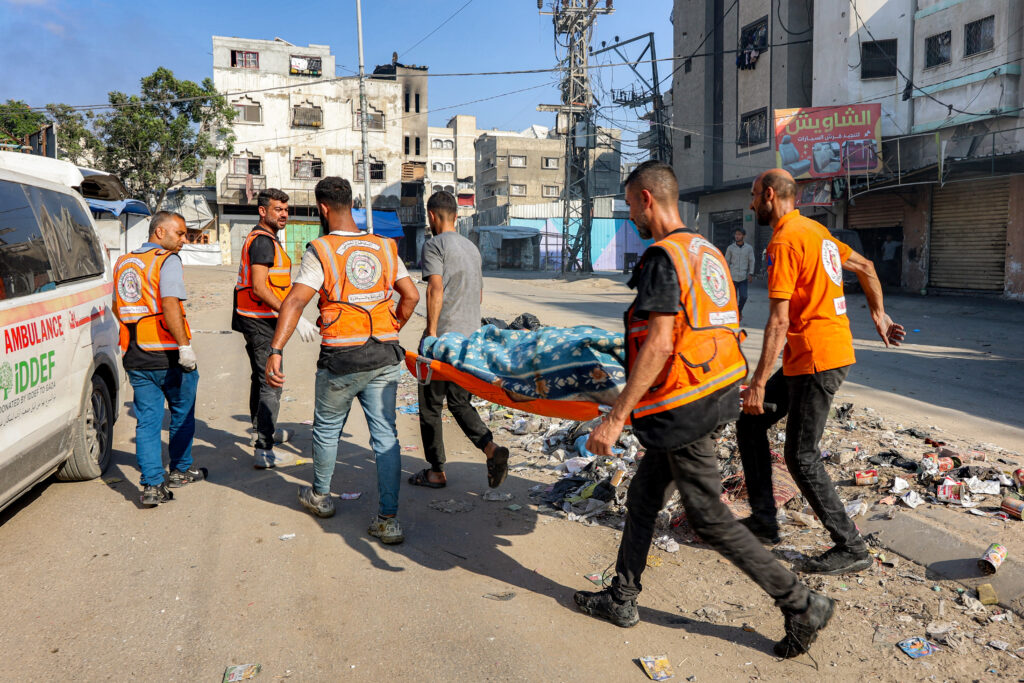
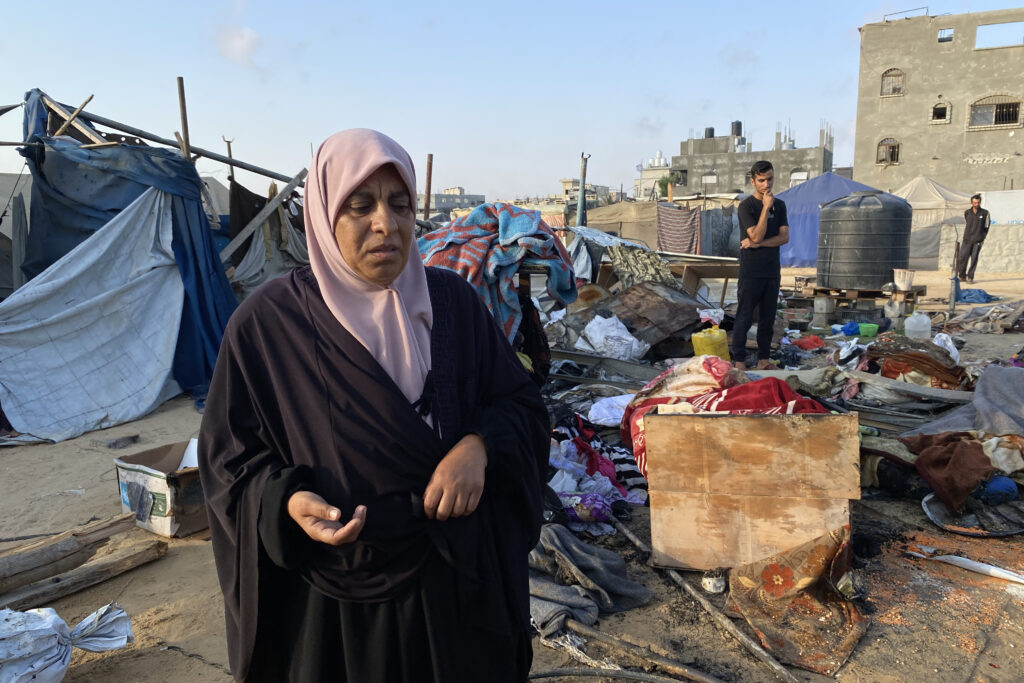
Gaza’s civil defence agency said Israeli fire killed at least 25 people on Thursday, including 15 who had gathered near an aid distribution site.Civil defence official Mohammad al-Mughayyir told AFP that 15 people were killed and 60 wounded, while waiting for aid in central Gaza’s Netzarim corridor, where thousands of people have gathered daily in the hope of receiving rations.The Israeli army told AFP it was “looking into” the reports.Witness Bassam Abu Shaar said thousands of people had gathered overnight in the hope of receiving aid at the US- and Israeli-backed distribution site when it opened in the morning.”Around 1:00 am (2200 GMT Wednesday), they started shooting at us. The gunfire intensified from tanks, aircraft and quadcopter bombs,” he told AFP by phone.He said the size of the crowd had made it impossible for people to escape the Israeli fire near Shuhada Junction, and dead and wounded were left lying on the ground within walking distance of the distribution point run by the Gaza Humanitarian Foundation. “We couldn’t help them or even escape ourselves,” he said.Mughayyir said the casualties had been taken to the Al-Awda and Al-Aqsa hospitals, in north and central Gaza respectively.Dozens of Palestinians have been killed in recent weeks while trying to reach aid distribution points in Gaza, which is suffering from famine-like conditions, according to UN agencies operating in the territory.Israeli restrictions on media in the Gaza Strip and difficulties in accessing some areas mean AFP is unable to independently verify the tolls and details provided by the civil defence agency.In early March, Israel imposed an aid blockade on the territory amid a deadlock in truce negotiations, only partially easing restrictions in late May.After Israel loosened its blockade, the privately run Gaza Humanitarian Foundation began distributing aid, but its operations have been marred by chaotic scenes.UN agencies and major aid groups have refused to cooperate with the foundation over concerns it was designed to cater to Israeli military objectives.Elsewhere in Gaza, another 10 people were killed by Israeli fire on Thursday, the civil defence agency said.Three were killed by Israeli shelling of a residential building in Gaza City, while seven were killed in a strike on Al-Shati refugee camp to its west.

Relieved Pakistanis recall ‘horrifying nights’ as Israel, Iran trade strikes

Mohammad Hassan anxiously returned to Pakistan from neighbouring Iran this week after witnessing drones, missiles, and explosions tear through Tehran’s sky during what he called long, “horrifying nights”. The 35-year-old  University of Tehran student is one of about 3,000 Pakistanis who, according to the Ministry of Foreign Affairs, have returned home since Israel launched its aerial war against its long-time enemy last week.Governments around the world are scrambling to evacuate their nationals caught up in the rapidly spiralling conflict as Israel and Iran trade missile and drone strikes. “I was in the city centre where most of the strikes took place and even one of the student dormitories was attacked and luckily no one was dead, but students were injured,” Hassan said.There are more than 500 Pakistani students at his university alone, he said, all of them on their way “back home”.”Those days and nights were very horrifying… hearing sirens, the wailing, the danger of being hit by missiles. As one peeped out the window in the night, you could see drones, missiles with fire tails,” he told AFP.- Ghost town -Pakistan and Iran have a shaky diplomatic relationship. They bombed each other’s territory little more than a year ago, both claiming to target rebels using their neighbour’s land to launch attacks.Yet they have never suspended trade, tourism and academic ties.Iranian consulates across Pakistan have stepped up efforts to promote their universities.Between 25 million and 35 million Pakistani Shiite Muslims also hope to make at least one pilgrimage in their lifetime to holy sites in Iran, foremost among them the sacred city of Qom.Mohammad Khalil, a 41-year-old petroleum engineer, left Tehran three days ago, the capital of the Islamic Republic looking like a ghost town as residents sheltered indoors and families fled.”In the last two days, I saw people moving out of the city in different vehicles with necessary commodities,” Khalil said.Abdul Ghani Khan sells medical equipment in his hometown of Peshawar in northwest Pakistan and travels to Iran regularly for supplies.He had been in Tehran for a week when the first Israeli missiles fell on Friday. Iran and Israel have traded heavy missile fire in the days since, raising fears of a wider regional conflict.Pakistan is in a difficult position as the only Muslim-majority country with nuclear weapons. It, like Iran, does not recognise Israel but is also a major ally of the United States.Khan had to make the journey home by road because the airspace is now closed. Pakistan has also shut its border crossings with Iran to all except Pakistanis wanting to return home.”We saw drones, red lights of anti-aircraft guns and I spotted one building catch fire,” Khan said.- ‘Offering prayer’ -Mohammad Asif, a lawyer from Lahore in Pakistan’s east, heard about the air strikes while on a pilgrimage in Qom.He wasn’t initially afraid and continued his pilgrimage to Mashhad in Iran’s northeast, home to the golden-domed Imam Reza shrine.That was until Israeli strikes hit the airport in Mashhad, nearly 1,000 kilometres (620 miles) from the Pakistani border.Samreen Ali was also in Mashhad but, like Asif, cut her trip short and returned with her husband and 15-year-old son.She was praying in a mosque in Mashhad when Israel struck the city.Ali said she had visited Iran nine times before on pilgrimages and never imagined witnessing war there.”I was offering prayer when I heard two explosions,” she told AFP.She then noticed she wasn’t receiving messages on her phone and assumed that “communication was being restricted… because of the war”.Syed Saqib, 46, was in Qom and had to travel 500 kilometres (310 miles) by bus southeast to Yazd. “We had to take alternative routes, spend an entire night waiting at a bus terminal,” Saqib said.They then boarded buses to Zahedan, a city near the border with Pakistan’s Balochistan province. A relieved Saqib recalled making the border crossing at Taftan, surrounded by families carrying heavy luggage.

Israel’s Netanyahu says Iran will ‘pay heavy price’ after hospital hit

Prime Minister Benjamin Netanyahu said Iran would “pay a heavy price” after a hospital in southern Israel was hit during an Iranian missile attack on Thursday, while his defence minister said Iran’s supreme leader would be “held accountable”.”This morning, Iran’s terrorist dictators fired missiles at Soroka Hospital… and at civilians in the centre of the country. We will make the tyrants in Tehran pay a heavy price,” Netanyahu said in a post on X.The Soroka Hospital in the southern town of Beersheba was left in flames following an early morning barrage of “dozens” of Iranian ballistic missiles, with impacts also reported in two Israeli towns close to coastal hub Tel Aviv. Speaking at the scene of the hospital, director Shlomi Kodesh said that a surgical building which had been evacuated in the past few days was hit, adding that 40 people had sustained injuries.”Several wards were completely demolished and there is extensive damage across the entire hospital with damage to buildings, structures, windows, ceilings across the medical centre,” he told journalists.Iran said it was targeting an Israeli military and intelligence base, not the health facility.The latest escalation came on the seventh day of deadly exchanges between the two countries, with US President Donald Trump maintaining suspense about whether Washington will enter the war alongside Israel.Iran’s supreme leader Ayatollah Ali Khamenei has rejected Trump’s demand for an “unconditional surrender”, despite claims from the US leader that “Iran’s got a lot of trouble and they want to negotiate”.- ‘Never surrender’ -Trump has left his intentions on joining the conflict deliberately ambiguous, saying Wednesday: “I may do it, I may not do it. I mean, nobody knows what I’m going to do.””The next week is going to be very big,” he added, without further details.Any US involvement would be expected to involve the bombing of a crucial underground Iranian nuclear facility in Fordow, for which special bunker-busting bombs have been developed.The White House said Trump would receive an intelligence briefing on Thursday, a US holiday. Top US diplomat Marco Rubio is set meet his British counterpart for talks expected to focus on the conflict.”I have ideas as to what to do, but I haven’t made a final (decision),” Trump said. “I like to make the final decision one second before it’s due, because things change. Especially with war.”The Wall Street Journal reported that Trump had told aides on Tuesday he had approved attack plans but was holding off to see if Iran would give up its nuclear programme.Trump told reporters that Iranian officials “want to come to the White House”, a claim denied by Tehran.The US president had favoured a diplomatic route to end Iran’s nuclear programme, seeking a deal to replace the 2015 agreement he tore up in his first term.But since Israel unleashed the campaign against Iran last week, Trump has stood behind the key US ally.- Nuclear sites -On Thursday morning, Israel said it had carried out dozens of fresh raids on Iranian targets overnight, including the partially built Arak nuclear reactor and a nuclear facility in Natanz that has been struck previously. The Israeli military said the Arak site on the outskirts of the village of Khondab in central Iran had been hit “to prevent the reactor from being restored and used for nuclear weapons development”.There was also a “near-total national internet blackout” in Iran on Wednesday, a London-based watchdog said, with Iran’s Fars news agency confirming heavier internet restrictions after initial curbs imposed last week.The military campaign has sparked calls for a return to diplomacy.Russian President Vladimir Putin said Thursday that a deal to guarantee both Israel’s security and Iran’s desire for a civilian nuclear programme was possible.”I believe it would be good for all of us together to look for ways to stop the fighting and seek ways for the participants in the conflict to find an agreement,” he told foreign journalists at a televised event.He said Iran had not asked Russia for military help.- Daily barrages -An Israeli military official, who asked not to be named, said Wednesday that Iran had fired around 400 ballistic missiles and 1,000 drones since the conflict began on Friday. About 20 missiles had struck civilian areas in Israel, the official added.Iranian strikes have killed at least 24 people and injured hundreds since they began, Israeli Prime Minister Benjamin Netanyahu’s office said on Monday.Iran said Sunday that Israeli strikes had killed at least 224 people, including military commanders, nuclear scientists and civilians.Both countries have not issued an updated official toll since then.Israel says its surprise air campaign is aimed at preventing Iran from acquiring nuclear weapons.Iran had been enriching uranium to 60 percent — far above the 3.67-percent limit set by the 2015 nuclear death but still short of the 90-percent threshold needed for a nuclear warhead.Israel has maintained ambiguity on its own atomic activities, but the Stockholm International Peace Research Institute says it has 90 nuclear warheads.burs-sah-adp/jsa