AFP Asia Business

Netanyahu to visit White House as Gaza truce pressure mounts

Israeli Prime Minister Benjamin Netanyahu will visit the White House next week for talks with President Donald Trump, a US official said Monday, as Washington ramps up the pressure for a ceasefire in Gaza.The July 7 visit — Netanyahu’s third since Trump returned to power in January — comes after Trump said that he hoped for a truce in the war-ravaged Palestinian territory within a week.A Trump administration official confirmed the visit to AFP on condition of anonymity.White House Press Secretary Karoline Leavitt said earlier that Netanyahu had “expressed interest” in a meeting with Trump and that both sides were “working on a date.”This has been a priority for the president since he took office, to end this brutal war in Gaza,” Leavitt told reporters in a briefing.”It’s heartbreaking to see the images that have come out from both Israel and Gaza throughout this war, and the president wants to see it end.”A senior Israeli official, Strategic Affairs Minister Ron Dermer, is due to visit the White House this week for talks to lay the ground for Netanyahu’s visit, Leavitt said.Netanyahu became the first foreign leader to visit Trump in his second term in February, when the US president surprised him by suddenly announcing a plan for the United States to “take over” Gaza.The Israeli premier visited again in April.The end of Israel’s 12-day war with Iran has provided a window of opportunity for a deal, with Trump keen to add another peace agreement to a series of recent deals he has brokered.”We think even next week, we’re going to get a ceasefire,” Trump told reporters on Friday. He followed up by pressing Israel in a post on his Truth Social network on Sunday to “make the deal in Gaza”.But on the ground, Israel has continued to pursue its offensive across the Palestinian territory in a bid to destroy the militant group Hamas. Gaza’s civil defence agency said Israeli forces killed at least 51 people on Monday, including 24 at a seafront rest area.Trump meanwhile appeared to leverage US aid to Israel at the weekend as he called for that country’s prosecutors to drop corruption charges against Netanyahu.”The United States of America spends Billions of Dollar a year, far more than on any other Nation, protecting and supporting Israel. We are not going to stand for this,” Trump posted.The war in Gaza was triggered by Hamas’s unprecedented attack on Israel on October 7, 2023, which resulted in the deaths of 1,219 people, mostly civilians, according to an AFP tally based on Israeli official figures.Palestinian militants seized 251 hostages during Hamas’s attack on Israel on October 7, 2023. Of these, 49 are still believed to be held in Gaza, including 27 the Israeli military says are dead.Israel’s retaliatory campaign has killed at least 56,531 people in Gaza, also mostly civilians, according to the Hamas-run territory’s health ministry. The United Nations considers these figures to be reliable.

Over 230,000 Afghans left Iran in June ahead of return deadline: IOM

More than 230,000 Afghans left Iran in June, most of them deported, as returns surge ahead of a deadline set by Tehran, the United Nations migration agency said on Monday.The number of returns from Iran rose dramatically in recent weeks. Afghans have reported increased deportations ahead of the July 6 deadline announced by Iran for undocumented Afghans to leave the country.From June 1-28, 233,941 people returned from Iran to Afghanistan, International Organization for Migration spokesman Avand Azeez Agha told AFP, with 131,912 returns recorded in the week of June 21-28 alone. Since January, “691,049 people have returned, 70 percent of whom were forcibly sent back”, he added. For several days last week, the number reached 30,000 per day, the IOM said, with numbers expected to increase ahead of the deadline.Afghans spilled into an IOM-run reception centre out of buses arriving back-to-back at the Islam Qala border point in western Afghanistan’s Herat province on Saturday. The recent returns have been marked by a sharp increase in the number of families instead of individuals, the UN said, with men, women and children lugging suitcases carrying all their belongings.Many have few assets and few prospects for work, with Afghanistan facing entrenched poverty and steep unemployment.The country is four years into a fragile recovery from decades of war under Taliban authorities, who have called for a “dignified” return of migrants and refugees from neighbouring countries.Kabul’s Foreign Minister Amir Khan Muttaqi raised the Taliban government’s concerns in a meeting with Iran’s ambassador, according to a statement, saying: “A coordinated mechanism should be put in place for the gradual return of migrants.” The cash-strapped government faces challenges in integrating the influx of returnees, which has piled on to hundreds of thousands also forced out in recent years from Pakistan — another traditional host of Afghans fleeing conflict and humanitarian crises.Severe international aid cuts have also hamstrung UN and NGO responses, with the IOM saying it was “only able to assist a fraction of those in need”.”On some high-volume days, such as recently at Islam Qala, assistance reached as few as three percent of undocumented returnees,” it said in a recent statement.Returnees AFP spoke to in recent days at the border cited mounting pressure by Iranian authorities and increased deportations, with none pointing to the recent Iran-Israel conflict as a spur to leave the country.However, “regional instability — particularly the fallout from the Israel-Iran conflict — and shifting host country policies have accelerated returns, overwhelming Afghanistan’s already fragile humanitarian and development systems”, the UN mission in Afghanistan, UNAMA, said in a statement.Samiullah Ahmadi, 28, was seeing his country of origin for the first time when he crossed the border.Unsure of what he would do once he reached the Afghan capital Kabul with his family, he was defiant in response to the pressures to return.”I was born there (Iran). But the situation for Afghans is such that no matter how good you are or even if you have valid documents, they still don’t treat you with respect.”

Iran unleashes ‘wave of repression’ after Israel war: activists

Iranian authorities have arrested hundreds of people and executed dozens in a wave of repression following the 12-day war with Israel, activists say, accusing the Islamic republic of using fear to compensate for weaknesses revealed by the conflict.Campaigners have been detained on the street or at home, executions expedited, prisoners transferred to unknown locations and minorities also targeted, according to rights groups.Six men have been hanged on charges of spying for Israel since the start of the conflict, dozens more on other charges and more than 1,000 arrested during or after the conflict on charges related to the war, according to Iran Human Rights, a Norway-based NGO.It said the majority of those detained were people whose mobile devices were searched and content such as footage of Israeli military actions was reportedly discovered.Leading campaigners arrested include the freedom of speech activist Hossein Ronaghi, while other figures such as rapper Toomaj and activist Arash Sadeghi were released after being roughly arrested and interrogated, according to reports.Roya Boroumand, executive director of the US-based NGO Abdorrahman Boroumand Center, said that with the crackdown Iranian authorities were attempting to suppress public discontent over the “humiliating blow” inflicted by Israel, which showed the Islamic republic was “unable to control its airspace and protect civilians”.”Now, to maintain control and prevent its opponents inside the country from organising and mobilising forces, Iran’s leaders are turning to fear. And they may only just be getting started,” she told AFP.- ‘Wounded animal’ -Boroumand recalled that the ceasefire that ended the 1980-1988 war with Iraq was followed by a wave of repression that included the execution of thousands of dissidents.”If unchecked, the violence that targets Iranians today will target others outside Iran’s borders,” she added.Iran’s leaders have faced criticism from inside the country over their apparent failure to prevent the Israeli and US air attacks. There was no working siren or shelter system, with what protection there was dating back to the 1980s conflict with Saddam Hussein’s Iraq.Meanwhile, the killing in air strikes of top officials, military officers and nuclear scientists exposed Israel’s deep intelligence penetration of Iran.That has prompted a major hunt for spies.Iran’s judiciary chief Gholamhossein Mohseni Ejei said after the start of the war that the trial and punishment of anyone arrested on suspicion of collaborating with Israel “should be carried out and announced very quickly”.Three Europeans, who have not been identified, have also been arrested, two of whom are accused of spying for Israel, according to the authorities.”Like a wounded animal, the Islamic republic is going after every perceived threat in the country with deadly force,” said Hadi Ghaemi, executive director of the New York-based Center for Human Rights in Iran (CHRI).- ‘Wave of repression’ -The Norway-based Hengaw rights group, which focuses on Kurdish-populated areas of western and northwestern Iran, said 300 people of Kurdish ethnicity had been arrested in the crackdown.”A widespread wave of repression and mass arrests has unfolded across the country,” it said, adding that “Kurdish cities have borne a disproportionate share of these crackdowns” and that detainees have included a “significant number of women and teenage girls”.Non-Muslim religious minorities have also faced pressure.Some 35 members of Iran’s remaining Jewish community, estimated to be just 10,000-strong but recognised as an official minority by the Islamic republic, have been summoned for questioning in recent days, according to the US-based Human Rights Activists News Agency (HRANA).Iranian security forces have also raided dozens of homes belonging to members of the Baha’i religious minority during and after the war with Israel, according to the IranWire news website.The Baha’i faith, which has a spiritual centre in the Israeli city of Haifa, is Iran’s largest non-Muslim minority but has no official recognition.

Kneecap, Bob Vylan Glastonbury sets spark police probe and global criticism

UK police on Monday launched a criminal investigation into remarks made by rap groups Kneecap and Bob Vylan during the Glastonbury festival, as the US revoked visas for the latter after its frontman led an anti-Israel chant.Bob Vylan, a London-based duo which often tackles racism in its tracks, was slammed by international and British politicians after the group led the crowds in chants of “Death to the IDF” — the Israeli military.Prime Minister Keir Starmer said after the show there was “no excuse for this kind of appalling hate speech”.Avon and Somerset Police in southwest England said a “criminal investigation is now being undertaken” after reviewing “video footage and audio” of both Kneecap and Bob Vylan.”The investigation will be evidence-led and will closely consider all appropriate legislation, including relating to hate crimes,” police said in a statement.The BBC apologised for not pulling the live stream of Bob Vylan’s performance at the festival over the weekend.”With hindsight we should have pulled the stream during the performance. We regret this did not happen,” the broadcaster said.It added that the “antisemitic sentiments expressed by Bob Vylan were utterly unacceptable and have no place on our airwaves”.Media watchdog Ofcom said it was “very concerned” and the BBC had questions to answer. “We have been speaking to the BBC over the weekend and we are obtaining further information as a matter of urgency,” it added.Israel’s deputy foreign minister Sharren Haskel called for the public broadcaster to be investigated over the time it took for the video to be removed from the BBC’s online streaming platform.”I think that the latest (BBC) statement is absolutely pathetic,” Haskel told Times Radio.- ‘Not welcome visitors’ -Controversy descended on this year’s festival before it even began over the inclusion of Kneecap, one of whose members was recently charged under terror legislation. During their show on Saturday, one Kneecap member also wore a T-shirt dedicated to the Palestine Action Group, which is about to be banned under UK terror laws.The chants about Israel’s military were led by Bob Vylan’s frontman who goes by the stage name Bobby Vylan, and were broadcast live on the BBC.Bob Vylan also chanted “free, free Palestine” and “from the river to the sea, Palestine will be free” — an expression which some see as a call for Israel’s destruction, but others say demands an end to Israeli occupation in Gaza and the West Bank.The United States on Monday said it would revoke visas for Bob Vylan’s members, ahead of its American tour dates scheduled later this year.”Foreigners who glorify violence and hatred are not welcome visitors to our country,” Deputy Secretary of State Christopher Landau posted on X.- ‘Crossed a line’ -Causing a possible political headache for the UK, the Israel embassy issued a statement saying “it was “deeply disturbed by the inflammatory and hateful rhetoric expressed on stage at the Glastonbury Festival”.US ambassador to the UK Warren Stephens slammed the chants as “anti-Semitic” and a “disgrace”.Glastonbury’s organisers said the the comments had “very much crossed a line”.”We are urgently reminding everyone involved in the production of the festival that there is no place at Glastonbury for antisemitism, hate speech or incitement to violence,” the festival said in a statement.Kneecap, which has made headlines in recent months with its pro-Palestinian and anti-Israel stance, also led crowds in chanting abuse against Prime Minister Starmer.Starmer and other politicians had said the band should not perform after its member Liam O’Hanna, known by his stage name Mo Chara, was charged with a terror offence.He appeared in court this month accused of having displayed a Hezbollah flag while saying “Up Hamas, Up Hezbollah” at a London concert last year.The Iran-backed Lebanese group Hezbollah and the Palestinian militants Hamas are banned in the UK, where it is an offence to express support for them.

Gaza rescuers say Israeli forces kill 48 as ceasefire calls mount

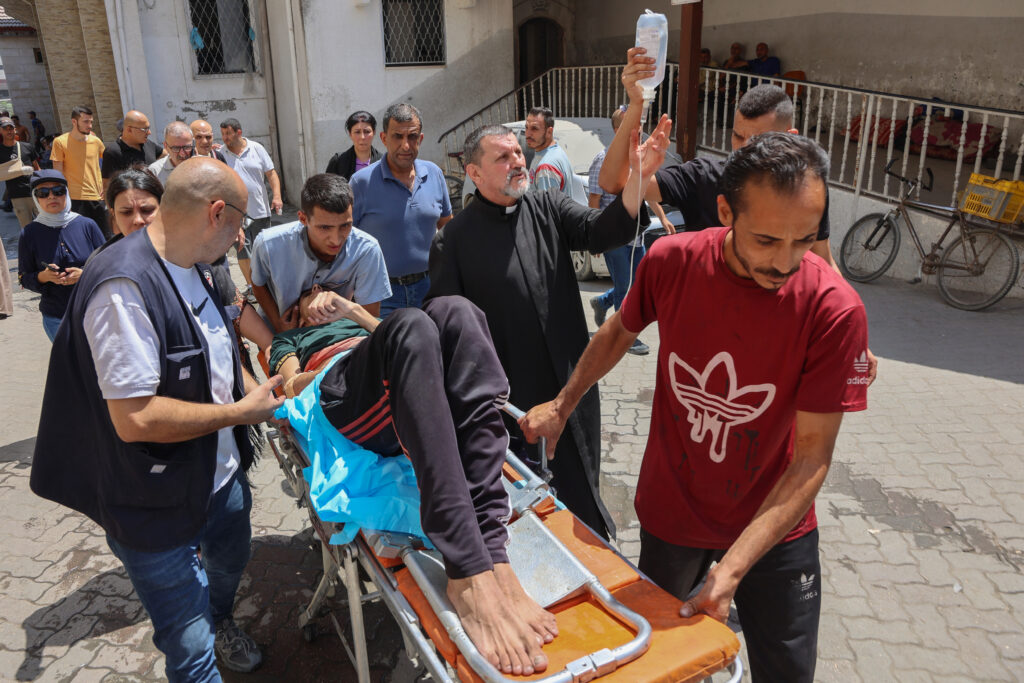
Gaza’s civil defence agency said Israeli forces killed at least 48 people on Monday, including 21 at a seafront rest area, as fresh calls grew for a ceasefire in the war-ravaged Palestinian territory.The swift resolution of Israel’s 12-day war with Iran has revived hopes for a halt to the fighting in Gaza, where more than 20 months of combat have created dire humanitarian conditions for the population of more than two million.US President Donald Trump has recently urged Israel to “make the deal in Gaza”, while key mediator Qatar said Monday that “momentum” had been created by the truce with Iran last week.But on the ground, Israel has continued to press its offensive across the Palestinian territory in a bid to destroy the militant group Hamas. Gaza’s civil defence agency said 48 people had been killed by Israeli forces on Monday, including 21 in a strike on a seafront rest area near Gaza City.”The place is always crowded with people because the rest area offers drinks, family seating and internet access,” eyewitness Ahmed Al-Nayrab, 26, told AFP, recalling a “huge explosion that shook the area”.”I saw body parts flying everywhere, and bodies cut and burned… It was a scene that made your skin crawl.”Another eyewitness, Bilal Awkal, 35, said “blood covered the ground and screams filled the air”. “Women and children were everywhere, like a scene from a movie about the end of the world.”  Approached for comment by AFP, the Israeli army said it was “looking into” the reports. The Hamas government media office reported that photojournalist Ismail Abu Hatab was among those killed in the strike.Israeli restrictions on media in Gaza and difficulties in accessing some areas mean AFP is unable to independently verify the tolls and details provided by rescuers and authorities in the territory.- ‘Targeting was deliberate’ -Civil defence spokesman Mahmud Bassal told AFP that 27 others were killed by Israeli strikes or gunfire across Gaza, including “11 people killed near aid distribution points in the central and southern parts of the territory”.Eyewitnesses and local authorities have reported repeated killings of Palestinians near distribution centres in recent weeks, after Israel began allowing in a trickle of aid at the end of May. Samir Abu Jarbou, 28, told AFP by phone that he had gone with  relatives to pick up food in an area of central Gaza around midnight.”Suddenly the (Israeli) army opened fire, and drones started shooting. We ran away and got nothing,” he said.In the southern city of Khan Yunis, the dead and wounded were rushed to a hospital in an open-top trailer after aid seekers said they were fired on by Israeli forces in nearby Rafah. “The targeting was deliberate, aimed at people as they were leaving,” eyewitness Aboud al-Adwi told AFP.”There was no one among us who was wanted or posed any threat. We were all civilians, simply trying to get food for our children,” he added.AFP footage from Nasser Hospital showed the wounded being treated on the blood-stained floor.The Israeli military said it needed more information when asked for comment on Monday’s deadly strikes and gunfire.It also issued a fresh evacuation order for several areas in and around Gaza City.- ‘No longer any benefit’ -Netanyahu had said on Sunday that Israel’s “victory” over Iran had created “opportunities”, including for freeing hostages.”Israel is serious in its will to reach a hostage deal and ceasefire in Gaza,” Foreign Minister Gideon Saar told journalists Monday.Opposition leader Yair Lapid, meanwhile, urged an end to the fighting in the territory, saying there was “no longer any benefit” to the war.Trump had said on Friday that he was hoping for a new ceasefire in Gaza “within the next week”.Qatar’s foreign ministry spokesman Majed Al-Ansari told journalists on Monday that “momentum” had been created by the Iran-Israel ceasefire on June 24.”We won’t hold our breath for this to happen today and tomorrow, but we believe that the elements are in place to push forward towards restarting the talks,” he added. Israel launched its campaign in Gaza in response to Hamas’s October 7, 2023 attack, which resulted in the deaths of 1,219 people, mostly civilians, according to an AFP tally based on Israeli official figures.Of the 251 hostages seized during the assault, 49 are still held in Gaza, including 27 the Israeli military says are dead. Israel’s retaliatory campaign has killed at least 56,531 people in Gaza, also mostly civilians, according to the Hamas-run territory’s health ministry. The United Nations considers these figures to be reliable.