AFP Asia Business

Divided EU weighs action against Israel over Gaza war

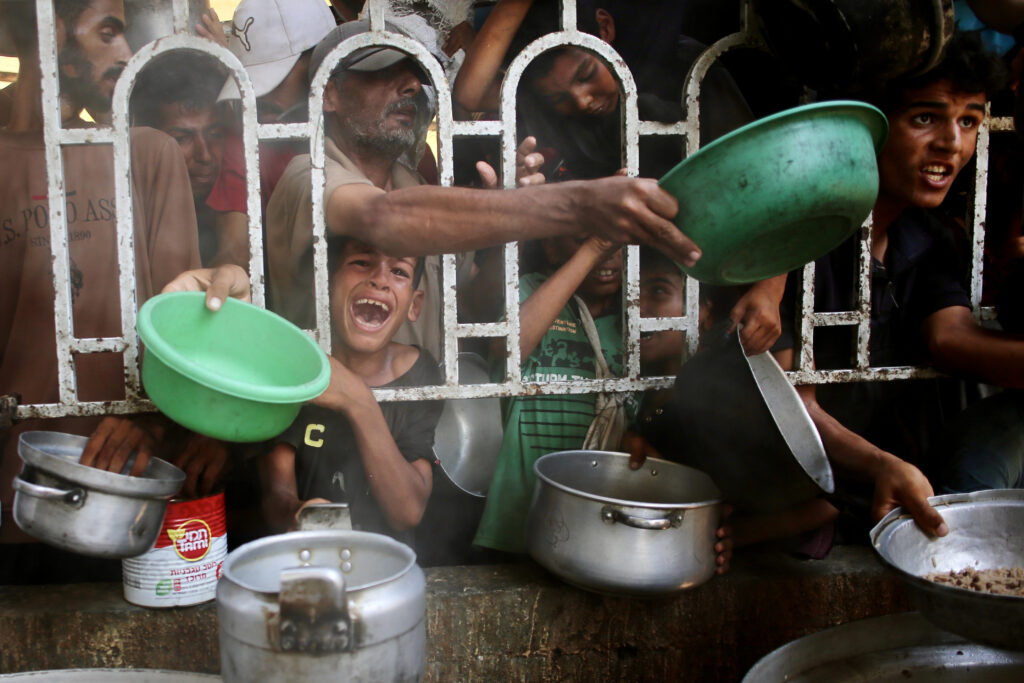
EU foreign ministers on Tuesday discussed options for action against Israel over the war in Gaza — but looked unlikely to agree on any.The bloc’s foreign policy chief Kaja Kallas has put forward 10 potential steps after Israel was found to have breached a cooperation deal between the two sides on human rights grounds.The measures range from suspending the entire accord or curbing trade ties to sanctioning Israeli ministers, imposing an arms embargo and halting visa-free travel.Despite growing anger over the devastation in Gaza, EU states remain divided over how to tackle Israel and diplomats say there appears to be no critical mass for any move.”I can’t predict how the discussion will go,” Kallas said, ahead of the foreign ministers’ talks in Brussels. She said the main focus would likely be on how the EU could leverage improvements to the humanitarian crisis in Gaza.That comes after Kallas on Thursday announced a deal with Israel’s Foreign Minister Gideon Saar, to open more entry points and allow in more food.Gaza’s two million residents face dire humanitarian conditions as Israel has severely limited aid during its war with Palestinian militant group Hamas.”We see some positive signs when it comes to border crossings open, we see some positive signs of them reconstructing the electricity lines, providing water, also more trucks of humanitarian aid coming in,” Kallas said Monday.But she said the situation in Gaza remained “catastrophic”. “Of course, we need to see more in order to see real improvement for the people on the ground,” she said. – ‘No justification’ -Saar, speaking at a meeting in Brussels on Monday, was confident Israel would avoid further EU action.”I’m sure not any of them will be adopted by the EU member states,” said the foreign minister. “There’s no justification whatsoever.”While the EU appears unable to take further moves against Israel, just getting to this stage has been a considerable step.The bloc only agreed to review the cooperation deal after Israel relaunched military operations in Gaza following the collapse of a ceasefire in March.Until then deep divisions between countries backing Israel and those more favourable to the Palestinians had hamstrung any move.In a sign of that, Hungary looked likely to maintain a block on more sanctions on Israeli settlers in the West Bank despite French minister Jean-Noel Barrot making a fresh plea for action. The war was sparked by Hamas’s October 7, 2023 attack on Israel, which led to 1,219 deaths, most of them civilians, according to an AFP tally based on official figures.Of 251 people taken hostage by Hamas, 49 are still held in Gaza, including 27 the Israeli military says are dead.Hamas-run Gaza’s health ministry says that at least 58,386 Palestinians, most of them civilians, have been killed in Israel’s retaliatory campaign. The UN considers those figures reliable.

Who are the Middle East’s Druze minority?

The Druze are a prominent religious community of more than a million people spread across Syria, Lebanon and Israel, who for centuries have sought to preserve a distinct identity.In Syria, Druze fighters have clashed both with neighbouring Bedouin tribes and with forces loyal to the Islamist government, as they have struggled to find their place in the new order ushered in by the December overthrow of longtime president Bashar al-Assad.Israel’s bombardment of government forces deployed to the community’s Sweida province following the latest unrest has further complicated Druze relations with the ruling Islamists.Israel says it is acting to protect the minority community, a claim challenged by most Druze outside Israel as well as the Damascus authorities.Here is a brief look at Druze beliefs and history:- Religion and customs -The Druze emerged in Egypt in the early 11th century as a branch of the Ismaili sect of Shiite Islam.They are monotheistic and call themselves “muwahhidun”, or unitarians.The sect is highly secretive and includes mystical elements like a belief in reincarnation.It does not allow new converts and marriage outside the community is strongly discouraged.A source familiar with Druze rituals, requesting anonymity to discuss matters considered sensitive, said the faith’s emergence was influenced by other religious and philosophical teachings, including those of Greek philosopher Plato.Some Druze religious occasions align with those of other Islamic sects.Traditional Druze garb is black, with men wearing white caps or turbans and women covering their heads and part of their faces with a flowing white scarf.- Where are they? -“The Druze don’t really recognise borders,” said Makram Rabah, assistant professor of history at the American University of Beirut.”You have marriages and you have standing relationships between the Druze across the region,” he said, adding that “clerics play a very important role in keeping this relationship alive.”Before civil war erupted in Syria in 2011, the community was estimated to number around 700,000.According to “The Druze Faith” by historian Sami Makarem, Druze have been migrating to southern Syria since the 16th century, to an area now known as Jabal al-Druze, meaning Druze Mountain, in Sweida province.Syria’s Druze are now mainly concentrated in their Sweida heartland, as well as nearby Quneitra province, with smaller pockets in the Damascus suburbs, notably Jaramana and Sahnaya, which saw sectarian violence earlier this year.In Lebanon, an estimated 200,000 Druze are concentrated in the mountainous centre as well as in the south near Israel and Syria.In Israel, some 153,000 Druze are Israeli citizens, living mainly in the north. Unlike other Arab Israelis, Druze serve in the Israeli army.In the Israeli-occupied Golan Heights, seized from Syria in 1967, more than 22,000 Druze hold permanent resident status. Only around 1,600 have taken up the offer of Israeli citizenship. The rest maintain their Syrian identity.Some Druze from southern Syria have settled in neighbouring Jordan, where the community is estimated to number between 15,000 and 20,000.Two delegations of Syrian Druze clerics have made pilgrimages to a holy site in Israel this year.Outside the Middle East, there is a Druze diaspora, particularly in North America and Australia.Well-known Druze include prominent human rights lawyer Amal Alamuddin Clooney and Jordanian Foreign Minister Ayman Safadi.- Leading role -Despite their minority status, Druze “have filled an important and sometimes a leading role in the political and social life” of the Middle East, according to historian Makarem.In Syria, Druze Sultan Pasha al-Atrash led a nationalist revolt against the French mandatory power which had established a Druze statelet in southern Syria during the 1920s and 1930s.In Lebanon, Druze leader Kamal Jumblatt played a key role in politics from the 1950s until his assassination in 1977, and his son Walid is a powerful politician.In April, Jumblatt urged Syria’s Druze to reject “Israeli interference”, after Israel warned the Islamists who ousted Assad against harming the minority.Druze leaders have declared their loyalty to a united Syria, though some have called for international protection.Israeli Druze spiritual leader Sheikh Mowafaq Tarif has urged Israel to protect Syria’s Druze.Rabah said there was a Druze “power struggle across three states”, adding that he believes Syria’s community does not aspire to statehood.The Druze largely stayed on the sidelines of the Syrian civil war, focusing on defending their heartland.Most Druze armed groups have yet to reach a settlement with the new authorities.

Israel strikes Syrian forces sent into Druze-majority Sweida

Israel launched strikes Tuesday against Syrian government forces in the Druze-majority region of Sweida, saying it was acting to protect the religious minority.Damascus had deployed troops to Sweida after clashes between Druze fighters and Bedouin tribes killed more than 100 people.Israel announced its strikes shortly after Syria’s defence minister declared a ceasefire in Sweida city, with government forces having entered the city in the morning.While most Druze religious leaders supported the deployment, at least one senior figure called for armed resistance.”Prime Minister Benjamin Netanyahu and Defence Minister Israel Katz have instructed the Israeli military to immediately strike regime forces and weaponry that were brought into the Sweida region… in order to carry out operations against the Druze,” a joint statement said.”We are acting to prevent the Syrian regime from harming them and to ensure the demilitarisation of the area adjacent to our border with Syria,” it added.In a statement shortly after, the Israeli military said it had begun hitting military vehicles in the area. Syrian state media also reported strikes.Israel, which has its own Druze population, has sought to portray itself as a defender of the minority group since the overthrow of longtime president Bashar al-Assad in December.It also says it will not allow a Syrian military presence south of Damascus. Analysts, however, say Israel is using the Druze as a pretext for intervention.Damascus, which recently entered diplomatic talks with Israel, did not immediately comment on the strikes.- ‘Complete ceasefire’ -“To all units operating within the city of Sweida, we declare a complete ceasefire after an agreement with the city’s notables and dignitaries,” Defence Minister Murhaf Abu Qasra posted on X shortly before midday (0900 GMT).”We will respond only to sources of fire and deal with any targeting by outlaw groups,” he added.Druze representatives gathered at the residence of key leader Sheikh Youssef Jarbouh to discuss implementing the ceasefire, a source close to the participants said.An AFP correspondent at a city entrance said gunfire subsided after the ceasefire announcement. A photographer saw government troops waving the Syrian flag atop a roundabout.They had earlier reported clashes as government forces entered the city, with Druze spiritual leaders having sent conflicting messages before their arrival.Most had welcomed the deployment, but the influential Sheikh Hikmat al-Hijri changed his stance and called in a statement for “resisting this brutal campaign by all available means”. A curfew was to be imposed on the southern city in a bid to halt the violence, which erupted at the weekend and has since spread across Sweida governorate.The defence ministry urged people to “stay home and report any movements of outlaw groups”.Abu Qasra said defence ministry units were undertaking “combing operations” in Sweida city and would hand the areas over to the forces of the interior ministry once they were completed.Government forces said they intervened to separate the two sides but ended up taking control of several Druze areas around Sweida, an AFP correspondent reported.Troops had begun heading towards the city on Monday, taking control of at least one Druze village, with one Druze faction saying talks were underway with the Damascus government.The Syrian Observatory for Human Rights war monitor earlier reported 116 people killed since the fighting erupted on Sunday — 64 Druze, including four civilians, as well as 52 members of the government forces and Bedouin tribes.The defence ministry reported 18 deaths among the ranks of the armed forces.- Druze-Bedouin feud -The fighting underscores the challenges facing interim leader Ahmad al-Sharaa, whose Islamist forces ousted Assad after nearly 14 years of civil war.Syria’s pre-war Druze population was estimated at around 700,000, mostly concentrated in Sweida province. Followers of an esoteric offshoot of Shiite Islam, the Druze are primarily found in Syria, Lebanon and Israel.Following deadly clashes with government forces in April and May, local and religious leaders reached an agreement with Damascus under which Druze fighters had been providing security in the province.Amal, a 46-year-old woman, said: “We fear a repeat of the coastal scenario”, referring to massacres in March of more than 1,700 mostly Alawite civilians in northwest Syria, where groups affiliated with the government were blamed for most of the killings.”We are not against the state, but we are against surrendering our weapons without a state that treats everyone the same,” she added.The violence began on Sunday when Bedouin gunmen abducted a Druze vegetable vendor on the highway to Damascus, prompting retaliatory kidnappings.The Observatory said members of Bedouin tribes, who are Sunni Muslims, had sided with security forces during earlier confrontations with the Druze.Bedouin and Druze factions have a longstanding feud in Sweida, and violence occasionally erupts between the two sides.

‘Dialogue’ must be at heart of China, Australia ties, PM tells Xi

“Dialogue” must be at the heart of ties between Canberra and Beijing, Australian Prime Minister Anthony Albanese said on Tuesday as he met President Xi Jinping in the Chinese capital.Albanese is on his second visit to China as prime minister, seeking to bolster recently stabilised trade ties even as geopolitical tensions remain high.Relations between Beijing …

‘Dialogue’ must be at heart of China, Australia ties, PM tells Xi Read More »

Syrian forces enter Druze city after deadly clashes

Syrian government forces entered the majority Druze city of Sweida on Tuesday, the interior ministry said, aiming to end clashes with Bedouin tribes that have killed nearly 100 people.The southern city had been under the control of armed factions from the Druze minority, whose religious leaders said they had approved the deployment of Damascus’s troops and called on fighters to hand over their weapons.A curfew was to be imposed on the southern city in a bid to halt the violence, which erupted at the weekend and has since spread across Sweida governorate.Government forces said they intervened to separate the two sides but ended up taking control of several Druze areas around Sweida, an AFP correspondent reported.Military columns were seen advancing toward Sweida on Tuesday morning, with heavy artillery deployed nearby.The defence ministry said later that they had entered the city, and urged people to “stay home and report any movements of outlaw groups”.An AFP correspondent heard explosions and gunshots as soldiers moved into Sweida.Troops had begun heading towards the city on Monday, taking control of at least one Druze village, with one Druze faction saying talks were underway with the Damascus government.The Syrian Observatory for Human Rights war monitor reported 99 people killed since the fighting erupted on Sunday — 60 Druze, including four civilians, 18 Bedouin fighters, 14 security personnel and seven unidentified people in military uniforms.The defence ministry reported 18 deaths among the ranks of the armed forces.While Druze religious authorities had called on Monday evening for a ceasefire and said they didn’t oppose the central government, Sheikh Hikmat al-Hijri, one of the three Druze spiritual leaders in Sweida, opposed the arrival of the security forces and called for “international protection”.Israel, which has attempted to portray itself as a protector of the Druze in Syria and sees them as potential allies, bombed several Syrian tanks on Monday.The strikes were “a clear warning to the Syrian regime — we will not allow harm to be done to the Druze in Syria”, said Defence Minister Israel Katz, whose country has its own Druze population.- ‘Extreme terror’ -The fighting underscores the challenges facing interim leader Ahmad al-Sharaa, whose Islamist forces ousted president Bashar al-Assad in December after nearly 14 years of civil war.Syria’s pre-war Druze population was estimated at around 700,000, many of them concentrated in Sweida province.The Druze, followers of an esoteric religion that split from Shiite Islam, are mainly found in Syria, Lebanon and Israel.Following deadly clashes with government forces in April and May, local and religious leaders reached an agreement with Damascus under which Druze fighters had been providing security in the province.”We lived in a state of extreme terror — the shells were falling randomly,” said Abu Taym, a 51-year-old father.Amal, a 46-year-old woman, said: “We fear a repeat of the coastal scenario”, referring to massacres in March of more than 1,700 mostly Alawite civilians in northwest Syria, where groups affiliated with the government were blamed for most of the killings.”We are not against the state, but we are against surrendering our weapons without a state that treats everyone the same,” she added.In a post on X, Syrian Defence Minister Murhaf Abu Qasra urged his troops to “protect your fellow citizens” from “outlaw gangs”, and to “restore stability to Sweida”.The violence began on Sunday when Bedouin gunmen abducted a Druze vegetable vendor on the highway to Damascus, prompting retaliatory kidnappings.The Observatory said members of Bedouin tribes, who are Sunni Muslims, had sided with security forces during earlier confrontations with the Druze.Bedouin and Druze factions have a longstanding feud in Sweida, and violence occasionally erupts between the two sides.