
AFP Asia Business
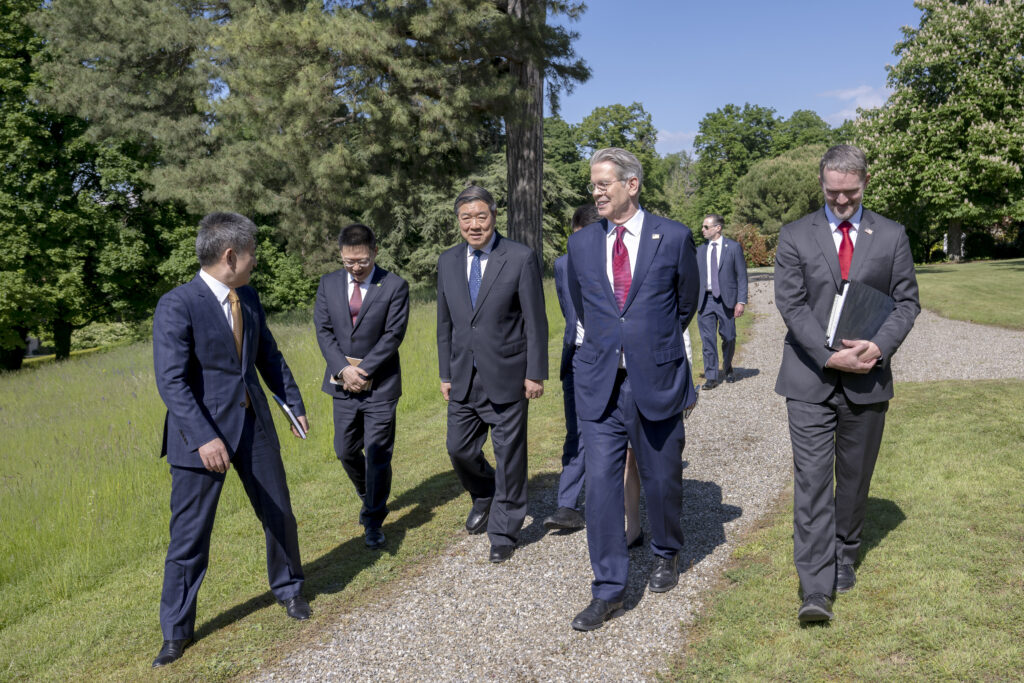
China and US wrap first day of trade talks
Chinese and US officials wrapped the first day in a fresh round of talks in Stockholm on Monday, with the world’s top two economies looking to extend a fragile trade truce in the face of President Donald Trump’s global tariff war.The talks came a day after Trump reached a deal with the EU that will …
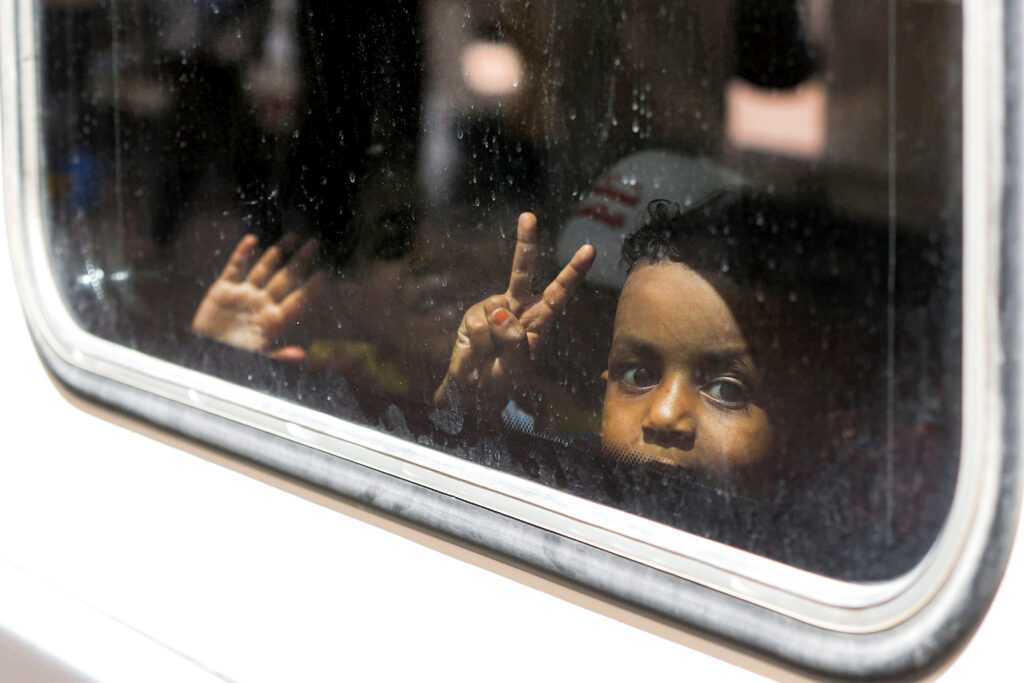
Hundreds of Sudanese refugees in Cairo take up chance to return home for free
On a sweltering Monday morning at Cairo’s main railway station, hundreds of Sudanese families stood waiting, with bags piled at their feet and children in tow, to board a train bound for a homeland shattered by two years of war.The war is not yet over, but with the army having regained control of key areas and life in Egypt often hard, many refugees have decided now is the time to head home.”It’s an indescribable feeling,” said Khadija Mohamed Ali, 45, seated inside one of the train’s ageing carriages, her five daughters lined beside her.”I’m happy that I’ll see my neighbours again — my family, my street,” she told AFP ahead of her return to the capital Khartoum, still reeling from a conflict that has killed tens of thousands and displaced more than 14 million.She was among the second group of refugees travelling under Egypt’s voluntary return programme, which offers free transportation from Cairo to Khartoum, more than 2,000 kilometres away by train and bus.The first convoy left a week earlier.The programme is a joint effort between the Egyptian National Railways and Sudan’s state-owned arms company Defence Industries System, which is covering the full cost of the journey, including tickets and onward bus travel from Egypt’s southern city of Aswan to the Sudanese capital.The Sudanese army is keen for the refugees to return, in part to reinforce its control over recently recaptured areas and as a step towards normality.Each Monday, a third-class, air-conditioned train departs Cairo carrying hundreds on a 12-hour journey to Aswan before they continue by bus across the border.At precisely 11:30 am, a battered locomotive rumbled into the station and women broke into spontaneous ululation.But while some Sudanese are returning home, many continue to flee their homeland, which has been ravaged by war and famine. According to a June report from the UN’s refugee agency UNHCR, over 65,000 Sudanese crossed into Chad in just over a month.Crossings through Libya, one of the most dangerous routes to Europe, have increased this year, according to the Mixed Migration Center.- Khartoum retaken -The war, which began in April 2023, pits army chief Abdel Fattah al-Burhan against his erstwhile ally Mohamed Hamdan Daglo, who leads the paramilitary Rapid Support Forces (RSF).The fighting first erupted in Khartoum and quickly spread, triggering one of the world’s worst humanitarian crises, according to the United Nations.Earlier this year, Sudan’s army declared it had fully retaken Khartoum. Since then, a trickle of returnees has begun.Last week, the country’s new prime minister, Kamil Idris, made his first visit to the capital since the conflict began, promising that “national institutions will come back stronger than before”.The UN has predicted that more than two million people could return to greater Khartoum by the end of the year, though that figure depends heavily on improvements in security and public infrastructure.The capital remains a fractured city. Its infrastructure has been decimated, health services remain scarce and electricity is still largely out in many districts.- ‘Just go back’ -“Slowly things will become better,” said Maryam Ahmed Mohamed, 52, who plans to return to her home in Khartoum’s twin city of Omdurman with her two daughters. “At least we’ll be back at home and with our family and friends,” she told AFP.For many, the decision to return home is driven less by hope than by hardship in neighbouring countries like Egypt.Egypt now hosts an estimated 1.5 million Sudanese refugees, who have limited access to legal work, healthcare and education, according to the UNHCR.Hayam Mohamed, 34, fled Khartoum’s Soba district with her family to Egypt 10 months ago when the area was liberated, but was in ruins.Though services remain nearly non-existent in Khartoum, Mohamed said she still wanted to leave Egypt and go home.”Life was too expensive here. I couldn’t afford rent or school fees,” Mohamed said. Elham Khalafallah, a mother of three who spent seven months in Egypt, also said she struggled to cope.She’s now returning to the central Al-Jazirah state, which was retaken by the army late last year and is seen as “much safer and having better services than Khartoum”.According to the UN’s International Organization for Migration, about 71 percent of returnees were heading to Al-Jazirah, southeast of the capital, while fewer than 10 percent were going to Khartoum.Just outside the Cairo station, dozens more were sitting on benches, hoping for standby tickets.”They told me the train was full,” said Maryam Abdullah, 32, who left Sudan two years ago with her six children.”But I’ll wait. I just want to go back, rebuild my house, and send my children back to school,” she told AFP.
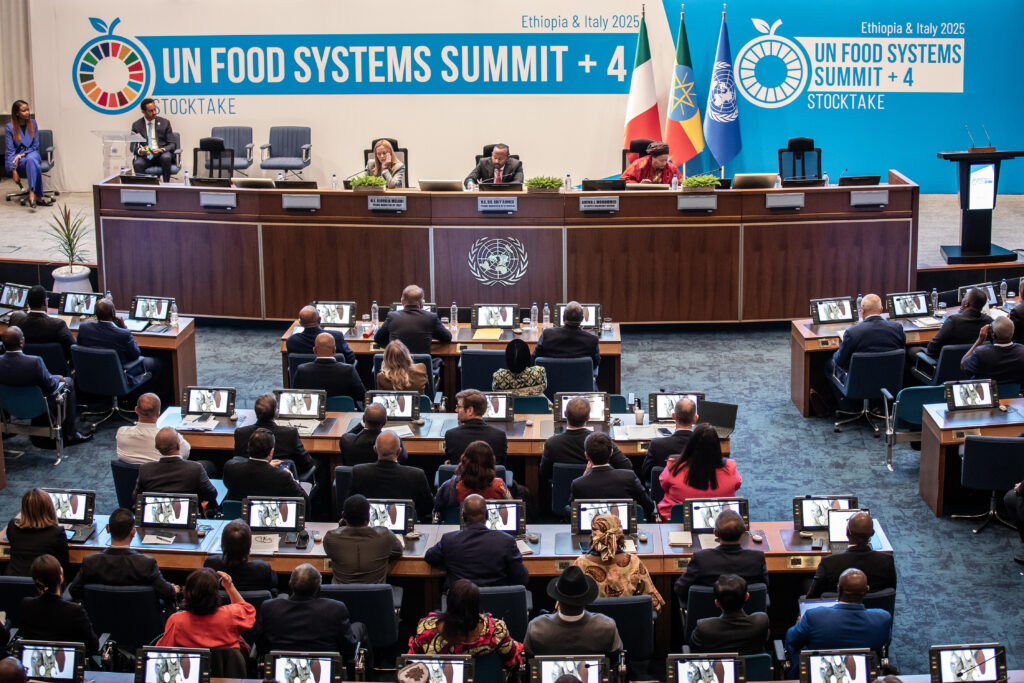
Hunger must never be ‘weapon of war’, UN chief tells Africa food summit
UN chief Antonio Guterres on Monday said food must not be used as a weapon of war as world leaders gathered for a food summit in Africa, where 280 million people face chronic hunger.The African Union urged donors to provide greater support for the world’s poorest continent, which is struggling with poverty, unrest and the effects of climate change.A new report co-authored by several United Nations agencies found global hunger fell slightly in 2024 thanks to progress in Asia and South America.But 8.2 percent of the world — an estimated 638 to 720 million people — still faced hunger last year, and the situation was worsening particularly in Africa, where the figure is 20.2 percent.”Hunger fuels instability and undermines peace. We must never accept hunger as a weapon of war,” Antonio Guterres told the UN Food Systems Summit in the Ethiopian capital Addis Ababa via video link.”Climate change is disrupting harvests, supply chains and humanitarian aid,” he said. He highlighted the worsening crises in Sudan and Gaza. The World Health Organization has warned that malnutrition in the occupied Palestinian territory has reached “alarming levels” since Israel imposed a total blockade on Gaza on March 2.In late May, Israel began allowing a trickle of aid to enter, but more than 100 NGOs have warned that “mass starvation” is spreading.- Millions going hungry -The summit takes place against the backdrop of aid cuts by the United States and other Western nations that are badly affecting much of the developing world.Mahmoud Ali Youssouf, head of the African Union’s executive commission, told the summit that food insecurity was on the rise across Africa, blaming “climate shocks, conflicts and economic disruptions”.”At this crucial moment, how many children and mothers on the continent are sleeping hungry? Millions, certainly,” he said.Youssouf said more than 280 million Africans were malnourished, with “nearly 3.4 million… on the brink of famine” and some 10 million displaced by drought, floods and cyclones.He urged AU member states to devote 10 percent of their gross domestic product to agriculture to help foster “nutritional resilience”.”But we cannot do this alone. We call on our partners to honour their commitments to finance and support African solutions,” he said.- ‘Not good news’ -The UN report made clear how far there was to go to meet its goal of ending world hunger by 2030.Current projections suggest some 512 million people will still be undernourished by the end of the decade, 60 percent of them in Africa. “Global hunger figures have slightly improved compared to 2022 and 2023,” Alvaro Lario, president of the International Fund for Agricultural Development, told AFP.”But we have not come back to the levels of five years ago. This is not very good news.”Four of the worst five countries for food security are in Africa: Nigeria, Sudan, the Democratic Republic of Congo, and Ethiopia. The UN report highlights “persistent inequalities”, with women and rural communities most affected, and the gap widening further over the previous year.”Despite adequate global food production, millions of people go hungry or are malnourished because safe and nutritious food is not available, not accessible or, more often, not affordable,” it said.It found the response to price spikes between 2021 and 2023 was “more coordinated, informed and restrained” than the previous inflationary shock during the 2007-08 financial crisis. Some 2.3 billion people had to occasionally skip a meal in 2024 and are considered moderately or severely food insecure — 335 million more than in 2019.
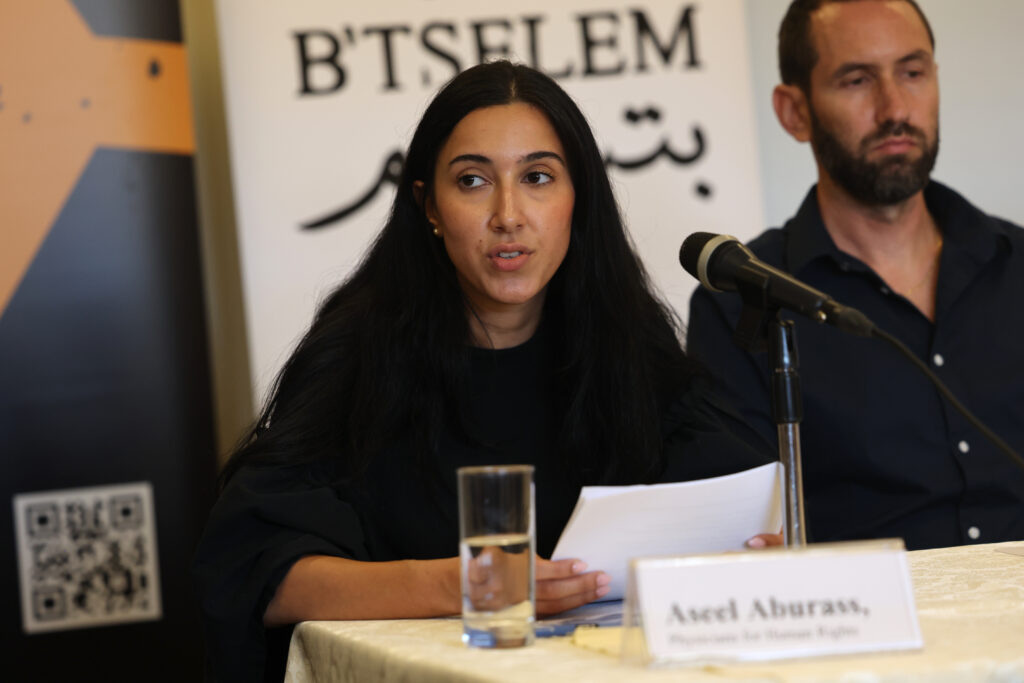
Major Israeli rights groups brand Gaza campaign ‘genocide’
Rights groups B’Tselem and Physicians for Human Rights Israel said on Monday that they had concluded the war in Gaza amounts to a “genocide” against Palestinians, a first for Israeli NGOs.Both organisations are frequent critics of Israeli government policies, but the language in their reports issued on Monday was their most stark yet.”Nothing prepares you for the realisation that you are part of a society committing genocide. This is a deeply painful moment for us,” B’Tselem executive director Yuli Novak told a news conference unveiling the two reports.”As Israelis and Palestinians who live here and witness the reality every day, we have a duty to speak the truth as clearly as possible,” she said.”Israel is committing genocide against the Palestinians.”A spokesman from the Israeli prime minister’s office, David Mencer, denounced the allegation.”We have free speech here in Israel but we strongly reject the accusation,” he said. “Our defence forces target terrorists and never civilians. Hamas is responsible for the suffering in Gaza.”Israel’s war in Gaza for the past 21 months began in response to an unprecedented attack by Palestinian militant group Hamas on October 7, 2023.The Israeli assault has left much of the Gaza Strip, home to more than two million Palestinians, in ruins, and according to the Hamas-run territory’s health ministry has killed at least 59,921 people, most of them civilians.All Gazans have been driven from their homes at least once since the start of the war, and UN agencies warn that residents face a growing threat of famine and malnutrition.The International Court of Justice, in an interim ruling in early 2024 in a case lodged by South Africa, found it “plausible” that the Israeli offensive had violated the UN Genocide Convention.The Israeli government, backed by the United States, fiercely denies the charge and says it is fighting to defeat Hamas and to bring back Israeli hostages still held in Gaza.The reports from B’Tselem — one of Israel’s best-known rights groups — and Physicians for Human Rights Israel argue that the war’s objectives go further.B’Tselem’s report cites statements from senior politicians to illustrate that Israel “is taking coordinated action to intentionally destroy Palestinian society in the Gaza Strip”.Physicians for Human Rights Israel’s report documents what the group says is “the deliberate and systematic destruction of Gaza’s healthcare system”.

Trump says Gaza ceasefire ‘possible’ amid Starmer talks
Donald Trump said a ceasefire in Gaza was “possible”, and stepped up warnings to Russia, as he met UK Prime Minister Keir Starmer at one of the US president’s Scottish golf resorts on Monday.Trump made the comments as he greeted Starmer and his wife Victoria at Turnberry, south of Glasgow, where he has spent two days playing golf.The US leader said he would “reduce” a 50-day ultimatum that he has set Russian President Vladimir Putin to end the war in Ukraine, as he took questions from reporters before his talks with the British leader.”I’m disappointed in President Putin, very disappointed in him. So we’re going to have to look and I’m going to reduce that 50 days that I gave him to a lesser number,” Trump said.Downing Street said Starmer would press Trump on ending “the unspeakable suffering” in Gaza and urge a revival of stalled ceasefire talks between Israel and Hamas as a hunger crisis deepens in the besieged Palestinian territory.Asked whether he agreed with Israeli Prime Minister Benjamin Netanyahu that there was no starvation in Gaza, Trump said: “I don’t know. I mean, based on television, I would say not particularly, because those children look very hungry.”The meeting on Trump’s third full day in Scotland came after the United States and the European Union reached a landmark deal to avert a full-blown trade war over tariffs.Starmer and Trump were to discuss implementing a recent UK-US trade deal.But Gaza was expected to be the focus as European countries express growing alarm over events. Starmer also faces domestic pressure to follow France’s lead and recognise a Palestinian state.- ‘Reject hunger’ -Trump said Sunday the United States would give more aid to Gaza but he wanted other countries to step up.”It’s not a US problem. It’s an international problem,” he said, before embarking on trade talks with EU chief Ursula von der Leyen.He accused Hamas of intercepting aid, saying “they’re stealing the food, they’re stealing a lot of things. You ship it in and they steal it, then they sell it.”Truckloads of food reached hungry Gazans on Monday after Israel promised to open secure aid routes and declared a “tactical pause” in fighting in parts of the territory.But humanitarian agencies warned vast amounts more were needed to counter starvation.United Nations chief Antonio Guterres urged international action against hunger. “Hunger fuels instability and undermines peace. We must never accept hunger as a weapon of war,” he told a UN conference.- Tariffs -Last week, the United States and Israel withdrew from Gaza truce talks, with US envoy Steve Witkoff accusing Hamas of blocking a deal — a claim rejected by the Palestinian militant group.Starmer held talks with French and German counterparts on Saturday, after which the UK government said they agreed “it would be vital to ensure robust plans are in place to turn an urgently-needed ceasefire into lasting peace”.But the Downing Street statement made no mention of Palestinian statehood, which French President Emmanuel Macron has announced his country will recognise in September.More than 220 MPs in Britain’s 650-seat parliament, including dozens from Starmer’s own Labour party, have demanded that he too recognise Palestinian statehood.Business Secretary Jonathan Reynolds told ITV on Monday that “every Labour MP, was elected on a manifesto of recognition of a Palestinian state” and that it was “a case of when, not if.”The UK-US trade deal was signed on May 8 and lowered tariffs for certain UK exports but has yet to come into force.Trump said Sunday the agreement was “great” for both sides but Reynolds told the BBC that “it wasn’t job done” and cautioned not to expect any announcement of a resolution on issues such as steel and aluminium tariffs.After their meeting the two leaders will travel to Aberdeen in Scotland’s northeast, where the US president is to open a new golf course at his resort on Tuesday.Trump played golf at Turnberry on Saturday and Sunday on a five-day visit that has mixed leisure with diplomacy, and also further blurred the lines between the presidency and his business interests.