AFP Asia Business

Egypt grand museum delay puts tourism hopes on hold

In the shadow of the Grand Egyptian Museum, souvenir shop owner Mona has been readying for the tourist boom she hoped the long-awaited opening would bring — now once again out of reach.”I had bet everything on this opening,” she told AFP from her shop, just steps from the iconic pyramids of Giza, which the much-anticipated museum overlooks.Originally scheduled to fully open this month, the museum was expected to attract up to five million visitors annually, fuelling optimism across Cairo’s battered tourism sector.”We planned our entire summer and fall packages around the museum opening,” said Nadine Ahmed, a 28-year-old agent with Time Travel tours.”But with group cancellations, refunds and route changes, we’ve lost tens of thousands of dollars.”Though parts of the museum have been open for months, the main draw — the treasures of Tutankhamun — will remain under wraps until the official launch.Less than three weeks before its July 3 opening, the government announced another delay, this time pushing the landmark event to the final quarter of the year.Prime Minister Mostafa Madbouly cited regional security concerns and the desire to host an event of “global scale”.- Decades in the making -The vast museum, two decades in the making, has faced repeated delays — from political upheaval and economic crises to the Covid-19 pandemic.Ahead of the expected launch, Mona, who asked to be identified by her first name only, took out a loan to renovate her store and stock up on goods inspired by the museum’s collection.A few streets away, Mohamed Mamdouh Khattab, 38, prepared months in advance, hiring and training extra staff and expanding his inventory.”The opening of the museum is a key milestone,” said Khattab, who owns a sprawling bazaar of handcrafted jewellery and ancient replicas.”It’s a project that should have been launched a long time ago,” said the vendor, whose family has been in the industry since the 1970s.Tourism accounts for about 10 percent of Egypt’s workforce, but the sector has struggled — from the fallout of the 2011 Arab Spring to militant attacks and the Covid shutdown.Still, signs of recovery have emerged: Egypt welcomed 3.9 million tourists in the first quarter of 2025, up 25 percent from the same period last year — itself a record.- Fragility -At a Giza papyrus workshop, 30-year-old tour guide Sara Mahmoud hopes the opening will revive visitor numbers.”Big openings have brought a lot of tourism to Egypt before,” she said, pointing to the 2021 Pharaohs’ Golden Parade and the reopening of the Avenue of the Sphinxes.”These events get people excited — we saw the crowds coming in.”Such momentum could make a real difference, said Ragui Assaad, an economist at the University of Minnesota.”Any initiative that directly increases foreign exchange earnings is likely to have a good return on investment,” he told AFP.”If you compare it with all the other mega-projects, which do not increase foreign exchange earnings… this is a far better project.”He was referring to a sweeping infrastructure drive under President Abdel Fattah El-Sisi, including the construction of a massive new administrative capital east of Cairo.The stakes are high: since 2022, Egypt’s currency has lost two-thirds of its value, squeezing household budgets and straining every layer of the economy.”There were days when I sold just one bracelet,” Mona lamented, thinking back to the years when “tourists arrived in droves”.

Syrian forces advance on Sweida as Druze leader says truce talks underway

Syrian government forces were advancing towards the southern city of Sweida on Monday to quell deadly clashes between Druze fighters and Bedouin tribes, with one Druze armed group saying talks with authorities aimed at brokering a truce were underway.The Syrian Observatory for Human Rights war monitor reported 99 people killed since the fighting erupted on Sunday — 60 Druze, including four civilians, 18 Bedouin fighters, 14 security personnel and seven unidentified people in military uniforms.As the violence escalated, Israel — which has previously warned it would intervene in Syria to protect the Druze — said it struck “several tanks” in the area as a “warning” to DamascusAn AFP correspondent saw Syrian forces on Monday take control of the Druze village of Al-Mazraa, where Bedouin fighters were also located.A commander, Ezzeddine al-Shamayer, told AFP the forces “are heading toward Sweida” city.In a statement, the interior ministry declared that “army and internal security forces have moved closer to the centre” of Sweida province.Bassem Fakhr, spokesperson for the Men of Dignity movement, one of the largest Druze factions in Sweida, told AFP talks were “underway between the notables of the city of Sweida and representatives of the general security (forces) and the defence ministry to reach a solution”.Druze religious authorities had called on Monday evening for a ceasefire in the area, saying they were not opposed to the Syrian central government.But Sheikh Hikmat al-Hijri, one of the three Druze spiritual leaders in Sweida, expressed his “rejection of the entry” of general security forces into the province, demanding “international protection”.Israel — which also has a Druze population, and has previously attacked Syria in purported defence of the group — reported hitting several tanks heading towards Sweida on Monday.The strikes were “a clear warning to the Syrian regime — we will not allow harm to be done to the Druze in Syria”, Defence Minister Israel Katz posted on X.- Fear of massacres -The fighting in the south underscores the challenges facing interim leader Ahmad al-Sharaa, whose Islamist forces ousted president Bashar al-Assad in December after nearly 14 years of civil war.Syria’s pre-war Druze population was estimated at around 700,000, many of them concentrated in Sweida province.The Druze, followers of an esoteric religion that split from Shiite Islam, are mainly found in Syria, Lebanon and Israel.Following deadly clashes with government forces in April and May, local and religious leaders reached an agreement with Damascus under which Druze fighters have been providing security in the province.The streets of Sweida were deserted Monday, with an AFP photographer reporting distant gunfire during funerals.”We lived in a state of extreme terror — the shells were falling randomly,” said Abu Taym, a 51-year-old father, adding “most shops are closed”.”We fear a repeat of the coastal scenario,” said Amal, 46, referring to massacres in March of more than 1,700 mostly Alawite civilians in northwest Syria, where groups affiliated with the government were blamed for most of the killings.”We are not against the state, but we are against surrendering our weapons without a state that treats everyone the same,” she added.In a post on X, Syrian Defence Minister Murhaf Abu Qasra urged his troops to “protect your fellow citizens” from “outlaw gangs”, and to “restore stability to Sweida”.- ‘Lack of state institutions’ -The violence began on Sunday when Bedouin gunmen abducted a Druze vegetable vendor on the highway to Damascus, prompting retaliatory kidnappings.Though hostages were later released, the fighting carried on Monday outside Sweida city, with mortar fire hitting villages and dozens wounded, according to the Suwayda 24 news outlet.In a Sunday post on X, Interior Minister Anas Khattab said “the lack of state, military and security institutions is a major reason” for the ongoing tensions in Sweida.The Observatory said members of Bedouin tribes, who are Sunni Muslims, had sided with security forces during earlier confrontations with the Druze.Bedouin and Druze factions have a longstanding feud in Sweida, and violence occasionally erupts between the two sides.The wave of coastal massacres in March targeting the Alawite community and the subsequent attacks on Druze areas, as well as a deadly attack on a Damascus church in June, have undermined confidence in the new Syrian authorities’ ability to protect minorities.str-lk-at-mam/nad/smw

Mediators working to bridge gaps in faltering Gaza truce talks

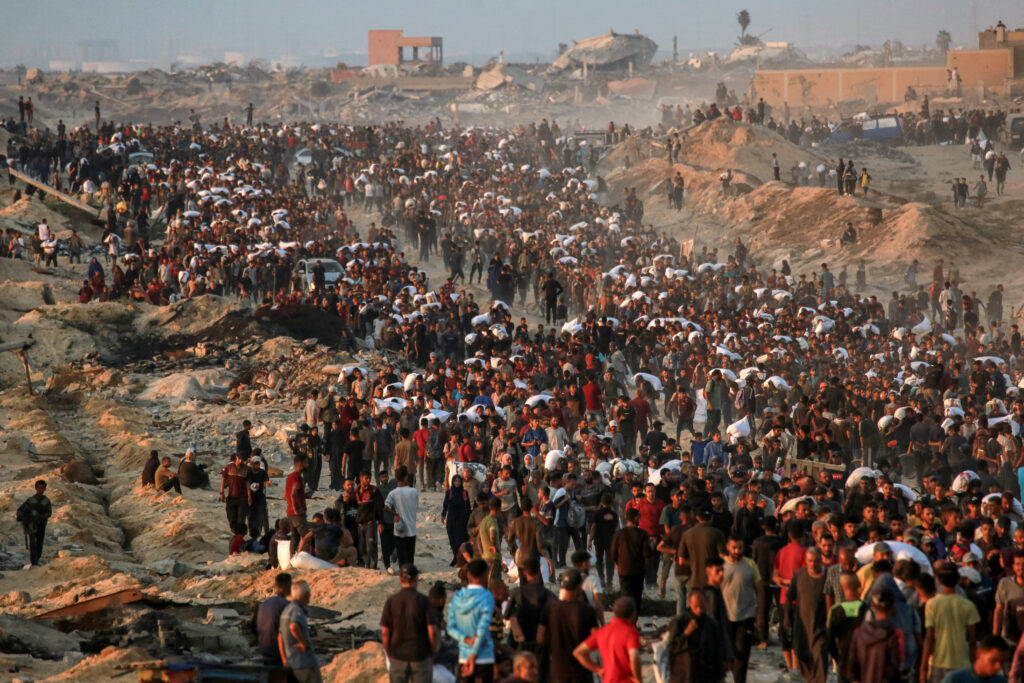
Stuttering Gaza ceasefire talks entered a second week on Monday, with mediators seeking to close the gap between Israel and Hamas, as more than 20 people were killed across the Palestinian territory.The indirect negotiations in Qatar appear deadlocked after both sides blamed the other for blocking a deal for the release of hostages and a 60-day ceasefire after 21 months of fighting.An official with knowledge of the talks said they were “ongoing” in Doha on Monday, telling AFP: “Discussions are currently focused on the proposed maps for the deployment of Israeli forces within Gaza.””Mediators are actively exploring innovative mechanisms to bridge the remaining gaps and maintain momentum in the negotiations,” the source added on condition of anonymity.Hamas accused Israeli Prime Minister Benjamin Netanyahu — who wants to see the Palestinian militant group destroyed — of being the main obstacle.”Netanyahu is skilled at sabotaging one round of negotiations after another, and is unwilling to reach any agreement,” the group wrote on Telegram.In Gaza, the civil defence agency said at least 22 people were killed Monday in the latest Israeli strikes in and around Gaza City and in Khan Yunis in the south.An Israeli military statement said troops had destroyed “buildings and terrorist infrastructure” used by Hamas and Palestinian Islamic Jihad militants in Gaza City’s Shujaiya and Zeitun areas.The Al-Quds Brigades — the armed wing of Islamic Jihad, which has fought alongside Hamas — released footage on Monday that it said showed its fighters firing missiles at an Israeli army command and control centre near Shujaiya.The military later on Monday said three soldiers — aged 19, 20 and 21 — “fell during combat in the northern Gaza Strip” and died in hospital on Monday. Another from the same battalion was severely injured.- Talks ‘ongoing’ -US President Donald Trump said he was still hopeful of securing a truce deal, telling reporters on Sunday night: “We are talking and hopefully we’re going to get that straightened out over the next week.”Hamas’s top negotiator, Khalil al-Hayya, and the leadership of Hamas and Islamic Jihad held a “consultative meeting” in Doha on Sunday evening to “coordinate visions and positions”, a Palestinian source with knowledge of the talks told AFP.”Egyptian, Qatari and American mediators continue their efforts that make Israel present a modified withdrawal map that would be acceptable,” they added.On Saturday, the same source said Hamas rejected Israeli proposals to keep troops in more than 40 percent of Gaza, as well as plans to move Palestinians into an enclave on the border with Egypt.A senior Israeli political official countered by accusing Hamas of inflexibility and trying to deliberately scupper the talks by “clinging to positions that prevent the mediators from advancing an agreement”.- Pressure – Netanyahu has said he would be ready to enter talks for a more lasting ceasefire once a deal for a temporary truce is agreed, but only when Hamas lays down its arms.He is under pressure to wrap up the war, with military casualties rising and with public frustration mounting at both the continued captivity of the hostages taken on October 7 and a perceived lack of progress in the conflict.Politically, Netanyahu’s fragile governing coalition is holding, for now, but he denies being beholden to a minority of far-right ministers in prolonging an increasingly unpopular conflict.He also faces a backlash over the feasibility, cost and ethics of a plan to build a so-called “humanitarian city” from scratch in southern Gaza to house Palestinians if and when a ceasefire takes hold.Israel’s security establishment is reported to be unhappy with the plan, which the UN agency for Palestinian refugees and Israel’s former prime minister Ehud Olmert have described as a “concentration camp”.”If they (Palestinians) will be deported there into the new ‘humanitarian city’, then you can say that this is part of an ethnic cleansing,” Olmert was quoted as saying by The Guardian newspaper late on Sunday.Hamas’s attack on Israel in 2023 resulted in the deaths of 1,219 people, most of them civilians, according to an AFP tally based on official figures.A total of 251 hostages were taken that day, of whom 49 are still being held, including 27 the Israeli military says are dead.Israel’s military reprisals have killed 58,386 Palestinians, mostly civilians, according to the health ministry in Hamas-run Gaza.

Almost 100 killed as Syria sectarian clashes rage

Syrian government forces were advancing towards the southern city of Sweida on Monday amid clashes in the region between Druze fighters and Bedouin tribes that have killed nearly 100 people, according to a war monitor.As the violence escalated, Israel — which had previously warned that it would intervene in Syria to protect the Druze — said it struck “several tanks” in the area, citing security concerns.The fighting underscores the challenges facing interim leader Ahmad al-Sharaa, whose Islamist forces ousted president Bashar al-Assad in December after nearly 14 years of civil war.The Syrian Observatory for Human Rights war monitor raised its death toll to 99 killed since fighting erupted Sunday, including 60 Druze, four of them civilians, 18 Bedouin fighters, 14 security personnel and seven unidentified people in military uniforms.Syrian forces on Monday took control of the Druze village of Al-Mazraa, where Bedouin fighters were also located, an AFP correspondent said.A commander, Ezzeddine al-Shamayer, told AFP the forces “are heading toward Sweida” city.In a statement, the interior ministry declared that “army and internal security forces have moved closer to the centre” of Sweida.Israel, which has attacked Syria in the past months under the pretext of protecting the Druze, said it hit several tanks heading towards Sweida.The strikes were “a clear warning to the Syrian regime — we will not allow harm to be done to the Druze in Syria”, Israeli Defence Minister Israel Katz posted on X.Druze spiritual leaders called for calm and urged Damascus to intervene.But Sheikh Hikmat al-Hijri, one of the three Druze spiritual leaders in Sweida, expressed his “rejection of the entry” of general security forces into the province, demanding “international protection”.- Fear of massacres -Syria’s pre-war Druze population was estimated at around 700,000, many of them concentrated in Sweida province.The Druze, followers of an esoteric religion that split from Shiite Islam, are mainly found in Syria, Lebanon and Israel.Following deadly clashes with government forces in April and May, local and religious leaders reached an agreement with Damascus under which Druze fighters have been providing security in the province since May.The streets of Sweida were deserted, with an AFP photographer reporting gunfire during funerals.”We lived in a state of extreme terror — the shells were falling randomly,” said Abu Taym, a 51-year-old father in Sweida.”Traffic on the streets is paralysed, and most shops are closed.””We fear a repeat of the coastal scenario,” said Amal, 46, referring to the March massacres of over 1,700 mostly Alawite civilians in Syria’s coast, where groups affiliated with the government were blamed for most of the killings.”We are not against the state, but we are against surrendering our weapons without a state that treats everyone the same,” she added, noting that she and her family escaped Sweida to a nearby village.In a post on X, Syrian Defence Minister Murhaf Abu Qasra urged his troops to “protect your fellow citizens” from “outlaw gangs” and “restore stability to Sweida”.- ‘Lack of state institutions’ -The violence began Sunday when Bedouin gunmen abducted a Druze vegetable vendor on the highway to Damascus, prompting retaliatory kidnappings.Though hostages were later released, the fighting carried on Monday outside Sweida city, with mortar fire hitting villages and dozens wounded, according to the Suwayda 24 news outlet.In a Sunday post on X, Interior Minister Anas Khattab said “the lack of state, military and security institutions is a major reason” for the ongoing tensions in Sweida.The latest bloodshed follows deadly violence in April and May, when clashes between Druze fighters and security forces in Druze-populated areas near Damascus and Sweida killed more than 100 people.The Observatory said members of Bedouin tribes, who are Sunni Muslims, had sided with security forces during earlier confrontations.Bedouin and Druze factions have a longstanding feud in Sweida, and violence occasionally erupts between the two sides.The wave of massacres in March targeting the Alawite community and the subsequent attacks on Druze areas, as well as a deadly attack on a Damascus church in June, have undermined confidence in the new Syrian authorities’ ability to protect minorities.

LVMH Italian fashion house Loro Piana put under court administration

Italian fashion house Loro Piana, owned by French giant LVMH, has been placed under court administration for allegedly facilitating the exploitation of workers by subcontractors, police and a company source said Monday.In a statement, the Italian police labour protection service said it had “executed a decree of judicial administration issued by the Milan court” against …

LVMH Italian fashion house Loro Piana put under court administration Read More »