AFP Asia Business

Gaza civil defence says Israeli attacks kill 26 near two aid centres

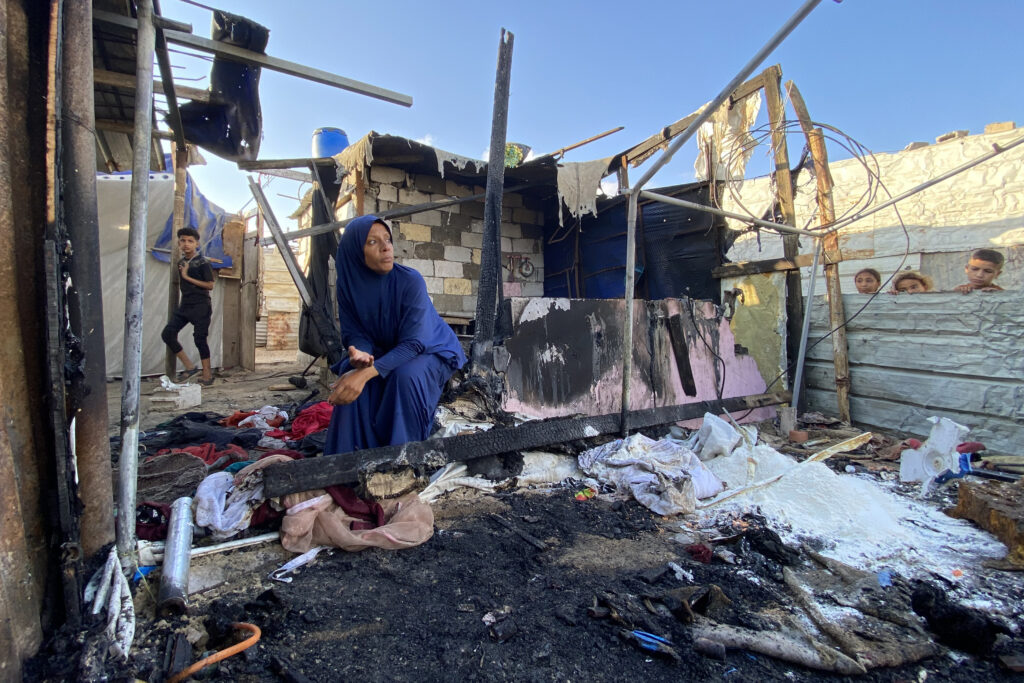
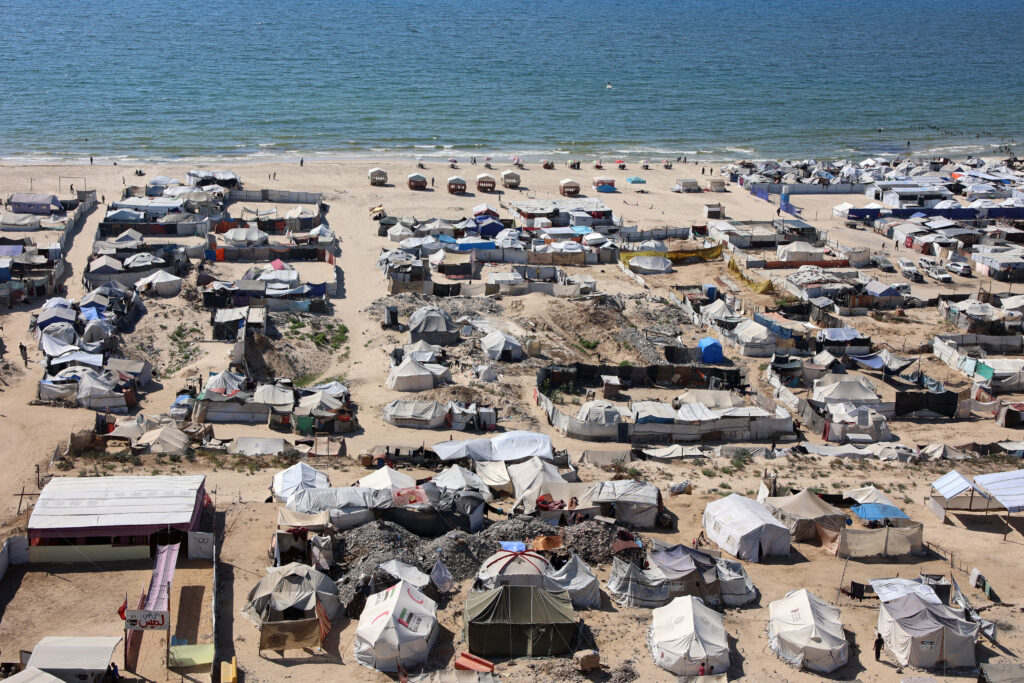
Gaza’s civil defence agency on Saturday said Israeli gunfire killed 26 people and wounded more than 100 near two aid centres, in the latest deaths of Palestinians seeking food.Deaths of people waiting for handouts in huge crowds near food points in Gaza have become a regular occurrence, with the territory’s authorities frequently blaming Israeli fire.But the US- and Israel-backed Gaza Humanitarian Foundation (GHF), which is the main distributor of aid in the territory, has accused militant group Hamas of fomenting unrest and shooting at civilians.The Israeli military said it was “looking into” the latest reports when contacted by AFP.Civil defence agency spokesman Mahmud Bassal said the deaths happened near a site southwest of Khan Yunis and another centre northwest of Rafah, both in the south, attributing the deaths to “Israeli gunfire”.One eyewitness said he headed to the Al-Tina area of Khan Yunis before dawn with five of his relatives to try to get food when “Israeli soldiers” started shooting.”My relatives and I were unable to get anything,” Abdul Aziz Abed, 37, told AFP. “Every day I go there and all we get is bullets and exhaustion instead of food.”Three other eyewitnesses also accused troops of opening fire.”They started shooting at us and we lay down on the ground. Tanks and jeeps came, soldiers got out of them and started shooting,” said Tamer Abu Akar, 24.Nine people were killed in gunfire at the same centre in the Al-Shakoush area northwest of Rafah on Friday, the civil defence agency said.Media restrictions in Gaza and difficulties in accessing many areas mean AFP is unable to independently verify tolls and details provided by the agency and other parties.- ‘Agitators’ -The war in Gaza, sparked by militant group Hamas’s deadly attack on Israel on October 7, 2023, has created dire humanitarian conditions for the more than two million people who live in the coastal territory.Most people have been displaced at least once by the fighting and doctors and aid agencies say the physical and mental health effects of 21 months of conflict are being increasingly seen.”We are receiving cases suffering from extreme exhaustion and complete fatigue, in addition to severe emaciation and acute malnutrition due to prolonged lack of food,” the director of the Kuwaiti Field Hospital in Khan Yunis, Sohaib Al-Hums, said on Friday.”Hundreds” of people were facing “imminent death”, he added. The World Food Programme said nearly one in three people in Gaza were not eating for days at a stretch and “thousands” were “on the verge of catastrophic hunger”.The free flow of aid into Gaza is a key demand of Hamas in the indirect talks with Israel for a 60-day ceasefire in the war, alongside a full Israeli military withdrawal.Following a more than two-month total Israeli blockade, GHF took over the running of aid distribution in late May, despite criticism from the United Nations, which previously coordinated handouts, that it was designed to cater to Israeli military objectives.GHF said 20 people died at its Khan Yunis site on Wednesday but blamed “agitators in the crowd… armed and affiliated with Hamas” for creating “a chaotic and dangerous surge” and firing at aid-seekers.The previous day, the UN said it had recorded 875 people killed in Gaza while trying to get food, including 674 “in the vicinity of GHF sites”, since it began operating.Hamas’s 2023 attack on Israel led to the deaths of 1,219 people, most of them civilians, according to an AFP tally based on official figures.Of the 251 people taken hostage that day, 49 are still in Gaza, including the 27 the Israeli military says are dead.Israel’s retaliatory military action has killed 58,667 Palestinians, most of them civilians, according to the health ministry in Hamas-run Gaza.

West Bank ‘plane chalet’ helps aviation dreams take off

A guest house in the shape of a plane would stand out anywhere in the world, but in the occupied West Bank devoid of airports, Minwer Harsha’s creation helps aviation dreams take flight.”So many kids want to come,” said 27-year-old Harsha, who built the guest house in the hills of the northern West Bank, within view of the separation barrier between Israel and the Palestinian territory.”And that’s the goal: since we don’t have planes or airports, people come here instead,” he told AFP.Harsha said he designed the concrete plane himself, with a master bedroom in the cockpit and a children’s bedroom in the tail.The price tag, between 1,000 and 2,000 shekels (about $300-$600) per night, is out of reach for most Palestinians, particularly as unemployment soars due to the war in Gaza.He has nonetheless been pleased with the reactions to his chalet, having initially faced scepticism.”I wanted to bring something unique, something new to the area and to Palestine,” Harsha said of the unit, which opened a month ago.Since its launch, his red and white concrete plane has become a local landmark, featuring in local media and on social networks.Harsha said he originally wanted to place a Palestinian flag on his chalet and call it the “Palestinian Queen”, but avoided such signs out of caution.The guest house is located in the West Bank’s Area C, which covers more than 60 percent of the territory and is under full Israeli control.”I just made it look like a plane. I avoided politics entirely because of the hardships our people are going through,” he said.”We’re a people who are constantly losing things — our land, our rights, our lives.”- Using the land -Israel has occupied the West Bank since 1967, and frequently demolishes homes it says are built without permission in the mostly rural Area C.Though no airport currently services the Palestinian territories, both the West Bank and Gaza once had their own terminals, in east Jerusalem and the southern Gaza city of Rafah, respectively.Both were closed during the Second Intifada, the Palestinian uprising of the early 2000s, and what remains of east Jerusalem’s airport is now isolated from the rest of the West Bank by Israel’s separation barrier.Despite difficulties and threats of demolition, Harsha believes that Palestinians can find freedom and fulfilment in projects like his.”I encourage everyone who has land to work on it and invest in it — with creativity and ambition,” he said, flanked by his two brothers who helped him build the unit.Harsha himself has more plans for his land.”After this aeroplane, we’ll build a ship next year,” he said.”It will be something unique and beautiful,” he said, pointing out that while many West Bank Palestinians have seen planes flying overhead, a large number of people from the landlocked territory have never seen a real ship at all.

US announces Syria-Israel truce as new clashes rock Druze heartland

The United States said early Saturday that it had negotiated a ceasefire between Israel and Syria’s government as new clashes erupted in Syria’s Druze heartland following violence that prompted massive Israeli strikes.At least 638 people have died since Sunday in violence between the Druze and Bedouins, according to the Syrian Observatory for Human Rights, drawing questions over the authority of Syria’s interim leader Ahmed al-Sharaa.Israel intervened Wednesday with major strikes in the heart of the capital Damascus, including hitting the army’s headquarters.Tom Barrack, the US pointman on Syria, said in the early hours of Saturday in the Middle East that Sharaa and Israeli Prime Minister Benjamin Netanyahu “have agreed to a ceasefire” negotiated by the United States.Barrack, who is US ambassador to Ankara, said the deal was backed by Turkey, a key supporter of Sharaa, as well as neighbouring Jordan.”We call upon Druze, Bedouins and Sunnis to put down their weapons and together with other minorities build a new and united Syrian identity in peace and prosperity with its neighbours,” he wrote on X.The United States on Wednesday announced an earlier deal in which Sharaa pulled government forces out of Sweida, the southern hub of the Druze minority.Sharaa said the mediation helped avert a “large-scale escalation” with Israel but his office accused Druze fighters of violating it.Sharaa’s office on Friday evening pledged to deploy fresh forces to the region to break up further clashes in the south, urging “all parties to exercise restraint and prioritise reason”.Renewed fighting erupted Friday between Bedouin tribal factions and the Druze at the entrance to Sweida, an AFP correspondent said.About 200 tribal fighters clashed with armed Druze men from the city using machine guns and shells, the AFP correspondent said, while the Syrian Observatory also reported fighting and shelling on neighbourhoods in Sweida.In the corridors of the Sweida National Hospital, a foul odour emanated from the swollen and disfigured bodies piled up in refrigerated storage units, an AFP correspondent reported.A small number of doctors and nurses at the hospital worked to treat the wounded arriving from the ongoing clashes, some in the hallways.Omar Obeid, a doctor at the government hospital, told AFP that the facility has received “more than 400 bodies” since Monday morning.”There is no more room in the morgue. The bodies are in the street” in front of the hospital, added Obeid, president of the Sweida branch of the Order of Physicians.The UN’s International Organization for Migration on Friday said that 79,339 people have been displaced since Sunday, including 20,019 on Thursday alone.- Tribal back-up -Tribal reinforcements from across Syria gathered in villages around Sweida on Friday to reinforce local Bedouin, whose longstanding enmity towards the Druze erupted into violence last weekend.Anas al-Enad, a tribal chief from the central city of Hama, said he and his men had made the journey to the village of Walgha, northwest of Sweida, because “the Bedouin called for our help and we came to support them”.An AFP correspondent saw burning homes and shops in the village, now under the control of the Bedouin and their allies.Israel, which has its own sizable Druze community, said Friday that it was sending support valued at nearly $600,000, including food and medical supplies, to Druze in Sweida.Israel has vowed to defend the Druze community, although some diplomats and analysts say its goal is to weaken the military in Syria, its historic adversary, seeing it at a weak point since Sharaa’s Sunni Islamists toppled Bashar al-Assad, an Iranian ally, in December.- UN demands independent probe -Rayan Maarouf, editor-in-chief of local news outlet Suwayda 24, said the humanitarian situation was “catastrophic”.”We cannot find milk for children,” he told AFP.UN High Commissioner for Human Rights Volker Turk called for an end to the bloodshed and “independent, prompt and transparent investigations into all violations”.The International Committee for the Red Cross warned that health facilities were overwhelmed, with power cuts impeding the preservation of bodies in overflowing morgues.”The humanitarian situation in Sweida is critical. People are running out of everything,” said Stephan Sakalian, the head of ICRC’s delegation in Syria.”Hospitals are increasingly struggling to treat the wounded and the sick, and families are unable to bury their loved ones in dignity,” he said.The latest violence erupted Sunday after the kidnapping of a Druze vegetable merchant by local Bedouin triggered tit-for-tat abductions, the Britain-based Observatory said.burs-sbk-sct/sco

New clashes rock Syria’s Druze heartland as tribal fighters reinforce Bedouin

Armed tribes supported by Syria’s Islamist-led government clashed with Druze fighters in the community’s Sweida heartland on Friday, a day after the army withdrew under Israeli bombardment and diplomatic pressure.The United Nations called for an end to the “bloodshed” and demanded an “independent” investigation of the violence, which has claimed at least 638 lives since Sunday, according to the Syrian Observatory for Human Rights.The renewed fighting raised questions over the authority of interim leader Ahmed al-Sharaa, whose interim government also has difficult relations with the Kurdish and Alawite minorities. It was Sharaa who ordered government forces to pull out, saying that mediation by the United States and others had helped avert a “large-scale escalation” with Israel.However his office on Friday evening pledged to deploy fresh forces to the region to break up further clashes in the south, urging “all parties to exercise restraint and prioritise reason”.Renewed fighting erupted Friday between Bedouin tribal factions and the Druze at the entrance to Sweida, an AFP correspondent said.About 200 tribal fighters clashed with armed Druze men from the city using machine guns and shells, the AFP correspondent said, while the Observatory also reported fighting and “shelling on neighbourhoods in Sweida city”.In the corridors of the Sweida National Hospital, a foul odour emanated from the swollen and disfigured bodies piled up in refrigerated storage units, an AFP correspondent reported.A small number of doctors and nurses at the hospital worked to treat the wounded arriving from the ongoing clashes, some in the hallways.Omar Obeid, a doctor at the government hospital, told AFP that the facility has received “more than 400 bodies since Monday morning.”There is no more room in the morgue, the bodies are in the street” in front of the hospital, added Obeid, president of the Sweida branch of the Order of Physicians.The UN’s International Organization for Migration on Friday said that “79,339 people have been displaced since 13 July, including 20,019 on 17 July”.- Tribal back-up -After the clashes broke out, the Syrian presidency said late on Friday that “the relevant authorities are working on dispatching a specialised force to break up the clashes and resolve the conflict on the ground” in the Druze heartland.Tribal reinforcements from across Syria gathered in villages around Sweida on Friday to reinforce local Bedouin, whose longstanding enmity towards the Druze erupted into violence last weekend.Anas al-Enad, a tribal chief from the central city of Hama, said he and his men had made the journey to the village of Walgha, northwest of Sweida, because “the Bedouin called for our help and we came to support them”.An AFP correspondent saw burning homes and shops in the village, now under the control of the Bedouin and their allies.The Britain-based Observatory said “the deployment of tribal fighters to Sweida province was facilitated by government forces, because government forces are unable to deploy to Sweida under the terms of the security agreement with Israel”.Israel, which bombed the Syrian military in Sweida and Damascus earlier this week to put pressure on the government to withdraw, said Friday that it was sending aid to the Druze community in Sweida.The two-million-shekel (nearly $600,000) package includes food parcels and medical supplies, the ministry said.A ceasefire was supposed to take effect on Thursday, but Sharaa’s office accused Druze fighters of violating it.Sweida has been heavily damaged in the fighting and its mainly Druze inhabitants have been deprived of water and electricity, while communication lines have been cut.- UN demands independent probe -Rayan Maarouf, editor-in-chief of local news outlet Suwayda 24, said the humanitarian situation was “catastrophic”.”We cannot find milk for children,” he told AFP.UN High Commissioner for Human Rights Volker Turk called for an end to the bloodshed, saying “the protection of all people must be the utmost priority”.He demanded “independent, prompt and transparent investigations into all violations” adding that “those responsible must be held to account”.The International Committee for the Red Cross warned that “health facilities are overwhelmed, medical supplies are dwindling and power cuts are impeding the preservation of human remains in overflowing morgues”.”The humanitarian situation in Sweida is critical. People are running out of everything,” said Stephan Sakalian, the head of ICRC’s delegation in Syria.”Hospitals are increasingly struggling to treat the wounded and the sick, and families are unable to bury their loved ones in dignity.”The latest violence erupted on Sunday after the kidnapping of a Druze vegetable merchant by local Bedouin triggered tit-for-tat abductions, the Britain-based Observatory said.The Islamist-led government sent in the army, promising to put a halt to the fighting, but witnesses and the Observatory said the troops sided with the Bedouin and committed many abuses against Druze civilians as well as fighters.The interim government has had strained relations with Syria’s religious and ethnic minorities since it toppled longtime leader Bashar al-Assad in December.This week’s fighting marks the most serious outbreak of violence since government forces battled Druze fighters in Sweida province and around Damascus in April and May, leaving more than 100 people dead.burs-sbk/jj

Argentines commemorate Jewish center bombing, demand justice

Hundreds of Argentines gathered Friday to commemorate the 1994 bombing of a Jewish cultural center that killed dozens, demanding justice for a crime for which there has not yet been a trial.In the worst such attack in Argentina’s history, a car bomb on July 18, 1994, killed 85 people and injured more than 300 at the seven-story Argentine Israelite Mutual Association (AMIA) building in Buenos Aires.Two years earlier, an explosion at the Israeli embassy killed 29 and wounded 200.”Impunity persists, terrorism too” was the slogan for Friday’s 31st commemoration of the AMIA attack — the second such event attended by President Javier Milei, a staunch defender of Israel.Survivors and victims’ relatives hope there will be movement under Catholic-born Milei, who has already visited Israel twice since taking office in December 2023, and has professed a deep interest in Judaism.In April 2024, an Argentine court found Iran and Hezbollah were responsible for what it called a crime against humanity.It ruled the likely motive for the attacks was the cancellation by the Argentine government under then-president Carlos Menem of three contracts with Iran for the supply of nuclear equipment and technology.In June, a judge authorized a trial in absentia against ten Iranian and Lebanese defendants — former ministers and diplomats. No date has been set.Iran has always denied any involvement and has refused to hand over any suspects.- Cover-up? -The Memoria Activa organization, which represents victims’ families, rejects a trial in absentia as it believes it “essential for the accused to participate” for the whole truth to come out.The AMIA itself is in favor, but has cautioned that “holding a trial only for it to end… in some sort of nullity or a declaration of unconstitutionality would once again be very painful for everyone.”Both organizations have been highly critical of the Argentine state’s handling of the case. Last year, the Inter-American Court of Human Rights in San Jose, Costa Rica, found the state responsible for not preventing, or properly investigating, the AMIA attack.It also blamed the state for efforts to “cover up and obstruct the investigation.”Prosecutor Alberto Nisman, investigating accusations of a cover-up against former president Cristina Kirchner, was later found murdered.No one was ever charged over his death.Argentina is host to the largest Jewish community in Latin America, with nearly 300,000 people living mostly in Buenos Aires. 

‘Mass grave’: Medics appeal for aid at last working hospital in Syria’s Sweida

In the last barely-functional hospital in Sweida, bodies are overflowing from the morgue, staff said, amid violence that has wracked the Druze-majority southern Syrian city for nearly a week.”It’s not a hospital anymore, it’s a mass grave,” said Rouba, a member of the medical staff at the city’s sole government hospital, weeping as she appealed for aid.Dr Omar Obeid, who heads the Sweida division at Syria’s Order of Physicians, said the facility has received “more than 400 bodies since Monday morning”, including women, children and the elderly.”There’s no more space in the morgue, the bodies are out on the street” in front of the hospital, he continued.Fighting erupted Sunday night between Druze fighters and local Bedouin tribes before Syrian government forces intervened on Tuesday with the stated intention of quelling the violence.But in the subsequent events, those government forces were accused of grave abuses against the minority, according to rights organisations, witnesses and Druze groups.The government forces withdrew from the city on Thursday following threats from Israel, which has vowed to protect the Druze.In the hospital on Friday, corridors were engulfed by the stench of the dead bodies, which had bloated beyond recognition, an AFP correspondent said.Visibly overwhelmed, the handful of medical personnel remaining at the facility nonetheless rushed to do their best to offer care to the seemingly endless stream of wounded, many of them waiting in the hallways.”There are only nine doctors and medical staff left, and they are working nonstop,” said Rouba, who preferred not to give her full name.- ‘No water, no electricity’ -“The situation is very bad, we have no water and no electricity, medicines are starting to run out,” Rouba continued.”There are people who have been at home for three days and we can’t manage to rescue them,” she said. “The bodies are on the streets and no one can go out to get them. Yesterday, five big cars filled with bodies arrived at the hospital.”There are women, children, people whose identities are unknown, cut-off arms or legs.”The United Nations on Friday urged an end to the bloodshed, demanding “independent, prompt and transparent investigations into all violations”.According to the Syrian Observatory for Human Rights, the violence has claimed the lives of nearly 600 people since Sunday.Omar Obeid told AFP that three of his colleagues were killed, including one who was “shot dead in his house, in front of his family”.Another was killed at point-blank range in her car as she drove through a security checkpoint, he said.The third, “surgeon Talaat Amer was killed while he was at the hospital on Tuesday in a blue surgical gown to perform his duty”, Obeid said.”They shot him in the head. Then they called his wife and told her: your husband was wearing a surgical cap — it’s red now.”