AFP Asia Business
In Syria’s Sweida, bodies wait to be identified at overwhelmed hospital
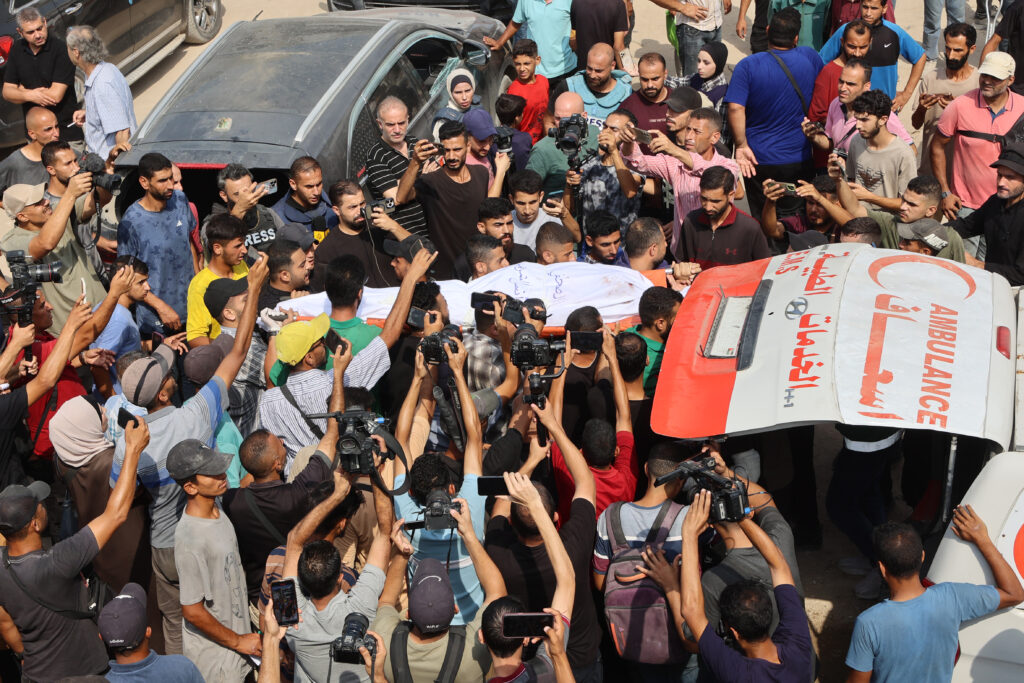
At the main hospital in south Syria’s Sweida city, dozens of bodies are still waiting to be identified as the death count of days of sectarian clashes continues to rise.”We have handed 361 bodies over to family members, but we still have 97 unidentified corpses,” a forensic medicine official at facility said on condition of anonymity.Clashes erupted on July 13 in Syria’s Druze-majority province of Sweida between local fighters and Sunni Bedouin, spiralling and drawing in government forces, tribal allies of the Bedouin and the military of neighbouring Israel.Witnesses, Druze factions and a monitor have accused government forces of siding with the Bedouin and committing abuses including summary executions when they entered Sweida last week.More than 1,100 people, most of them Druze fighters and civilians, have been killed, according to the Syrian Observatory for Human Rights monitor, whose toll also includes several hundred government security personnel.Health authorities have not released a comprehensive death toll.More than 450 bodies had been taken to Sweida’s main hospital by Sunday evening, while bodies were still being collected from streets and homes in the city.”The dead bodies sent a terrible smell through all the floors of the hospital,” said nurse Hisham Breik, who said he had not left the facility since the violence began.”The situation has been terrible. We couldn’t walk around the hospital without wearing a mask,” he said, his voice trembling, adding that the wounded included women, children and the elderly.Medical personnel have been working in tough conditions at the hospital, which has seen clashes around it and has been flooded with wounded, some of whom were lying in the corridors.Bodies have yet to be removed from villages in Sweida province’s north and west, the hospital administration and health workers said.The United Nations Office for the Coordination of Humanitarian Affairs (OCHA) said that hospitals and health centres in Sweida province were out of service, with “reports of unburied bodies raising serious public health concerns”.Humanitarian access to Sweida “remains highly constrained”, it said a statement late Sunday.- ‘Catastrophe’ -The Sweida national hospital has remained open despite the dire situation that has also included supply shortages and water and power cuts.A first Syrian Red Crescent convoy entered Sweida on Sunday carrying UN humanitarian assistance including food, water, medical supplies and fuel, OCHA said.A Red Crescent official told AFP the supplies included body bags.Another convoy facilitated by the Red Crescent was to leave Damascus on Monday, OCHA said.But as the supplies were unloaded on Sunday, activist Moatasem Aflak, who works for a body affiliated with the Sweida health department, told AFP that the aid “doesn’t cover everything required”.”We received water and medical supplies but we need more because we are facing a medical catastrophe,” he said, adding that a list of requirements had been handed to the Red Crescent.”We haven’t yet been able to count the bodies” and some families have been unable to arrive to identify their loved ones, Aflak said.”We are trying to cooperate with the Red Crescent to put the bodies in bags and establish a mass grave to transfer them to,” he added.According to the United Nations, the violence has displaced more than 128,000 people, an issue that has also made collecting and identifying bodies more difficult.
Libya commander Haftar seeks to force international engagement
Libya’s eastern authorities recently expelled a senior European delegation in a move analysts say was meant to send a message: the unrecognised administration backed by military leader Khalifa Haftar cannot be ignored.On July 8, an EU commissioner and ministers from Greece, Italy and Malta were in Libya to discuss irregular migration from the North African country.Their visit was divided in two, as is Libya, which is still grappling with the aftermath of the armed conflict and political chaos that followed the 2011 NATO-backed uprising that toppled longtime dictator Moamer Kadhafi.The delegation first visited the capital Tripoli, seat of the internationally recognised Libyan government of Prime Minister Abdelhamid Dbeibah.They then travelled to Benghazi, in the east, where a rival administration backed by Haftar and his clan is based, and with whom the EU has generally avoided direct contact.Almost immediately, a reported disagreement prompted the eastern authorities to accuse the European delegation of a “flagrant breach of diplomatic norms”, ordering the visiting dignitaries to leave.In Brussels, the European Commission admitted a “protocol issue”.Tarek Megerisi, a senior policy fellow at the European Council on Foreign Relations think tank, said the scene at the airport “was a calculated move”.Haftar was playing to EU fears of irregular migration in order “to generate de facto European recognition”, and thus “broaden relations with Europe away from just engagement with him as a local military leader”. Turning the delegation away showed that declining to engage with the eastern civilian administration was no longer an option.- ‘Punish Athens’ -The complex situation in Libya has required unusual diplomacy.European governments recognise and work with the Tripoli-based government and not the eastern administration, but still hold contact with Haftar’s military forces.In their visit earlier this month, the European commissioner and ministers were meant to meet with eastern military officials.But once at the Benghazi airport, they saw “there were people there that we had not agreed to meet”, a European official in Brussels told journalists on condition of anonymity.”We had to fly back,” the official said, adding that “of course” it was linked to recognition of the eastern government.Claudia Gazzini, a Libya expert at the International Crisis Group, said she did not believe “it was a premeditated incident”.But “the question does present itself as to why” ministers from the eastern government were at the airport in the first place, and why Haftar would let it play out the way it did, she said.”We can’t completely rule out that there was some particular issue or bilateral disagreement with one of the countries represented in the delegation,” Gazzini added.Libya expert Jalel Harchaoui suggested Greece may have been the target.On July 6, two days before the axed visit, “the Greek foreign minister had come to demand concessions on migration and maritime (issues) without offering any tangible incentives”, Harchaoui said.Despite Haftar’s personal involvement, the July 6 visit “had yielded nothing”, added the expert.Then, on July 8, “a Greek representative — this time as part of an EU delegation — wanted to negotiate on the same day with the rival Tripoli government, placing the two governments on an equal footing”, he said.This was “an affront in Benghazi’s view”, Harchaoui said, and the administration wanted to “punish Athens”.- Legitimacy -To Harchaoui, the diplomatic flap was a sign not to “underestimate” the Haftars’ foreign policy.”The Haftar family is an absolutely essential actor” in tackling the influx of migrants or, for example, advancing energy projects, due to its key role in securing Libya’s eastern coast, said Harchaoui.The message delivered at the Benghazi airport “is clear: take the eastern faction seriously”, he added.Harchaoui said that the Haftars, already “rich in cash and strong” in terms of strategic assets, have recently increased efforts to “consolidate their legitimacy”.Haftar himself was hosted in February by French President Emmanuel Macron, and in May by Russia’s Vladimir Putin.And Haftar’s son, Saddam, recently visited the United States, Turkey, Italy and Niger.Even Ankara, which has provided support for the Tripoli-based government in repelling attacks from the east, “is now seeking to further profit off the Haftars through things like construction projects”, said Megerisi.He added that Turkey also has wider geopolitical ambitions, hoping to see the Haftars endorse a maritime border agreement in the eastern Mediterranean, which Tripoli had already signed but Athens regards as illegal.
Iran confirms fresh nuclear talks with European powers: state media
Iran confirmed fresh talks with European powers to be held on Friday in Istanbul, the country’s state media reported, the first since the United States attacked Iranian nuclear facilities a month ago.Iranian diplomats will meet counterparts from Britain, France and Germany, known as the E3, after the trio warned that sanctions could be reimposed on Tehran if it does return to the negotiating table over its nuclear programme. Western nations and Israel have long accused Iran of seeking to develop nuclear weapons, a charge Tehran has consistently denied.”In response to the request of European countries, Iran has agreed to hold a new round of talks,” said foreign ministry spokesperson Esmail Baghai, as quoted by state TV on Monday.The subject of the talks will be Iran’s nuclear programme, it added.A German diplomatic source had told AFP on Sunday the E3 were in contact with Tehran and said “Iran must never be allowed to acquire a nuclear weapon”. “That is why Germany, France and the United Kingdom are continuing to work intensively in the E3 format to find a sustainable and verifiable diplomatic solution to the Iranian nuclear programme,” the source said.Israel launched on June 13 a wave of surprise strikes on its regional nemesis, targeting key military and nuclear facilities.The United States launched its own set of strikes against Iran’s nuclear programme on June 22, hitting the uranium enrichment facility at Fordo, in Qom province south of Tehran, as well as nuclear sites in Isfahan and Natanz.- Kremlin meeting -Iran and the United States had held several rounds of nuclear negotiations through Omani mediators before Israel launched its 12-day war against Iran.However, US President Donald Trump’s decision to join Israel in striking Iranian nuclear facilities effectively ended the talks.The E3 countries last met with Iranian representatives in Geneva on June 21 — just one day before the US strikes.Also Sunday, Russian President Vladimir Putin held a surprise meeting in the Kremlin with Ali Larijani, top adviser to Iran’s supreme leader on nuclear issues.Larijani “conveyed assessments of the escalating situation in the Middle East and around the Iranian nuclear programme”, Kremlin spokesman Dmitry Peskov said of the unannounced meeting.Putin had expressed Russia’s “well-known positions on how to stabilise the situation in the region and on the political settlement of the Iranian nuclear programme”, he added.Moscow has a cordial relationship with Iran’s clerical leadership and provides crucial backing for Tehran but did not swing forcefully behind its partner even after the United States joined Israel’s bombing campaign.- Snapback mechanism -Iran and world powers struck a deal in 2015 called the Joint Comprehensive Plan of Action (JCPOA), which placed significant restrictions on Tehran’s nuclear programme in exchange for sanctions relief.But the hard-won deal began to unravel in 2018, during Trump’s first presidency, when the United States walked away from it and reimposed sanctions on Iran.European countries have in recent days threatened to trigger the deal’s “snapback” mechanism, which allows the reimposition of sanctions in the event of non-compliance by Iran.After a call with his European counterparts on Friday, Iranian Foreign Minister Abbas Araghchi said the Western allies had “absolutely no moral (or) legal grounds” for reactivating the snapback sanctions.He elaborated in a post to social media Sunday. “Through their actions and statements, including providing political and material support to the recent unprovoked and illegal military aggression of the Israeli regime and the US… the E3 have relinquished their role as ‘Participants’ in the JCPOA,” said Araghchi.That made any attempt to reinstate the terminated UN Security Council resolutions “null and void”, he added. “Iran has shown that it is capable of defeating any delusional ‘dirty work’ but has always been prepared to reciprocate meaningful diplomacy in good faith,” Araghchi wrote.However, the German source said Sunday that “if no solution is reached over the summer, snapback remains an option for the E3”.Ali Velayati, an adviser to supreme leader Ayatollah Ali Khamenei, said last week there would be no new nuclear talks with the United States if they were conditioned on Tehran abandoning its uranium enrichment activities.burs-sbk/jj/tc/mtp
Gaza civil defence says Israeli fire kills 93 aid seekers
Gaza’s civil defence agency said Israeli forces opened fire on crowds of Palestinians trying to collect humanitarian aid in the war-torn Palestinian territory on Sunday, killing 93 people and wounding dozens more.Eighty were killed as truckloads of aid arrived in the north, while nine others were reported shot near an aid point close to Rafah in the south, where dozens of people lost their lives just 24 hours earlier.Four were killed near another aid site in Khan Yunis, also in the south, agency spokesman Mahmud Basal told AFP.The UN World Food Programme said its 25-truck convoy carrying food aid “encountered massive crowds of hungry civilians which came under gunfire” near Gaza City, soon after it crossed from Israel and cleared checkpoints.Israel’s military disputed the death toll and said soldiers had fired warning shots “to remove an immediate threat posed to them” as thousands gathered near Gaza City.Deaths of civilians seeking aid have become a regular occurrence in Gaza, with the authorities blaming Israeli fire as crowds facing chronic shortages of food and other essentials flock in huge numbers to aid centres.The UN said earlier this month that nearly 800 aid-seekers had been killed since late May, including on the routes of aid convoys.- Like ‘hunting animals’ -In Gaza City, Qasem Abu Khater, 36, told AFP he had rushed to try to get a bag of flour but instead found a desperate crowd of thousands and “deadly overcrowding and pushing”.”The tanks were firing shells randomly at us and Israeli sniper soldiers were shooting as if they were hunting animals in a forest,” he added.”Dozens of people were martyred right before my eyes and no one could save anyone.”The WFP condemned violence against civilians seeking aid as “completely unacceptable”.Media restrictions in Gaza and difficulties accessing many areas mean AFP is unable to independently verify tolls and details provided by the agency and other parties.The army says it works to avoid harm to civilians, and that this month it issued new instructions to its troops on the ground “following lessons learned” from a spate of similar incidents.Israel on Sunday withdrew the residency permit of head of the OCHA (United Nations Office for the Coordination of Humanitarian Affairs) office in Israel, Jonathan Whittall, who has repeatedly condemned the humanitarian conditions in Gaza.Israeli Foreign Minister Gideon Saar, in a post to X, accused him of spreading lies about the war in Gaza. – Papal call -The war was sparked by Hamas’s attack on Israel on October 7, 2023, leading to the deaths of 1,219 people, most of them civilians, according to an AFP tally based on official figures.Israel’s retaliatory campaign has killed 58,895 Palestinians, mostly civilians, according to the health ministry in Hamas-run Gaza.Separately, Israeli Prime Minister Benjamin Netanyahu on Thursday expressed his regret to Pope Leo XIV after what he described as a “stray” munition killed three people sheltering at the Holy Family Church in Gaza City.At the end of the Angelus prayer on Sunday, the pope slammed the “barbarity” of the Gaza war and called for peace, days after the Israeli strike on the territory’s only Catholic church.The strike was part of the “ongoing military attacks against the civilian population and places of worship in Gaza”, he added.The Catholic Latin Patriarch of Jerusalem, Pierbattista Pizzaballa, held mass at the Gaza church on Sunday after travelling to the devastated territory in a rare visit on Friday.- ‘Expanding’ operations -Most of Gaza’s population of more than two million people have been displaced at least once during the war and there have been repeated evacuation calls across large parts of the coastal enclave.On Sunday morning, the Israeli military told residents and displaced Palestinians sheltering in the Deir el-Balah area to move south immediately due to imminent operations in the area.Whole families were seen carrying what few belongings they have on packed donkey carts heading south.”They threw leaflets at us and we don’t know where we are going and we don’t have shelter or anything,” one man told AFP.The displacement order was “another devastating blow to the already fragile lifelines keeping people alive across the Gaza Strip”, the UN OCHA said on Sunday.According to the aid agency, 87.8 percent of Gaza is now under displacement orders or within Israeli militarized zones, leaving “2.1 million civilians squeezed into a fragmented 12 per cent of the Strip, where essential services have collapsed.” The army’s latest announcement prompted concern from families of hostages held since October 7, 2023 that the Israeli offensive could harm their loved ones.Delegations from Israel and militant group Hamas have spent the last two weeks in indirect talks on a proposed 60-day ceasefire in Gaza and the release of 10 living hostages.Of the 251 hostages taken during Hamas’s 2023 attack, 49 are still being held in Gaza, including 27 the Israeli military says are dead.bur-strs-jj/gv/aha
European powers plan fresh nuclear talks with Iran
European powers plan fresh talks with Iran on its nuclear programme in the coming days, the first since the US attacked Iranian nuclear facilities a month ago, a German diplomatic source told AFP on Sunday.Britain, France and Germany, known as the E3, “are in contact with Iran to schedule further talks for the coming week”, the source said.The trio had recently warned that international sanctions against Iran could be reactivated if Tehran does not return to the negotiating table.Iran’s Tasnim news agency also reported that Tehran had agreed to hold talks with the three European countries, citing an unnamed source.Consultations are ongoing regarding a date and location for the talks, the report said.”Iran must never be allowed to acquire a nuclear weapon,” the German source said.”That is why Germany, France and the United Kingdom are continuing to work intensively in the E3 format to find a sustainable and verifiable diplomatic solution to the Iranian nuclear programme,” the source added.Israel and Western nations have long accused Iran of seeking to develop nuclear weapons, a charge Tehran has consistently denied.On June 13, Israel launched a wave of surprise strikes on its regional nemesis, targeting key military and nuclear facilities.The United States launched its own set of strikes against Iran’s nuclear programme on June 22, hitting the uranium enrichment facility at Fordo, in Qom province south of Tehran, as well as nuclear sites in Isfahan and Natanz.- Kremlin meeting -Iran and the United States had held several rounds of nuclear negotiations through Omani mediators before Israel launched its 12-day war against Iran.However, US President Donald Trump’s decision to join Israel in striking Iranian nuclear facilities effectively ended the talks.The E3 countries last met with Iranian representatives in Geneva on June 21 — just one day before the US strikes.Also Sunday, Russian President Vladimir Putin held a surprise meeting in the Kremlin with Ali Larijani, top adviser to Iran’s supreme leader on nuclear issues.Larijani “conveyed assessments of the escalating situation in the Middle East and around the Iranian nuclear programme”, Kremlin spokesman Dmitry Peskov said of the unannounced meeting.Putin had expressed Russia’s “well-known positions on how to stabilise the situation in the region and on the political settlement of the Iranian nuclear programme”, he added.Moscow has a cordial relationship with Iran’s clerical leadership and provides crucial backing for Tehran but did not swing forcefully behind its partner even after the United States joined Israel’s bombing campaign.- Snapback mechanism -Iran and world powers struck a deal in 2015 called the Joint Comprehensive Plan of Action (JCPOA), which placed significant restrictions on Tehran’s nuclear programme in exchange for sanctions relief.But the hard-won deal began to unravel in 2018, during Trump’s first presidency, when the United States walked away from it and reimposed sanctions on Iran.European countries have in recent days threatened to trigger the deal’s “snapback” mechanism, which allows the reimposition of sanctions in the event of non-compliance by Iran.After a call with his European counterparts on Friday, Iranian Foreign Minister Abbas Araghchi said the Western allies had “absolutely no moral (or) legal grounds” for reactivating the snapback sanctions.He elaborated in a post to social media Sunday. “Through their actions and statements, including providing political and material support to the recent unprovoked and illegal military aggression of the Israeli regime and the US… the E3 have relinquished their role as ‘Participants’ in the JCPOA,” said Araghchi.That made any attempt to reinstate the terminated UN Security Council resolutions “null and void”, he added. “Iran has shown that it is capable of defeating any delusional ‘dirty work’ but has always been prepared to reciprocate meaningful diplomacy in good faith,” Araghchi wrote.However, the German source said Sunday that “if no solution is reached over the summer, snapback remains an option for the E3”.Ali Velayati, an adviser to supreme leader Ayatollah Ali Khamenei, said last week there would be no new nuclear talks with the United States if they were conditioned on Tehran abandoning its uranium enrichment activities.burs-sbk/jj