AFP Asia Business

Amnesty accuses Iran of firing cluster munitions at Israel

Amnesty International said on Thursday that Iran fired widely-banned cluster munitions at Israel during a war between the two countries in June, in attacks that endangered civilians.”Last month, the Iranian forces fired ballistic missiles whose warheads contained submunitions into populated residential areas of Israel,” the human rights group said, citing new research.The organisation said it analysed photos and videos showing cluster munitions that, according to media reports, struck inside the Gush Dan metropolitan area around Tel Aviv on June 19.On top of that, the southern city of Beersheba on June 20 and Rishon LeZion to the south of Tel Aviv on June 22 were also “struck with ordnance that left multiple impact craters consistent with the submunitions seen in Gush Dan”, Amnesty said.”By using such weapons in or near populated residential areas, Iranian forces endangered civilian lives,” said Erika Guevara Rosas, senior director at Amnesty International.”Iranian forces’ deliberate use of such inherently indiscriminate weapons is a blatant violation of international humanitarian law.”Cluster munitions explode in mid-air and scatter bomblets. Some of them do not explode on impact and can cause casualties over time, particularly among children.Neither Iran nor Israel is among more than a hundred countries that are party to the 2008 Convention on Cluster Munitions, which prohibits the use, transfer, production and storage of cluster bombs.Amnesty said international law “prohibits the use of inherently indiscriminate weapons, and launching indiscriminate attacks that kill or injure civilians constitutes a war crime”.Israel and Iran fought a 12-day war sparked by an Israeli bombing campaign on June 13. Israel said the strikes were aimed at preventing the Islamic republic from developing a nuclear weapon, an ambition Tehran has consistently denied.

Israel denies Gaza ‘mass starvation’ accusations

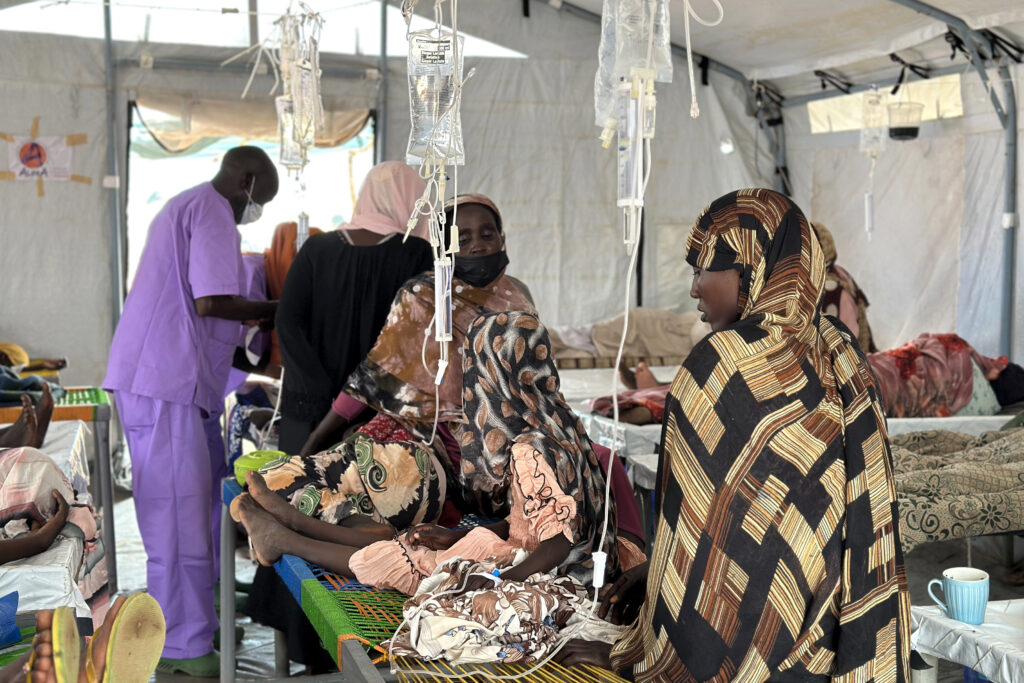
Israel hit back on Wednesday at growing international criticism that it was behind chronic food shortages in Gaza, instead accusing Hamas of deliberately creating a humanitarian crisis in the Palestinian territory.More than 100 aid and human rights groups said earlier Wednesday that “mass starvation” was spreading in the Gaza Strip, while France warned of a growing “risk of famine” caused by “the blockade imposed by Israel”.The head of the World Health Organization also weighed in, saying that a “large proportion of the population of Gaza is starving”.”I don’t know what you would call it other than mass starvation — and it’s man-made,” Tedros Adhanom Ghebreyesus told reporters.But an Israeli government spokesman, David Mencer, said there was “no famine caused by Israel. There is a man-made shortage engineered by Hamas.”President Isaac Herzog, visiting troops in Gaza, maintained that Israel was acting “according to international law”, while Hamas was “trying to sabotage” aid distribution in a bid to obstruct the Israeli military campaign that began more than 21 months ago.An organisation backed by the United States and Israel, the Gaza Humanitarian Foundation (GHF), began distributing aid in Gaza in May as Israel eased a two-month total blockade, effectively sidelining the longstanding UN-led system.Aid agencies have said permissions from Israel were still limited, and coordination to safely move trucks to where they are needed was a major challenge in an active war zone.Mencer accused Hamas, whose attack on Israel on October 7, 2023 sparked the war, of preventing supplies from being distributed and looting aid for themselves or to sell at inflated prices.”Aid has been flowing into Gaza,” he said, blaming the United Nations and its associates for failing to pick up truckloads of foodstuffs and other essentials that were cleared and waiting on the Gaza side of the border.- ‘Torment’ -The United States, meanwhile, said its top Middle East envoy was heading to Europe for talks on a possible Gaza ceasefire and an aid corridor, raising hopes of a breakthrough after more than two weeks of negotiations.With no let-up in deadly Israeli strikes across the territory, getting aid to the more than two million people who need it has become a key issue in the conflict, and doctors and aid agencies have reported increasing cases of malnutrition and starvation.The humanitarian organisations said in a joint statement that warehouses with tonnes of supplies were sitting untouched, while people were “trapped in a cycle of hope and heartbreak, waiting for assistance and ceasefires”.”It is not just physical torment but psychological. Survival is dangled like a mirage,” they added.The 111 signatories, including Doctors Without Borders (MSF), Save the Children and Oxfam, called for an immediate negotiated ceasefire, the opening of all land crossings and the free flow of aid through UN-led mechanisms.In New York, the Committee to Protect Journalists added its voice to the appeal, accusing Israel of “starving Gazan journalists into silence”, after AFP reporters in Gaza said they were all affected by the lack of food.In Khan Yunis, in Gaza’s south, residents told AFP how they battled to get food aid, with one man calling it “a catastrophic scene and a real famine”.The UN said on Tuesday that Israeli forces had killed more than 1,000 Palestinians trying to get aid since late May, most near GHF sites.GHF and Israel have accused Hamas of firing on civilians.- Stalled talks -Even after Israel began easing its aid blockade in late May, Gaza’s population is still suffering extreme scarcities.GHF said the UN, which refuses to work with it over neutrality concerns, had “a capacity and operational problem” and called for “more collaboration” to deliver life-saving aid.COGAT, an Israeli defence ministry body overseeing civil affairs in the Palestinian territories, said the “main obstacle to maintaining a consistent flow of humanitarian aid” was a “collection bottleneck” that it blamed on international organisations.Israel’s military campaign in Gaza has killed 59,219 Palestinians, mostly civilians, according to the health ministry in the Hamas-run territory.Hamas’s October 2023 attack on Israel resulted in the deaths of 1,219 people, most of them civilians, according to an AFP tally based on official figures.Mediators have been shuttling between Israeli and Hamas negotiators in Doha since July 6 in search of an elusive truce, with each side blaming the other for refusing to budge on their key demands.burs-phz/smw

Lebanese militant says ‘struggle’ helped him endure French prison

Sitting near a poster of Che Guevara inside his French prison cell before his release this week, pro-Palestinian Lebanese militant Georges Ibrahim Abdallah said the “struggle” kept him going during his four decades behind bars.A court last week ordered the 74-year-old — who was jailed over the 1982 killings of two foreign diplomats in Paris — be released from the Lannemezan prison in southern France on Friday.Abdallah is one of the longest-serving prisoners in France, where most convicts with life sentences are freed after less than 30 years.Between his bed, desk and microwave corner, Abdallah had decorated the yellow walls of his 11-square-metre cell with the flag of the Argentine Marxist revolutionary, but also a map of the world and postcards.An office chair near his bed was piled high with newspapers.”If I’m alive in front of you today, it’s because I’ve kept up the fight — otherwise 40 years (in jail) would turn your brain to mush,” said the prisoner, whose hair and beard have turned grey.AFP visited his cell on July 17, along with a hard-left member of parliament, Andree Taurinya, who used her right as a lawmaker to visit detention centres to see him on the day the court ordered his release.Dressed in a red sleeveless t-shirt and beige shorts, he greeted her warmly and they posed together for a selfie.Abdallah said that for more than 40 years he had continued to be a “militant with a struggle” — even if it was in very “particular” conditions behind bars.He said he did not foresee a “radical change in (his) struggle outlook” after leaving France and flying home to Lebanon — the condition for his release.- Birthday calendar -Next to his computer, he had pinned up images of flowers, including poppies and cherry blossom, as well as Palestinian flags and a picture of the Al-Aqsa mosque in Jerusalem.”Forty years is a lot but you don’t feel them go by when you keep up the struggle,” he said.Many of his fellow militants have died over the years however, he said.”On my computer I have a calendar to keep track of every day: dead comrades, that’s in brown, orange is for visits, and green is for birthdays,” he explained.But these days, “the colour brown is taking up more and more space.”Abdallah was detained in 1984 and sentenced to life in prison in 1987 for his involvement, which he denies, in the murders of US military attache Charles Robert Ray and Israeli diplomat Yacov Barsimantov in Paris.After his arrest, French police discovered submachine guns and transceiver stations in one of his Paris apartments.- ‘Pampered’ -Lebanese of Maronite Christian heritage, Abdallah has always insisted he is a “fighter” who battled for the rights of Palestinians, and not a “criminal”.Before the decision to release him, he had been eligible for release for 25 years.But the United States — a civil party to the case — had consistently opposed him leaving prison.The Israeli embassy in Paris objected to the decision to release Abdallah, saying “such terrorists, enemies of the free world, should spend their life in prison”.Abdallah, who considers himself to be a “political prisoner”, said he had been “pampered” compared to “what is going on in Gaza and the West Bank, especially for comrades in prison”.His release comes as Israel wages war against Palestinian militants in the Gaza Strip for a 22nd month, with aid and rights groups warning of mass starvation for civilians trapped in the besieged Palestinian territory.Deadly Israeli settler attacks on Palestinians in the occupied West Bank have also become commonplace.Abdallah, who founded a now dissolved Marxist anti-Israel militant group in his youth, endorsed recent protests in the West calling for a Gaza ceasefire.”Palestine remains the historical lever of the revolution throughout the Arab world,” he said.