AFP Asia Business

Australia expels Iran ambassador over antisemitic attacks

Australia expelled Iran’s ambassador on Tuesday, accusing the country of being behind antisemitic arson attacks in Sydney and Melbourne.It marks the first time Australia has expelled an ambassador since World War II.Intelligence services reached the “deeply disturbing conclusion” that Iran directed at least two antisemitic attacks, Prime Minister Anthony Albanese said.Tehran was behind the torching of a kosher cafe in Sydney’s Bondi suburb in October 2024, the prime minister told a news conference.It also directed a major arson attack on the Adass Israel Synagogue in Melbourne in December 2024, he said, citing the intelligence findings.No injuries were reported in the two attacks.”These were extraordinary and dangerous acts of aggression orchestrated by a foreign nation on Australian soil,” Albanese said.”They were attempts to undermine social cohesion and sow discord in our community.”Iran’s foreign ministry spokesman denied the accusations and vowed “reciprocal reaction” to any unjustified diplomatic measures by Australia.Australia declared Iranian ambassador Ahmad Sadeghi “persona non grata” and ordered him and three other officials to leave the country within seven days.- ‘Web of proxies’ -Australia also withdrew its own ambassador to Iran and suspended operations at its embassy in Tehran, which opened in 1968.The Australian diplomats were all “safe in a third country”, the prime minister said.  Australia will also legislate to list Iran’s Islamic Revolutionary Guard Corps as a terrorist organisation, Albanese said.Foreign Minister Penny Wong said it was the first time in the post-war period that Australia had expelled an ambassador.Canberra will maintain diplomatic lines with Iran to advance the interests of Australians, Wong said.Though Australians have been advised not to travel through Iran since 2020, Wong said Canberra’s ability to provide consular assistance was now “extremely limited”.”I do know that many Australians have family connections in Iran, but I urge any Australian who might be considering travelling to Iran, please do not do so,” she said.”Our message is, if you are an Australian in Iran, leave now if it is safe to do so.”Australian spy chief Michael Burgess said a “painstaking” intelligence service investigation had uncovered links between the antisemitic attacks and Iran’s Revolutionary Guard.The probe found that the Guard directed at least two and “likely” more attacks on Jewish interests in Australia, said Burgess, director-general of the Australian Security Intelligence Organisation.- ‘Fanned the flames’ -The Revolutionary Guard, the ideological arm of Iran’s military, used a complex web of proxies to hide its involvement in the attacks, he said.Iran’s embassy in Australia and its diplomats were not involved, however, the spy chief said.The Australian intelligence service was still investigating possible Iranian involvement in a number of other attacks, Burgess said.The Jewish community may find some solace in the investigation breakthrough, said Daniel Aghion, president of the Executive Council of Australian Jewry.”Yet there will be great anxiety that we have been targeted in such a callous and calculated way, by a ruthless and violent foreign force, because of who we are,” he said.Last year’s fire at the cafe in Bondi gutted the outlet, although police initially said there was nothing to suggest it was a targeted attack.The blaze at the Adass Israel Synagogue in Melbourne was one of the most destructive in a string of antisemitic incidents following Hamas’ October 7, 2023, attack on Israel and the ensuing war in Gaza.The fire destroyed much of the synagogue, shocked Australians and was tagged by police as a “likely terrorist incident”.- ‘Important move’ -Any fallout from Australia’s actions against Iran was likely to be constrained by the two countries’ limited ties, said Australian National University counter terrorism expert Levi West.”We don’t have any defence arrangements like we do with other Middle East countries or intelligence relationships,” he told AFP.Israel’s embassy in Australia welcomed the government’s decision to designate the Islamic Revolutionary Guard Corps as a terrorist organisation.”This is a step we have long advocated for,” it said in a statement posted on social media.

Aid to famine-struck Gaza still ‘drop in the ocean’: WFP

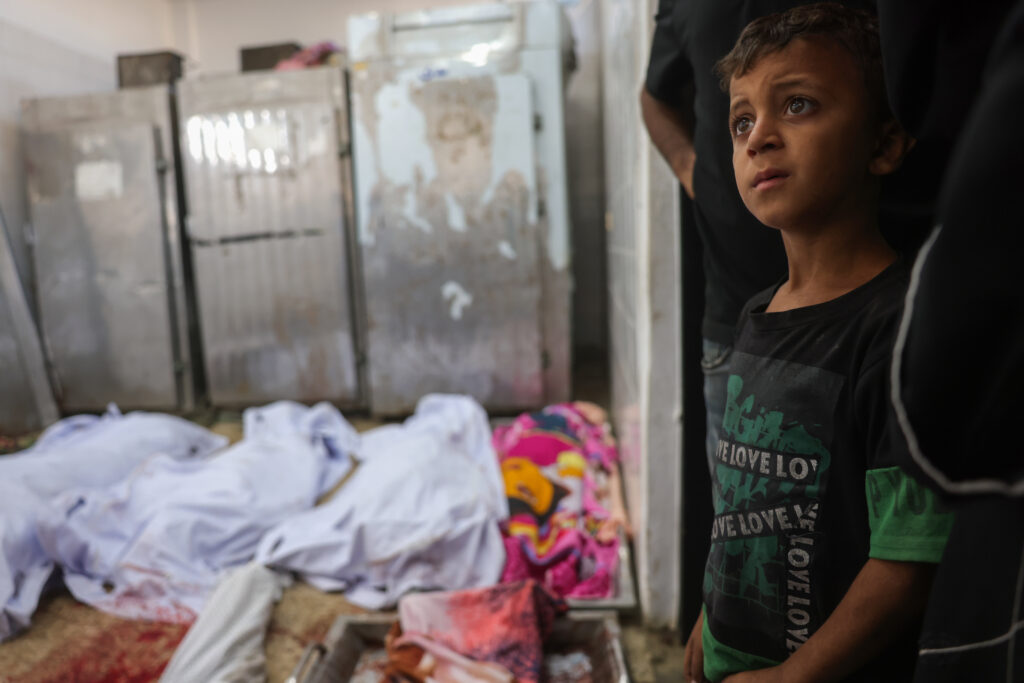
The World Food Programme warned Tuesday that the aid Israel is allowing to enter Gaza remains a “drop in the ocean”, days after famine was formally declared in the war-torn Palestinian territory.The United Nations declared a famine in Gaza on Friday, blaming the “systematic obstruction” of aid by Israel during its nearly two-year war with the Palestinian militant group Hamas.Carl Skau, WFP’s chief operating officer, said that over the past two weeks, there has been a “slight uptick” in aid entering, averaging around 100 trucks per day.”That’s still a drop in the ocean when we’re talking about assisting some 2.1 million people,” Skau told AFP during a visit to New Delhi.”We need a completely different level of assistance to be able to turn this trajectory of famine around.”The Rome-based Integrated Food Security Phase Classification Initiative (IPC) said famine was affecting 500,000 people in Gaza.It defines famine as when 20 percent of households face extreme food shortages, more than 30 percent of children under five are acutely malnourished, and there is an excess mortality threshold of at least two in 10,000 people a day.Skau painted a grim picture of Gaza.”The levels of desperation are so high that people keep grabbing the food off our trucks,” the former Swedish diplomat said.”And when we’re not able to do proper orderly distributions, we’re not sure that we’re reaching the most vulnerable — the women and the children furthest out in the camps,” he said. “And they’re the ones we really need to reach now, if we want to avoid a full-scale catastrophe.”- ‘Starvation phase’ -But Skau also warned that Gaza was only one of many global crises, with multiple famine zones emerging simultaneously as donor funding collapses.Some 320 million people globally are now acutely food insecure — nearly triple the figure from five years ago. At the same time, WFP funding has dropped by 40 percent compared with last year.”Right now, we’re seeing a number of crises that, at any other time in history, would have gotten the headlines and been the top issue discussed,” he said.That includes Sudan, where 25 million people are “acutely food insecure”, including 10 million in what Skau called “the starvation phase”.”It’s the largest hunger and humanitarian crisis that we probably have seen in decades — since the end of the 1980s with the Ethiopia famine,” he said.”We have 10 spots in Sudan where famine has been confirmed. It’s a disaster of unimaginable magnitude.”He detailed how a UN aid convoy in June tried to break the siege by paramilitary Rapid Support Forces (RSF) of Sudan’s city of El-Fasher in Darfur, only for the truck convoy to be hit by a deadly drone attack.Neighbouring South Sudan is also struggling, he said, suggesting “there might well be a third confirmation of a famine”.”That will be unprecedented”, he said, citing “extremely expensive” operations in the young nation’s Upper Nile state, where, with few roads, aid must be delivered by helicopters or airdrops.”This is maybe the number one crisis where you have on one hand staggering needs and, frankly, no resources available”, he said.At the same time, traditional donors have cut aid.US President Donald Trump slashed foreign aid after taking office, dealing a heavy blow to humanitarian operations worldwide.”We are in a funding crunch, and the challenge here is that the needs keep going up”, Skau said.While conflict is the “main driver” of rising hunger levels, other causes include “extreme weather events due to climate change” and the economic shock of trade wars.”Our worry is that we are now cutting from the hungry to give to the starving,” he said.Skau said the organisation was actively seeking new donors.”We’re engaging countries like India, Indonesia, Brazil, and others, beyond the more traditional donors, to see how they can also assist”.

Israeli protesters call for hostage deal ahead of cabinet meeting

Protesters calling for an end to the war in Gaza and the return of hostages being held there took to the streets in Israel on Tuesday morning ahead of a security cabinet meeting scheduled for the evening.Demonstrators blocked roads in Tel Aviv, where they waved Israeli flags and held up pictures of the hostages, according to AFP journalists on the ground. Israeli media reported others rallying near a US embassy branch in the city, as well as outside the houses of various ministers across the country. “Prime Minister (Benjamin) Netanyahu prioritises the destruction of Hamas over releasing the hostages,” said Ruby Chen, whose son was abducted by militants in October 2023. “He believes it is OK and it is a valid alternative to sacrifice 50 hostages for political needs,” he added, addressing one of the gatherings on Tuesday.The agenda of the security cabinet meeting has not been officially disclosed, but local reports suggest it could be to discuss renewed negotiations for a ceasefire and hostage release deal.The cabinet approved in early August a plan for the military to take over Gaza City, triggering fresh fears for the safety of the hostages and a new wave of protests that has seen tens of thousands take to the streets. Netanyahu last week ordered immediate talks aimed at securing the release of all remaining captives in Gaza, while also doubling down on the plans for a new offensive to seize Gaza’s largest city. That came days after Hamas said it had accepted a new ceasefire proposal put forward by mediators that would see the staggered release of hostages over an initial 60-day period in exchange for Palestinian prisoners held by Israel.- Journalists killed -Israel has been under mounting pressure both at home and abroad to wrap up its campaign in Gaza, where the war has created a humanitarian crisis and devastated much of the territory.On Monday, Israeli strikes hit a Gaza hospital, killing at least 20 people, including five journalists working for Al Jazeera, the Associated Press and Reuters, among other outlets.The United Nations, NGOs and world powers including staunch Israeli allies all expressed shock at the attack.Netanyahu later expressed regret over what he called a “tragic mishap”, and the Israeli military ordered an initial inquiry into the strikes. The ongoing war in Gaza has been one of the deadliest for journalists, with around 200 media workers killed over the course of the nearly two-year Israeli assault, according to press watchdogs.The war in Gaza was sparked by Hamas’s October 2023 attack on Israel, which resulted in the deaths of 1,219 people, mostly civilians, according to an AFP tally based on official figures.Out of 251 hostages seized during Hamas’s 2023 attack, 49 are still held in Gaza including 27 the Israeli military says are dead. Palestinian militants also hold the remains of an Israeli soldier killed in a 2014 war.Israel’s retaliatory offensive has killed at least 62,744 Palestinians, most of them civilians, according to figures from the health ministry in Hamas-run Gaza that the United Nations considers reliable.